Qian Zhan Wang

Search documents
【行业深度】洞察2025:中国包装行业竞争格局(附竞争梯队、企业竞争力评价等)
Qian Zhan Wang· 2025-07-31 06:08
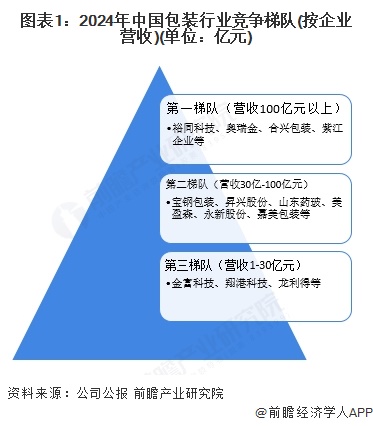
Group 1: Industry Overview - The Chinese packaging industry can be divided into three competitive tiers based on revenue: the first tier includes companies like Yutong Technology, Aorikin, and Hexing Packaging with revenues over 10 billion yuan; the second tier includes Baosteel Packaging, Shengxing Co., and Shandong Pharmaceutical Glass with revenues between 3 billion and 10 billion yuan; the third tier consists of companies like Jinfutec, Xianggang Technology, and Longlide with revenues below 3 billion yuan [1][6] - The industry is characterized by a fragmented market structure, with many small-scale companies lacking innovation capabilities, leading to disordered competition in the low-end market [6][13] - The market concentration in the packaging industry is low, with the top 10 companies (CR10) holding less than 5% market share, indicating a need for further consolidation [6][13] Group 2: Market Segmentation - The packaging industry in China is segmented into glass packaging, paper packaging, plastic packaging, and metal packaging, with leading companies in each category: Shandong Pharmaceutical Glass and Zhengchuan Co. for glass; Wanshun New Materials and Shanying International for paper; Tongchan Lixing and Hongyu Packaging for plastic; and Shengxing Packaging and Jiamei Packaging for metal [4][9] Group 3: Competitive Landscape - The competitive landscape shows that leading companies like Shandong Pharmaceutical Glass and Zhengchuan Co. have extensive business layouts covering regions such as North America, Europe, Japan, and Southeast Asia [8][9] - The majority of packaging companies focus on specific materials, with Shandong Pharmaceutical Glass leading in medicinal glass, while companies like Dashing and Wanshun New Materials dominate the paper packaging sector [10][11] - The industry is experiencing a strong demand growth driven by the increasing consumption of food and beverages, which indirectly boosts the demand for packaging products [14]


英伟达黄仁勋:AI是史上最伟大的技术均衡器,未来五年创造百万富翁数量将超过互联网过去20年总和【附人工智能行业市场分析】
Qian Zhan Wang· 2025-07-31 04:13
Group 1 - Nvidia's CEO Jensen Huang describes AI as "the greatest technology equalizer in history," predicting that the number of millionaires created by AI in the next five years will surpass the total from the internet over the past 20 years [2] - Huang emphasizes AI's core value lies in its ability to lower technical barriers, allowing anyone to become a programmer, artist, or writer through natural language interaction [2] - The AI industry is recognized as one of the most innovative and influential sectors in technology, with significant advancements in areas such as natural language processing, image recognition, autonomous driving, and medical diagnosis [2] Group 2 - China's AI industry has developed rapidly and is now among the world's leaders, with notable companies including Huawei, iFlytek, Tencent, Baidu, SenseTime, and Cambricon [3] - According to the "Global AI Industry Development White Paper (2024)," China's core AI industry scale grew by 13.9% year-on-year in 2023, nearing 600 billion RMB [5] Group 3 - Elon Musk predicts that by 2030, large-scale unemployment will occur as most technical jobs will be replaced by AI, suggesting that working may become an option for people [7] - Zhou Hongyi, founder of 360, notes that as AI technology advances, certain jobs will be eliminated, and those who can use AI will replace those who cannot [7]


2025年中国文旅融合行业细分市场分析之旅游演艺 2024年中国旅游演艺剧出场次数显著提升【组图】
Qian Zhan Wang· 2025-07-31 04:10
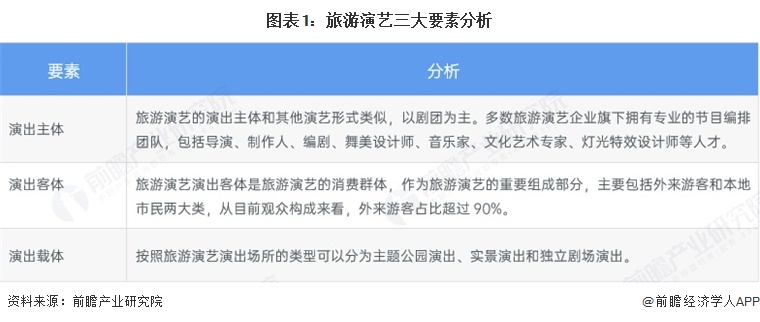
转自:前瞻产业研究院 行业主要上市公司:华侨城(000069.SZ)、张家界(000430.SZ)、三湘印象(000863.SZ)、曲江文旅 (600706.SH)、复星旅游文化(01992.HK)、宋城演艺(300144.SZ)等 本文核心数据:出场次数;票房收入 1、界定 旅游演艺作为演出市场的一个细分领域,背后依托整个演出/文化娱乐市场的发展,与旅游和景区文化建设 紧密相连。对于旅游演艺的界定,学术界有"旅游演出"、"旅游表演"、"旅游演艺"等说法,其中,旅游演艺 的说法最为普遍。 | 要素 | 分析 | | --- | --- | | 演出主体 | 旅游演艺的演出主体和其他演艺形式类似,以剧团为主。多数旅游演艺企业旗下拥有专业的节目编排 团队,包括导演、制作人、编剧、舞美设计师、音乐家、文化艺术专家、灯光特效设计师等人才。 | | 演出客体 | 旅游演艺演出客体是旅游演艺的消费群体,作为旅游演艺的重要组成部分,主要包括外来游客和本地 | | | 市民两大类,从目前观众构成来看,外来游客占比超过90%。 | | 演出载体 | 按照旅游演艺演出场所的类型可以分为主题公园演出、实景演出和独立剧场演出。 | ...
预见2025:《2025年中国人工智能代理行业全景图谱》(附市场现状、竞争格局和发展趋势等)
Qian Zhan Wang· 2025-07-30 14:39
Industry Overview - The artificial intelligence agent industry in China is defined as software systems driven by large language models (LLMs) that integrate various plugins to make autonomous decisions and learn from their environment [1] - The industry has formed a complete system covering the foundational, technical, and application layers, with hardware and computing power providers at the base, model providers in the middle, and application developers and service providers at the downstream [2][5] Market Size and Growth - In 2023, the AI agent market in China reached 55.4 billion yuan, with projections to grow to 852 billion yuan by 2028, reflecting a compound annual growth rate (CAGR) of 72.7% [12] - The demand structure for AI agents is diverse and rapidly growing, with the intelligent customer service market exceeding 7 billion yuan in 2023 and expected to reach 18.13 billion yuan by 2027, a CAGR of over 27% [13] Development Trends - The AI agent industry is still in its early stages, evolving from simple chatbots to more complex agents capable of autonomous reasoning and decision-making [8] - The penetration rate of AI agents in enterprises is currently below 5% but is expected to rise to 25% for large enterprises and 15% for small and medium-sized enterprises by 2028 [15] Policy Background - Since 2015, the Chinese government has been promoting AI technology development and application through a comprehensive policy framework that includes ethical norms and data security [10][11] Competitive Landscape - The competitive landscape is characterized by a concentration of leading companies such as Alibaba, Tencent, and Baidu, which dominate the large model layer, while vertical players focus on specific industry applications [21][24] - Initial companies are leveraging technological breakthroughs and innovative models to disrupt the industry, with examples like Manus and Dify gaining significant traction [25] Future Outlook - The AI agent market is expected to experience significant growth, with industrial and medical applications showing strong potential due to the rapid release of smart manufacturing and automation needs [27] - Key technological breakthroughs in multi-modal interaction, autonomous decision-making, and multi-agent collaboration are critical for the industry's future development [30]




2025年超硬材料行业发展现状分析——技术突破驱动产业升级与高端转型
Qian Zhan Wang· 2025-07-30 07:16
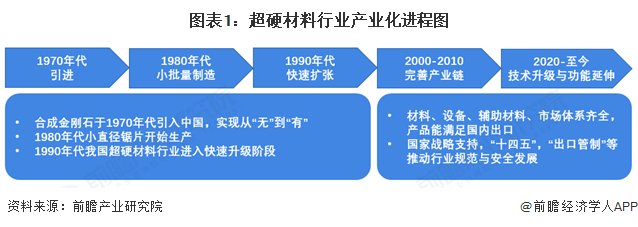
Core Viewpoint - By 2025, China's superhard materials industry will establish a dual-track development pattern of HPHT and CVD technologies, accelerating the transition from traditional processing to high-end fields such as semiconductors and new energy, with the market expected to exceed 100 billion yuan by 2030, driven by technological upgrades and high-end application expansion [1] Group 1: Industry Evolution - Since the first synthetic diamond was produced in China in 1963, the superhard materials industry has entered a phase of industrialization, achieving significant milestones such as the first cBN synthesis in 1966, breaking foreign technology monopolies [2] - The industry chain has continuously improved, with accelerated domestic equipment production and the emergence of large industrial clusters in regions like Henan, leading to integrated production capabilities in HPHT machines and products [2][4] - By 2025, domestic diamond production capacity is expected to account for nearly half of the global total, with an industry output value exceeding 17 billion yuan [2] Group 2: Technological Advancements - The transition from "HPHT dominant" to "HPHT + CVD collaborative development" has been achieved, with HPHT enabling large-scale production of industrial and jewelry-grade diamonds, while CVD is used for cultivating large, high-purity, and functional single crystal diamonds [4] - Recent advancements in CVD technology, particularly in regions like Ningbo and Shanghai, have led to breakthroughs in high conductivity, high purity, and environmental performance, promoting the construction of large-scale CVD diamond production lines [4] Group 3: Market Dynamics - The superhard materials market in China is projected to grow at a compound annual growth rate (CAGR) of approximately 5.8%-5.9% from 2023 to 2030, with China holding over 20% of the global market share [10] - By 2025, the global superhard materials market is expected to reach approximately 75 billion yuan, with China's market projected to grow to 17.2 billion yuan, representing about 22.8% of the global market [12]
【干货】土壤修复行业产业链全景梳理及区域热力地图
Qian Zhan Wang· 2025-07-30 03:08
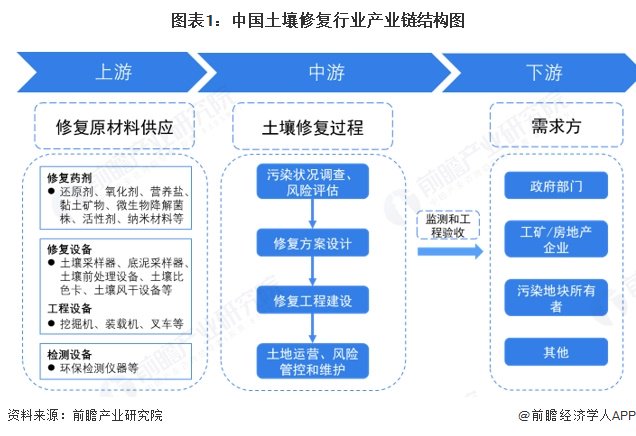
Core Viewpoint - The soil remediation industry in China is rapidly growing, with increasing participation from various sectors due to the anticipated large market size. The industry is characterized by a comprehensive supply chain involving upstream suppliers, midstream consulting and engineering services, and downstream clients including government and industrial entities [1][2][6]. Industry Overview - The soil remediation industry chain consists of upstream suppliers providing remediation agents and equipment, midstream businesses focusing on consulting and engineering, and downstream clients such as government departments and real estate companies [1]. - The number of companies engaged in soil remediation in China is increasing, with significant contributions from various sectors due to the expected market potential [2]. Company Distribution - The distribution of listed soil remediation companies is concentrated in regions like Beijing, Guangdong, and Zhejiang, with notable companies such as JianGong Repair and GaoNeng Environment leading in these areas [6]. - Other regions like Guangxi, Hunan, and Hubei have also developed some listed soil remediation enterprises [6]. Business Layout of Listed Companies - Most listed companies in the soil remediation sector have developed comprehensive capabilities covering pollution investigation, remediation engineering, and project management [9]. - Companies like JingLan Technology and JianGong Repair have a high proportion of their business (over 60%) dedicated to soil remediation, while others like GaoNeng Environment and SenTe have broader focuses in waste treatment and metal containment systems [9]. - Regional characteristics are evident, with companies like YongQing Environmental focusing heavily on Hunan province, where over 60% of their revenue comes from [9]. Latest Developments and Business Plans - Many companies are integrating AI models, digital twins, and IoT monitoring into their operations to enhance decision-making and cost control [10]. - GaoNeng Environment is focusing on heavy metal pollution remediation and plans to promote integrated models combining soil remediation with waste treatment [11]. - JianGong Repair is developing a low-code ECO system to streamline soil monitoring and risk assessment, aiming for a 30% reduction in remediation costs by 2025 [11]. - Companies are also exploring innovative technologies such as in-situ thermal desorption and microbial-plant joint remediation to address complex pollution challenges [11].


前瞻全球产业早报:新央企中国长安汽车集团挂牌成立
Qian Zhan Wang· 2025-07-29 23:09
Group 1 - China Chang'an Automobile Group officially registered on July 27, 2025, with a registered capital of 20 billion yuan, becoming a new state-owned enterprise in the automotive sector [2] - Apple announced the closure of its first direct store in China, located in Dalian, effective August 9, due to the departure of multiple retailers from the shopping center [3] - The Fuman oil and gas field in the Taklamakan Desert achieved a daily production of over 10,000 tons, marking a new phase in deep oil and gas extraction in China [4] Group 2 - The latest round of fuel price adjustments in China has been suspended, with no changes to gasoline and diesel prices due to insufficient price fluctuation [5] - Douyin is integrating its instant retail business by merging Douyin Supermarket into Hourly Delivery to enhance operational efficiency [6] - UBTECH Robotics completed a share placement raising approximately 3.15 billion USD, setting a record for the largest share placement in the humanoid robot sector [6] Group 3 - Insta360 announced its entry into the drone market, planning to launch the world's first panoramic drone, driven by unmet customer demand [6] - Tesla's Shanghai energy factory produced its 1,000th Megapack energy storage system in less than six months, which will be shipped to Europe [7] - Xiaomi ranked 297th in the 2025 Fortune Global 500, achieving its largest increase of 100 places since its debut on the list [7] Group 4 - WeRide's Robotaxi received the first autonomous driving license in Saudi Arabia, making it the only tech company with autonomous driving licenses in six countries [8] - Nissan is considering shutting down two factories in Mexico as part of its global restructuring efforts due to declining sales [8] - The cumulative registration of eco-friendly vehicles in South Korea has surpassed 3 million, driven by the demand for hybrid and electric vehicles [10] Group 5 - Thailand's Gulf Energy Development plans to invest 20 billion USD to build a liquefied natural gas receiving terminal by 2029 to address declining domestic gas supplies [11] - Tesla co-founder expressed disappointment over Elon Musk's decision to cancel the affordable electric vehicle project, emphasizing the need for such vehicles in the market [12]





前瞻全球产业早报:国家育儿补贴方案公布
Qian Zhan Wang· 2025-07-29 12:29
Group 1: National Policies and Initiatives - The national childcare subsidy program was announced, providing 3,600 yuan per child per year for infants under three years old starting from January 1, 2025 [2] - Shanghai is supporting innovation in key areas such as general artificial intelligence and smart chips, with funding up to 50 million yuan for strategic projects [3] Group 2: Robotics and AI Developments - Yushun Technology's VP highlighted the "pseudo-intelligence" dilemma faced by humanoid robots, citing issues like fragmented environmental perception and lack of coherent action [3] - Ant Financial released a financial reasoning model, Agentar-Fin-R1, which surpasses other models in financial evaluations [7] - JD.com announced the launch of the first 100% open-source enterprise-level intelligent agent, JoyAgent, enhancing model efficiency and reducing training costs significantly [7] Group 3: Automotive Industry Insights - The China Automobile Association organized a seminar on building a unified automotive market, focusing on digitalizing the entire automotive consumption process [5][6] Group 4: Semiconductor and Material Innovations - Tsinghua University developed a new type of extreme ultraviolet (EUV) photoresist material, providing new design strategies for advanced semiconductor manufacturing [8] Group 5: International Trade and Investment - The U.S. and EU reached a trade agreement, with the EU committing to increase investments in the U.S. by $600 billion [8] - Japan's recent investment commitment to the U.S. is expected to yield only 1-2% in actual investments, with the majority being loans [8] Group 6: Electric Vehicle Market Expansion - VinFast opened its first showroom in India as part of its strategy to establish a nationwide charging and after-sales service network [11]
2025年中国医疗美容市场供给分析:医美人才结构性短缺
Qian Zhan Wang· 2025-07-29 06:10
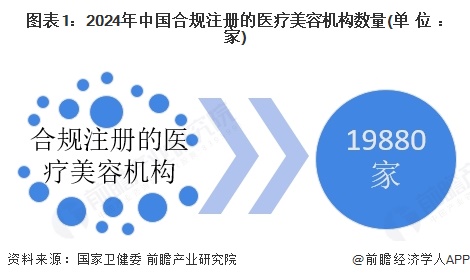
Group 1 - The medical beauty market in China is experiencing continuous growth, with the number of compliant specialized medical beauty institutions reaching 19,880 in the first half of 2024, an increase of 1,296 institutions or 7% from January 2024 [1][3] - The increase in compliant medical beauty institutions is driven by enhanced regulatory oversight and a growing consumer demand for legitimate medical beauty services [1][3] Group 2 - There is a significant shortage of compliant medical beauty doctors, with an estimated gap of around 20,000 qualified professionals, while the total number of medical beauty practitioners is approximately 1.02 million [4] - The annual growth rate of medical beauty practitioners is around 10%, but the supply of qualified professionals is only increasing at a rate of 5%-8%, highlighting a supply-demand imbalance [4] Group 3 - The distribution of medical beauty positions in China shows a clear imbalance, with only 10% of positions being medical technical roles, which require solid medical knowledge and qualifications [6] - Over 60% of positions are in marketing and operations, which are crucial for attracting customers and driving business growth, but this focus may compromise the quality of medical services [6] Group 4 - The educational requirements for core positions in the medical beauty industry are increasing, with a trend towards higher educational qualifications among professionals [9] - Large medical beauty companies are setting stricter educational standards, with some requiring a full-time bachelor's degree for medical technical roles [9] Group 5 - The distribution of medical beauty talent in China shows a pattern of concentration in eastern regions and high-tier cities, with first-tier cities holding over 50% of medical beauty positions [10] - New first-tier cities are competing for mid-level talent through differentiated strategies, while lower-tier cities struggle due to a lack of local training capabilities [10]





【最全】2025年奶酪行业上市公司全方位对比(附业务布局汇总、业绩对比、业务规划等)
Qian Zhan Wang· 2025-07-29 03:08
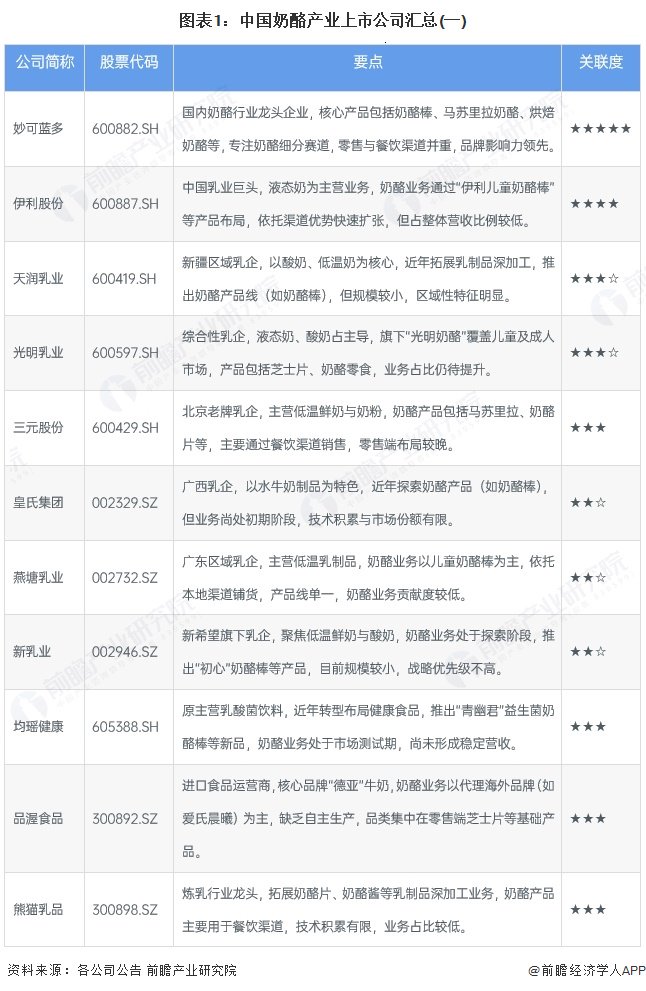
Core Insights - The Chinese cheese industry features a mix of leading companies and regional players, with Miaokelan Duo being the only listed company focused solely on cheese products, dominating the retail cheese stick and catering ingredient markets [1][6] - Major dairy companies like Yili and Mengniu leverage their channel and capital advantages to expand their cheese offerings, although cheese remains a minor segment compared to liquid milk [1][6] - Regional dairy companies such as Guangming, Sanyuan, and Tianrun focus on liquid milk as their core business while expanding into cheese as a supplementary category, targeting local markets and catering channels [1][6] - The industry is characterized by a high concentration of children's snacks, while opportunities in catering and adult cheese products remain underexplored [6][11] Company Overview - **Miaokelan Duo (600882.SH)**: The leading company in the domestic cheese industry, focusing on cheese sticks and mozzarella cheese, with a strong brand influence and a balanced approach to retail and catering channels [3][6] - **Yili (600887.SH)**: A major player in the dairy sector, primarily focused on liquid milk, with cheese products like "Yili Children's Cheese Sticks" contributing to its growth, although they represent a small portion of overall revenue [3][6] - **Tianrun Dairy (600419.SH)**: A regional player in Xinjiang, focusing on yogurt and low-temperature milk, recently expanding into cheese products, but with limited scale [3][6] - **Guangming Dairy (600597.SH)**: A comprehensive dairy company with a focus on liquid milk and yogurt, offering cheese products but with a need to increase their business share [3][6] - **Sanyuan Dairy (600429.SH)**: A well-established dairy company in Beijing, primarily selling low-temperature fresh milk and milk powder, with cheese products mainly sold through catering channels [3][6] - **Huangshi Group (002329.SZ)**: A regional player in Guangxi, exploring cheese products but still in the early stages with limited market share [3][6] - **Yantang Dairy (002732.SZ)**: A regional company in Guangdong, focusing on low-temperature dairy products, with cheese offerings primarily targeting children [3][6] - **New Dairy (002946.SZ)**: A subsidiary of New Hope, focusing on low-temperature fresh milk and yogurt, with cheese products still in the exploratory phase [3][6] - **Panda Dairy (300898.SZ)**: A leader in the condensed milk sector, expanding into cheese products mainly for catering, but with limited innovation [3][6] Financial Performance - Yili and Mengniu lead the industry in revenue, achieving 115.4 billion yuan and 94 billion yuan respectively in 2024, with most companies maintaining gross margins above 14% [6][7] - The highest gross margin is reported by H&H International at 60.65%, while Tianrun Dairy, Guangming Dairy, and Pinwa Foods have margins below 20% [6][7] - Earnings per share show significant variation, with Yili at 1.33 yuan, followed by Panda Dairy, Guangming Dairy, Yantang Dairy, and New Dairy, while smaller companies like Miaokelan Duo and Tianrun Dairy report lower earnings [10][11] Market Dynamics - The cheese industry in China is experiencing a tiered development, with Miaokelan Duo as the core leader, while Yili and Mengniu focus on children's cheese products [6][11] - Regional companies like Guangming and Sanyuan are concentrating on local markets, while others like Huangshi and Yantang are testing niche cheese products with limited scale [6][11] - The market is characterized by a reliance on imported raw materials and intense competition, necessitating innovation and localization of supply chains for future growth [6][11] Strategic Planning - Leading companies are enhancing their supply chain integration and focusing on differentiated innovation, while regional brands are honing in on local market needs [14][19] - Miaokelan Duo aims to deepen its market presence in children's cheese and expand into adult health snacks, while Yili plans to leverage its channel advantages to grow its cheese segment [17][19] - Companies like Tianrun and Guangming are exploring unique product offerings and regional partnerships to strengthen their market positions [17][19]