
Zhong Guo Huan Jing Bao

Search documents
黑龙江“十四五”期间生态环境质量稳居全国第一梯队 年均减排二氧化碳六千余吨
Zhong Guo Huan Jing Bao· 2025-10-28 04:44
Core Viewpoint - During the "14th Five-Year Plan" period, Heilongjiang Province has achieved significant progress in ecological and environmental quality, ranking among the top tier in the country, with six consecutive years of excellent performance in pollution prevention assessments [1][2]. Group 1: Ecological Protection Initiatives - The province focuses on addressing urgent environmental issues for the public, emphasizing the importance of clean air, water, and soil [1]. - By 2024, the proportion of good air quality days is expected to increase by 1.3 percentage points compared to 2020, and PM2.5 concentration is projected to decrease by 0.6 micrograms per cubic meter [1]. - The improvement of water quality in the Songhua River is highlighted, with a target of increasing the proportion of good water quality monitoring sections by 10.2 percentage points by 2024 compared to 2020 [2]. Group 2: Economic Development through Ecological Value - The province aims to catalyze economic growth through ecological value, establishing a comprehensive ecological environment zoning and control system [2]. - Since the launch of the national carbon emissions trading market, 99 key emission units in Heilongjiang have actively participated, with a notable project in Daxing'anling that reduces carbon dioxide emissions by over 6,000 tons annually [2]. Group 3: Legal Framework for Environmental Governance - Heilongjiang has implemented local regulations and standards tailored to its specific conditions, focusing on water pollution prevention and other environmental laws [2]. - Innovative systems such as environmental judicial linkage and ecological compensation have been developed to enhance legal governance in environmental protection [2]. Group 4: Technological Empowerment in Environmental Management - The establishment of digital platforms for environmental monitoring and data analysis has been prioritized, utilizing big data and cloud computing for real-time environmental data collection and intelligent decision-making [3]. - The "smart environmental protection" system aims to upgrade environmental supervision from manual to technological and intelligent methods [3].
“十五五”时期,四川生态环境保护工作如何发力?
Zhong Guo Huan Jing Bao· 2025-10-28 00:20
Core Points - The "15th Five-Year Plan" period is crucial for Sichuan Province to achieve socialist modernization and advance the construction of a beautiful China, emphasizing ecological protection and high-quality development [1] Group 1: Carbon Neutrality and Emission Control - Sichuan aims to achieve carbon peak goals by transitioning to dual control of carbon emissions and intensity, establishing a comprehensive evaluation system for carbon neutrality [2] - The province will expand the carbon trading market and innovate regional carbon management mechanisms to promote low-carbon development [2] - Key areas will focus on collaborative innovation in pollution reduction and carbon reduction, ensuring completion of national carbon peak pilot tasks [2] Group 2: Green Economic Transformation - The province will optimize spatial structure through ecological environment zoning and enhance management of environmental factors [3] - Sichuan will adjust its industrial structure by promoting green upgrades and developing strategic emerging industries [3] - Energy structure will be optimized by promoting clean energy and implementing the "Electric Sichuan" initiative [3] Group 3: Pollution Prevention and Control - Comprehensive air quality management will be strengthened, focusing on the control of NOX and VOCs emissions [4] - Water environment governance will be enhanced through integrated management of water resources and ecosystems [5] - Soil safety will be prioritized with strict management of agricultural land and pollution remediation [5] Group 4: Ecosystem Protection and Restoration - Sichuan will establish a robust ecological safety framework and enhance the protection of critical ecosystems [6] - Biodiversity protection efforts will be intensified, focusing on rare and endangered species [6] - Regulatory measures for ecological protection will be reinforced, ensuring compliance with ecological red lines [6] Group 5: Major Projects and Reforms - The province will plan significant projects with national and regional impacts, including ecological protection and environmental quality improvement initiatives [7] - Reforms will focus on ecological damage compensation and resource environment rights trading [7] - Major policies will address critical ecological and environmental issues, enhancing management and compensation mechanisms [7]
浙江“三效统一”为“两山”转化提供清晰路径
Zhong Guo Huan Jing Bao· 2025-10-27 23:24
Core Viewpoint - Zhejiang has developed a comprehensive action framework centered on the organic unity of ecological, economic, and social benefits, termed "Three Effects Unity," through 20 years of exploration in implementing the "Two Mountains" concept [1][9]. Group 1: Planning and Systematic Framework - The transformation of the "Two Mountains" concept relies on scientific top-level design and systematic institutional arrangements, with "Three Effects Unity" as the core value orientation in major strategic deployments [2]. - Strategic guidance and planning integration are emphasized, ensuring ecological protection, economic development, and improvement of people's livelihoods are interconnected from the outset [2]. - Rigorous constraints and goal orientation are reinforced in project approvals and policy-making, establishing a robust institutional framework to ensure the correct direction and sustained momentum for the transformation [3]. Group 2: Ecological Protection and Safety - The foundation of ecological safety is recognized as essential for the transformation, with a focus on strict environmental protection and resource conservation [4]. - Scientific greening efforts are undertaken to enhance ecological value, demonstrating that investment in ecosystems can yield significant ecological, economic, and social benefits [4]. - Smart management through digital means is implemented to improve ecological monitoring and protection efficiency, ensuring the sustainability of the transformation [5]. Group 3: Innovative Transformation Paths - Multiple parallel and mutually reinforcing pathways for transforming ecological advantages into developmental advantages are explored [6]. - The "Direct Value Addition" path promotes the industrialization of ecology through carbon economy and ecological branding [6]. - The "Mechanism Breaking" path focuses on institutional innovation to address bottlenecks in property rights, value assessment, and market transactions [7]. Group 4: Shared Development Goals - The ultimate goal of the transformation is to benefit the people, with a focus on improving environmental quality and enhancing public welfare [8]. - Efforts are made to reduce development disparities through collaborative economic models and revitalizing rural areas, ensuring that the benefits of green development reach broader communities [8]. - Social consensus is fostered through community engagement in ecological civilization construction, promoting a culture of environmental stewardship and shared outcomes [8].
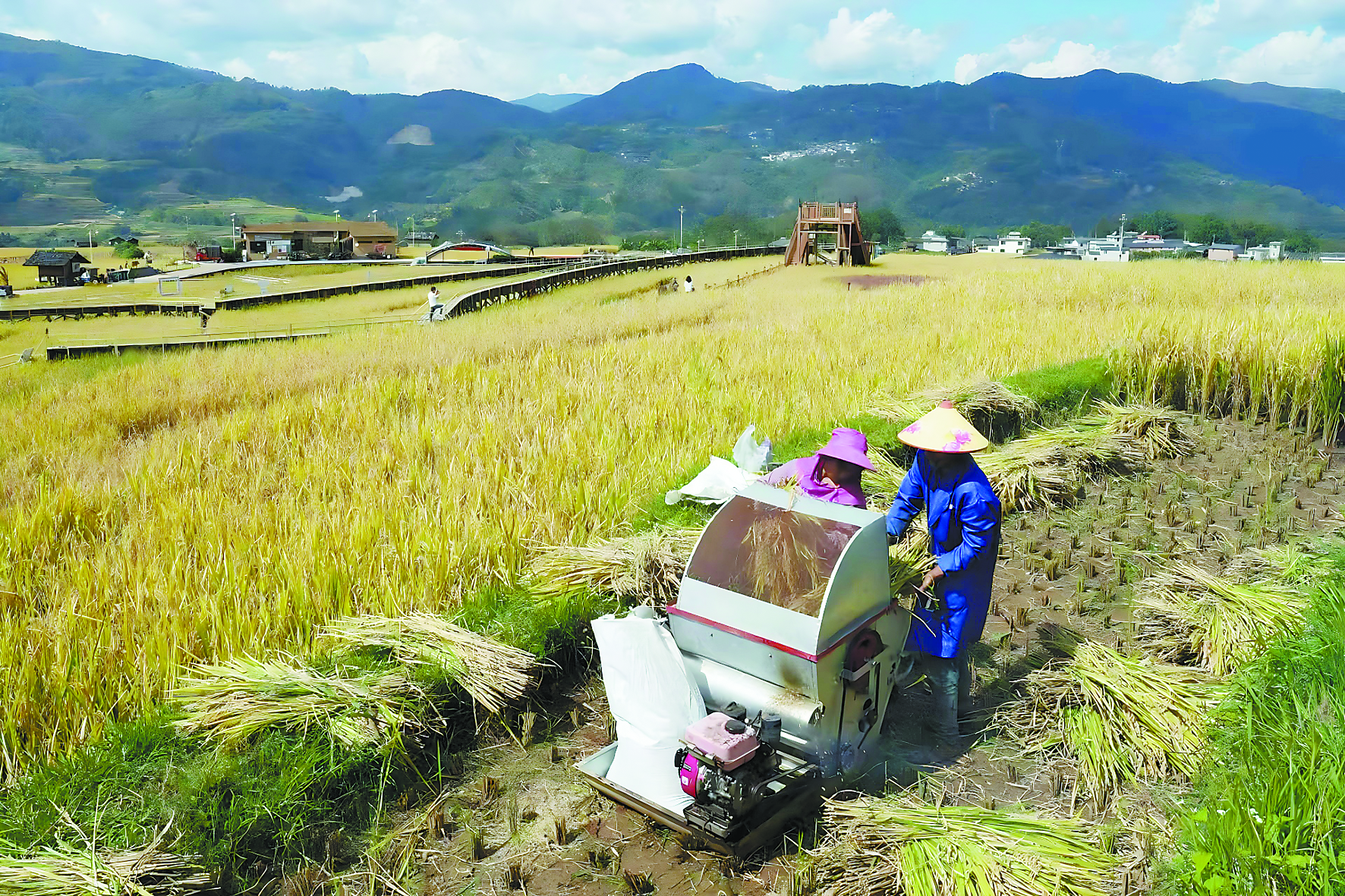
读图丨云南龙江依托万亩高山梯田发展“稻+鱼”共生循环农业
Zhong Guo Huan Jing Bao· 2025-10-27 07:02
Core Viewpoint - Yunnan Province's Baoshan City Longling County is actively exploring the integration of agriculture, culture, and tourism, leading to a win-win situation for rural economic development, ecological protection, and cultural heritage preservation [1] Group 1: Agricultural Development - Longjing Township relies on thousands of acres of high mountain terraced fields to develop a "rice + fish" symbiotic circular agriculture model, which reduces the use of pesticides and fertilizers [1] - This agricultural model has achieved both ecological benefits and economic gains, showcasing a successful integration of sustainable practices with profitability [1] Group 2: Tourism and Cultural Integration - The focus on rural and ecological tourism has contributed to the overall development of the local economy while preserving cultural traditions [1] - The activities in Longjing Township, such as rice harvesting in the rice paddy park, highlight community involvement and the promotion of local culture through tourism [1]

平凉市生态环境局党组书记、局长王怀义:坚持生态立市筑牢绿色屏障
Zhong Guo Huan Jing Bao· 2025-10-27 05:23
Core Viewpoint - Gansu Province's Pingliang City has adopted an "ecology-oriented city" strategy since the 14th Five-Year Plan, focusing on improving ecological environment quality and effectively combating pollution, leading to significant progress in building a beautiful Pingliang and establishing itself as a national leader in ecological civilization construction [1] Group 1: Source Control and Spatial Optimization - The city has implemented strict spatial control measures, designating 31 priority protection units, 22 key control units, and 6 general control units, and has developed a comprehensive ecological environment protection planning system [1] - Local regulations such as the Dust Pollution Prevention Regulation and Drinking Water Source Protection Regulation have been established, creating a preliminary local legal framework covering key environmental factors [1] - Environmental impact assessments (EIA) have been rigorously managed, with 679 EIAs completed and 2,954 filings, achieving full coverage of 343 fixed pollution sources [1] Group 2: Systematic Governance and Environmental Quality Improvement - The city has launched six major actions targeting pollution from vehicles, coal, industrial enterprises, dust, domestic sources, and ozone, resulting in the retrofitting of 8 coal-fired units and the elimination of 178 coal boilers [2] - A comprehensive list of river discharge outlets has been established, with 2,160 outlets investigated and a 99.8% completion rate for remediation [2] - Soil pollution investigations have been completed for 72 sites, achieving a 100% safety utilization rate for contaminated farmland and key construction land [2] Group 3: Process Management and Ecological Safety - The city has established 25 automatic environmental quality monitoring stations and 153 pollution source monitoring points, investing 26.156 million yuan in monitoring equipment [3] - A full-process environmental supervision system has been implemented, with 8 hazardous waste collection units and 3 medical waste disposal units established [3] - Continuous law enforcement training has been conducted, resulting in the city winning first prize in provincial law enforcement competitions for three consecutive years [3] Group 4: Demonstration and Green Development - Since 2021, the city has allocated 3.066 billion yuan for ecological function area transfer payments and secured 624 million yuan in central and provincial environmental protection funds for 246 ecological protection and pollution control projects [4] - Pingliang has been recognized as a national ecological civilization construction demonstration city, with several counties receiving accolades for their ecological initiatives [4] - A long-term development plan for the ecological and environmental protection industry chain has been established, with a total investment of 14.446 billion yuan for 279 projects [4]
从政策、区域、产业三个维度推动建设零碳货运走廊
Zhong Guo Huan Jing Bao· 2025-10-27 03:28
Core Viewpoint - The transportation sector is crucial for achieving China's "dual carbon" goals, with carbon emissions from this sector accounting for over 10% of the national total, primarily driven by road freight, necessitating a green transformation to reduce overall carbon intensity [1] Group 1: Zero Carbon Freight Corridor - The zero carbon freight corridor aims to integrate "vehicles, energy, roads, and cloud" systems, facilitating a shift from localized optimization to systemic transformation in the freight industry [1] - This initiative utilizes the national comprehensive transportation corridor to manage carbon emissions across the entire freight chain, enhancing the green momentum for high-quality development in the transportation sector [1] Group 2: Collaborative Mechanism - A collaborative mechanism involving "central coordination, inter-provincial linkage, and market leadership" is essential for advancing the construction of zero carbon freight corridors, addressing the challenges posed by administrative divisions and fragmented policies [2] - Policy coordination is fundamental, requiring a unified planning framework and regional strategies to overcome barriers and ensure effective implementation [2] Group 3: Regional Coordination - Regional coordination is vital for the seamless execution of zero carbon freight corridors, necessitating a multi-level governance system that promotes collaboration among provincial and local governments [3] - Establishing inter-provincial meetings and coordination platforms will enhance information sharing and unified enforcement, ensuring continuity and operational coherence of the corridors [3] Group 4: Industrial Collaboration - Industries should form alliances to drive technological advancements, infrastructure investment, and innovative business models, fostering a cycle of "technological breakthroughs, industrial upgrades, market expansion, and reinvestment" [4] - The construction of zero carbon freight corridors is progressing from pilot demonstrations to broader regional explorations, providing replicable solutions for green transformation in the freight sector [4]
钟寰平:奋力开创美丽中国建设新局面
Zhong Guo Huan Jing Bao· 2025-10-27 01:47
Core Points - The 20th Central Committee's Fourth Plenary Session is a significant meeting aimed at advancing the second centenary goal, with a focus on top-level design and strategic planning for the next five years [1][2] - The session emphasizes the importance of ecological civilization and environmental protection, highlighting the need for a comprehensive green transformation in economic and social development [2][3] Group 1: Strategic Planning - The "15th Five-Year Plan" period is crucial for solidifying the foundation of socialist modernization and will serve as a transitional phase [2] - The meeting outlines major deployments for accelerating ecological civilization construction and environmental protection, reflecting the central leadership's commitment to these issues [2][3] Group 2: Implementation and Goals - There is a call for high-quality completion of the ecological environment sector's "15th Five-Year Plan," focusing on major goals, projects, and policy measures [3] - The construction of a beautiful China is identified as a national priority, with an emphasis on integrating carbon peak and carbon neutrality goals into broader environmental strategies [3][4] Group 3: Political Commitment - The session stresses the importance of maintaining the Party's leadership and advancing strict governance to ensure high-quality economic and social development during the "15th Five-Year Plan" [3][4] - There is a strong emphasis on political awareness and action to align with the central leadership's directives and to promote a culture of accountability and effectiveness in environmental protection efforts [3][4]
广东加快构建碳足迹管理体系助力经济高质量发展
Zhong Guo Huan Jing Bao· 2025-10-27 00:48
Core Viewpoint - Guangdong Province is actively developing a carbon footprint management system to promote green and low-carbon transformation among enterprises, aiming for high-quality development and compliance with international green trade rules [1][3][5]. Group 1: Carbon Footprint Management System Development - Guangdong has established the "Guangdong Carbon Label" and issued 146 certificates to 128 enterprises across 24 product categories by September 2023 [1]. - The "Work Plan" aims to complete carbon footprint assessments for around 200 products by 2027 and 500 products by 2030, with a focus on building a product carbon footprint factor database [2]. - The plan includes 17 key tasks across four areas: management system construction, application promotion, cross-border cooperation, and capacity building [2]. Group 2: Financial and Government Support - The province will enhance financial support for enterprises, using carbon footprint as a key metric in financing processes [2]. - Government and state-owned enterprises are encouraged to increase procurement of low-carbon products, promoting their application [2][4]. Group 3: International Cooperation and Standards - Guangdong is exploring cross-border mutual recognition of carbon footprints with Hong Kong and aims to establish a carbon footprint alliance in the Greater Bay Area [6]. - The province is working on aligning its carbon footprint accounting standards with international norms to improve the competitiveness of export products [5]. Group 4: Green Transformation and Public Engagement - The "Work Plan" emphasizes a lifecycle approach to carbon footprint management, aiming to enhance the green competitiveness of export products and support the "dual carbon" goals [4]. - Initiatives will encourage public engagement in low-carbon consumption, creating a positive cycle of green production and consumption [4].
北京大兴以“微改革”推动生态文明体制改革的路径探索
Zhong Guo Huan Jing Bao· 2025-10-26 23:18
Core Viewpoint - The article emphasizes the necessity of deepening ecological civilization system "micro-reforms" as a means to support high-quality development and enhance the ecological environment welfare for the public [1] Summary by Relevant Sections Current Status of "Micro-Reforms" in Ecological Civilization - "Micro-reforms" focus on specific issues, aiming for visible results through process optimization and mechanism innovation rather than large-scale policy adjustments [2] - Numerous successful cases of "micro-reforms" have emerged, achieving significant outcomes in ecological protection, economic development, and public welfare [2][3] Measures and Achievements of Daxing District's "Micro-Reforms" - Environmental Impact Assessment (EIA) reforms have streamlined approval processes, significantly reducing time and costs for businesses [4] - The "2251" EIA approval model has improved efficiency by 80%, allowing for quicker project initiation and substantial cost savings for companies [4][5] - A green credit system has been established to enhance regulatory efficiency and support enterprise transformation, with a structured evaluation system for environmental credit [6] - Collaborative pollution reduction and carbon reduction initiatives have been implemented, focusing on energy structure adjustment and industrial upgrades [7] Core Pathways of Daxing District's "Micro-Reforms" - The reforms are problem-oriented, addressing specific pain points in regional development, such as complex approval processes and regulatory inefficiencies [8] - A pilot-first approach is adopted to minimize risks, allowing for gradual expansion of successful initiatives [9] - Systematic integration of reforms is emphasized to create synergistic effects, enhancing overall governance [9] - A collaborative governance model is promoted, involving both government and enterprises in the reform process [10] Challenges and Recommendations for Future Reforms - Challenges include insufficient policy outreach and low participation from small and medium-sized enterprises [11] - Recommendations include enhancing targeted communication strategies and digital capabilities to improve participation and streamline processes [13][14]
面包当天卖不完就扔,这样太浪费
Zhong Guo Huan Jing Bao· 2025-10-24 08:08
Core Viewpoint - The recent public outcry regarding a popular bakery in Shanghai discarding unsold bread highlights the issue of food waste and the need for businesses to adopt more responsible practices in managing unsold inventory [1][2] Group 1: Food Waste Regulations - The "Anti-Food Waste Law" mandates that food retailers, including supermarkets and stores, must enhance daily inspections of their products and manage items nearing expiration with special labeling or concentrated displays [1] - Businesses causing significant food waste during operations can face fines up to 50,000 yuan [1] Group 2: Alternative Solutions for Unsold Bread - Businesses can implement effective solutions to reduce food waste, such as using big data management systems to adjust production and sales based on demand [2] - Establishing a mechanism for selling by quantity allows for production based on actual purchasing needs [2] - Donating unsold bread to groups like sanitation workers and delivery personnel can help in practicing corporate social responsibility while minimizing waste [2]