
Zhong Guo Huan Jing Bao

Search documents
北京大兴以“微改革”推动生态文明体制改革的路径探索
Zhong Guo Huan Jing Bao· 2025-10-26 23:18
Core Viewpoint - The article emphasizes the necessity of deepening ecological civilization system "micro-reforms" as a means to support high-quality development and enhance the ecological environment welfare for the public [1] Summary by Relevant Sections Current Status of "Micro-Reforms" in Ecological Civilization - "Micro-reforms" focus on specific issues, aiming for visible results through process optimization and mechanism innovation rather than large-scale policy adjustments [2] - Numerous successful cases of "micro-reforms" have emerged, achieving significant outcomes in ecological protection, economic development, and public welfare [2][3] Measures and Achievements of Daxing District's "Micro-Reforms" - Environmental Impact Assessment (EIA) reforms have streamlined approval processes, significantly reducing time and costs for businesses [4] - The "2251" EIA approval model has improved efficiency by 80%, allowing for quicker project initiation and substantial cost savings for companies [4][5] - A green credit system has been established to enhance regulatory efficiency and support enterprise transformation, with a structured evaluation system for environmental credit [6] - Collaborative pollution reduction and carbon reduction initiatives have been implemented, focusing on energy structure adjustment and industrial upgrades [7] Core Pathways of Daxing District's "Micro-Reforms" - The reforms are problem-oriented, addressing specific pain points in regional development, such as complex approval processes and regulatory inefficiencies [8] - A pilot-first approach is adopted to minimize risks, allowing for gradual expansion of successful initiatives [9] - Systematic integration of reforms is emphasized to create synergistic effects, enhancing overall governance [9] - A collaborative governance model is promoted, involving both government and enterprises in the reform process [10] Challenges and Recommendations for Future Reforms - Challenges include insufficient policy outreach and low participation from small and medium-sized enterprises [11] - Recommendations include enhancing targeted communication strategies and digital capabilities to improve participation and streamline processes [13][14]
面包当天卖不完就扔,这样太浪费
Zhong Guo Huan Jing Bao· 2025-10-24 08:08
Core Viewpoint - The recent public outcry regarding a popular bakery in Shanghai discarding unsold bread highlights the issue of food waste and the need for businesses to adopt more responsible practices in managing unsold inventory [1][2] Group 1: Food Waste Regulations - The "Anti-Food Waste Law" mandates that food retailers, including supermarkets and stores, must enhance daily inspections of their products and manage items nearing expiration with special labeling or concentrated displays [1] - Businesses causing significant food waste during operations can face fines up to 50,000 yuan [1] Group 2: Alternative Solutions for Unsold Bread - Businesses can implement effective solutions to reduce food waste, such as using big data management systems to adjust production and sales based on demand [2] - Establishing a mechanism for selling by quantity allows for production based on actual purchasing needs [2] - Donating unsold bread to groups like sanitation workers and delivery personnel can help in practicing corporate social responsibility while minimizing waste [2]
协同发力遏制电鱼行为
Zhong Guo Huan Jing Bao· 2025-10-24 06:43
Core Viewpoint - The phenomenon of electric fishing continues to exist in certain rivers during the autumn and winter seasons, causing significant harm to aquatic life and disrupting the ecological balance of water bodies, necessitating a multi-faceted approach to curb this behavior [1] Group 1: Environmental Impact - Electric fishing leads to the mass death of fish and shrimp, severely damaging aquatic ecosystems [1] - Autumn and winter are critical periods for water ecological protection, highlighting the urgency of addressing electric fishing [1] Group 2: Awareness and Education - Many electric fishers lack awareness of the harm caused by their actions, indicating a need for increased public education and awareness campaigns [1] - Suggested methods for awareness include a combination of traditional media (village broadcasts, bulletin boards) and modern communication (public service text messages) [1] - The establishment of warning signs in key water areas and showcasing real cases of electric fishing harm are recommended to foster a consensus against electric fishing [1] Group 3: Regulatory Measures - Electric fishing often occurs in remote areas, making regulation challenging; thus, enhanced law enforcement is necessary [1] - A multi-departmental collaboration mechanism is proposed, involving agricultural, public security, and market regulation departments to tackle electric fishing effectively [1] - The use of technology such as drones and video surveillance is suggested to create a comprehensive monitoring system [1] Group 4: Legal and Punitive Actions - Addressing electric fishing should not solely rely on penalties; a combination of punishment and education is essential [2] - First-time offenders should be educated through community service related to ecological restoration, while severe cases should face stricter penalties [2] - The exploration of a "blacklist" system and the implementation of "administrative penalties + ecological compensation" are recommended to balance enforcement with educational efforts [2]
规范涉企行政执法不能随意降低执法刚性
Zhong Guo Huan Jing Bao· 2025-10-24 03:11
Core Viewpoint - The article emphasizes the importance of standardizing administrative law enforcement related to enterprises to support healthy economic development, optimize the business environment, and protect the legitimate rights and interests of enterprises [1] Group 1: Administrative Law Enforcement Practices - The national ecological environment system has actively carried out a special action to standardize administrative law enforcement related to enterprises, achieving positive results through various effective measures [1] - Many localities have strictly implemented relevant deployments and requirements, utilizing advanced technologies such as satellite remote sensing and drones to enhance regulatory effectiveness while reducing on-site enforcement [1] Group 2: Issues in Law Enforcement - Some local practices have shown concerning behaviors, such as equating fewer enforcement actions with stronger execution, imposing additional conditions for on-site enforcement, and substituting avoidance of enforcement for standardized enforcement [1][2] - These inappropriate practices have negatively impacted ecological environment protection and need to be corrected [1] Group 3: Distinction Between Administrative and Civil Domains - A significant reason for these improper practices is the confusion between the "administrative domain" and the "civil domain," where the former involves public management actions characterized by legality and authority, while the latter involves equal interactions among civil subjects [2] - Ecological environment administrative law enforcement should maintain sufficient deterrence and authority, and not weaken the rigidity and dignity of enforcement [2] Group 4: Improving Law Enforcement Quality - There is a need to balance the intensity and warmth of ecological environment law enforcement, ensuring that enforcement is both effective and considerate [3] - Law enforcement personnel should enhance their awareness of the overall situation, combining principles with discretionary power, and consider the severity of violations and the attitude of responsible parties when deciding on penalties [3] - Encouraging compliance through education and guidance can help enterprises reduce the likelihood of penalties, fostering a cooperative relationship between local governments and enterprises [3]
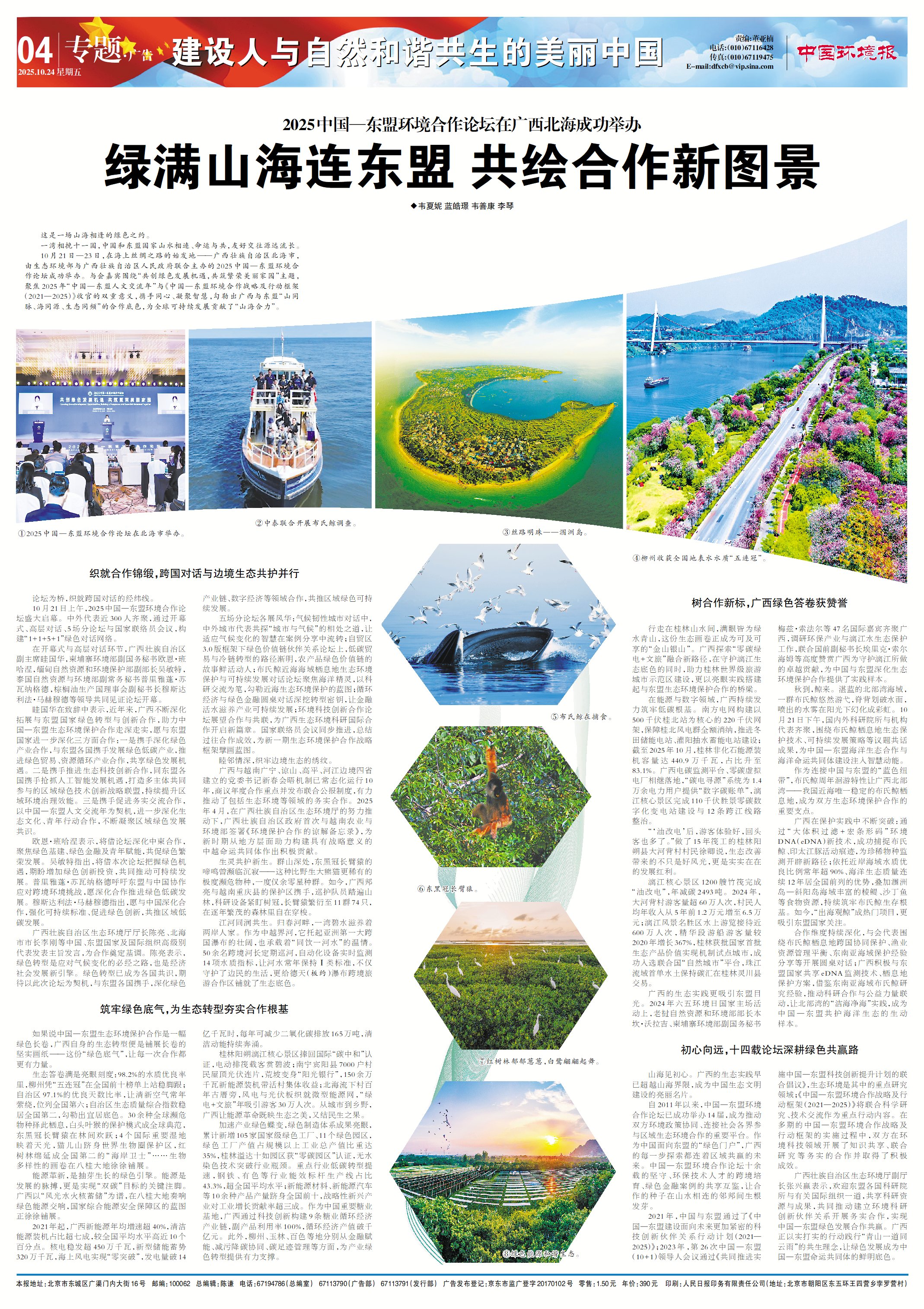
绿满山海连东盟 共绘合作新图景——2025中国—东盟环境合作论坛在广西北海成功举办
Zhong Guo Huan Jing Bao· 2025-10-24 01:40
Core Viewpoint - The 2025 China-ASEAN Environmental Cooperation Forum was successfully held in Beihai, Guangxi, focusing on creating green development opportunities and building a prosperous and beautiful home, emphasizing the significance of the 2025 "China-ASEAN Cultural Exchange Year" and the conclusion of the "China-ASEAN Environmental Cooperation Strategy and Action Framework (2021-2025)" [3][18][21]. Group 1: Forum Overview - The forum gathered nearly 300 representatives from China and ASEAN countries, featuring an opening ceremony, high-level dialogues, five sub-forums, and a national liaison meeting, establishing a "1+1+5+1" green dialogue network [6][21]. - Key leaders, including the Vice Chairman of Guangxi and representatives from various ASEAN countries, highlighted the importance of deepening green industry cooperation, ecological technology innovation, and practical exchanges [9][23]. Group 2: Sub-Forum Highlights - The five sub-forums addressed various topics, including climate-resilient cities, low-carbon trade, sustainable development of marine ecosystems, and the role of financial support in sustainable industry development [24]. - Discussions on the protection of the habitat of the endangered Bryde's whale emphasized the need for scientific collaboration and sustainable practices [40][41]. Group 3: Environmental Achievements - Guangxi reported a water quality excellence rate of 98.2%, ranking it among the top ten in the nation, and maintained a high air quality index with 97.1% of days classified as good [31][32]. - The region has made significant strides in renewable energy, with an annual growth rate exceeding 40% since 2021, and over 70% of its energy capacity coming from clean sources [32][33]. Group 4: Cross-Border Cooperation - Guangxi has established a mechanism for regular meetings with neighboring provinces in Vietnam, enhancing practical cooperation in ecological and environmental protection [28]. - The successful conservation efforts for endangered species, such as the Eastern black crested gibbon, demonstrate the effectiveness of cross-border ecological initiatives [11][30]. Group 5: Future Directions - The forum aims to strengthen the partnership between China and ASEAN in environmental research and innovation, promoting a shared vision for sustainable development [43][44]. - The ongoing collaboration in environmental technology and green finance is expected to yield further advancements in regional ecological protection efforts [43][44].

让“口碑工程”真正留下好口碑
Zhong Guo Huan Jing Bao· 2025-10-24 00:20
在工作谋划上,要保生态、求发展并重,以正确的发展思路延续好口碑。美丽中国建设是涉及全领域转 型、全方位提升、全地域建设、全社会行动的综合性工程,要以发展方式、生活方式的转型为核心,实 现人与自然和谐共生的现代化。《关于全面推进美丽中国建设的意见》《关于建设美丽中国先行区的实 施意见》是推进美丽中国建设的总纲,对其中的原则、目标等要坚决落实,不搞变通。在具体的工作谋 划和落实上,特别是基层一线,切忌以照抄照搬文件代替实际任务落实。要多倾听人民群众的意见和呼 声,结合本地区自然禀赋、产业结构、空间规划、污染源特点等因素,找到一条符合本地实情的高质量 发展道路,防止政策措施"水土不服"。 在工作推进过程中,坚持人民至上、实干为先,以好作风、真成效赢得好口碑。要始终把人民满意不满 意作为衡量工作成效的标尺,摒弃脱离当地实际制定"大目标"、搞"应景式"的"大动作"。反对形式主 义,不搞群众厌烦的层层评比、处处留痕和不切实际的创建。以取得实际成果为导向,围绕绿色转型、 治污攻坚、生物多样性保护、生态安全、生态环境治理能力现代化、美丽中国先行区建设等重点任务, 盯紧抓牢本地区的突出生态环境问题,扬长避短,敢拼敢试,交出一份 ...
全面加强非二氧化碳温室气体排放控制
Zhong Guo Huan Jing Bao· 2025-10-23 23:13
Core Points - The Chinese government has announced a new round of national contributions to reduce greenhouse gas emissions, aiming for a 7%-10% decrease in total emissions by 2035 compared to peak levels, marking a significant milestone in climate change response [1] - The focus on controlling non-CO2 greenhouse gases has been integrated into China's carbon peak and carbon neutrality policy framework since the announcement of the "dual carbon" goals in 2020 [2] Group 1: National Policy and Goals - The new absolute reduction target for greenhouse gases includes all types of emissions, emphasizing the importance of controlling non-CO2 gases such as methane and nitrous oxide [1][2] - The government has issued various policies to strengthen the control of non-CO2 gases, including action plans for methane emissions and guidelines for greenhouse gas inventory compilation [3][4] Group 2: Implementation Strategies - A series of supporting policies have been developed, such as revising emission standards and implementing action plans for specific sectors like agriculture and industry to reduce greenhouse gas emissions [3][4] - The establishment of a carbon market that includes non-CO2 gases and the development of a national greenhouse gas emission factor database are part of the efforts to enhance emission control mechanisms [4] Group 3: Local Level Challenges and Recommendations - Local governments face challenges such as unclear emission data and inadequate policy frameworks for controlling non-CO2 gases [5] - Recommendations include improving data collection, developing localized policies, and implementing targeted emission control measures based on regional characteristics [5][6]
从“一水共护”迈向“一域共富”
Zhong Guo Huan Jing Bao· 2025-10-23 09:03
Core Viewpoint - The article emphasizes the importance of establishing a market-oriented and diversified ecological protection compensation mechanism to bridge the gap between ecological preservation and economic development, particularly in the context of the Jinjiang and Luoyang River upstream water resource protection compensation mechanism [2][3][4]. Group 1: Systematic Enhancement of Ecological Compensation - The core goal of watershed ecological compensation is to quantify the consensus level among compensation subjects, reflecting the depth and stability of ecological protection awareness [3]. - A well-defined initial goal that aligns with urban development needs indicates a strong motivation for the synergy between ecological protection and economic development [3]. - The compensation mechanism aims to balance development between ecological protection areas and beneficiary regions, promoting coordinated reforms in ecological resource protection, environmental governance, and ecological rights trading [3]. Group 2: Diversification of Ecological Compensation - A diversified ecological compensation mechanism relies on various compensation subjects sharing a common compensation burden, creating a multi-channel and efficient compensation system [4]. - This approach enhances public recognition and acceptance of ecological compensation, transitioning from "single water quality governance" to "shared prosperity in watershed development" [4]. - The mechanism categorizes compensation subjects into government, market entities, and social organizations, fostering collaboration and enhancing public awareness of ecological compensation [4]. Group 3: Synergistic Expansion of Ecological Compensation - The article discusses the need to break down regional and sectoral barriers to create a deep integration of ecological protection and economic development [4][5]. - A multi-faceted compensation framework is proposed, linking provincial, municipal, and county levels, and facilitating cross-regional cooperation between protected and beneficiary areas [4]. - The use of diverse green financial tools is suggested to address funding challenges in ecological protection compensation, establishing a market-oriented channel for converting governance costs into industrial premiums [4]. Group 4: Institutional Support for Ecological Products - The government is encouraged to leverage local legislative powers to create a differentiated regulatory framework that aligns ecological development needs with ecological product industries [5]. - The article highlights the importance of clearly defining principles, scope, subjects, and standards for watershed ecological compensation to provide institutional support for ecological protection initiatives [5]. - It suggests incorporating multiple compensation factors based on various environmental characteristics, such as pollution types, river sizes, and biodiversity [5].

江西吉安如何推进“无废城市”建设?
Zhong Guo Huan Jing Bao· 2025-10-23 06:13
Group 1 - The city of Ji'an in Jiangxi Province is prioritizing the construction of a "waste-free city" as part of its top ten key initiatives, aiming to enhance the ecological environment and improve residents' sense of well-being and safety [1] - A high-level task force has been established, led by the mayor and party secretary, to coordinate efforts across various departments, ensuring collaboration and information sharing in solid waste management [1] - Financial support for green projects has been increased, with a total of 1.242 billion yuan in tax reductions for resource utilization enterprises since 2022 [1] Group 2 - The city is developing a circular resource system focusing on industrial solid waste, agricultural waste, construction waste, and hazardous waste, aiming to reduce pollution and promote resource utilization [2] - Key sectors identified for the "waste-free city" initiative include industry, agriculture, construction, and hazardous waste, with specific projects aimed at enhancing resource recycling and safety [2] - Ji'an has established 19 national-level green factories and 40 provincial-level green factories, leading in the province for green industrial development [3] Group 3 - A new model of "two networks integration" is being explored to improve waste classification and recycling rates, alongside enhanced management of hazardous waste [3] - The city is focusing on green low-carbon development paths, with a strong emphasis on the electronic information industry and emerging sectors like hydrogen energy and new energy storage [3] - Legislative measures have been introduced to clarify responsibilities for industrial solid waste management and to regulate the operation of waste treatment facilities [3]
守护京杭大运河,扬州依靠“天空地协同”
Zhong Guo Huan Jing Bao· 2025-10-23 04:33
Core Viewpoint - The Yangzhou section of the Grand Canal plays a crucial role in the South-to-North Water Diversion Project and serves as a key ecological corridor connecting the Yangtze River Economic Belt with the North China Plain [1][2] Group 1: Monitoring System - The "Sky, Air, and Ground Coordination" model is a sophisticated and efficient water environment monitoring system that enhances monitoring efficiency and accuracy [1] - The system utilizes satellite remote sensing for macro-level ecological monitoring, drones for spectral water quality monitoring, and autonomous monitoring vessels for on-site checks [1] Group 2: Monitoring Actions - From May to July this year, the Yangzhou Monitoring Center conducted high-density monitoring of the Grand Canal using the "Jianghuai Environmental Monitoring No. 1" vessel, setting up 204 monitoring points along the canal at 500-meter intervals [1] - The monitoring actions aimed to deeply assess the water environment and systematically record changes in water quality [1] Group 3: Technological Integration - The monitoring model leverages new technologies such as remote sensing and image recognition for dynamic identification and continuous monitoring of pollution sources, thereby improving governance efficiency [2] - This technological integration supports the construction of a green modern shipping demonstration zone along the Grand Canal, revitalizing this ancient waterway in the modern era [2]