
Zhong Guo Huan Jing Bao

Search documents
中邮保险:深化绿色金融实践服务国家发展战略
Zhong Guo Huan Jing Bao· 2025-09-17 03:12
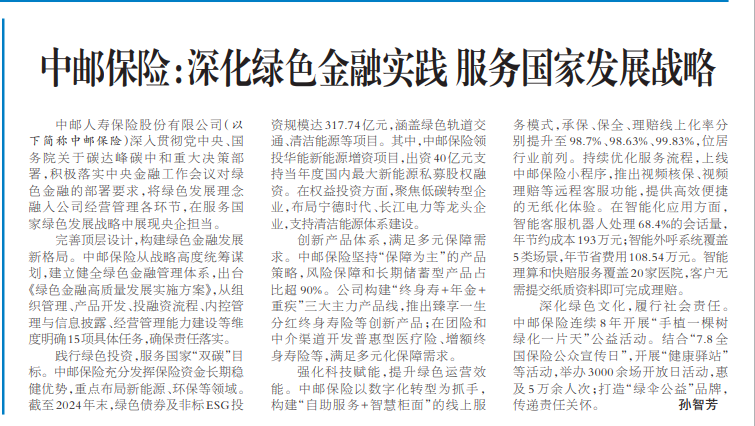
Core Viewpoint - China Post Life Insurance Co., Ltd. actively implements the national strategy for carbon peak and carbon neutrality, integrating green development concepts into its operations and showcasing its responsibilities as a state-owned enterprise [1][2]. Group 1: Green Finance Development - The company has established a comprehensive green finance management system and released the "Implementation Plan for High-Quality Development of Green Finance," outlining 15 specific tasks across various dimensions to ensure accountability [1]. - By the end of 2024, the scale of green bonds and non-standard ESG investments is expected to reach 31.774 billion yuan, covering projects in green rail transportation and clean energy [1]. - The company led a 4 billion yuan investment in Huaneng New Energy's capital increase project, supporting the largest private equity financing in the domestic renewable energy sector for the year [1]. Group 2: Product Innovation and Technology Empowerment - The company maintains a product strategy focused on "protection as the main priority," with over 90% of its products being risk protection and long-term savings types [2]. - The main product lines include "whole life insurance + annuity + critical illness," with innovative products like the "Zhenxiang Lifetime Dividend Whole Life Insurance" being launched [2]. - The digital transformation has led to an online service model with self-service and smart counters, achieving online processing rates of 98.7% for underwriting, 98.63% for policy maintenance, and 99.83% for claims, ranking among the industry leaders [2]. Group 3: Social Responsibility and Green Culture - The company has conducted the "Plant a Tree, Green a Piece of Sky" public welfare activity for eight consecutive years, promoting environmental responsibility [2]. - It has organized over 3,000 open day events benefiting more than 50,000 people, alongside initiatives like the "Health Station" during the National Insurance Publicity Day [2]. - The "Green Umbrella Public Welfare" brand has been established to convey a sense of responsibility and care within the community [2].

中邮证券:绿色金融实践结硕果
Zhong Guo Huan Jing Bao· 2025-09-17 03:12
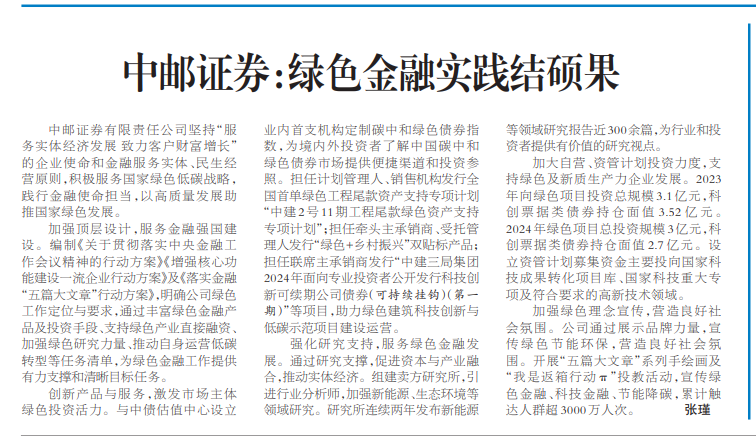
中邮证券有限责任公司坚持"服务实体经济发展 致力客户财富增长"的企业使命和金融服务实体、民生经 营原则,积极服务国家绿色低碳战略,践行金融使命担当,以高质量发展助推国家绿色发展。 加强顶层设计,服务金融强国建设。编制《关于贯彻落实中央金融工作会议精神的行动方案》《增强核心 功能建设一流企业行动方案》及《落实金融"五篇大文章"行动方案》,明确公司绿色工作定位与要求,通 过丰富绿色金融产品及投资手段、支持绿色产业直接融资、加强绿色研究力量、推动自身运营低碳转型等 任务清单,为绿色金融工作提供有力支撑和清晰目标任务。 创新产品与服务,激发市场主体绿色投资活力。与中债估值中心设立业内首支机构定制碳中和绿色债券指 数,为境内外投资者了解中国碳中和绿色债券市场提供便捷渠道和投资参照。担任计划管理人、销售机构 发行全国首单绿色工程尾款资产支持专项计划"中建2号11期工程尾款绿色资产支持专项计划";担任牵头主 承销商、受托管理人发行"绿色+乡村振兴"双贴标产品;担任联席主承销商发行"中建三局集团2024年面向 专业投资者公开发行科技创新可续期公司债券(可持续挂钩)(第一期)"等项目,助力绿色建筑科技创新 与低碳示范项目建设运 ...
每3度电中就有1度绿电!风电光伏应用场景亟待进一步拓展
Zhong Guo Huan Jing Bao· 2025-09-17 03:10
Group 1 - The core viewpoint is that China has established the world's largest and fastest-growing renewable energy system, with renewable energy generation capacity increasing from 40% to approximately 60% [1] - The total electricity consumption in China now includes one-third green electricity, indicating a significant shift towards greener energy sources [1] - Distributed photovoltaic (PV) systems have emerged as a new force, with over 400 million kilowatts of new installations, including 160 million kilowatts from household PV systems, making over 7 million families "PV landlords" [1] Group 2 - China continues to prioritize large-scale renewable energy projects in regions with optimal conditions, such as Qinghai, Gansu, Shaanxi, and Ningxia, leading to the construction of major solar and wind power bases [1] - The "big base, big project" approach has resulted in significant investments and advancements in renewable energy technology, with China's renewable energy patents accounting for over 40% of the global total [1] - The average cost of electricity generated from wind and solar projects has decreased by 60% and 80%, respectively, over the past decade, showcasing China's contribution to global low-carbon transition [1] Group 3 - During the 14th Five-Year Plan, there has been a push to expand small-scale distributed wind and solar power markets, with over 7 million households adopting the "self-use and surplus electricity online" model [2] - The potential for small-scale distributed wind and solar power is significant, as these installations can be located near populated areas, leading to lower investment costs and improved land use [2] - Challenges remain in public awareness and willingness to utilize rooftops or barren land for solar installations, necessitating patience and targeted demonstrations in suitable communities [2] Group 4 - China has established a comprehensive wind and solar power technology system capable of producing a wide range of equipment and facilities [3] - To enhance product offerings, it is crucial to conduct thorough research to identify user needs and improve product design [3]
中国邮政的绿色实践与“两山”答卷
Zhong Guo Huan Jing Bao· 2025-09-17 03:06
Core Viewpoint - The article emphasizes the commitment of China Post to promote green development and ecological harmony as part of China's modernization strategy, showcasing various initiatives in sustainable practices and environmental responsibility [1][12]. Group 1: Green Transformation Initiatives - China Post is actively implementing circular packaging as a key strategy for green transformation, focusing on reducing resource consumption and environmental impact [5][6]. - The company has successfully recycled 53.14 million corrugated boxes by June this year, with a 98.64% usage rate of reusable transit bags in provincial operations and 10% of urban express deliveries utilizing circular packaging [7]. - The "Bamboo Instead of Plastic" initiative aims to replace plastic packaging with biodegradable bamboo products, with pilot applications already launched in Beijing and Hainan [8][9]. Group 2: Collaborative and Community Engagement - China Post has organized the "Internet + National Volunteer Tree Planting" initiative, engaging over 130,000 participants and raising over 2.23 million yuan for afforestation projects [10][11]. - The company integrates its green initiatives with public participation, enhancing awareness and involvement in environmental protection through its services [11]. Group 3: Future Directions and Commitments - China Post plans to continue its commitment to ecological sustainability by utilizing clean energy vehicles, optimizing transportation modes, and enhancing green facility construction [13]. - The company aims to leverage its research capabilities and collaborative efforts across the industry to provide new pathways and technologies for green governance [13].

绿意新生:邮储银行深耕绿色金融显实效
Zhong Guo Huan Jing Bao· 2025-09-17 03:06
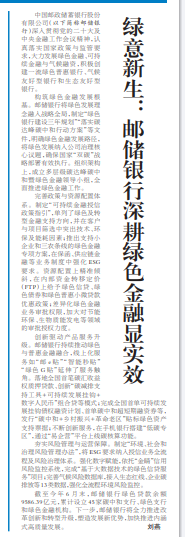
中国邮政储蓄银行股份有限公司(以下简称邮储银行)深入贯彻党的二十大及中央金融工作会议精神, 认真落实国家政策与监管要求,大力发展绿色金融、可持续金融与气候融资,积极创建一流绿色普惠银 行、气候友好型银行和生态友好型银行。 构筑绿色金融发展根基。邮储银行将绿色发展理念融入战略全局,制定"绿色银行建设三年规划""落实 碳达峰碳中和行动方案"等文件,明确绿色金融发展路径,将绿色发展纳入公司治理核心议题,确保国 家"双碳"战略部署有效执行。组织架构上,成立多层级碳达峰碳中和暨绿色金融领导小组,全面推进绿 色金融工作。 夯实风险管理与运营保障。制定"环境、社会和治理风险管理办法",将ESG要求纳入授信业务全流程及 风险治理体系。强化数字赋能,依托"金睛"信用风险监控系统,完成"基于大数据技术的绿色信贷服 务"项目;完善气候风险数据库,接入生态红线、企业碳排放等13类数据,强化全流程环境风险监控。 截至今年6月末,邮储银行绿色贷款余额9586.39亿元,累计设立45家碳中和支行、绿色支行和绿色金融 机构。下一步,邮储银行将全力推进改革创新和转型升级,塑造发展新优势,加快推进内涵式高质量发 展。 完善政策与资源配置体系。制 ...

践行“无痕旅游”,留住自然本真之美
Zhong Guo Huan Jing Bao· 2025-09-17 01:49
国庆长假即将来临,很多人已经在谋划出游事宜。不久前,中国林学会、中国旅游协会、中国登山协会 联合发起"爱护绿水青山 倡导无痕旅游"倡议,呼吁公众提升旅游活动中的生态环境意识,以实际行动 呵护绿水青山。 社会力量的广泛参与不可或缺。各类生态环保组织可深入景区、学校、社区,开展"无痕旅游"宣传活 动,通过举办讲座、发放宣传册、组织环保实践等形式,普及生态环境保护知识,提升公众认知水平。 媒体要发挥舆论引导作用,播放"无痕旅游"主题公益广告,曝光不文明行为,营造良好舆论氛围。 同时,每一位游客都应将"无痕旅游"理念内化于心、外化于行,出游前主动查阅目的地生态环境保护规 定,旅途中约束自身行为,不触碰生态环境保护"红线",旅行后分享美景的同时,也要分享"无痕旅 游"的经验做法,带动身边人自觉践行"无痕旅游"。 此次倡议提出了5方面内容。其一,践行生态文明理念。这意味着游客要深怀对自然的敬畏之心,以观 察者、体验者、保护者的身份融入自然,而非以征服者的姿态肆意妄为。其二,遵守自然保护地和林区 相关规定。这是保障山林安全与生态稳定的基础,可避免因人类活动对生态敏感脆弱区造成不可逆的破 坏。其三,尊重自然、保持山林原貌。这 ...
“科技+生态环境”创造更多可能
Zhong Guo Huan Jing Bao· 2025-09-17 00:26
Group 1 - The core viewpoint emphasizes the need for accelerated technological innovation in ecological and environmental protection to effectively combat pollution and enhance ecological restoration efforts [1][2] - The integration of modern technologies such as 5G, big data, cloud computing, artificial intelligence, and robotics is crucial for transforming ecological protection efforts [1] - Traditional methods are becoming less effective in addressing complex environmental issues, necessitating a reliance on advanced technologies for pollution prevention and control [1] Group 2 - Current ecological and environmental technology development must align closely with the practical needs of environmental protection, particularly in addressing pollution challenges [2] - There is a call to attract more research resources into the ecological environment sector and to expand the market for environmental technology applications [2] - Continuous innovation and the introduction of new technologies, products, and methods are essential for supporting ecological protection efforts [2] Group 3 - The establishment of platforms for efficient exchange and transaction of advanced technological products is necessary to enhance resource allocation in ecological research [3] - Existing platforms should be improved or integrated to better serve the needs of ecological research, ensuring effective connections between demand and supply [3] - The goal is to facilitate the flow of advanced research outcomes into practical applications, maximizing economic, social, and ecological benefits [3]
坚决遏制“两高”项目盲目上马 坚定不移走高质量发展之路
Zhong Guo Huan Jing Bao· 2025-09-16 23:19
有的地方明知上马"两高"项目违反相关规定,但在项目审批时却流于形式、默许纵容,或在监管执法时 偏宽松软,其根源就在于一些地方党委政府和有关部门没有完整、准确、全面贯彻新发展理念,把高质 量发展当做口号,仍然指望"两高"项目在短期内发挥出拉动经济的作用;一些地方在思想认识层面对经 济社会发展全面绿色转型、"双碳"目标任务的理解不深入,误解了碳达峰的真正含义;还有一些地方 对"两高"项目的监管缺乏韧劲和办法。从长期来看,"两高"项目盲目上马依然是对高耗能、高排放粗放 型发展方式的路径依赖,会加剧我国的碳排放压力,这与当前我国实现高质量发展和"双碳"目标的要求 是相背离的。 当前,我国已经进入高质量发展阶段,要实现高质量发展,一个关键环节就是要推动经济社会发展全面 绿色低碳转型。这不仅要求要发展新质生产力,促进新兴产业发展,还要推动传统产业深度转型,从而 提高经济社会发展的"含金量""含绿量"。在这一经济社会发展大趋势面前,以大量消耗资源能源为基础 的粗放型增长模式已经没有了生存的空间。加之当前决战决胜"十四五"、全面谋划"十五五"进入重要阶 段,距离"力争 2030年前二氧化碳排放达到峰值"的目标实现仅剩5年时间 ...
内蒙古自治区党委书记孙绍骋部署中央生态环保督察整改 立即快改实改 注重建章立制
Zhong Guo Huan Jing Bao· 2025-09-16 09:12
Group 1 - The Inner Mongolia Autonomous Region is focusing on implementing the "breakthrough" project in technology to enhance the integration of artificial intelligence with local industries, aiming for high-quality economic and social development [1] - The region plans to leverage its geographical, resource, and industrial advantages to strengthen foreign investment and trade cooperation, particularly in expanding the export scale of used cars and "new three samples" [1] Group 2 - The meeting emphasized the importance of adhering to ecological civilization principles and addressing issues highlighted in the Central Ecological Environment Protection Inspection Report, with a focus on improving ecological construction and environmental protection [2] - There is a commitment to immediate and effective rectification of issues raised by the central inspection, with a zero-tolerance approach towards slow or ineffective responses [2] - The region aims to enhance regulatory frameworks to prevent recurring environmental issues, particularly concerning deforestation, over-extraction of groundwater, and pollution from open storage sites [2]
推进乡村生态产品高质量生产经营需守正创新
Zhong Guo Huan Jing Bao· 2025-09-16 06:46
Core Insights - The realization of ecological product value is a practical pathway to transform the "Two Mountains" theory into reality, emphasizing the importance of agricultural ecological economy in rural revitalization [1] - The relationship between government guidance and market orientation must be effectively managed to optimize the production of ecological products [1][2] Group 1 - The agricultural ecological economy is becoming a vital means to stimulate rural development by integrating agricultural production with diverse values [1] - High-quality production and operation of rural ecological products require adherence to traditional agricultural practices while innovating through technology and improved management mechanisms [1] - A collaborative system of "efficient market + proactive government" should be established to ensure fairness in ecological product value realization and enhance resource allocation efficiency [1][2] Group 2 - The implementation of value conversion assessments is crucial, focusing on market pricing and compensation standards to guide decision-making and pricing in ecological product value realization [2] - A differentiated, diversified, and specialized ecological product value realization model should be constructed based on regional functional area positioning [2] - The establishment of an ecological product trading system and platform is necessary to create universal ecological product value accounting standards and facilitate cross-regional transactions [2]