
Zhong Guo Huan Jing Bao

Search documents
严禁排污许可证“搭便车”!需高度警惕“一证供多企”现象
Zhong Guo Huan Jing Bao· 2025-08-08 00:29
首先,生态环境部门要强化监管。建立"证照核查—现场核验—数据比对"的全面检查机制,深入车间核 查实际经营者与许可主体的一致性,调取租赁合同、水电费记录等识别"隐性租赁"情况;运用无人机、 在线监测和大数据,对超量排污等异常情况自动预警。同时,提升执法刚性,对查实的"厂中厂"严格执 行"双罚制",既追究持证企业转借排污许可证的责任,依法吊销其许可证并罚款,也严惩无证排污企 业,实施按日计罚、停产整治,绝不姑息。 其次,企业必须坚守环保守法底线。持证企业要明确,排污许可证是"准入证"更是"责任状",不是可交 易的商品。出租厂房时必须核查承租方环保资质,严禁提供排污指标;建立内部环境管理制度,定期自 查,杜绝"厂中厂"现象。无证企业需摒弃侥幸心理,主动申请排污许可,按要求配套治污设施,做 到"持证排污、按证排污";不具备环保条件的应主动退出,不能靠违法"搭便车"。 第三,生态环境部门要与司法机关多方联动凝聚整治合力。生态环境部门推进"一证式"监管改革,将排 污许可与环评、总量控制、执法检查等制度衔接,实现"一张许可证管到底"。建立跨部门信息共享平 台,打通数据壁垒,让"一证供多企"问题无所遁形。司法机关应与生态环境 ...
既要力度,又要温度,以更规范方式保持执法严的主基调
Zhong Guo Huan Jing Bao· 2025-08-07 23:19
Core Viewpoint - The recent training session on ecological environment law enforcement emphasizes the need for precise, scientific, and lawful pollution control, while avoiding one-size-fits-all approaches and excessive burdens on enterprises [1][2] Group 1: Regulatory Framework - Strict regulation of administrative inspections related to enterprises is crucial for enhancing lawful administration, optimizing the business environment, and stabilizing market expectations [1] - The initiative aims to resolve deep-rooted contradictions in traditional regulatory models by optimizing systems to improve regulatory efficiency and unleash enterprise vitality [1][2] Group 2: Enforcement Practices - The combination of "normative enforcement" and "strict duty performance" is essential for modern governance, where effective regulation is achieved through standardized processes and rights protection mechanisms [1][2] - There is a zero-tolerance policy for actions that damage the ecological environment, which is necessary to delineate boundaries for high-quality development [2] Group 3: Inspection Frequency and Efficiency - The implementation of a "comprehensive check once" mechanism is proposed to enhance inspection efficiency by addressing multiple issues in a single visit [3] - The need to ensure that inspections are justified and based on legal grounds is emphasized, moving away from arbitrary and excessive inspections [3] Group 4: Technological Integration - The use of modern technologies such as big data, satellite remote sensing, and AI models is encouraged to improve the timeliness and accuracy of identifying violations [3] - The goal is to minimize disruptions for compliant enterprises while maintaining strict oversight on violators [3]
临夏州持续筑牢黄河上游生态安全屏障
Zhong Guo Huan Jing Bao· 2025-08-07 08:30
Core Viewpoint - The article emphasizes the ecological and economic development efforts in Linxia Hui Autonomous Prefecture, highlighting the region's strategic importance in water conservation and environmental protection while promoting high-quality economic growth [1]. Group 1: Ecological Protection and Restoration - Linxia Prefecture adopts a systematic governance approach to enhance ecological protection and restoration, focusing on key areas for soil and water loss prevention and treatment [2]. - The region has implemented 42 soil conservation projects, treating an area of 129.6 square kilometers, achieving a soil conservation rate of 67.14% and a forest coverage rate of 14.27% [2]. Group 2: Pollution Prevention and Control - The prefecture has been actively engaged in pollution prevention, with significant actions taken since 2019, including the closure of 155 brick and tile factories and the elimination of over 48,000 old vehicles [3]. - A total of 2,772,670 square meters of clean heating source transformations have been completed, alongside the establishment of pollution prevention facilities at 10 docks and a ship repair factory [3]. Group 3: Green Transformation and Sustainable Development - Linxia Prefecture is focused on transitioning to a green economy by balancing development with environmental protection, implementing strict ecological zoning and control measures [4]. - The region has seen a 10% reduction in energy consumption intensity from 2021 to 2023, exceeding the targets set for the 14th Five-Year Plan [4]. - The development of clean energy projects, including 178.4 MW of photovoltaic power, is a key focus area, alongside the promotion of ecological industries such as cultural tourism and health [4].
永煤集团:守护生态底色绘就绿色转型新画卷
Zhong Guo Huan Jing Bao· 2025-08-07 06:06
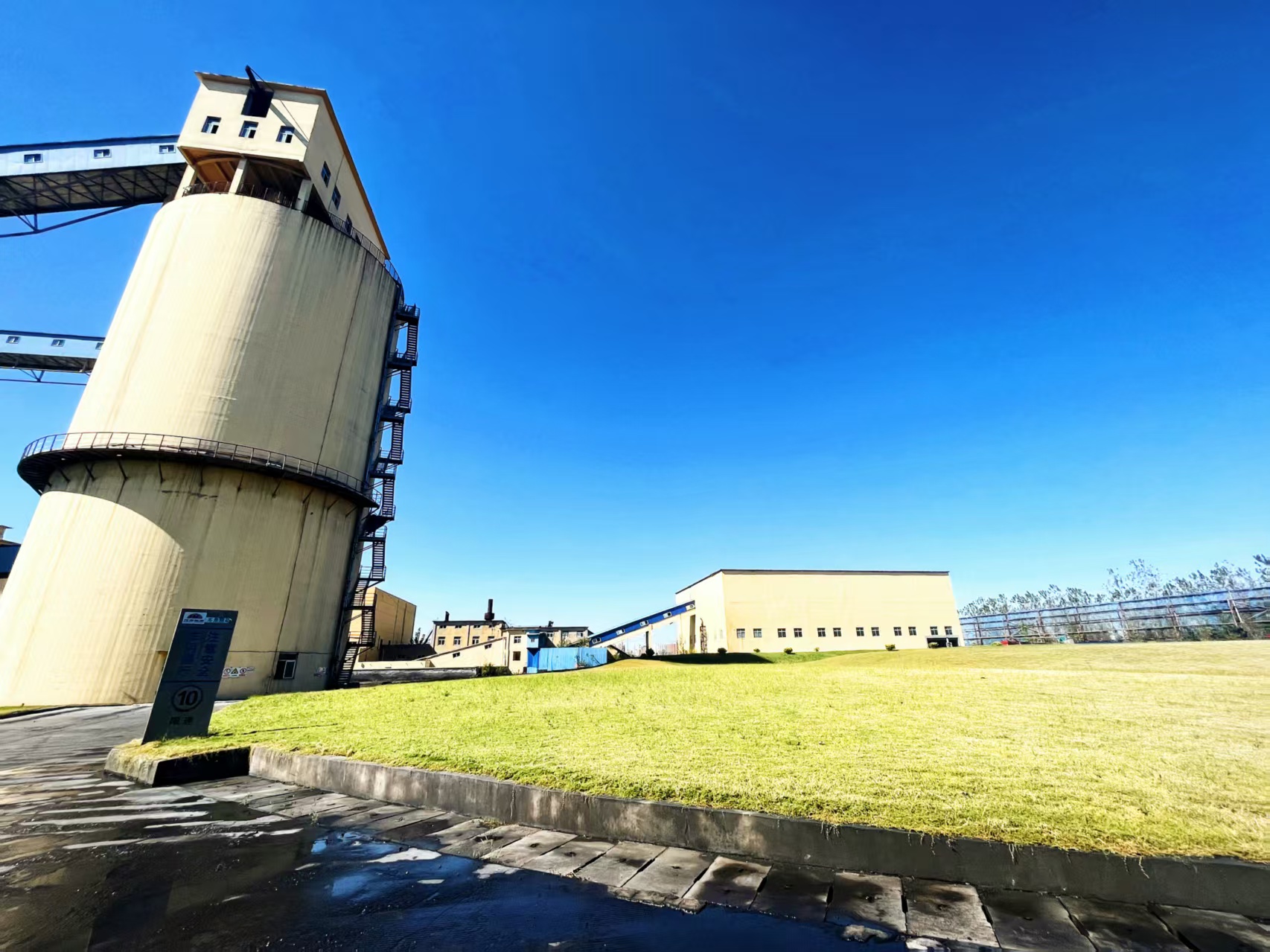
永城煤电控股集团有限公司(以下简称永煤集团)作为河南能源集团骨干煤炭企业,本部扎根全国六大无烟煤基地之一的永夏矿区,地处"豫东明珠"永城 市,坐拥38.4亿吨煤炭资源储量,下辖16对生产矿井,核定年生产能力超3000万吨,累计供应清洁优质煤炭6亿吨,贡献利税超900亿元。 在践行"双碳"战略与探索新质生产力的进程中,永煤集团以环保底线为"尺"、绿色发展为"笔",将生态环境保护深度融入煤炭产业全链条。通过推进安全高 效智能化开采、全面实施全煤入洗模式,以技术创新驱动绿色转型;凭借主产的特低硫、特低磷、低灰优质无烟煤,打造"中永一号""永煤精粒"等享誉海内 外的品牌,为钢铁、化工等行业提供高端原料,助力产业绿色升级。同时,企业从污染物精准管控、采煤沉陷区"四位一体"治理、智能环境管理等多维度发 力,构建生态、经济双赢模式,实现从"黑金"到"绿金"的蝶变,以国企担当筑牢绿色根基,为资源型企业转型提供"永煤样板"。 全封闭绿色存储系统 严守法规红线,筑牢环保根基 永煤集团始终将环保法规作为行动最高准则,全面贯彻落实各项环保政策、规范及标准。在污染物管控环节,严格执行排放标准,确保废水、废气、噪声、 辐射等各类污染物排 ...

以“四个优化”破解焊接烟尘收集处理难题
Zhong Guo Huan Jing Bao· 2025-08-07 05:41
Core Viewpoint - The article discusses the stringent regulations and challenges faced by manufacturing enterprises in managing welding fume emissions, emphasizing the need for effective collection and treatment measures to comply with environmental laws [1]. Regulatory Environment - National regulations, such as the Air Pollution Prevention and Control Law, require enterprises to enhance management and implement measures for controlling dust and gaseous pollutant emissions [1]. - Local regulations, like the Beijing Air Pollution Prevention and Control Ordinance, mandate the installation of purification devices to prevent pollution [1]. - Increased government scrutiny and penalties for non-compliance have intensified the focus on welding fume management in the manufacturing sector [1]. Current Practices - Most large manufacturing enterprises are implementing fume collection measures, particularly state-owned enterprises, which are investing significantly in fume management technologies [1]. - For instance, China Communications Construction Group's subsidiary, Shanghai Zhenhua Heavy Industries, has installed over a thousand mobile fume collection devices and is actively pursuing technological innovations [1]. Challenges in Fume Management - Balancing product quality and fume collection efficiency is difficult, as high negative pressure can disrupt the welding process and affect product quality [2]. - Many small mobile fume collection devices are ineffective, often serving merely as compliance tools rather than functional equipment [2]. - Changing the operational habits of frontline workers is challenging, as many do not recognize the importance of fume collection, and additional procedures may reduce their income [3]. - Outdoor welding poses significant challenges for fume collection, especially for large structures that cannot be welded indoors [3]. Optimization Strategies - The article suggests four optimization strategies to enhance fume collection efficiency: 1. **Optimize Production Processes**: Reduce welding steps in product design and utilize robotic welding and automated fume collection systems [4]. 2. **Optimize Collection Techniques**: Implement differentiated collection methods based on production environments, such as using mobile fume collection canopies for outdoor welding [4]. 3. **Optimize Equipment Management**: Regular maintenance and timely replacement of consumables are essential to ensure the effectiveness of fume collection devices [4]. 4. **Optimize Behavioral Drivers**: Training and incentivizing workers to adhere to fume collection protocols can improve compliance and efficiency [4].

理论实践融合推进高校生态文明教育
Zhong Guo Huan Jing Bao· 2025-08-07 03:09
Group 1 - The core viewpoint emphasizes the importance of ecological civilization education in higher education institutions to cultivate a generation of youth with green development concepts and environmental awareness, which is crucial for the progress and quality of ecological civilization construction [1] - The main task of ecological civilization education in universities is to help students establish correct ecological values and internalize green development concepts into their actions, recognizing the intrinsic logic of "ecological prosperity leads to civilizational prosperity" [1] - A multi-level ecological civilization education system should be constructed, integrating ecological concepts into various disciplines, including political education, engineering, and social sciences, to foster a comprehensive understanding of the relationship between ecology, economy, and society [1][2] Group 2 - Ecological civilization education should not be limited to theoretical instruction but should involve deep integration of theory and practice, using vivid case studies to enhance educational effectiveness and help students understand the value of green development [2] - Practical examples, such as the green transformation of the steel industry in Jichang Town, Tianjin, can help students visualize that green transformation does not equate to industrial decline but rather to high-quality development through technological and model innovation [2] - Universities can collaborate with local governments and enterprises to establish ecological civilization education practice bases, allowing students to engage in hands-on activities that enhance their awareness of environmental protection [3] Group 3 - Initiatives like the "Protect Mother River" campaign at Tianjin Agricultural University demonstrate the effectiveness of ecological civilization education through student participation in environmental protection activities, with over 150 events conducted and more than 8,000 student participants [3] - The establishment of student volunteer service teams focused on environmental issues, such as straw utilization and air pollution prevention, showcases the collaboration between universities and environmental agencies to promote ecological awareness [3] - The success of ecological civilization education is reflected in students' actual capabilities to serve green industry development and participate in ecological civilization construction, translating green concepts into actionable abilities [3]
让硬核制造与诗意栖居共融——宁波高质量奏响新时代“两山”转化澎湃乐章
Zhong Guo Huan Jing Bao· 2025-08-07 01:49
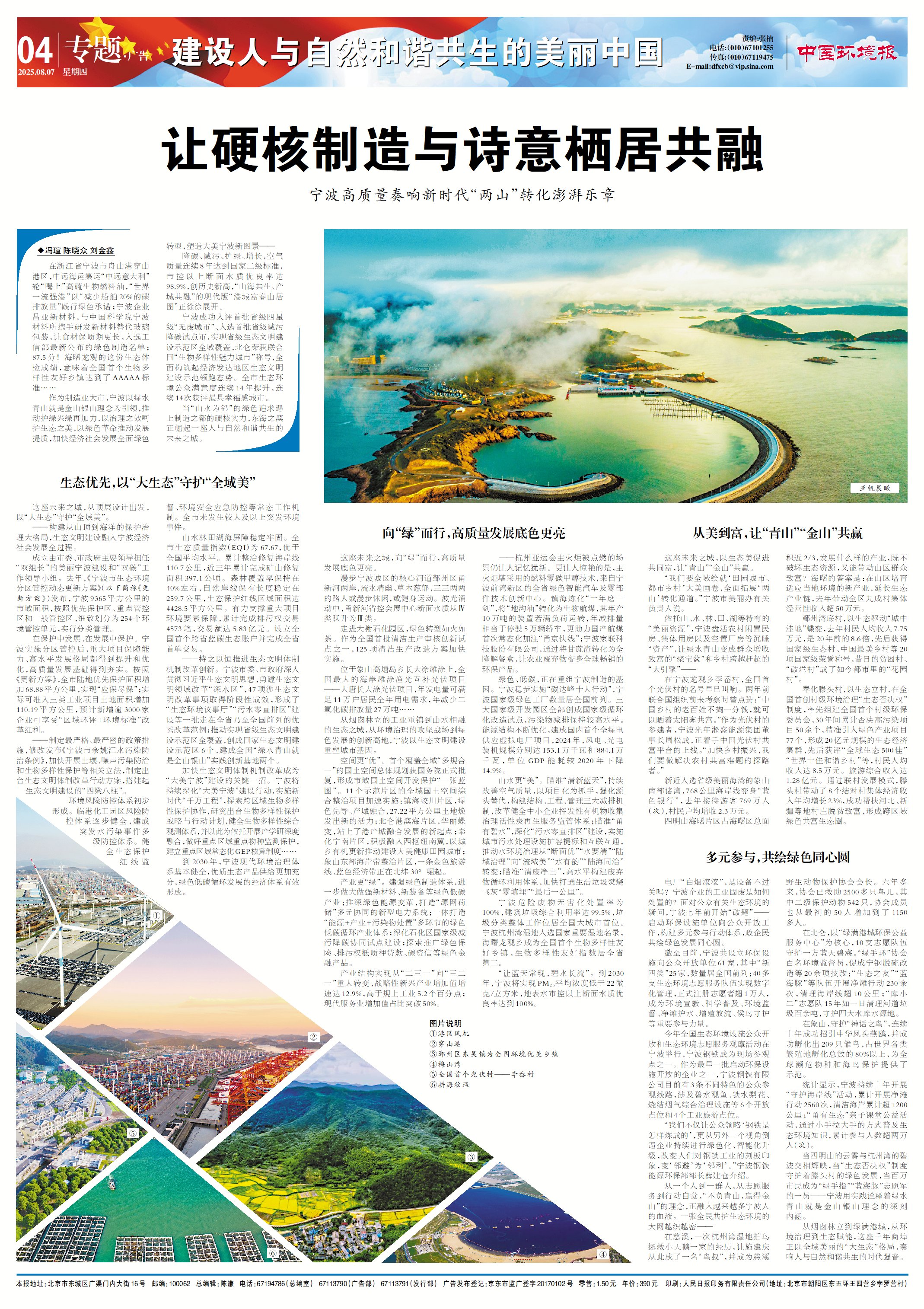
在浙江省宁波市舟山港穿山港区,中远海运集运"中远意大利"轮"喝上"高硫生物燃料油,"世界一流强港"以"减少船舶20%的碳排放量"践行绿色承诺;宁波 企业昌亚新材料,与中国科学院宁波材料所携手研发新材料替代玻璃包装,让食材保质期更长,入选工信部最新公布的绿色制造名单;87.5分!海曙龙观的 这份生态体检成绩,意味着全国首个生物多样性友好乡镇达到了AAAAA标准…… 作为制造业大市,宁波以绿水青山就是金山银山理念为引领,推动护绿兴绿再加力,以治理之效呵护生态之美,以绿色革命推动发展提质,加快经济社会发 展全面绿色转型,塑造大美宁波新图景—— 降碳、减污、扩绿、增长,空气质量连续8年达到国家二级标准,市控以上断面水质优良率达98.9%,创历史新高,"山海共生、产城共融"的现代版"港城富 春山居图"正徐徐展开。 宁波成功入评首批省级四星级"无废城市"、入选首批省级减污降碳试点市,实现省级生态文明建设示范区全域覆盖,北仑荣获联合国"生物多样性魅力城 市"称号,全面构筑起经济发达地区生态文明建设示范领跑态势。全市生态环境公众满意度连续14年提升,连续14次获评最具幸福感城市。 当"山水为邻"的绿色追求遇上制造之都的硬核实 ...
威海真抓实干争当美丽山东建设排头兵
Zhong Guo Huan Jing Bao· 2025-08-07 01:49
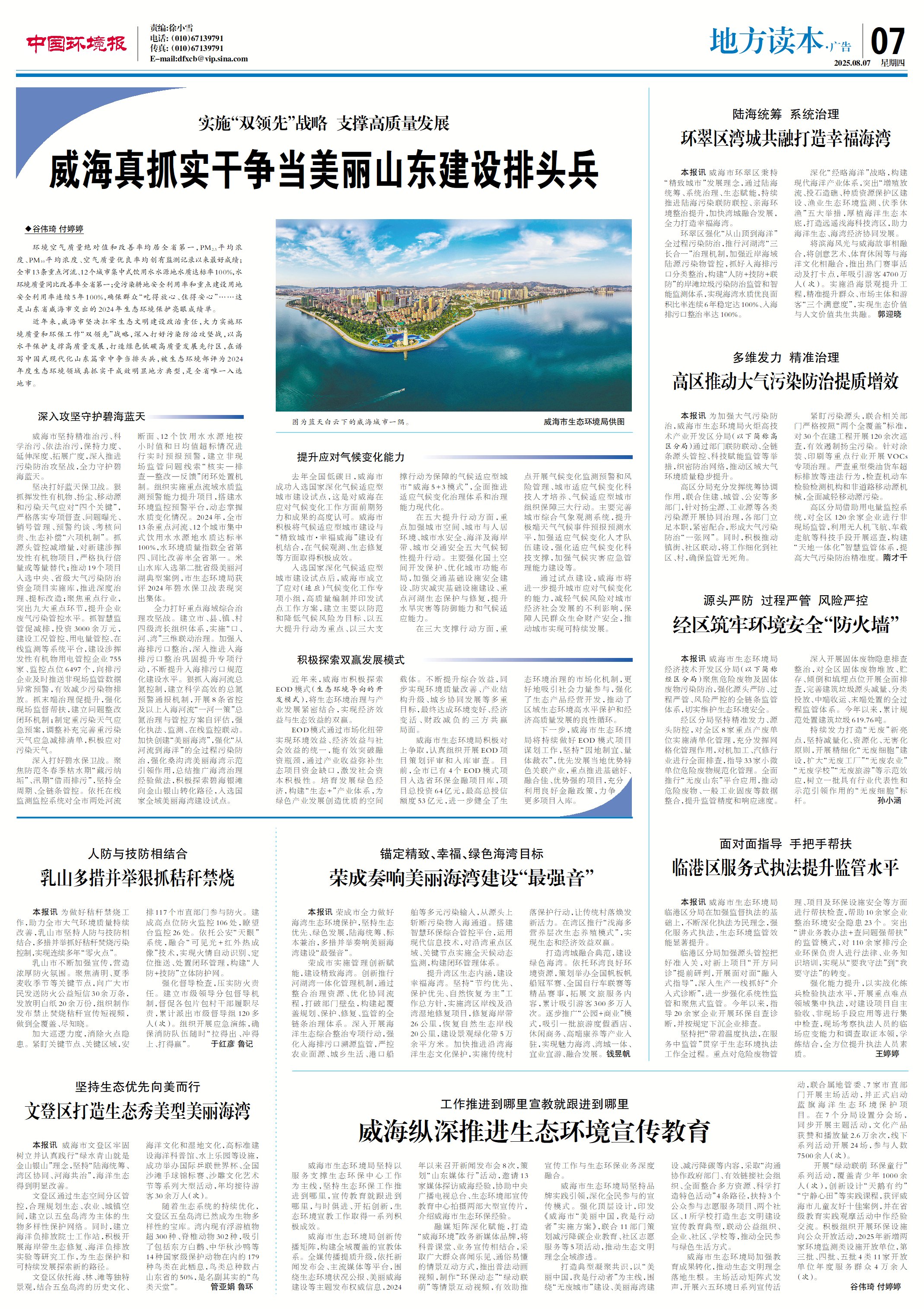
Core Viewpoint - Weihai City has achieved significant improvements in ecological and environmental protection, being recognized as a model for effective environmental governance in Shandong Province for 2024 [12]. Group 1: Environmental Quality Achievements - The average PM2.5 and PM10 concentrations, as well as the air quality good rate, have reached the best levels since monitoring began, with Weihai ranking first in the province for both absolute values and improvement rates [11][12]. - All 13 key rivers and 12 centralized drinking water sources in the city have achieved a 100% compliance rate for water quality, with the water environment quality improvement rate also ranking first in the province [11][12]. Group 2: Pollution Prevention Strategies - Weihai City has implemented a "dual-leading" strategy for environmental quality and protection, focusing on pollution prevention and control through precise, scientific, and legal measures [15]. - The city has invested over 30 million yuan in smart monitoring systems to enhance pollution reduction efforts, establishing 755 enterprises under volatile organic compounds (VOCs) control and 6,497 monitoring points [15][16]. Group 3: Climate Change Adaptation - Weihai has been selected as a national pilot for climate-adaptive city construction, integrating climate resilience into urban development plans [18]. - The city has established a specialized group to address climate change, focusing on five major enhancement actions and three supporting actions to improve governance capabilities [19]. Group 4: EOD Model for Sustainable Development - Weihai is exploring the EOD (Ecological Environment-Oriented Development) model, which aligns ecological governance with industrial development to achieve economic and ecological benefits [20]. - Four EOD projects have been included in the provincial environmental finance project library, with a total investment of 6.4 billion yuan and a maximum credit limit of 5.3 billion yuan [20].
本报评论员:以监督推动制度落地见效|四论贯彻落实《地方党政领导干部生态环境保护责任制规定(试行)》
Zhong Guo Huan Jing Bao· 2025-08-07 01:48
Group 1 - The core viewpoint of the news is the introduction of the "Regulations on the Responsibility System for Ecological and Environmental Protection of Local Party and Government Leaders," which establishes clear responsibilities and accountability mechanisms for local leaders in ecological protection [1] - The regulations create a management loop of "knowing responsibility - clarifying responsibility - fulfilling responsibility - ensuring responsibility," providing institutional guarantees for local leaders to take on ecological protection responsibilities [1] - Effective supervision mechanisms are emphasized as crucial for ensuring local leaders actively assume ecological protection responsibilities, shifting the mindset from "I have to protect the environment" to "I want to protect the environment" [1] Group 2 - Supervision should be goal-oriented, ensuring that local development decisions align with the central government's ecological protection policies and high-quality development requirements [2] - Problem-oriented supervision is necessary to address challenges in green transformation across key sectors such as industrial upgrading and energy structure adjustment [2] - The effectiveness of ecological protection work is measured by environmental quality indicators, with a focus on pollution prevention and the resolution of pressing environmental issues [3] Group 3 - The results of supervision should be effectively utilized in the evaluation and selection of local leaders, with a strong emphasis on accountability for poor performance and recognition for outstanding contributions [3] - The introduction of the regulations is seen as an opportunity for local leaders to strengthen their commitment to ecological protection, transforming institutional advantages into governance effectiveness [4]
主汛期如何抓好饮用水水源环境监管?
Zhong Guo Huan Jing Bao· 2025-08-07 00:24
Core Viewpoint - The article emphasizes the increasing challenges posed by extreme weather events on drinking water safety and the need for coordinated efforts to ensure water source protection during flood seasons [1][2][3][4]. Group 1: Cross-Department Collaboration - Establish a joint prevention and control system for water environment safety during flood seasons, ensuring unified command and departmental collaboration [1]. - Implement cross-departmental data sharing platforms to integrate information from various sectors, enhancing monitoring from water condition forecasting to pollution warning [1][2]. - Conduct joint emergency drills to ensure seamless coordination in all response phases, reinforcing ecological safety [1][2]. Group 2: Risk Prevention and Technological Integration - Strengthen the role of river and lake chiefs in supervising drinking water source protection areas during flood seasons to prevent water quality deterioration [2]. - Enhance dynamic risk perception and assessment to monitor real-time weather and disaster information, focusing on key pollution sources [2]. - Utilize modern technologies such as AI, IoT, and big data for improved information collection and rapid pollution alerts [2][3]. Group 3: Infrastructure and Community Engagement - Conduct risk assessments in sensitive environmental areas, ensuring compliance with emergency response plans for water pollution incidents [3]. - Address safety gaps in rural drinking water sources and engage community organizations in pollution source management [3]. - Encourage public participation in reporting environmental hazards through established communication channels [3][4]. Group 4: Emergency Preparedness - Reinforce emergency response readiness among environmental departments, focusing on extreme weather conditions and potential impacts on water safety [4]. - Develop tailored emergency measures for key rivers and drinking water sources, ensuring resource availability for effective response [4]. - Maintain a state of readiness for environmental monitoring and rapid response to assess and mitigate ecological impacts from flood disasters [4].