Hu Xiu

Search documents
黄仁勋:英伟达成了中美对决的“牺牲者”
Hu Xiu· 2025-10-22 09:01
英伟达CEO黄仁勋在纽约公开发声,感叹公司在中国市场份额从95%跌到0%,直指美国出口管制让他 们百分百退出中国。 ...

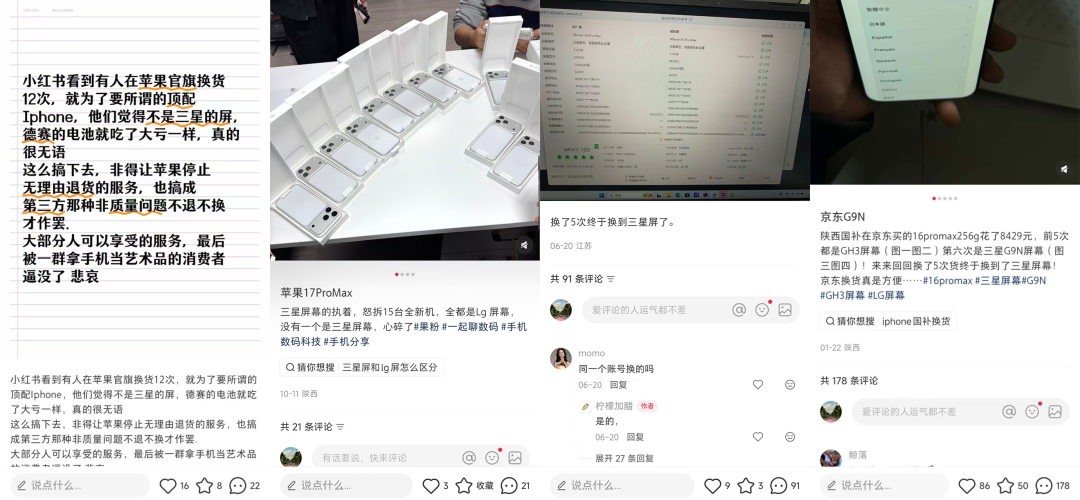
苹果用户把好好的手机退换十几次,就为了个“三星屏”
Hu Xiu· 2025-10-22 08:35
Core Viewpoint - The article discusses the phenomenon of iPhone users frequently returning and exchanging their devices to obtain models with Samsung screens, which are perceived to have superior display quality compared to LG screens. This behavior is driven by a combination of consumer dissatisfaction with display quality and the perceived advantages of Samsung's display technology over LG's [1][4][15]. Group 1: Reasons Behind Returns - The motivation for returning and exchanging iPhones is not solely about minor defects but rather the pursuit of a better display, specifically the Samsung screen [5][15]. - Users believe that Samsung screens offer better color accuracy, wider viewing angles, and clearer text compared to LG screens, leading to a preference for Samsung displays [6][8][10]. Group 2: Technical Differences - Samsung's proprietary "Diamond Pixel" technology enhances text clarity and reduces color fringing, making it more effective in rendering sharp edges compared to LG's pixel arrangement [16][19][22]. - The phenomenon of "Mura effect," which refers to uneven brightness in displays, is more prevalent in LG screens, contributing to user dissatisfaction [24][25][31]. Group 3: Quality Control and Production Variability - Apple's stringent quality control standards ensure that all screens, regardless of supplier, meet a minimum quality threshold, making differences between Samsung and LG screens less noticeable to the average consumer [34][35][43]. - Variability in production can lead to random quality differences within the same model, meaning that even devices with the same screen type can exhibit different performance [37][38][45]. Group 4: Consumer Behavior and Risks - The practice of returning multiple devices to find the "perfect screen" is legally supported by Apple's return policies, but it poses risks of being flagged as a high-risk account by Apple or e-commerce platforms [46][50][51]. - Consumers face a dilemma between the desire for an ideal device and the potential consequences of excessive returns, which could affect their purchasing capabilities in the future [52].


一文读懂:十五五计划如何影响普通人?
Hu Xiu· 2025-10-22 08:35
Core Insights - The article discusses the significance of the 15th Five-Year Plan, emphasizing its potential to transform the lives of China's 1.4 billion population [1] Group 1 - The 15th Five-Year Plan is presented as a crucial document that can influence the future of the entire nation [1] - Understanding this plan is portrayed as essential for individuals to avoid being left behind in the evolving socio-economic landscape [1]
新茶饮赚疯了,卖茶叶的为啥挣不到钱?
Hu Xiu· 2025-10-22 08:35
Core Insights - The traditional tea industry in China is facing significant challenges, with many businesses experiencing a sharp decline in sales and closures, while new tea beverage brands are thriving and expanding rapidly [1][3][6] Industry Overview - The tea industry in China is vast, with a total production value projected to reach approximately 330 billion yuan by 2025, and the entire industry chain exceeding one trillion yuan [1] - The market is characterized by a large number of small and medium-sized enterprises, with a few leading companies shaping the industry dynamics [2] Market Trends - New tea beverages account for about 10% of tea sales and are seen as a potential savior for the traditional tea industry, driving significant growth and providing a new revenue stream for upstream tea producers [6][7] - The new tea beverage sector has shown impressive performance, with total revenue exceeding 300 billion yuan in the first half of the year, and individual brands like Mixue Ice City achieving over 10 billion yuan in revenue [6][7] Capitalization Challenges - Traditional tea companies, such as Baima Tea, have faced numerous challenges in their attempts to go public, highlighting the difficulties in capitalizing the tea industry [3][4][5] - The lack of successful listings for traditional tea companies on the A-share market reflects a broader trend of capital disinterest in the sector [3][4] Brand and Product Differentiation - The tea industry struggles with brand recognition and standardization, making it difficult for companies to establish strong market positions [9][10][11] - The non-standard nature of tea products complicates consumer decision-making, as quality and value are often subjective [9][10] Consumer Behavior Shifts - The younger generation, particularly Generation Z, is driving changes in tea consumption preferences, favoring convenience and diverse flavors, which has led to the rise of new brands that leverage social media for marketing [21][22] - Online sales channels are flourishing, but they also present challenges, including issues of quality and trust among consumers [22] Future Outlook - The tea industry must find a balance between industrial efficiency and the cultural significance of tea, as it navigates the complexities of modernization and consumer expectations [22]

高市早苗这位女版安倍,拿什么来复兴日本?
Hu Xiu· 2025-10-22 08:03
Core Viewpoint - The appointment of Sanna Marin as Japan's first female Prime Minister has led to a euphoric response in the capital markets, with Japanese stocks surging, signaling a potential new era, yet underlying market dynamics remain unchanged [1] Group 1 - The capital markets reacted positively to the news of Sanna Marin's appointment, indicating a collective celebration among investors [1] - Japanese stocks experienced a significant rise, reflecting optimism in the market following the historic political change [1] - Despite the initial excitement, the article suggests that the fundamental market logic and dynamics are still in play, hinting at continuity in underlying economic factors [1]
买量金融学:如何做一份“大概率失败”的工作?
Hu Xiu· 2025-10-22 07:11
Core Insights - The article discusses the perceived simplicity and low technical barrier of the buying volume industry, comparing it to stock trading, where both require minimal actions to potentially earn significant returns [1][6][12] - It highlights the common misconception that roles in finance and buying volume lack complexity, leading to a public perception that anyone can perform these jobs successfully [13][14][15] - The article draws parallels between fund managers and buying volume personnel, emphasizing that both manage large sums of money and face similar public scrutiny regarding their performance [12][24] Industry Analysis - The entry barrier for both finance and buying volume roles has significantly decreased, allowing many individuals to enter these fields quickly [13][14] - The performance of fund managers has fluctuated, with notable figures experiencing both acclaim and criticism based on market conditions, reflecting the volatile nature of investment success [18][20][28] - The article notes that the success rate of professional investors is often below 50%, with some top fund managers achieving only a 40% success rate in stock selection [25][27] Professional Development - Continuous learning in financial knowledge and buying volume strategies is essential to reduce decision-making errors, although it may not guarantee wealth [30][36] - Building trust and credibility within the industry is crucial for market professionals, as they often face skepticism and pressure from others who may not understand the market dynamics [39][40] - The article suggests that market workers should negotiate higher salaries to compensate for the high likelihood of facing criticism and doubt in their roles [34]
互联网巨头,盯上了9.9折扣超市?
Hu Xiu· 2025-10-22 07:04
Core Insights - The price war has expanded from food delivery services to the supermarket industry, with significant discounts on essential products [1] - Major players like JD Discount Supermarket, Super Box (formerly Alibaba's Hema NB), and Happy Monkey (Meituan's supermarket brand) are competing aggressively for consumer attention with remarkably low prices [1] - The driving force behind this competition is the concept of "hard discounts," which has become a new battleground for large companies [2] Pricing Strategies - 30 anti-fresh eggs are priced at 11.5 yuan, indicating a significant reduction in prices for basic food items [1] - A box of 12 bottles of 550ml mineral water is sold for 7.9 yuan, showcasing the aggressive pricing strategies employed by supermarkets [1] - 2.5 kilograms of premium soy sauce is available for 19.9 yuan, reflecting the trend of steep discounts on staple products [1] - 5 kilograms of self-operated laundry detergent is priced at 17.8 yuan, further illustrating the competitive pricing landscape [1] Competitive Landscape - The competition is primarily focused on attracting older consumers, as evidenced by the targeting of "大爷大妈" (elderly consumers) in urban areas [1] - The emergence of hard discounts as a strategy indicates a shift in market dynamics, with companies vying for market share through aggressive pricing [2]
奔驰的固态电池、太阳能汽车还没来,但两档变速箱的纯电车,它来了...
Hu Xiu· 2025-10-22 07:04
Core Insights - The article discusses the cultural attitudes of Germans towards work-life balance, particularly in relation to leisure activities such as lounging on sofas, suggesting that it reflects deeper societal values rather than mere personal choice [1] Group 1: Cultural Attitudes - Germans exhibit a distinct approach to leisure, often prioritizing efficiency and productivity over relaxation, which may lead to a perception that they do not engage in leisurely activities like lounging on sofas [1] - The article posits that this behavior is not solely due to a lack of desire but is influenced by societal expectations and norms surrounding work and productivity [1] Group 2: Work-Life Balance - The discussion highlights the contrast between German work culture and that of other countries, where a more relaxed attitude towards leisure is often embraced [1] - It suggests that the reluctance to "roll on the sofa" may indicate a broader commentary on the balance between work and personal life in Germany, reflecting a commitment to work ethics [1]

AI是如何变成一门关于钢铁、电力与土地的生意的?
Hu Xiu· 2025-10-22 06:44
Core Insights - The article discusses the significant shift in AI investment from algorithm development to foundational infrastructure, highlighting a recent $40 billion acquisition of a major data center and Google's $15 billion investment in an AI hub in India [3][4][5] - It emphasizes the increasing capital expenditure on data centers, with U.S. spending projected to reach $40 billion annually by mid-2025, a 30% increase from the previous year [8] - A McKinsey report estimates that global investment in data centers to meet computing demands could reach $6.7 trillion by 2030, with over $5 trillion allocated for AI workloads [10] Investment Trends - The article notes a "gravity return" in AI investment, where the focus has shifted from lightweight algorithms to heavy infrastructure, including power supply and cooling systems [12][13] - Major companies like Nvidia and Microsoft are becoming power suppliers, indicating a new "digital gold rush" where capital is the primary driver [18] - The investment landscape is evolving, with a growing concern about the long payback periods and high costs associated with AI infrastructure [22][23] Market Dynamics - The article highlights a shift in investor sentiment, with U.S. AI sector price-to-earnings ratios dropping from 58 times in 2023 to around 35 times, indicating a market entering a "reporting cycle" where financial metrics are scrutinized [26][27] - There is a growing divide in the AI market, with large model companies struggling financially while smaller model firms thrive, reflecting a reversal in the wealth effect of AI [34] Energy and Resource Challenges - The article raises concerns about the energy consumption of AI, noting that a large data center's annual electricity usage can equal that of a city with 100,000 residents [42] - It discusses the societal implications of AI's resource demands, including water shortages and energy disputes in regions hosting data centers [46][47] - The competition for energy resources is intensifying globally, with countries vying for computing power and energy supply, marking a shift from data sovereignty to computing sovereignty [48] Future Outlook - The article suggests that the current AI investment cycle is characterized by a mix of excitement and anxiety, with investors grappling with the slow realization of returns [25][29] - It posits that the true challenge for AI lies not in algorithms but in energy supply, as the industry faces a "big appetite revolution" [40][44] - The narrative concludes with a reflection on the cyclical nature of technological belief, suggesting that while AI offers potential, it also raises questions about sustainability and societal impact [51][63]



Grok和维基百科站上擂台
Hu Xiu· 2025-10-22 06:38
Group 1 - The article discusses the competition between Wikipedia and AI-driven platforms, highlighting that Wikipedia's traffic has decreased by 8% compared to last year due to the rise of AI technologies [2][3] - AI is increasingly replacing traditional intermediaries, as exemplified by Zocdoc, which connects patients with doctors, indicating a shift in how users seek medical advice [3][4] - The CEO of Zocdoc, Oliver Kharraz, emphasizes the importance of human judgment in medical advice, despite the growing reliance on AI, due to the unresolved "hallucination" issues of AI [4][5] Group 2 - Zocdoc has been utilizing machine learning since 2007 to improve service matching and is now exploring how AI can enhance previously impossible tasks [5][7] - The comparison between Wikipedia and Zocdoc reveals that Zocdoc operates in a complex, dynamic environment, while Wikipedia's static knowledge is more easily consumed by AI models [7][8] - The article suggests that Wikipedia's future depends on its ability to establish a unique value proposition and maintain its relevance in the AI era [8]