
Jin Shi Shu Ju

Search documents
金十数据全球财经早餐 | 2025年11月26日
Jin Shi Shu Ju· 2025-11-25 23:01
Group 1: Economic Indicators - US September retail sales month-on-month recorded 0.2%, below expectations [12] - US PPI month-on-month recorded 0.3%, in line with expectations [12] - ADP weekly employment report indicated an average weekly reduction of 13,500 jobs in the private sector for the four weeks ending November 8, 2025 [12] Group 2: Market Performance - US stock indices showed mixed results with the Dow Jones initially rising by 1.4%, S&P 500 up by 0.9%, and Nasdaq increasing by 0.67% [4] - European major indices collectively rose, with Germany's DAX30 up by 0.97%, UK's FTSE 100 up by 0.78%, and Europe's Stoxx 50 up by 0.82% [4] - Hong Kong's Hang Seng Index rose by 0.69%, with significant activity in Xiaomi concept stocks and short video concept stocks [5] Group 3: Company News - Huawei launched the Mate 80 series starting at 4,699 yuan and the foldable Mate X7 series starting at 12,999 yuan [12] - Alibaba reported Q2 revenue of 247.795 billion yuan for fiscal year 2026, up from 236.503 billion yuan in the same period last year [12] - NIO's CEO expressed confidence in Q4 profitability despite challenges in the industry [12]


外媒曝乌克兰同意和平协议!俄外长警告:若背离“安克雷奇共识”,将拒签
Jin Shi Shu Ju· 2025-11-25 12:57
Group 1 - The core viewpoint of the articles revolves around the ongoing negotiations for a potential peace agreement between Ukraine and Russia, with significant involvement from the United States [1][2][3] - A U.S. official indicated that the Ukrainian delegation has reached an agreement on the terms of a possible peace deal, with some minor details still pending [2] - The latest draft of the peace plan is less favorable to Moscow, leaving sensitive issues for Trump and Zelensky to decide [2][3] Group 2 - Russian Foreign Minister Lavrov emphasized that if the peace plan disregards key agreements made between Putin and Trump, it could lead to fundamental changes in the situation [3] - Ukrainian officials are optimistic about the potential for a meeting between Trump and Zelensky in November to finalize the agreement [4] - Concurrently, Moscow has intensified attacks on Kyiv, targeting energy infrastructure and resulting in casualties, highlighting the ongoing conflict despite peace talks [4] Group 3 - French President Macron warned against any agreement that could be perceived as a "surrender" by Ukraine, which could embolden Russia and threaten European security [5] - Macron stated that only Ukraine can decide on territorial concessions, and the use of frozen Russian assets should be determined by Europe [5]
危机重演?里夫斯300亿英镑缺口引发恐慌,英镑期权押注异常
Jin Shi Shu Ju· 2025-11-25 12:18
Group 1 - Traders are paying high prices for options to hedge against potential volatility in the British pound due to speculation about possible tax increases in the upcoming UK budget announcement [1] - The price of options for the pound against the euro has reached a two-year high, indicating significant demand for currency hedging tools among investors [1] - Concerns are rising about the UK Chancellor of the Exchequer, Reeves, needing to raise up to £30 billion (approximately $39 billion) to rebuild the UK’s finances, which could impact business investment and the economy [1] Group 2 - The premium of pound options relative to realized volatility has reached its widest level in three years, suggesting that the market expects greater fluctuations in exchange rates than previously seen [2] - The activity in the options market indicates that traders are more focused on protecting their portfolios rather than speculating on significant movements in the pound against major currencies [2] Group 3 - The pound saw a slight increase on Tuesday, but it has weakened since reaching a high of $1.37 in July [3] - The pricing suggests that the pound may hold the important psychological level of 1.30, with its movement depending on the credibility and tone of Chancellor Reeves during the budget announcement [3] - Historically, UK budget announcement days have not been major volatility events, with the pound against the dollar averaging a volatility of about 0.5% on such days since 2017 [3]
每日投行/机构观点梳理(2025-11-25)
Jin Shi Shu Ju· 2025-11-25 10:39
Group 1: Federal Reserve and Economic Outlook - Goldman Sachs economists expect the Federal Reserve to cut interest rates in December, bringing rates to just above 3% due to a potential economic slowdown [1] - UBS highlights the awkward timing of the Fed's December meeting, which will occur before two key employment reports that could influence the decision to lower rates [3] - Morgan Stanley suggests that if the Fed continues to cut rates amid signs of economic slowdown, the Japanese yen could appreciate by nearly 10% against the dollar in the coming months [6] Group 2: Commodity and Market Predictions - Bank of America forecasts that gold prices could reach $5,000 per ounce by 2026, driven by tight mineral supply and low inventory [2] - Deutsche Bank predicts that the S&P 500 index could surpass 8,000 points by the end of next year, driven by rapid investments and applications in artificial intelligence [3] - JPMorgan warns that Brent crude oil prices could fall to $30-40 per barrel by 2027 due to a significant oversupply in the global oil market [4] Group 3: Investment Strategies and Market Sentiment - HSBC believes that now is a good time to increase exposure to risk assets, particularly in the tech sector, despite recent market volatility [4] - CICC reports that the global central bank's allocation of gold may still have room for growth, despite some central banks reducing their gold holdings due to rising prices [5] - CICC also notes that drones are reshaping the engineering operation and maintenance service ecosystem in China's infrastructure market, presenting investment opportunities [6] Group 4: Industry Developments - CITIC Construction indicates that powder metallurgy technology could transfer cost-saving and lightweight advantages from the automotive sector to humanoid robots [7] - CITIC Securities highlights the establishment of the Commercial Space Administration, which is expected to enhance coordination in the satellite industry and improve efficiency in key processes [9]
英伟达出击回应空头质疑,郭明錤力挺财报合规
Jin Shi Shu Ju· 2025-11-25 10:11
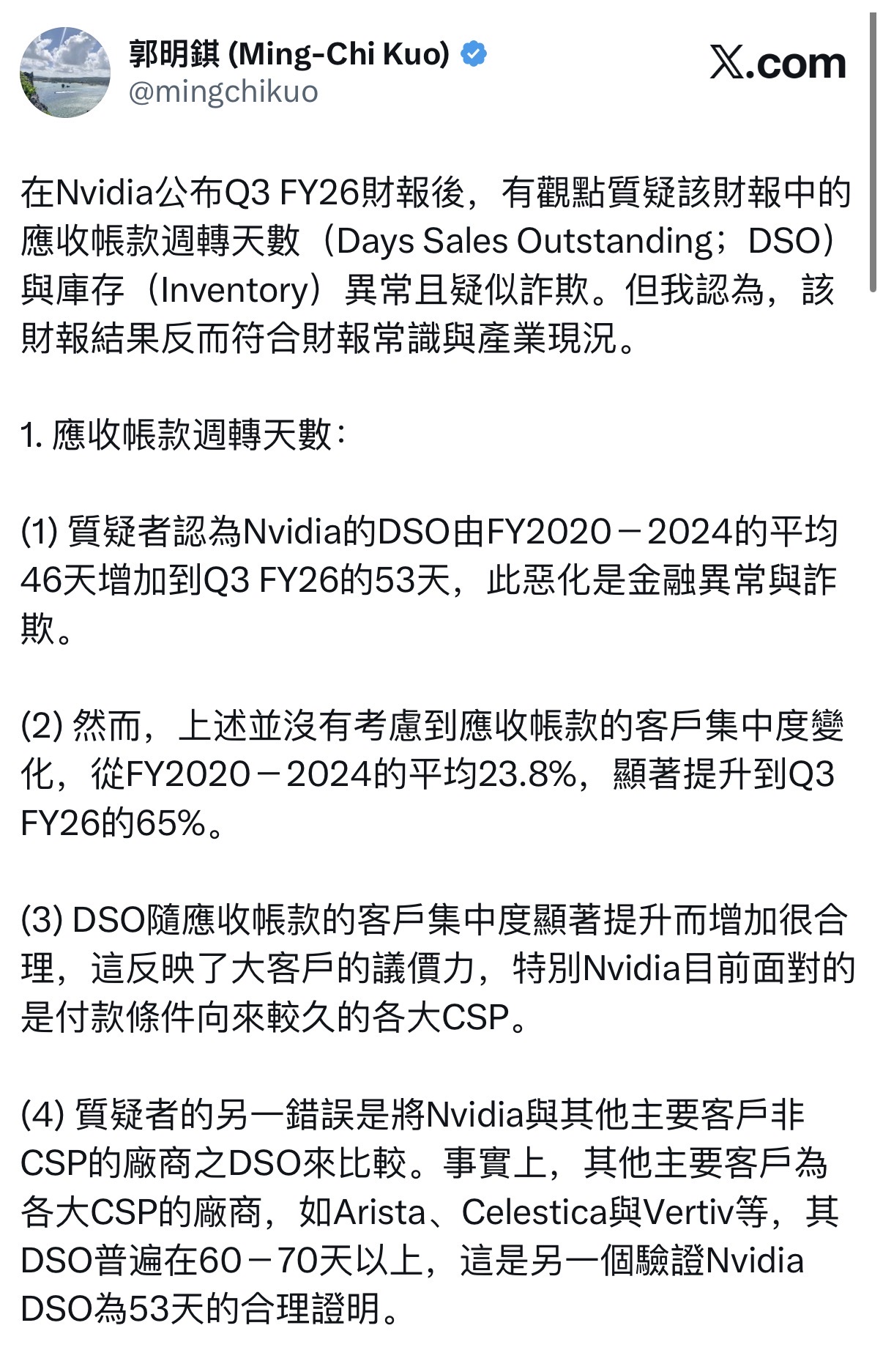
Core Viewpoint - Nvidia has become a focal point in discussions regarding the value of AI and related stocks due to a series of stock sell-offs and accounting fraud allegations, prompting the company to respond to market skepticism with a detailed memo addressing twelve key concerns raised by investors [1][2]. Group 1: Nvidia's Response to Investor Concerns - Nvidia's investor relations team sent a seven-page memo to Wall Street analysts addressing various doubts, including a response to Michael Burry's criticism regarding stock-based compensation dilution and stock buybacks, clarifying that the total amount spent on share repurchases since 2018 is $91 billion, not the $112.5 billion claimed by Burry [2]. - The memo also refuted allegations comparing Nvidia's situation to historical accounting fraud cases, asserting that the company's core business fundamentals are strong and its financial reporting is transparent, emphasizing that it does not use special purpose entities to hide debt or inflate profits [2]. - Nvidia addressed concerns about the economic value of its hardware, stating that customers set GPU depreciation periods based on actual usage, with older models like the A100 still generating significant profits, contrary to claims that their economic lifespan is only 2 to 3 years [2]. Group 2: Analyst Insights on Financial Metrics - Analyst Ming-Chi Kuo stated that Nvidia's financial results align with industry norms, countering claims of anomalies in accounts receivable turnover days (Days Sales Outstanding, DSO) and inventory levels [3]. - Kuo explained that the increase in DSO from an average of 46 days (2020-2024) to 53 days in Q3 2026 is reasonable due to a significant rise in customer concentration from 23.8% to 65%, reflecting the bargaining power of major customers [4]. - Regarding inventory, Kuo clarified that the reported 32% increase in inventory for Q3 2026 is consistent with industry trends and that the majority of the inventory consists of work-in-progress items, indicating preparations for strong demand for the new Blackwell B300 chip [6].

加沙停火再添变数!以军开火致三人死亡,特朗普方案陷僵局
Jin Shi Shu Ju· 2025-11-25 09:57
Core Viewpoint - The fragile ceasefire agreement between Hamas and Israel, praised globally six weeks ago, is facing significant challenges as recent violence has escalated tensions and highlighted the difficulties in expanding the agreement [2][3]. Group 1: Recent Violence - On Monday, the Israeli military killed three Palestinians near the Gaza border, with two deaths attributed to an Israeli drone strike and one from a tank shell [2]. - The Israeli military claimed the fire was in response to perceived threats from "terrorists" approaching the border [2]. - Since the ceasefire began on October 10, at least 342 Palestinians have reportedly died due to Israeli military actions, while three Israeli soldiers have been killed by armed groups during the same period [3]. Group 2: Ceasefire Agreement Details - The ceasefire agreement, signed on October 9, allowed Hamas to release 20 hostages in exchange for nearly 2000 Palestinian prisoners held by Israel, along with the return of 28 deceased hostages for 360 armed militants' remains [2]. - The agreement has only frozen the conflict without resolving the underlying issues, leaving the most contentious disputes for future negotiations [2]. Group 3: Diplomatic Efforts - Former UK Prime Minister Tony Blair met with Palestinian Authority official Hussein al-Sheikh to discuss developments following the UN Security Council's support for President Trump's peace plan [4][5]. - Discussions included the Palestinian demand for self-determination and the complexities surrounding the next phase of the ceasefire [5][6]. Group 4: Challenges Ahead - The path to the next phase of the ceasefire is complicated, with Hamas indicating that Israeli violations are undermining the agreement [6]. - There is significant uncertainty regarding the composition and mandate of international forces proposed to oversee the situation, with concerns that deploying troops without a political framework could exacerbate tensions [7].
普京“投其所好”?和平提案暗藏美俄商业大饼,只为“打窝”特朗普!
Jin Shi Shu Ju· 2025-11-25 08:59
AI播客:换个方式听新闻 下载mp3 音频由扣子空间生成 当外交官们正为俄乌冲突和平协议的核心条款争得不可开交时,草案中有一个细节却鲜有人注意:那就 是基于美俄商业关系未来可能"遍地开花"的设想而抛出的"甜头"。 这些提案主要由俄罗斯主权财富基金负责人德米特里耶夫(Kirill Dmitriev)与美国特使威特科夫 (Steve Witkoff)共同敲定,设想在两国间达成一项涵盖能源、稀土和数据中心的"长期经济合作协 议"。双方还计划设立一个用于联合项目的美俄投资基金,以此作为"不再重返冲突的强有力激励"。 这事儿还有另一种解读:这两位由商人转型为外交官的角色,正试图精心炮制一个让美国总统特朗普无 法拒绝的理由,好让他继续留在这个谈判局里。 将宏大的外交政策与商业机会捆绑在一起,已成为这位美国总统处理国际事务的一大特色。 在促成加沙停火之前,特朗普就曾勾勒过将该地区打造成"中东里维埃拉"度假胜地的蓝图。在他的第一 个任期内,在寻求与金正恩缓和关系时,他也曾高声畅想过朝鲜那"很棒的海滩"以及在那儿开发海景公 寓的潜力。 前中情局(CIA)中欧亚分部负责人Rob Dannenberg认为,和平提案中类似的论调背后 ...
鲍威尔坦言12月降息难定,手下官员立场持续割裂
Jin Shi Shu Ju· 2025-11-25 08:30
Core Viewpoint - The Federal Reserve's 2025 voting committee shows a split in opinions regarding interest rate cuts, with 5 members favoring gradual reductions and 6 advocating for caution due to concerns about inflation control. Group 1: Support for Rate Cuts (5 Votes) - New York Fed President Williams indicates that the Fed may consider a rate cut "soon" without jeopardizing inflation targets [2] - Fed Governor Waller believes a December rate cut is appropriate, but January's actions are more uncertain [2] - Fed Governor Milan expresses support for a small rate cut in December if his vote is decisive, having previously advocated for a 50 basis point cut in the last two meetings [2] - Fed Governors Bowman and Cook did not express a stance in November but lean towards a rate cut [2] Group 2: Caution Against Rate Cuts (6 Votes) - Fed Vice Chair Jefferson emphasizes the need for caution as rates approach neutral levels [3] - St. Louis Fed President Musalem notes limited room for easing and the need for careful action [3] - Kansas City Fed President Schmidt warns that further rate cuts could have lasting impacts on inflation, opposing cuts in the October meeting [3] - Boston Fed President Collins is skeptical about a December rate cut, asserting that current monetary policy is appropriate [3] - Chicago Fed President Goolsbee cautions against premature rate cuts, suggesting that while rates may decline, the current period must be navigated carefully [3] Group 3: Non-2025 Voting Members - San Francisco Fed President Daly supports a December rate cut, citing deteriorating labor market conditions [5] - Dallas Fed President Logan finds it difficult to support another December cut unless circumstances change [6] - Philadelphia Fed President Paulson advocates for a cautious approach to the December rate decision, stating that previous cuts have set higher thresholds for future reductions [6] - Cleveland Fed President Hamak emphasizes that rate cuts to support the labor market could lead to persistent inflation and encourages maintaining restrictive rates to curb inflation [6]
英国预算案倒计时:空头大军集结,英镑恐遭“至暗时刻”
Jin Shi Shu Ju· 2025-11-25 07:38
Core Viewpoint - Traders are betting heavily on a decline of the British pound against the US dollar ahead of the upcoming UK budget, with concerns that Chancellor Reeves' proposed tax increases may further weaken the already sluggish UK economic growth [1][2]. Group 1: Market Sentiment - The volume of put options for the pound has surged to over four times that of call options in the past week, indicating a strong bearish sentiment among traders [1]. - Nomura's G10 FX strategy head, Dominic Bunning, noted that the current wave of shorting the pound suggests that the market is prepared for severe outcomes for the currency [1]. - RBC BlueBay's Chief Investment Officer, Mark Dowding, expressed skepticism about Reeves' ability to present a plan that would positively impact UK growth and support the pound [1]. Group 2: Economic Indicators - Recent underperformance in UK economic growth, coupled with declining inflation, has led traders to increase bets on interest rate cuts, diminishing the currency's appeal [1]. - The pound is currently at its lowest level since April, around 1.30, and may face further declines if Reeves' tax and spending plans do not improve economic outlooks or investor confidence [1][2]. Group 3: Options Market Dynamics - The cost of put options expiring on the budget announcement day is significantly higher than that of call options, indicating that traders believe Reeves' tax plans are more likely to weaken the pound [2]. - The skew in options pricing is at its most pronounced level since January, reflecting traders' positioning against the pound's weakness [2]. Group 4: Fiscal Concerns - Concerns about the government's ability to raise funds without increasing income tax have led to skepticism regarding the fiscal measures that Reeves can implement, which may negatively impact the pound [2][3]. - Nomura's Bunning warned that without sufficient fiscal consolidation and signs of credibility, the pound could face significant selling pressure, potentially leading to a simultaneous decline in UK government bonds [3].
华尔街空头盯上哪些目标?高盛揭露AI浪潮下的做空暗线
Jin Shi Shu Ju· 2025-11-25 07:36
Core Insights - Current market sentiment in the US stock market is tense, with a notable increase in Oracle's credit default swap (CDS) trading volume, indicating signs of a potential bubble in the AI sector [1] - Goldman Sachs' latest hedge fund positioning report reveals that "smart money" is not yet ready to short AI giants but is starting to focus on weaker companies within the AI wave [1] Short Selling Trends - The median short interest for S&P 500 constituents is surprisingly high at 2.4%, placing it in the 99th percentile of the past five years and significantly above the long-term average since 1995 [1] - The Nasdaq 100 index shows a slightly higher short interest at 2.5%, while the Russell 2000 index has the highest short interest at 5.5% [1] - The utility sector has seen a notable increase in short interest, rising 0.3 percentage points to 3.2%, marking one of the highest levels historically [1][2] Utility Sector Dynamics - The surge in short interest in utility stocks is likely linked to the energy demands of data centers driving AI models, making previously "boring" utility stocks more attractive [2] - American Electric Power's stock has risen over 31% this year, with its market capitalization reaching $65 billion, and its short interest currently stands at 4%, up from the typical range of 1% to 2% over the past decade [2] Notable Shorted Stocks - Tesla remains the most shorted stock in the US, with JPMorgan making a notable entry into the top four most shorted stocks [2] - New entrants in the list of heavily shorted stocks include Oracle with $5.4 billion, Intel with $4.6 billion, and GE Vernova with $4.1 billion [2][3] Market Positioning - Goldman Sachs' hedge fund report reflects a snapshot of current market conditions, based on data from 982 hedge funds holding a total of $4 trillion in stock positions, with $2.6 trillion in long positions and $1.4 trillion in short positions [4] - Despite the recovery from recent market volatility, hedge funds remain cautious regarding AI giants, as bubbles can persist longer than the funds' ability to pay [4] - The increase in short selling in the utility sector and weaker AI stocks suggests that some funds are beginning to position themselves for potential short opportunities [4]