半导体芯闻

Search documents
村田掘金计算市场
半导体芯闻· 2025-09-22 10:36
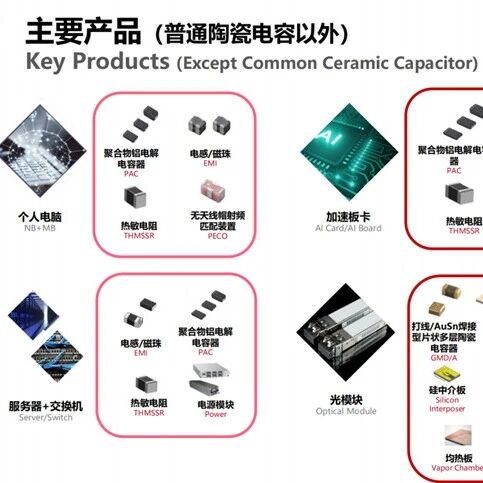
Core Viewpoint - Murata Manufacturing Co., Ltd. is leveraging its leadership in passive components, particularly MLCCs, to explore new markets and upgrade its products in response to the growing demand driven by artificial intelligence and cloud computing [2][4]. Group 1: Market Opportunities - The global optical module market is expected to grow at an annual rate of 30-35% from 2025 to 2026, driven by AI cluster construction [4]. - Murata's products, especially MLCCs, are anticipated to see significant usage increases in AI PCs, with a focus on maintaining and enhancing market share [4][5]. - The company is closely monitoring market demands and technological trends, particularly the impact of TLVR technology on its products [4][5]. Group 2: Product Innovations - Murata showcased a range of products at the optical communication exhibition, including high-density multilayer ceramic capacitors (MLCCs) with superior electrical characteristics and compact designs [8][11]. - The company introduced ultra-wideband silicon capacitor products capable of supporting bandwidths up to 220GHz, utilizing advanced 3D structures to enhance capacitance within a small footprint [11][12]. - Murata's silicon capacitors are designed for high reliability and performance, with a focus on customization to meet diverse customer needs [12]. Group 3: Power Solutions - The company has developed innovative power chip solutions to address the growing energy efficiency demands of data centers, featuring a two-stage architecture to reduce power loss and enhance system reliability [13]. - Murata's thermal resistors are compact and responsive, suitable for temperature detection and protection in optical modules and data centers, with applications in automotive electronics and medical devices [13]. Group 4: Strategic Vision - Murata emphasizes its commitment to innovation and strategic collaboration within the industry to drive optical communication technology advancements and industry upgrades [14].

AMD,慌吗?
半导体芯闻· 2025-09-19 10:38
Core Viewpoint - AMD faces challenges as Nvidia and Intel collaborate, potentially impacting its market position in both GPU and CPU sectors [2][3]. Group 1: Market Reactions - AMD's stock initially dropped by 5.9% due to the news of Nvidia and Intel's partnership but recovered to a decline of only 0.8% by the end of the trading day [2]. - Analysts express concerns that the collaboration between Nvidia and Intel could lead to a stronger competitive landscape for AMD, particularly in the AI-driven GPU market [2][3]. Group 2: Competitive Landscape - Jack Gold, a chief analyst, indicates that AMD is at risk of losing market share not only to Intel but also to emerging chip startups [2]. - AMD is noted to have a significant advantage in the AI sector due to Nvidia's limited delivery capabilities, which may drive customers to seek alternatives [3]. Group 3: Product Performance and Pricing - AMD chips are reported to offer robust performance at an average price lower than Nvidia's, making them an attractive alternative for customers [3]. - The collaboration between Nvidia and Intel aims to enhance the integration of their technologies, particularly through NVLink, which facilitates faster communication between GPUs and CPUs [4]. Group 4: Future Outlook - The chip market is expected to expand with the rise of AI inference and edge computing, where AMD may find opportunities despite Nvidia's current dominance [4]. - Intel's recent stock increase of 22.7% following its partnership with Nvidia suggests positive investor sentiment, although challenges remain in its manufacturing capabilities [5].



SiC,美国最新公布
半导体芯闻· 2025-09-19 10:38
Core Viewpoint - The establishment of the Multi-User Silicon Carbide (SiC) research manufacturing facility (MUSiC) by the University of Arkansas Power Group (UAPG) marks a significant advancement in the commercialization of SiC technology in the United States, aiming to bridge the gap between research and production [2][3][4]. Group 1: MUSiC Facility Overview - MUSiC is the first open SiC wafer fabrication facility in the U.S., focusing on research, prototyping, and large-scale commercialization of SiC technology [2]. - The facility aims to accelerate the commercialization process of SiC while advancing research on SiC and related materials [2]. - MUSiC offers various industry participation models, including standard multi-project wafers, semi-custom platforms, external R&D module integration, and fully customized builds [2]. Group 2: Strategic Importance - MUSiC provides unparalleled SiC R&D resources, acting as a bridge between R&D and mass production, which is crucial for maintaining U.S. competitiveness in the semiconductor sector [3][4]. - The facility supports the entire innovation process, from device design and manufacturing to prototyping and system-level testing [3]. - Innovations from UAPG include a SiC gate driver chip with integrated power modules, achieving a 35-fold increase in power density compared to existing solutions [3]. Group 3: Economic and Workforce Impact - MUSiC is expected to solidify Northwest Arkansas as an emerging semiconductor manufacturing hub, creating high-paying jobs in semiconductor manufacturing, design, packaging, and testing [5]. - The facility will also generate multiplier effects in construction, logistics, and supply industries, contributing to long-term economic benefits for the region and the nation [5]. - The initiative emphasizes the importance of developing a skilled workforce in semiconductor engineering, with programs aimed at engaging students early and preparing them for future technological advancements [4][5].

三星HBM3E,通过英伟达认证
半导体芯闻· 2025-09-19 10:38
如果您希望可以时常见面,欢迎标星收藏哦~ 来源:内容编译自chosun。 据报道,三星电子的12层HBM3E产品(第五代高带宽存储器,HBM)已通过NVIDIA的质量测 试。据半导体业界消息,三星电子近日通过了NVIDIA的12层HBM3E质量测试,并即将开始出 货。自去年2月成功研发该产品以来,约19个月过去了。尽管三星已向美国半导体设计公司AMD和 博通供应HBM3E,但该产品曾多次未能通过NVIDIA的质量测试。三星电子相关人士表示:"我们 正在按照客户NVIDIA的进度进行。" https://www.chosun.com/english/industry-en/2025/09/19/ZOTG73PV2BBY5K4C42QBJ7FLHM/ 点这里加关注,锁定更多原创内容 *免责声明:文章内容系作者个人观点,半导体芯闻转载仅为了传达一种不同的观点,不代表半导体芯闻对该 观点赞同或支持,如果有任何异议,欢迎联系我们。 推荐阅读 10万亿,投向半导体 芯片巨头,市值大跌 黄仁勋:HBM是个技术奇迹 Jim Keller:RISC-V一定会胜出 全球市值最高的10家芯片公司 喜欢我们的内容就点 "在看 " 分 ...
UWB,爆发前夜
半导体芯闻· 2025-09-19 10:38
Core Viewpoint - UWB technology is on the verge of significant growth, driven by advancements in consumer electronics and automotive applications, with companies like Qorvo positioning themselves as key players in this emerging market [2][5][9] Group 1: UWB Technology and Applications - UWB has been recognized for its precise positioning capabilities, achieving accuracy within ±6 centimeters for point-to-point measurements and 20 to 30 centimeters in real-world scenarios, comparable to GPS [5][6] - The technology's reliability and security are critical factors for its acceptance, with UWB meeting safety standards similar to NFC, which is used in high-security payment applications [5][6] - Qorvo's acquisition of Decawave has strengthened its position in the UWB market, allowing the company to leverage its existing technology to enhance UWB applications [6] Group 2: Market Dynamics and Competition - UWB faces competition from low-power Bluetooth, which is attempting to penetrate the RTLS market, but UWB offers superior centimeter-level precision compared to Bluetooth's meter-level accuracy [9] - The deployment of UWB technology has been made more cost-effective through advancements that allow accurate positioning with a single base station, reducing the complexity and expense of previous multi-base station setups [6][9] - Qorvo is actively collaborating with leading enterprise router suppliers to accelerate UWB base station deployment, further promoting the technology's adoption [6][9] Group 3: Product Innovations - Qorvo has introduced the QM35825, a low-power UWB system-on-chip (SoC) that integrates advanced positioning technologies, enhancing its product portfolio and catering to various industrial applications [8] - The QM35825 chip features a remarkable 104dBm link budget and incorporates AI and machine learning capabilities to improve measurement accuracy and stability [8] - Demonstrations at industry events showcased UWB applications, including a remote control system capable of high-speed data transmission, indicating UWB's potential in audio transmission markets [8]


寒武纪陈天石:不实
半导体芯闻· 2025-09-19 10:38
Core Viewpoint - The article discusses the significant growth in revenue and profit for the company, Cambrian, in the first half of 2025, highlighting a revenue of 2.881 billion yuan, a year-on-year increase of 4347%, and a net profit of 913 million yuan, compared to a loss of 609 million yuan in the same period last year [2][4]. Group 1: Financial Performance - Cambrian's revenue for the first half of 2025 reached 2.881 billion yuan, marking a staggering year-on-year growth of 4347% [2]. - The company achieved a net profit of 913 million yuan, a significant turnaround from a loss of 609 million yuan in the previous year [2]. - The stock price of Cambrian had seen a substantial increase over the past year and a half, peaking near 1600 yuan, with Goldman Sachs raising its target price to 2104 yuan [2][4]. Group 2: Market Strategy and Innovation - The company plans to focus on technological innovation in the field of artificial intelligence chips, particularly in developing a series of chips for large model tasks and building an advanced packaging technology platform [3][5]. - Cambrian aims to enhance its core competitiveness and expand market share by accelerating the deployment of its products in key industries such as telecommunications, finance, and the internet [4][6]. - The company has received approval for a nearly 4 billion yuan capital increase plan, which will be used to accelerate its layout in chip and software platforms for large models [4][5]. Group 3: Product Development and Ecosystem - Cambrian is working on optimizing its intelligent processor microarchitecture and instruction set to improve performance in various model training and inference scenarios [6][9]. - The company is establishing an open service capability for AI application development, providing resources for developers to facilitate the use of its products [7][9]. - Cambrian's products are designed to support mainstream open-source large models, including LLaMA and GPT series, indicating a strong alignment with current market demands [10].
外媒:黄仁勋填不了英特尔的坑
半导体芯闻· 2025-09-19 10:38
英特尔(Intel)获得了英伟达(Nvidia) 价值50亿美元的信任票。但这笔投资并不能转化为英特尔使 其芯片代工业务扭亏为盈所需的芯片产量。 如果您希望可以时常见面,欢迎标星收藏哦~ 来源:内容 编译自WSJ 。 点这里加关注,锁定更多原创内容 *免责声明:文章内容系作者个人观点,半导体芯闻转载仅为了传达一种不同的观点,不代表半导体芯闻对该 观点赞同或支持,如果有任何异议,欢迎联系我们。 推荐阅读 10万亿,投向半导体 芯片巨头,市值大跌 两家公司在周四下午的电话新闻发布会上明确表示,在开盘前宣布的一项合作专注于为数据中心和 笔记型电脑市场开发新产品。这些产品将把英伟达广受欢迎的GPU芯片与英特尔的CPU处理器相 结合,后者在伺服器和个人电脑(PC)细分市场的份额实际上一直在流失。 因此,这项合作对英特尔的产品业务来说是一次显著的胜利。英伟达首席执行官黄仁勋(Jensen Huang)在周四的电话会议上说:「我们将成为英特尔伺服器CPU的主要客户。」 但两家公司都特意回避就是否会在英特尔的芯片制造工厂实际生产这些产品发表评论。英伟达的大 部分芯片由台积电(TSMC)代工,黄仁勋在周四的电话会议上什至对这家 ...

刚刚,英飞凌卖了一个工厂
半导体芯闻· 2025-09-19 10:38
Core Insights - Infineon Technologies has finalized an agreement to transfer its backend manufacturing facility in Thailand to Malaysia Pacific Industries (MPI), along with a long-term supply agreement, enhancing collaboration on innovative packaging solutions [2][3] Group 1: Company Strategy - The transfer of the facility is part of Infineon's strategy to strengthen its presence in Thailand's growing semiconductor ecosystem, leveraging reliable suppliers and partners [3] - Infineon plans to launch a new advanced backend wafer fab in North Bangkok by January 2025, which will complement the partnership with MPI and optimize overall manufacturing layout [3][4] Group 2: Operational Impact - MPI will continue to develop its existing high-performance factory, which offers a wide range of standard packaging products for automotive, connectivity, and IoT solutions [3] - The new backend factory in North Bangkok is set to focus on frame power modules and wafer testing, with the first building expected to be operational by 2026 [4] Group 3: Long-term Value Creation - The acquisition is seen as a key step in MPI's strategic growth plan, aiming to enhance long-term value for all stakeholders involved [2][3] - Both companies express commitment to exploring synergies and developing solutions that will lead to mutually beneficial opportunities in the future [2][3]


晶圆厂,拿了巨额补助
半导体芯闻· 2025-09-19 10:38
州长格雷格·阿博特今天在德克萨斯州议会大厦与三星高管会面时宣布,德克萨斯州半导体创新基 金 (TSIF) 已向三星奥斯汀半导体有限责任公司(简称"三星")提供 2.5 亿美元的拨款,用于其位 于泰勒的半导体制造工厂。该项目总投资超过 47.3 亿美元。 "德克萨斯州是科技与创新的未来之乡,"州长阿博特表示。"三星在德克萨斯州投资约400亿美 元,助力巩固德克萨斯州作为半导体制造业领先州的地位,为德克萨斯州社区带来更多商业投资, 并为勤劳的德克萨斯州居民创造数千个高薪工作岗位。三星在泰勒半导体制造工厂投资47.3亿美 元,将为美国关键行业提供更稳定的国内芯片供应,并确保驱动下一代技术的最先进芯片在德克萨 斯州制造。" 三星将投资47.3亿美元,在泰勒半导体制造工厂开展一项新计划,这是其在岸化战略的一部分,旨 在向2纳米尖端逻辑芯片制造转型,为5G、人工智能 (AI) 和高性能计算等领域的下一代技术提供 支持。2021年11月,州长阿博特宣布三星将投资数十亿美元在泰勒工厂建设,这是德克萨斯州有 史以来最大的外国直接投资。 三星电子副董事长兼设备解决方案 (DS) 部门负责人杨铉俊表示:"过去 30 年来,三星一直 ...

三维存算一体3D-CIM,破解AI芯片产业困局!
半导体芯闻· 2025-09-18 10:42
Core Viewpoint - The AI industry is experiencing explosive growth in computing power demand, with a projected global smart computing power gap of 35% by 2025, highlighting the critical role of AI chips in the technology competition landscape [2][3]. Group 1: AI Chip Market Dynamics - The demand for AI computing power is driven by large model parameters expanding at a rate of 10 times per year, particularly in key applications like autonomous driving and smart healthcare [2]. - The domestic AI chip industry faces challenges such as technological bottlenecks, limitations of traditional architectures, and insufficient ecosystems, necessitating the development of a self-controlled AI chip ecosystem [2][3]. Group 2: RISC-V Architecture and Its Significance - The RISC-V architecture is emerging as a crucial breakthrough due to its open-source and scalable nature, enabling the construction of a self-controlled hardware and software ecosystem for domestic AI chips [2][3]. - The RISC-V computing architecture is being integrated into high-performance computing, enhancing inference efficiency and energy efficiency compared to traditional architectures [2][3]. Group 3: Industry Forum and Standardization - The RISC-V Storage-Compute Integration Industry Forum was held on September 9, 2025, marking a significant step in breaking traditional computing architecture bottlenecks and establishing a self-controlled AI chip ecosystem in China [3][5]. - The forum aimed to establish a standardized roadmap for "RISC-V + Storage-Compute Integration" technology to support domestic chips in addressing large model computing challenges [5]. Group 4: Technical Challenges and Solutions - The AI chip industry faces three major challenges: hardware bottlenecks, ecological barriers, and architectural limitations, with the need for innovative technologies to address the growing computing power demands [9][10]. - The report emphasizes the importance of a new architecture and an open-source self-controlled ecosystem to overcome these challenges, proposing a three-dimensional storage-compute integration (3D-CIM) approach [10][12]. Group 5: Innovations in Storage-Compute Integration - The 3D-CIM approach integrates SRAM storage and computing, significantly improving computing efficiency and energy density, with potential energy efficiency improvements of 5-10 times compared to traditional digital circuits [12][15]. - The architecture supports various data formats and is designed to meet the full range of AI model requirements, although it still faces challenges in computational completeness and software ecosystem development [13][14]. Group 6: Strategic Implications and Future Outlook - The 3D-CIM technology is expected to empower the AI industry across various applications, from edge AI models to cloud computing, and aims to provide a self-controlled chip solution for China's AI model industry [16][18]. - The integration of RISC-V architecture with storage-compute technology is seen as a pathway to overcome international technological restrictions and enhance domestic chip capabilities [17][18].