半导体芯闻

Search documents
中国企业停止购买英伟达相关芯片?外交部回应
半导体芯闻· 2025-09-18 10:40
Group 1 - The article discusses the recent news regarding Alibaba and ByteDance terminating orders for NVIDIA's RTX Pro 6000D chips, which has led to disappointment from NVIDIA's CEO Jensen Huang [2] - The Chinese Foreign Ministry spokesperson Lin Jian suggests that specific inquiries should be directed to the relevant Chinese authorities and emphasizes China's opposition to discriminatory practices in trade and technology against specific countries [2] - China expresses its willingness to maintain dialogue and cooperation with all parties to ensure the stability of global supply chains [2]



三星美国工厂,获巨额补贴
半导体芯闻· 2025-09-18 10:40
Core Viewpoint - The article discusses Samsung's significant investment in a semiconductor manufacturing facility in Taylor, Texas, highlighting the importance of this project for the U.S. semiconductor supply chain and job creation [2][3]. Group 1: Investment and Funding - Samsung has received a $2.5 billion grant from the Texas Semiconductor Innovation Fund for its manufacturing plant in Taylor, which is part of a larger $47.3 billion investment plan [2]. - The Texas CHIPS Act established the fund to enhance semiconductor research, design, and manufacturing within the state [2]. - The project is expected to create approximately 2,000 direct jobs and potentially thousands more in the manufacturing sector over the next five years [4]. Group 2: Project Timeline and Scale - The construction of the Taylor facility is set to begin by the end of 2026, with the initial production timeline having been updated from 2024 to 2025 [4]. - The facility will cover approximately 6 million square feet and is located on over 1,000 acres, with plans for up to 11 additional chip production facilities in the future [3][4]. Group 3: Strategic Importance - The Taylor plant has gained strategic significance due to a long-term chip manufacturing agreement with Tesla, valued at approximately $16.5 billion, for the production of next-generation AI chips [4][5]. - This expansion is viewed as crucial for enhancing the resilience of the U.S. supply chain and national security, particularly in the context of the upcoming AI manufacturing era [5].

SK海力士,被波及?
半导体芯闻· 2025-09-18 10:40
Core Viewpoint - China is tightening regulations on global semiconductor companies, particularly targeting Nvidia amid ongoing US-China trade tensions, with potential implications for South Korean firms as well [2][3]. Group 1: Nvidia's Situation - Nvidia is under investigation by China's State Administration for Market Regulation (SAMR) for alleged violations of antitrust laws related to its $6.9 billion acquisition of Mellanox, which was approved with conditions [2][3]. - The SAMR may impose fines ranging from 1% to 10% of Nvidia's previous year's revenue based on the investigation's findings [2]. Group 2: Impact on South Korean Companies - SK Hynix is also facing challenges, having received conditional approval for its acquisition of Intel's NAND business, which includes price controls and supply commitments to the Chinese market [3][4]. - The conditions imposed on SK Hynix's acquisition will remain in effect until at least December 2026 unless explicitly lifted by SAMR [3]. Group 3: Regulatory Environment - The SAMR has historically been the final gatekeeper for semiconductor mergers, often delaying approvals and imposing stringent conditions [4]. - Recent actions by the US government have further complicated the situation for South Korean companies, including the revocation of "validated end-user" status for their Chinese factories, impacting semiconductor equipment shipments [4].

先进封装技术,关键挑战!
半导体芯闻· 2025-09-18 10:40
Core Viewpoint - The article discusses the increasing complexity of materials in advanced semiconductor packaging and the challenges it poses for precision manufacturing, emphasizing the need for a holistic approach to material management and process optimization [26]. Group 1: Material Complexity and Integration Challenges - Advanced packaging now involves a variety of materials beyond silicon and copper, including polymers, adhesives, dielectrics, and advanced ceramics, each with unique thermal, mechanical, and electrical properties [2][3]. - The evolution of packaging stacks introduces heterogeneous integration challenges such as interface adhesion, chemical compatibility, and thermal management, which complicate precision manufacturing [8][9]. - Maintaining flatness and mechanical integrity during thermal cycling is a significant challenge for heterogeneous materials to work together effectively [4][8]. Group 2: Precision Manufacturing Requirements - Precision manufacturing requires a systematic approach that encompasses design, process, and materials science, as the interactions between different materials under stress and heat can lead to defects [3][6]. - The introduction of new materials necessitates verification of their properties and interactions with other components in the stack, complicating the precision requirements [6][10]. - As device thickness decreases, the challenges of integration become more severe, with surface effects dominating material behavior at the molecular scale [9][10]. Group 3: Metal Alternatives and Their Implications - Traditional materials like copper face limitations in advanced nodes, prompting the exploration of alternatives such as molybdenum, which can reduce contact resistance by 50% compared to conventional methods [12][13]. - The transition to alternative metals introduces new processing challenges, as each metal requires specific deposition and patterning techniques [13][14]. - The need for improved thermal management and resistance to electromigration is critical, with materials like cobalt and ruthenium showing promise but requiring different processing methods [12][13]. Group 4: Data Visibility and Yield Management - The complexity of material interactions necessitates improved data visibility across the supply chain to manage variability effectively [19][20]. - Fragmented data sharing between foundries and fabless companies complicates the management of material variability, leading to potential reliability issues [19][21]. - Yield management platforms aim to connect process data, defect data, and yield results to identify material-related variances that impact yield [20][21]. Group 5: Towards Material-Aware Precision Manufacturing - The integration of material complexity, predictive control, and yield visibility points towards a new paradigm of material-aware precision manufacturing [22][23]. - A multi-physics modeling approach is essential to address the interactions of materials across various process steps, ensuring compatibility and performance [23][24]. - Collaborative optimization across the ecosystem, including material suppliers, equipment vendors, and manufacturers, is crucial for achieving precision in advanced packaging [24][26].
华为披露芯片路线图,详情披露
半导体芯闻· 2025-09-18 10:40
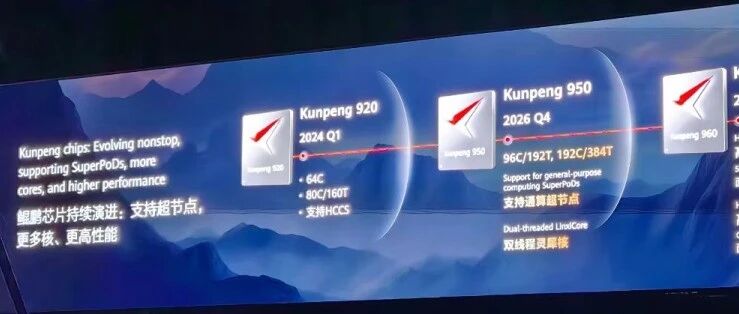
Core Viewpoint - Huawei is leading a new paradigm in AI infrastructure with its innovative supernode interconnection technology, emphasizing the importance of computing power in artificial intelligence development [2][8]. Summary by Sections Ascend Chip Development - Huawei has committed to the monetization of Ascend hardware and plans to open-source its CANN compiler and virtual instruction set interface by December 31, 2025 [2]. - The Ascend 950 series, including Ascend 950PR and Ascend 950DT, is set to significantly enhance computing power and efficiency compared to previous models [3][4]. - The Ascend 950 chip will support new data formats and achieve a computing power of 1 PFLOPS for FP8 and 2 PFLOPS for FP4, with interconnect bandwidth increased to 2 TB/s [5][6]. Upcoming Chip Releases - The Ascend 950PR chip is targeted for Q1 2026, focusing on inference prefill and recommendation scenarios, while the Ascend 950DT will be released in Q4 2026, emphasizing inference decode and training [6][7]. - The Ascend 960 chip, expected in Q4 2027, will double the specifications of the Ascend 950, enhancing performance for training and inference [7]. - The Ascend 970, planned for Q4 2028, aims to further upgrade performance metrics across various specifications [7]. Supernode Products - The Atlas 950 supernode, based on the Ascend 950DT, will support 8192 Ascend 950DT chips, achieving FP8 computing power of 8 EFLOPS and interconnect bandwidth of 16 PB/s, set to launch in Q4 2026 [9][10]. - The Atlas 960 supernode, launching in Q4 2027, will support 15488 cards, with FP8 computing power reaching 30 EFLOPS and interconnect bandwidth of 34 PB/s [11]. Interconnection Technology - Huawei has developed a new interconnection protocol, "Lingqu," to support large-scale supernodes, enhancing reliability and bandwidth while reducing latency [18][19]. - The Atlas 950 SuperCluster, consisting of 64 Atlas 950 supernodes, will achieve a total FP8 computing power of 524 EFLOPS, launching alongside the Atlas 950 supernode in Q4 2026 [20]. Future Directions - Huawei aims to continue evolving its supernode and cluster products to meet the growing demands for AI computing power, with a focus on both AI and general computing applications [12][21].
重磅官宣|第四届GMIF2025创新峰会议程正式发布!
半导体芯闻· 2025-09-18 10:40
Core Viewpoint - The article highlights the upcoming GMIF2025 Innovation Summit, focusing on the theme "AI Applications, Innovation Empowerment," which aims to explore the evolution of storage technology and industry opportunities driven by AI [5][17]. Group 1: Event Overview - The GMIF2025 Innovation Summit is organized by the Shenzhen Semiconductor Industry Association and Peking University's Integrated Circuit Institute, scheduled for September 25, 2025, at the Renaissance Shenzhen Bay Hotel [5][17]. - The summit will gather leading companies, technical experts, and industry leaders from the global storage supply chain to discuss advancements in storage technology influenced by AI [5][17]. Group 2: Key Topics and Speakers - The summit will feature various sessions, including topics such as "New Trends in China's Storage Market," "Hierarchical Storage and Computing Integration for Large Model Scenarios," and "Unlocking the Potential of Flash in the AI Age" [8][9][10]. - Notable speakers include representatives from major companies like Samsung, Sandisk, Intel, and MediaTek, who will share insights on storage technology, market strategies, and AI applications [17]. Group 3: Industry Participation - The event will showcase over 200 innovative products from more than 27 companies, covering the entire storage industry ecosystem, including storage manufacturers, control chip manufacturers, solution providers, and AI application vendors [17]. - The summit aims to facilitate immersive interactions and exchanges among attendees, allowing them to experience the latest industry trends and innovations [17].
Beyond-EUV,新方向!
半导体芯闻· 2025-09-18 10:40
Core Viewpoint - The article discusses advancements in lithography technology, particularly the development of "Beyond-EUV" (B-EUV) lithography, which utilizes a wavelength of 6.5nm to 6.7nm, potentially allowing for resolutions below 5nm, surpassing current EUV technology [2][3][18]. Summary by Sections Lithography Technology Evolution - The evolution of lithography has progressed from contact to projection methods, with current mainstream technology using extreme ultraviolet (EUV) light at a wavelength of 13.5nm [3][5]. - The need for higher resolution in lithography can be achieved by either increasing numerical aperture (NA) or shortening the wavelength [3]. Challenges of EUV and B-EUV - EUV technology faces challenges due to its high absorption rates by materials, necessitating advanced mirrors for effective light reflection [5][6]. - B-EUV technology is still in its infancy, with no industry-standard methods for generating the required 6.7nm wavelength radiation [6][19]. Innovations in Light Sources - Various companies are exploring new light sources for lithography, including the development of high-efficiency laser systems and compact, high-power sources [10][11][13]. - Inversion is working on Laser Wakefield Acceleration (LWFA) to create high-energy light sources, while xLight is developing free electron lasers (FEL) to enhance EUV power output significantly [13][16]. Breakthroughs in Photoresist Materials - Johns Hopkins University has made significant progress in photoresist materials, discovering that metals like zinc can effectively absorb B-EUV light and trigger chemical reactions for fine pattern etching [18][19]. - The development of a new technique called Chemical Liquid Deposition (CLD) allows for the creation of thin films that can be used in semiconductor manufacturing, highlighting the importance of matching materials with the appropriate wavelengths [19][20]. Future Prospects - The advancements in B-EUV technology and associated materials could lead to significant improvements in semiconductor manufacturing efficiency and cost reduction, although challenges remain before widespread adoption [20].


官宣:2025中国工博会全馆展位图发布!
半导体芯闻· 2025-09-17 10:24
Core Points - The 2025 China International Industry Fair (CIIF) is set to take place in 8 days, highlighting its significance in the industrial sector [1] - The exhibition will cover an area of 300,000 square meters, featuring 9 specialized exhibition zones and showcasing 3,000 high-quality exhibitors [2] Exhibition Details - The booth layout for the event has been updated as of September 15, 2025, with specific details to be confirmed on-site [3] - Attendees can register for the event by scanning a provided QR code [3] Industry Impact - The fair is expected to facilitate networking and collaboration among industry leaders, enhancing innovation and technological advancements within the sector [1][2]
全球DRAM出货量,增长16.6%
半导体芯闻· 2025-09-17 10:24
Core Insights - The global DRAM shipment volume reached 76.1EB in Q2, marking a 16.6% increase from Q1, the highest growth since Q2 2023 [2] - Total DRAM revenue for Q2 was $31.3 billion, up 17.2% quarter-over-quarter, with an average selling price (ASP) of $0.41 per Gigabit, reflecting a 0.6% increase [2] - The overall operating profit margin for the DRAM industry improved by 1 percentage point to 38% [2] Company Performance - SK Hynix led the HBM market with Q2 revenue of $12.2 billion and operating profit of $6.8 billion, solidifying its dominant position [3] - Samsung Electronics reported Q2 revenue of $10.1 billion, while Micron Technology generated $7.0 billion in revenue [3] - Chinese company CXMT and Taiwan's Nanya Technology followed with revenues of $1.3 billion and $0.3 billion, respectively [3] Market Trends - The demand for HBM is expected to continue growing due to the increasing need for AI servers, intensifying competition in the HBM4 market in the second half of the year [3] - SK Hynix has advanced the market to HBM3 and HBM3E, while Samsung and Micron have entered the HBM market, establishing a competitive landscape [3]


COWOS,被看好
半导体芯闻· 2025-09-17 10:24
Core Viewpoint - Morgan Stanley's recent report indicates that Oracle's orders exceeded expectations, positively impacting the overall AI semiconductor market sentiment, leading to an "overweight" rating for TSMC and an increased target price for King Yuan Electronics to 188 TWD [2] Group 1: Oracle and AI Semiconductor Market - Oracle's financial performance serves as a catalyst for NVIDIA and the AI supply chain, with expectations of 28,000 NVL 72 server cabinet orders by 2026 [2] - Broadcom has secured a $10 billion customized AI chip order from a fourth cloud customer, likely OpenAI, although Morgan Stanley analysts suggest this figure may represent cabinet value rather than guaranteed revenue [2] Group 2: TSMC and CoWoS Supply Chain - TSMC's COO mentioned that semiconductor technology has entered the "Moore's Law 2.0" era, emphasizing system integration over mere chip miniaturization [2] - TSMC's CoWoS capacity is projected to reach 93 kpwm by 2026, with OpenAI accounting for a small portion of approximately 10,000 units [3] Group 3: NVIDIA and Other Collaborations - NVIDIA's Rubin GPU chip is expected to begin mass production in Q2 2026, according to supply chain surveys [3] - Google, in collaboration with Broadcom, is increasing the production forecast for its 3nm TPU v7 to 300,000 units by 2026, while the 3nm TPU v8's output forecast has been revised down to 200,000-300,000 units due to delays [3][4] Group 4: King Yuan Electronics - With the anticipated ramp-up of TSMC's CoWoS TPU, Morgan Stanley expects an upward revision in King Yuan Electronics' 2026 TPU testing volume, raising its target price from 158 TWD to 188 TWD [5]