BTR NEW MATERIAL GROUP CO.(835185)

Search documents
中国宝安携贝特瑞入局杉杉集团重整
Nan Fang Du Shi Bao· 2025-12-14 23:09
Core Viewpoint - The restructuring of Shanshan Group has attracted significant players, including China Baoan, which aims to lead a consortium for the substantial merger and restructuring of Shanshan Group and its subsidiary Ningbo Pengze Trading Co., Ltd [2] Group 1: Restructuring Background - Shanshan Group has faced a debt crisis and control disputes following the sudden death of its founder Zheng Yonggang in February 2023, leading to management instability and a significant decline in operational performance [3] - In 2024, Shanshan Co., Ltd. reported its first annual loss since listing, with a net loss of 367 million yuan, a year-on-year decline of 147.97%, and total liabilities reaching 23.673 billion yuan, with a short-term debt gap of 5.355 billion yuan [3] - The ongoing debt pressure triggered judicial restructuring procedures, with the Ningbo Intermediate People's Court accepting the bankruptcy restructuring case on February 25, 2025 [3] Group 2: Initial Restructuring Efforts - The first round of restructuring nearly succeeded when a consortium signed an investment agreement to acquire 23.36% control of Shanshan Co. for 3.284 billion yuan, but it ultimately failed due to the rejection of the plan by creditor groups [4][5] - A key factor in the failure was a lawsuit from a former intended investor, which disrupted the restructuring process [4] Group 3: New Round of Restructuring - Following the failure of the first round, a new round of investor recruitment was initiated on November 7, with a focus on investors with backgrounds in polarizers and/or anode materials [5][6] - The investment proposals include acquiring 100% equity of the debtor or forming a consortium with specific investment conditions [6] - Notable participants in the new round include Fangda Carbon and Hunan Salt Industry Group, with China Baoan completing preliminary preparations and submitting required materials [6] Group 4: Strategic Advantages and Market Implications - China Baoan and its subsidiary Bettery have a strong synergy in the lithium battery anode materials sector, with Bettery being the global leader in anode material shipments for 15 consecutive years [6] - The potential collaboration between the "global anode leader" and "artificial graphite leader" could enhance cost competitiveness and market positioning [7] - The restructuring has evolved into a battle for industry consolidation in the new energy materials sector, with significant implications for the future of the lithium battery materials industry [7]


中国宝安入局杉杉集团重整
21世纪经济报道· 2025-12-14 12:45
Core Viewpoint - The restructuring case of Shanshan Group has attracted significant attention, with China Baoan leading a consortium to participate in the substantial merger and restructuring of Shanshan Group and its wholly-owned subsidiary, Ningbo Pengze Trading Co., Ltd [1] Group 1: Company Involvement and Financial Performance - China Baoan has submitted application materials and paid a due diligence deposit of 50 million yuan to participate in the restructuring process [1] - For the first three quarters of 2025, China Baoan reported revenue of 16.812 billion yuan, a year-on-year increase of 14.87%, while its net profit attributable to shareholders decreased by 26.51% to 283 million yuan [1] - During the same period, Beiterui achieved revenue of 12.384 billion yuan, up 20.60% year-on-year, with a net profit of 768 million yuan, reflecting a 14.37% increase [1] Group 2: Market Dynamics and Competitive Landscape - Beiterui and Shanshan Co., Ltd. are the top two companies in global anode material shipments, indicating a highly competitive market [3] - The potential acquisition of Shanshan Group could trigger antitrust reviews due to the combined revenue exceeding 12 billion yuan, which may affect the restructuring process [3] - The restructuring process has seen various companies, including Fangda Carbon and Hunan Salt Industry Group, express interest in participating, indicating a new round of capital competition in the industry [6]
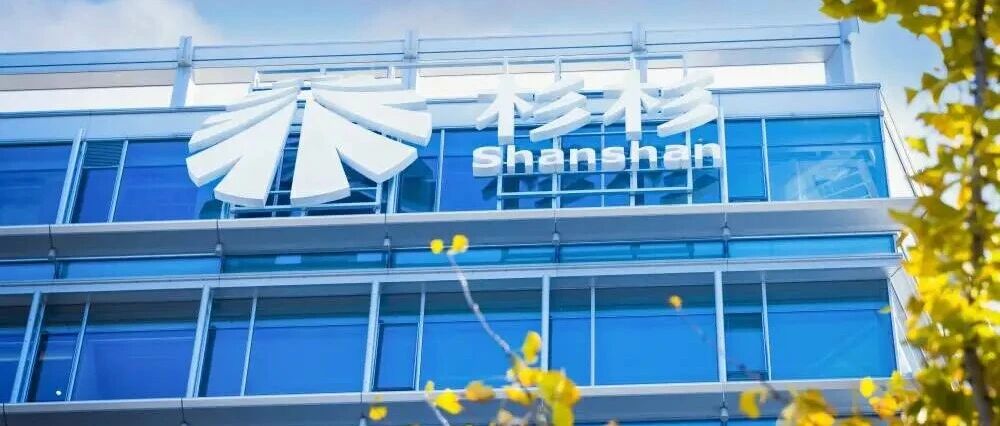
中国宝安携贝特瑞入局杉杉集团重整,负极材料行业或迎整合
Sou Hu Cai Jing· 2025-12-13 13:56
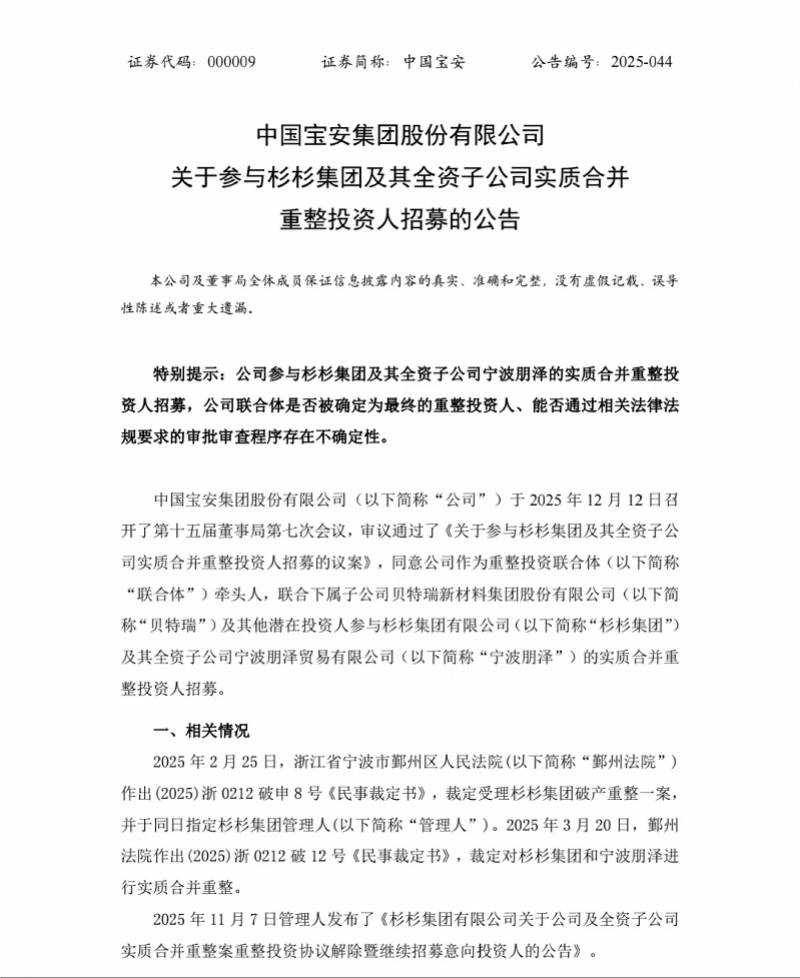
杉杉集团实质合并重整的资本棋局再添重量级玩家。12月12日晚间,中国宝安(000009.SZ)发布公告称,公司已 通过董事会决议,将作为重整投资联合体牵头人,联合旗下子公司贝特瑞(920185.BJ)及其他潜在投资人,参与 杉杉集团有限公司(下称"杉杉集团")及其全资子公司宁波朋泽贸易有限公司(下称"宁波朋泽")的实质合并重 整投资人招募。 回溯杉杉集团的重整之路,其背后是一场由债务危机、控制权纷争交织而成的困局。2023年2月,杉杉系创始人郑 永刚突发心脏病离世,随即引发了其子郑驹与继母周婷之间的控制权之争,这场内斗直接导致公司管理层频繁更 迭,经营稳定性遭受重创。 2024年,杉杉股份(600884.SH)迎来上市以来的首次年度亏损,归母净亏损达3.67亿元,同比大幅下滑 147.97%;截至2024年末,杉杉股份总负债攀升至236.73亿元,有息负债占比达67.29%,短债缺口高达53.55亿 元,资金链危机全面爆发。 债务压力的持续发酵最终触发了司法重整程序。2025年2月25日,浙江省宁波市鄞州区人民法院裁定受理杉杉集团 破产重整一案;3月20日,法院进一步裁定对杉杉集团与宁波朋泽进行实质合并重整, ...
中国宝安&贝特瑞报名参与杉杉公司重组!已缴纳5000万元尽职调查保证金!
起点锂电· 2025-12-13 11:08
Core Viewpoint - The article discusses the ongoing competition among various companies to acquire control of the Shanshan Group, particularly in the context of its restructuring process, highlighting the strategic interests of different players in the lithium battery supply chain [4][20]. Group 1: Participants in the Restructuring - China Baoan and Bettery have announced their intention to participate in the restructuring of Shanshan Group, with China Baoan submitting a guarantee deposit of 50 million yuan and initiating due diligence [6]. - Hunan Salt Industry Group has also registered as an interested investor, completing a 50 million yuan guarantee deposit [7]. - Fangda Carbon has expressed its interest in the restructuring, with market speculation suggesting a strategic move into negative electrode materials, leading to a significant increase in its stock price [10]. Group 2: Strategic Intentions - Hunan Salt Industry Group aims to integrate capital with its industrial operations to enhance its presence in the new energy materials sector, leveraging its extensive salt resources [9][15]. - Fangda Carbon's participation is seen as a way to stabilize its supply chain in the negative electrode industry, although it faces financial challenges, including high debt levels [17][18]. - The consortium formed by Xinyangzi Trading, TCL Industrial Investment, and Dongfang Asset Management plans to acquire a 23.36% stake in Shanshan but faced legal challenges that have complicated their restructuring efforts [11]. Group 3: Competitive Analysis - Bettery and Shanshan are leading players in the global negative electrode materials market, with Bettery reporting a revenue of 7.838 billion yuan and a net profit of 479 million yuan in the first half of 2025, indicating strong growth [13]. - Hunan Salt Industry Group's acquisition of Shanshan is viewed as a critical step in its strategic transformation, aiming to create a dual-driven growth model by integrating salt and new energy sectors [16]. - Fangda Carbon's business model focuses on carbon-based products, and its success in acquiring Shanshan would depend on overcoming significant operational and financial hurdles [18].

贝特瑞:拟参与杉杉集团及其全资子公司实质合并重整投资人招募
Zhong Zheng Wang· 2025-12-13 08:38
Group 1 - The core point of the article is that Betterray's major shareholder, Baoan Group, plans to lead a restructuring investment consortium to participate in the substantial merger and restructuring of Shanshan Group and its wholly-owned subsidiary, Ningbo Pengze [1] - Betterray has been focusing on the research, innovation, and industrial application of lithium-ion battery anode materials, cathode materials, and advanced new materials for many years [1] - The company has developed a product matrix that includes natural graphite anodes, artificial graphite anodes, silicon-based anodes, and ternary cathodes, covering three core areas: power batteries, energy storage batteries, and consumer batteries [1]
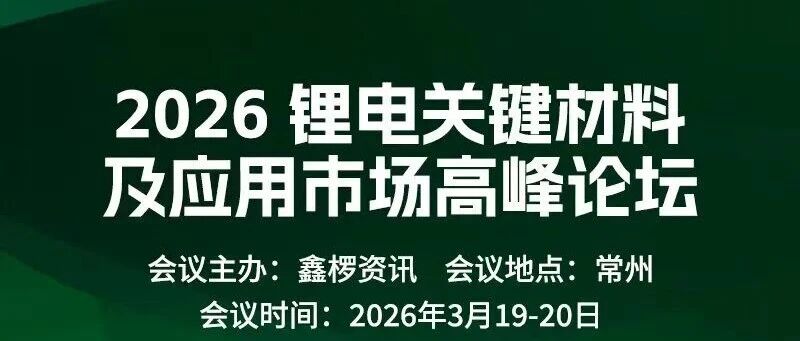
3月19-20日常州!2026锂电关键材料及应用市场高峰论坛
鑫椤锂电· 2025-12-10 08:06
Core Viewpoint - The lithium battery industry is poised for a significant growth cycle starting in 2026, characterized by strong demand recovery, accelerated global expansion, and disruptive technological advancements, leading to a "spiral rise" in both volume and price [3]. Group 1: Market Outlook - By 2025, global lithium battery production is expected to reach 2250 GWh, with a growth rate of 30% in 2026, and the energy storage sector projected to grow by 48.3%, driven by both domestic and international demand [5]. - There is a notable supply gap in the production of battery cells and key materials, making supply chain stability and efficiency crucial for capitalizing on this growth opportunity [5]. Group 2: Conference Details - The 2026 Lithium Battery Key Materials and Applications Market Summit will be held on March 19-20, 2026, in Changzhou, Jiangsu, organized by Xinluo Information [4]. - The summit will focus on three core topics: in-depth discussions on cutting-edge technologies and market supply-demand dynamics, the release of the authoritative 2025 lithium battery brand rankings, and B2B procurement matchmaking [5][6][7]. Group 3: Key Topics and Participants - The main forum will cover lithium carbonate fundamentals and supply-demand outlook, advancements in solid-state battery electrolytes, and high-performance electrolyte research [9]. - Notable participants include Tianqi Lithium Corporation, Liyang Zhongke Solid Energy New Technology Co., and various leading battery manufacturers and material suppliers [9][10]. Group 4: Participation and Sponsorship - The participation fee is set at 2800 yuan per person, with limited free attendance available for the first 200 registrants [16]. - Sponsorship opportunities are available for companies interested in participating in the event [16].





3月19-20日常州!2026锂电关键材料及应用市场高峰论坛
鑫椤锂电· 2025-12-08 08:06
Core Viewpoint - The lithium battery industry is poised for a significant growth cycle starting in 2026, characterized by strong demand recovery, accelerated global expansion, and disruptive technological advancements, leading to a "spiral rise" in both volume and price [3]. Group 1: Market Outlook - Global lithium battery production is projected to reach 2250 GWh by 2025, with a growth rate of 30% in 2026, and the energy storage sector expected to grow at an impressive rate of 48.3% [5]. - The demand surge will create substantial pressure on the supply of battery cells and upstream materials, highlighting the need for a stable and efficient supply chain to capitalize on this growth opportunity [5]. Group 2: Conference Details - The 2026 Lithium Battery Key Materials and Applications Market Summit will be held on March 19-20, 2026, in Changzhou, Jiangsu, organized by Xinluo Information [4]. - The summit will focus on three core topics: in-depth discussions on cutting-edge technologies and market supply-demand dynamics, the release of the authoritative 2025 lithium battery brand rankings, and B2B procurement matchmaking [5][6][7]. Group 3: Key Topics and Participants - The main forum will cover topics such as lithium carbonate fundamentals and supply-demand outlook, advancements in solid-state battery key electrolyte materials, and high-performance in-situ polymerized electrolytes [9]. - Notable participants include Tianqi Lithium Corporation, Liyang Zhongke Solid Energy New Technology Co., and various leading battery manufacturers and material suppliers [9][10]. Group 4: Participation and Sponsorship - The participation fee for the conference is set at 2800 yuan per person, with a limited-time free attendance option available for the first 200 registrants [16]. - Sponsorship opportunities are available for companies interested in promoting their brand at the event [16].


3月19-20日常州!2026锂电关键材料及应用市场高峰论坛
鑫椤锂电· 2025-12-08 01:15
Core Viewpoint - The lithium battery industry is poised for a significant growth cycle starting in 2026, characterized by strong demand recovery, accelerated global expansion, and disruptive technological advancements, leading to a "dual increase in volume and price + technological leap" pattern [3]. Group 1: Market Outlook - By 2025, global lithium battery production is expected to reach 2250 GWh, with a growth rate of 30% in 2026, and the energy storage sector projected to grow at 48.3%, driven by both domestic and international demand [5]. - There is a notable supply gap in battery cells and various materials, necessitating a stable and efficient supply chain to capitalize on this growth opportunity [5]. Group 2: Conference Details - The 2026 Lithium Battery Key Materials and Applications Market Summit will be held on March 19-20, 2026, in Changzhou, Jiangsu, organized by Xinluo Information [4]. - The summit will focus on three core topics: in-depth discussions on cutting-edge technologies and market supply-demand dynamics, the release of the authoritative 2025 lithium battery brand rankings, and B2B procurement matchmaking [5][6][7]. Group 3: Key Topics and Participants - The main forum will cover lithium carbonate fundamentals and supply-demand outlook, advancements in solid-state battery key electrolyte materials, and high-performance in-situ polymer electrolytes [9]. - Notable participants include Tianqi Lithium Corporation, Liyang Zhongke Solid Energy New Technology Co., and various leading battery manufacturers and material suppliers [9][10]. Group 4: Participation and Sponsorship - The participation fee is set at 2800 yuan per person, with limited free attendance available for the first 200 registrants [16]. - Sponsorship opportunities are available for companies interested in participating in the event [16].
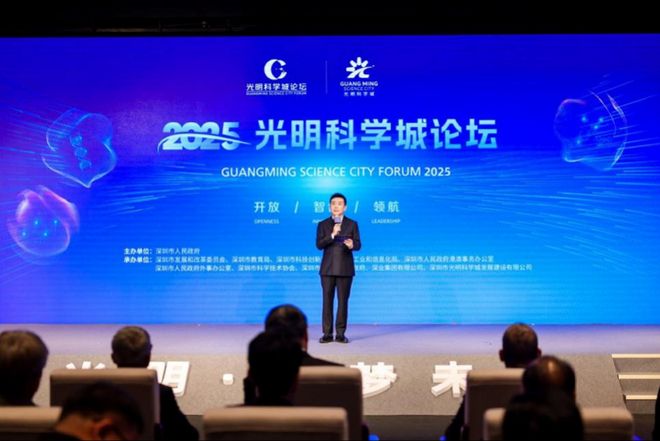
七年蝶变,从光明科学城看深圳科创的厚积薄发
Nan Fang Du Shi Bao· 2025-12-05 15:53
Core Insights - China's innovative drugs, new energy vehicles, and AI electronic products have emerged as the new three major export items, with innovative drug licensing output reaching $93.7 billion in the first three quarters of 2025, accounting for nearly 40% of the global total, reflecting the strong momentum of China's high-quality development [1][24]. Group 1: Major Technological Achievements - The launch of the National Bio-Manufacturing Industry Innovation Center, led by the Shenzhen Institute of Advanced Technology, marks China's only national-level innovation platform in the bio-manufacturing sector, focusing on green low-carbon, bio-agriculture, and medical health [3]. - The completion of the second phase of the Seventh Affiliated Hospital of Sun Yat-sen University in Shenzhen, a modern hospital designed with a patient-centered approach, aims to enhance healthcare innovation in the region [5]. - The Shenzhen Science and Technology Innovation Fund officially commenced operations, aiming to support original innovation and technology breakthroughs through early-stage investments [7]. Group 2: Infrastructure and Collaboration - The establishment of user committees for major scientific infrastructures like synthetic biology research facilities and brain analysis facilities will ensure efficient operation and high-level research output [9]. - The unveiling of the Regional Technology Transfer and Transformation Center for Higher Education Institutions in the Guangdong-Hong Kong-Macao Greater Bay Area will accelerate the conversion of academic research into practical applications [11]. - The emphasis on open collaboration has led to the formation of a global innovation network, enhancing regional cooperation and attracting international research institutions to participate in the development of the Guangming Science City [12]. Group 3: Talent and Innovation Ecosystem - Over the past seven years, Guangming Science City has attracted more than 3,100 high-level talents, including 59 academicians, forming a robust talent pool that supports innovation in fields like brain science and artificial intelligence [24]. - The establishment of a comprehensive open-sharing mechanism for major scientific infrastructures has allowed over 200 users, including universities and research institutions, to access advanced research facilities [25]. - The rise of industrial innovation has led to the development of several billion-dollar industry clusters, including high-end medical devices and synthetic biology, fostering a deep integration of technological and industrial innovation [26].


邀请函丨2025(第十届)起点锂电行业年会暨锂电金鼎奖颁奖典礼&起点研究十周年庆典12月18-19日,深圳举办!
起点锂电· 2025-12-03 10:13
Core Viewpoint - The 2025 (10th) Qidian Lithium Battery Industry Annual Conference and the Lithium Battery Golden Ding Award Ceremony will focus on the theme "New Cycle, New Technology, New Ecology," discussing the evolution of the lithium battery industry over the past decade and its future development [2]. Event Background and Significance - The Qidian Lithium Battery Industry Annual Conference is a significant annual event that has been held for nine consecutive years, attracting over 1,000 participants each year from the entire lithium battery supply chain [2]. - The 2025 event marks the 10th anniversary of the conference and the Qidian Research Institute, aiming to provide a platform for industry exchange and collaboration [2]. Event Details - Event Name: 2025 (10th) Qidian Lithium Battery Industry Annual Conference and the Lithium Battery Golden Ding Award Ceremony - Event Date: December 18-19, 2025 - Location: Venus Royal Hotel, Shenzhen - Scale: Over 1,200 offline participants and 30,000 online viewers [2][4]. Highlights of the Event - The conference will feature over 1,200 guests discussing industry development, nine specialized forums, and more than 60 prominent speakers addressing core issues [4]. - The 10th Lithium Battery Golden Ding Award will be held concurrently, recognizing outstanding contributions to the lithium battery industry [4][7]. - The event will also include the 2025 China New Energy Entrepreneurs Club Council meeting, facilitating direct connections among industry leaders [4]. Specialized Forums and Topics - The agenda includes specialized sessions on various topics such as high-energy density technologies, battery materials, and safety challenges in the lithium battery sector [5][6]. - Notable discussions will cover advancements in soft-pack batteries, solid-state battery technology, and the future of energy storage solutions [5][6]. Award Information - The Golden Ding Award aims to encourage innovation in the lithium battery industry and recognize brands that contribute significantly to its development [7]. - The application period for the awards is from September 1, 2025, to November 25, 2025, with the final winners announced between December 1 and December 10, 2025 [8][9]. Participation and Registration - Registration for the event is priced at 2,888 yuan per person, which includes access to the conference, meals, and industry white papers [10].