TINGYI(00322)

Search documents
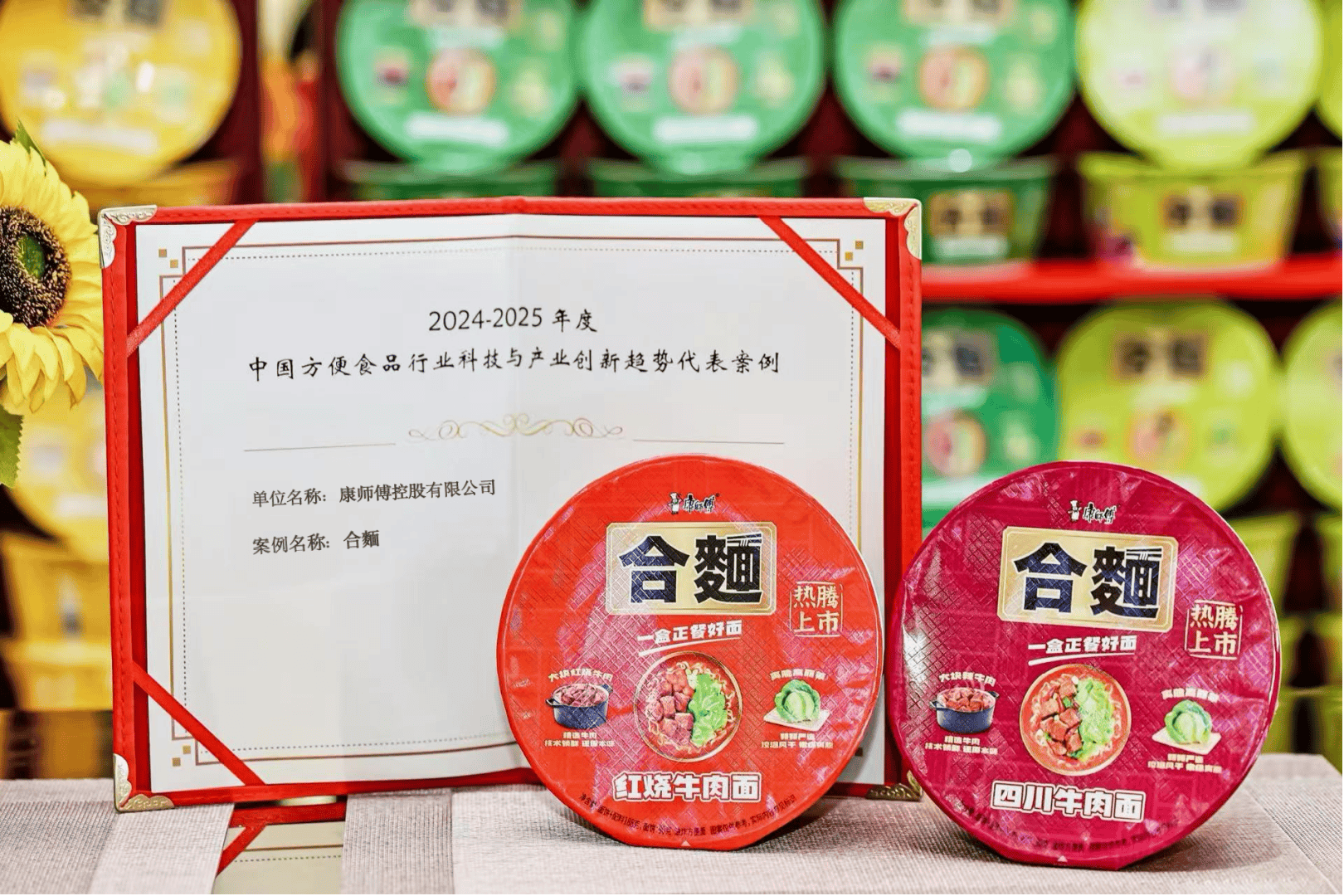
康师傅合麵:把“正餐体验”装进方便速食
Zhong Guo Shi Pin Wang· 2025-09-05 10:17
Core Insights - The convenience food industry is facing challenges from the rise of delivery services, prompting companies to innovate and adapt their products to meet consumer demands [1][5] - Master Kong has introduced a new product called "He Mian," which utilizes RP fresh-lock technology to enhance the taste and quality of instant noodles, positioning it as a meal alternative [1][10] - The company has successfully launched over 30 new flavors since 2025, demonstrating its ability to meet diverse consumer needs and maintain a competitive edge in the market [3][18] Product Innovation - "He Mian" is designed to provide a complete meal experience with a combination of wide noodles, large chunks of meat, fresh vegetables, and a rich broth, all ready in just four minutes [8][9] - The product addresses the needs of young professionals who seek quick yet high-quality meal options during busy workdays [9][10] - The use of advanced technologies, such as aerospace temperature control and RP fresh-lock, enhances the product's quality and consumer perception, breaking the stereotype that instant food is inferior [15][17] Market Positioning - Master Kong's strategy focuses on identifying and addressing unmet consumer needs, transforming potential demands into actual consumption [10][18] - The company has established a comprehensive pricing strategy, offering products ranging from 3 to 20 yuan to cater to various consumer segments [10] - By leveraging technology and innovation, Master Kong aims to shift the industry focus from price competition to quality and efficiency [17] Industry Trends - The convenience food sector is experiencing a shift towards innovation and quality improvement, as highlighted by industry analysts [5][14] - Master Kong's approach to product development emphasizes the importance of understanding consumer trends and preferences, allowing it to stay ahead of competitors [18] - The company's commitment to food safety and quality has positioned it as a leader in the industry, setting higher standards for competitors [14][15]

康师傅方便面坐稳10元正餐
Zhong Guo Shi Pin Wang· 2025-09-05 04:41
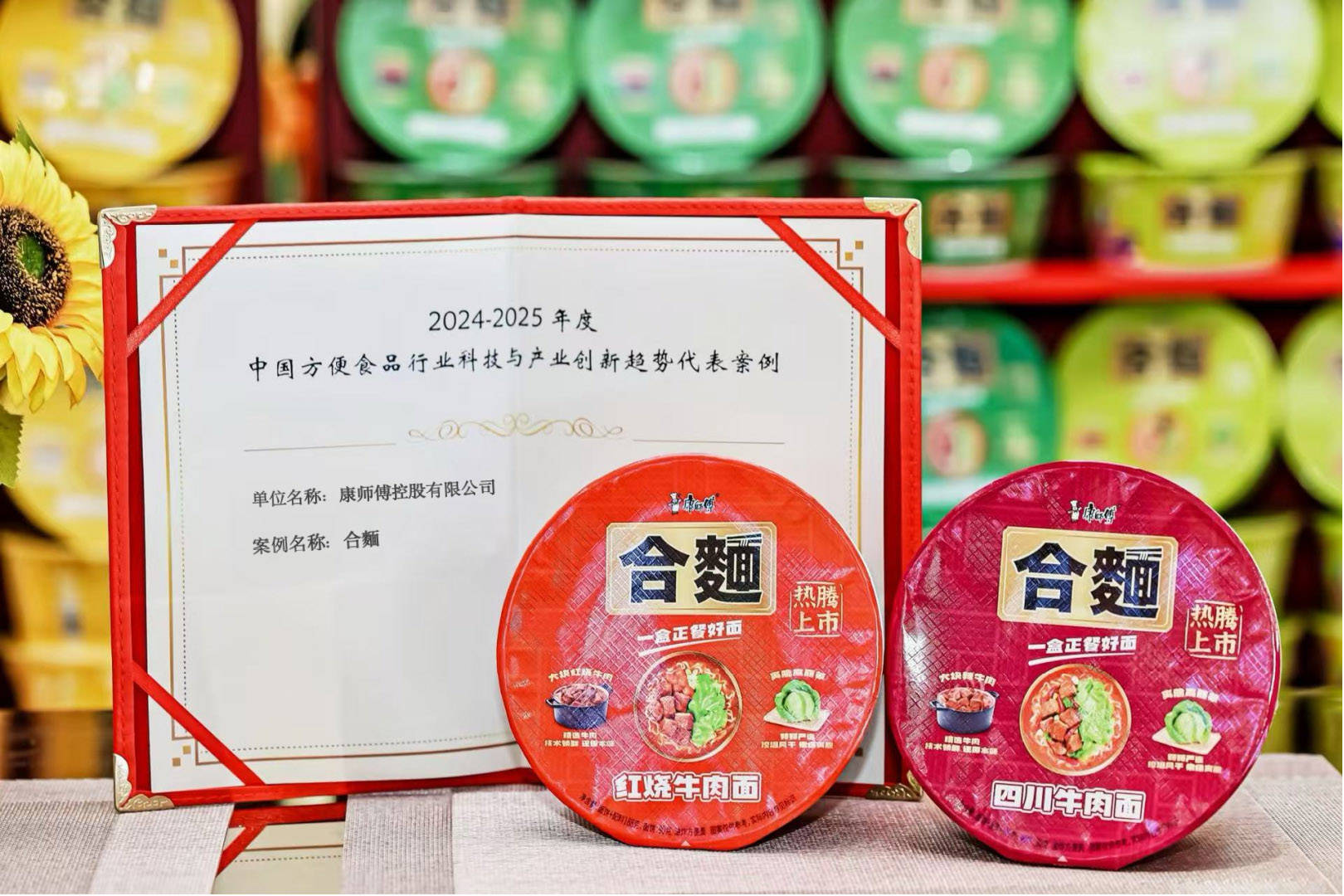
Core Insights - The 25th Convenience Food Industry Summit highlighted the latest advancements in the convenience food sector, focusing on technological innovation, smart manufacturing, and consumer experience upgrades, emphasizing the industry's shift towards "new" growth strategies [1][3] - The convenience noodle industry is expected to maintain a stable consumption volume from 2024 to 2025, transitioning from price competition to technology-driven development, with increased R&D investments across various aspects [3][5] Group 1: Product Innovation - The "He Mian" product by Master Kong, recognized for its "RP Lock Fresh" technology, addresses taste and flavor issues in the convenience food sector, marking a significant innovation in the industry [1][5] - Master Kong has launched over 30 new flavors this year, with price ranges from 3 to 20 yuan, reflecting a strategic focus on consumer demand and technological advancements [7][10] - The "He Mian" product aims to meet consumer expectations for a balanced meal, featuring high-quality ingredients and innovative packaging that enhances the dining experience [5][12] Group 2: Market Positioning - Master Kong is strategically positioning "He Mian" in the 10 yuan meal segment, balancing convenience and quality to cater to rational consumer spending behaviors [3][5] - The company is also exploring customized products for specific channels, such as Sam's Club and Costco, to attract middle-class consumers with premium offerings [10][12] Group 3: Quality and Safety Standards - Master Kong has established a "space-grade quality management system" with over 500 million yuan invested, ensuring traceability and safety from farm to table [17][18] - The company has become the first in the industry to receive AIB certification, reflecting its commitment to high food safety standards and operational excellence [13][18] - The emphasis on digitalization and transparency in product information aims to enhance consumer trust and safety in the convenience food sector [17][18]
康师傅合麵:正餐新选择,无需叫外卖
Cai Fu Zai Xian· 2025-09-04 09:29
Core Insights - The convenience food industry is experiencing a shift towards innovation and quality, moving from price competition to technology-driven product development [1][3][12] - The recent launch of "He Mian" by Master Kong represents a significant step towards the "quality meal" segment, aiming to provide balanced nutrition and a dining experience akin to home-cooked meals [5][15] - Master Kong has introduced over 30 new flavors this year, reflecting a strong commitment to innovation and consumer demand insights [7][10] Industry Trends - The overall consumption of instant noodles in China is expected to remain stable from 2024 to 2025, indicating resilience in the market [3] - The industry is entering a new phase characterized by structural adjustments and value enhancement, focusing on technological advancements rather than just price competition [3][12] - The convenience food category has seen a price index increase, suggesting that product upgrades are driving growth [8] Product Innovation - "He Mian" is designed to meet consumer expectations for a complete meal, featuring high-quality ingredients and innovative packaging that enhances the dining experience [5][12] - Master Kong is actively developing customized products for specific channels, such as premium offerings for membership stores, catering to the preferences of middle-class consumers [8][10] - The introduction of "Fresh Q Noodles" showcases Master Kong's commitment to quality through innovative cooking techniques that enhance texture and flavor [11] Quality and Safety Standards - Master Kong has established a comprehensive quality management system, investing over 500 million yuan in food safety initiatives and achieving AIB certification, marking it as the first in the industry [14][15] - The company emphasizes transparency and traceability in its supply chain, ensuring consumer confidence in food safety [14][15] - The shift towards quality leadership is seen as a pivotal moment for Master Kong, aligning with global food safety standards and enhancing consumer trust [15]
康师傅控股(00322) - 截至二零二五年八月三十一日止之股份发行人的证券变动月报表
2025-09-04 08:31
股份發行人及根據《上市規則》第十九B章上市的香港預託證券發行人的證券變動月報表 截至月份: 2025年8月31日 狀態: 新提交 致:香港交易及結算所有限公司 公司名稱: 康師傅控股有限公司 呈交日期: 2025年9月4日 第 1 頁 共 10 頁 v 1.1.1 FF301 II. 已發行股份及/或庫存股份變動 | 1. 股份分類 | 普通股 | 股份類別 | 不適用 | | 於香港聯交所上市 (註1) | | 是 | | | --- | --- | --- | --- | --- | --- | --- | --- | --- | | 證券代號 (如上市) | 00322 | 說明 | | | | | | | | | | 已發行股份(不包括庫存股份)數目 | | 庫存股份數目 | | | 已發行股份總數 | | | 上月底結存 | | | 5,636,516,360 | | | 0 | | 5,636,516,360 | | 增加 / 減少 (-) | | | | | | 0 | | | | 本月底結存 | | | 5,636,516,360 | | | 0 | | 5,636,516,360 | I. ...
技术构筑护城河,康师傅(00322.HK)以颠覆式创新重塑速食行业估值逻辑
Ge Long Hui A P P· 2025-09-02 08:26
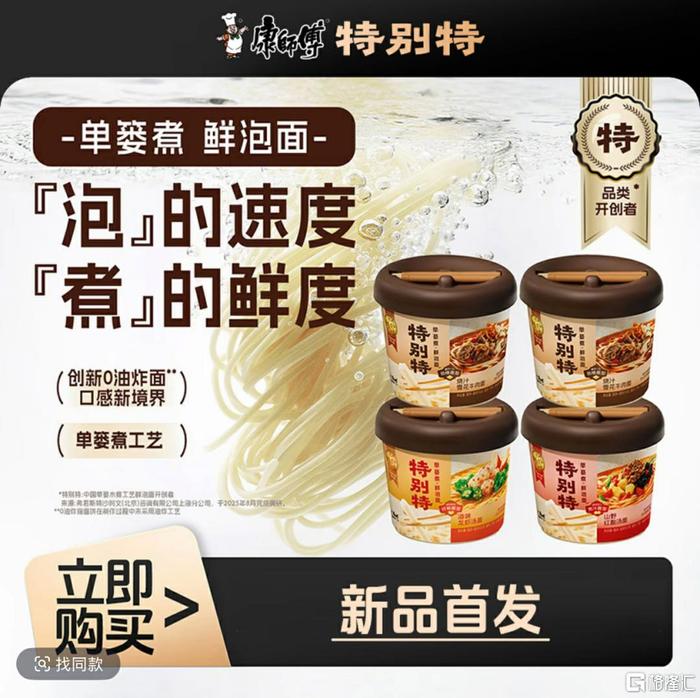
Group 1: Market Trends and Consumer Behavior - The core driving force behind the changing market landscape is the generational shift in mainstream consumer demographics, particularly urban middle-class and younger groups who prioritize quality and experience over mere affordability in food consumption [1][18] - The rise of food delivery and instant retail is providing consumers with diverse and convenient meal solutions, prompting traditional fast food industries to accelerate transformation and innovation [1] Group 2: Product Innovation by Kang Shifu - Kang Shifu has launched the "Special Fresh Boiled Noodles," a groundbreaking product that utilizes a unique single-basket boiling technique, addressing the industry's core pain points and redefining the standard for instant noodles [2][7] - The product achieved remarkable market success, with over 100,000 orders within three days of launch and surpassing 140,000 orders in the first week, making it a top-selling item in its category on Douyin [4][12] Group 3: Competitive Advantages - The product's competitive edge lies in its technological innovation, which allows for a fresh-boiled taste that distinguishes it from conventional instant noodles, thus breaking the homogenization of the market [7][11] - Kang Shifu has established a new industry standard for fresh-boiled noodles, moving away from traditional methods and creating a technical and value moat through the "5132 Fresh Boiling Standard" [9] Group 4: Market Strategy and Capital Implications - The launch of "Special Fresh Boiled Noodles" demonstrates Kang Shifu's capability for disruptive innovation, which is crucial for capital market evaluations as it indicates potential for high returns and market reconfiguration [12][15] - The product targets the mid-to-high-end instant noodle market, aiming to enhance profitability and improve overall business performance through differentiated advantages [13][15] Group 5: Long-term Market Potential - The Chinese instant noodle market, with a consumption of 42.2 billion servings in 2023, shows significant growth potential compared to other countries, emphasizing the need for products that meet evolving consumer demands [17] - The shift in consumer psychology towards valuing both convenience and quality presents an opportunity for Kang Shifu to capture market share and redefine consumer expectations in the instant noodle category [17][18]
技术构筑护城河, 康师傅(00322.HK)以颠覆式创新重塑速食行业估值逻辑
Ge Long Hui· 2025-09-02 07:59
Core Viewpoint - The emergence of new consumption trends is reshaping market competition, driven by the generational shift in mainstream consumer groups, particularly urban middle-class and younger demographics who prioritize quality and experience over mere affordability [1][22]. Group 1: Industry Trends - The rapid rise of food delivery and instant retail is providing diverse fast-food solutions, prompting traditional fast-food industries to accelerate transformation and innovation [1]. - The Chinese instant noodle market, with a consumption of 42.2 billion servings in 2023, shows significant growth potential compared to Japan and South Korea, indicating a shift in consumer demands towards quality and convenience [22]. Group 2: Company Innovation - Kang Shifu has launched the "Special Fresh Boiled Noodles," a disruptive innovation that introduces a new category of instant noodles, utilizing a unique single-basket boiling process to enhance taste and redefine quality standards [2][8]. - The product achieved remarkable market performance, with over 100,000 orders within three days of launch and 140,000 orders within a week, becoming a top seller on Douyin [4][12]. Group 3: Competitive Advantages - The core competitive advantage of "Special Fresh Boiled Noodles" lies in its technological innovation, which addresses the common issue of taste in traditional instant noodles by simulating the cooking process of fresh noodles [8][10]. - Kang Shifu has established a new industry standard for fresh boiled noodles, moving away from traditional methods and creating a technical moat with the "5132 Fresh Boiling Standard" [10][20]. Group 4: Market Strategy - The product's market strategy effectively targets the dual consumption needs of modern young consumers who seek both convenience and high quality, thus reshaping their perception of instant noodles [12][23]. - The pricing strategy aligns with dine-in and delivery options, aiming to capture the mid-to-high-end instant noodle market, which could enhance overall profitability for Kang Shifu [16][18]. Group 5: Capital Market Implications - The successful launch of "Special Fresh Boiled Noodles" signals Kang Shifu's capability for disruptive innovation, potentially leading to a re-evaluation of its long-term investment value in the capital market [14][15]. - The rapid sell-out of the product serves as a catalyst for changing market perceptions regarding consumer demand for high-end instant food products and Kang Shifu's brand influence [18][20].

【最全】2025年果汁行业上市公司全方位对比(附业务布局汇总、业绩对比、业务规划等)
Qian Zhan Wang· 2025-09-02 06:13
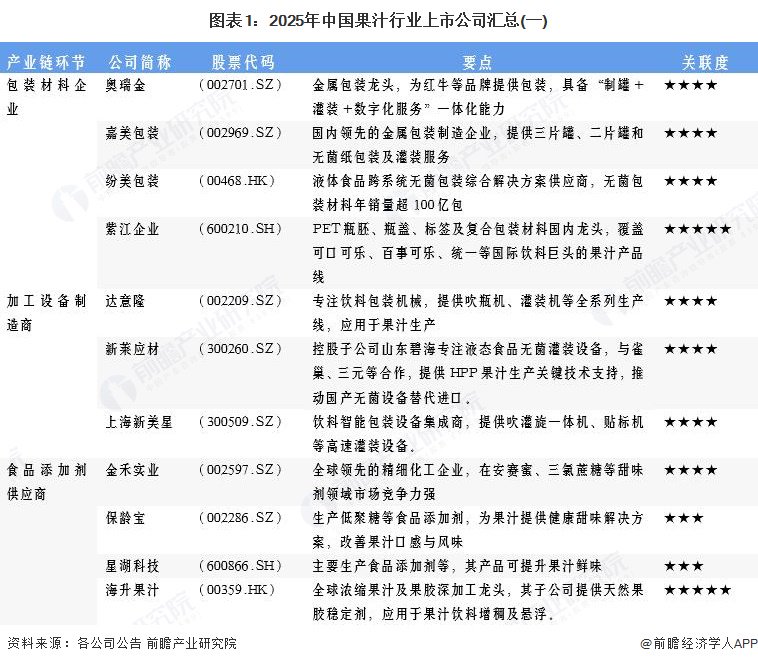
Group 1 - The juice industry is a significant direction for consumption upgrade in China's food and beverage sector, driving the integration of technologies such as deep processing of fruits and vegetables, cold chain logistics, and smart packaging [2][8] - Major listed companies in the juice industry include Nongfu Spring, Master Kong, and Uni-President, with a focus on concentrated juice, beverage OEM, and packaging [2][5] - The highest revenue in the juice production and processing segment for 2024 is expected to be from Master Kong, reaching 80.651 billion yuan [5][12] Group 2 - The juice industry listed companies are primarily distributed in Taiwan and Guangdong, with notable companies like Wei Chuan and Uni-President in Taiwan, and Aorijin and Jiamei Packaging in Guangdong [8][11] - The company with the most registered capital is Alibaba, while Wei Chuan is the oldest, established in 1953 [11][12] - Uni-President has the highest number of bidding information, totaling 405 entries [11][14] Group 3 - Nongfu Spring, Uni-President, and Master Kong have the broadest business layouts, covering various market levels and product types, while other companies focus on specific segments [16][20] - Nongfu Spring plans to expand its high-end NFC juice capacity and enhance smart management of raw material bases, aiming to become a global benchmark for healthy juice [20] - Master Kong aims to deepen market penetration in lower-tier cities and explore cross-category innovations between juice and tea beverages [20]



华润饮料少卖了14亿元
2 1 Shi Ji Jing Ji Bao Dao· 2025-09-02 02:28
Group 1: Company Performance - China Resources Beverage reported a revenue decline of 18.52% year-on-year to 6.206 billion yuan in the first half of 2025, with a net profit drop of 28.63% to 805 million yuan [2] - The revenue from packaged drinking water and beverages was 5.251 billion yuan and 955 million yuan respectively, with a decline of 23.11% in water revenue and a growth of 21.28% in beverage revenue [2] - The company's gross margin decreased by 2.6 percentage points to 46.67%, impacted by a significant revenue drop and an increased proportion of lower-margin beverages [2] Group 2: Industry Trends - The overall beverage market in China is still in a growth cycle, with a 4.7% increase in the domestic beverage market across all channels as of June this year [3] - Nongfu Spring reported a revenue increase of 15.6% year-on-year to 25.622 billion yuan in the first half of 2025, with its packaged water sales growing by 10.7% to 9.44 billion yuan [3] - The performance disparity between Nongfu Spring and China Resources Beverage indicates an intensifying competition in the beverage market [4]

康师傅控股(00322) - 海外监管公告
2025-09-01 08:36
香港交易及結算所有限公司及香港聯合交易所有限公司對本公告的內容概不負責,對其準確性或完 整性亦不發表任何聲明,並明確表示,概不對因本公告全部或任何部分內容而產生或因倚賴該等內 容而引致之任何損失承擔任何責任。 TINGYI (CAYMAN ISLANDS) HOLDING CORP. 康師傅控股有限公司 * (在開曼群島註冊成立之有限公司) (股份編號:0322) 以下附件是本公司依臺灣證券交易所股份有限公司規定於2025年 9 月1日在臺灣證券交易 所股份有限公司刊發的公告。 承董事會命 康師傅控股有限公司 公司秘書 葉沛森 香港,2025年9月1日 於本公告日期,本公司之執行董事為魏宏名先生、井田純一郎先生、魏宏丞先生、筱 原幸治先生、高橋勇幸先生及曾倩女士;本公司之獨立非執行董事為徐信群先生、栃尾雅也 先生及文暮良先生。 網址: http://www.masterkong.com.cn http://www.irasia.com/listco/hk/tingyi *僅供識別 康師傅控股有限公司臺灣存託憑證流通及兌回情形月報表 海外監管公告 本公告是由康師傅控股有限公司 (「本公司」) 根據香港聯交所有限 ...
一周新消费NO.324|Babycare官宣郭碧婷成为全新品牌代言人;喜茶上新网纹瓜瓜冰浆
新消费智库· 2025-08-31 13:04
Group 1 - The core viewpoint of the article highlights the recent product launches in the food and beverage industry, showcasing innovation and market expansion strategies by various brands [4][6][19]. Group 2 - Mixue Ice City has launched a new "Lemon Milk" series, which includes Lemon Milk Coffee and Snow King Lemon Milk, emphasizing rich and refreshing flavors [4][24]. - Want Power, a brand under Wangwang, introduced a new product "Berry Care," featuring five core ingredients aimed at health-conscious consumers [4]. - Joyoung has released a new fig and flaxseed soy milk powder, targeting female consumers with high protein and fiber content [4]. - Kirin Beverage has launched a roasted tea latte, designed for various consumption scenarios such as studying and working [5]. - Yili's Ikahuo has introduced a new health drink made from iron skin dendrobium and western ginseng, utilizing advanced preservation techniques [6]. - Menglong Ice Cream has unveiled a new glowing ice pop, appealing to health-conscious consumers with its low-calorie content [7]. - Heytea has launched a new ice drink made from a specific type of melon, highlighting unique production techniques [7]. - Nongfu Spring has introduced a new series of bottled water sourced from various locations across China [7]. - Sanofi Group has launched a new herbal tea product, focusing on light health benefits [7]. Group 3 - Babycare has announced actress Guo Biting as its new brand ambassador, launching a themed short film [8]. - Mengniu has appointed a new CFO, indicating a shift in its executive leadership [8]. - KFC has opened its first KPRO restaurant in Henan, focusing on balanced meal options [10]. - Lucky Coffee has opened its first overseas store in Malaysia, marking its global expansion [10]. Group 4 - Shibeikang has completed a nearly 100 million RMB Series B financing round, aimed at accelerating its drug development pipeline [14]. - Pure Fitness has secured $50 million in funding, indicating strong investor interest in the fitness sector [16]. - Sleep.ai has raised $5.5 million in funding, transitioning to a focus on commercialization and partnerships [17]. - Anta has announced an investment in the Korean fashion group MUSINSA, establishing a joint venture in China [17]. Group 5 - Coca-Cola has launched customized snack products for bulk retail, expanding its product offerings [19]. - Kangshifu has undergone significant management changes, indicating a strategic shift within the company [19]. - Nayuki has collaborated with a brand to launch a new beverage line, enhancing its product diversity [19]. - Ganyuan Food has introduced a new rice cake series with various flavors, focusing on quality ingredients and innovative cooking methods [19].