HISENSE H.A.(00921)

Search documents
港股家电股全线走高 创维集团涨10.45%
Mei Ri Jing Ji Xin Wen· 2026-01-02 06:36
Group 1 - The Hong Kong home appliance stocks experienced a significant increase, with major companies showing notable gains [1] - Skyworth Group (00751.HK) rose by 10.45%, reaching HKD 5.18 [1] - Midea Group (00300.HK) increased by 5%, trading at HKD 89.2 [1] - Haier Smart Home (06690.HK) saw a rise of 4.2%, priced at HKD 25.3 [1] - Hisense Home Appliances (00921.HK) grew by 2.33%, with a price of HKD 23.72 [1]
家电股全线走高 26年家电以旧换新政策出台 有望提振家电消费景气
Zhi Tong Cai Jing· 2026-01-02 06:23
Group 1 - Home appliance stocks experienced a significant increase, with Skyworth Group rising by 10.45% to HKD 5.18, Midea Group increasing by 5% to HKD 89.2, Haier Smart Home up by 4.2% to HKD 25.3, and Hisense Home Appliances gaining 2.33% to HKD 23.72 [1] - The National Development and Reform Commission and the Ministry of Finance jointly issued a notice on December 30 regarding the implementation of large-scale equipment updates and the replacement of consumer goods by 2026, which is expected to positively impact the home appliance sector [1] - Dongfang Securities anticipates that the domestic sales pressure will improve in the first quarter of 2026 as national subsidy funds become available, and the industry will gradually enter a post-subsidy era [1] - Guotou Securities forecasts that the home appliance replacement policy will continue into 2026, with optimized support scope, subsidy standards, and implementation mechanisms, benefiting companies with R&D, channel, and brand advantages [1] - The easing of the US-China trade conflict is expected to reduce tariff pressures, allowing home appliance companies to gradually release global production capacity, with emerging markets contributing to incremental growth [1]


港股异动 | 家电股全线走高 26年家电以旧换新政策出台 有望提振家电消费景气
智通财经网· 2026-01-02 06:22
Group 1 - Home appliance stocks experienced a significant rise, with Skyworth Group increasing by 10.45% to HKD 5.18, Midea Group rising by 5% to HKD 89.2, Haier Smart Home up by 4.2% to HKD 25.3, and Hisense Home Appliances gaining 2.33% to HKD 23.72 [1] - The National Development and Reform Commission and the Ministry of Finance jointly issued a notice on December 30 regarding the implementation of large-scale equipment updates and the old-for-new policy for consumer goods in 2026 [1] - Dongfang Securities anticipates that the domestic sales pressure will improve in the first quarter of 2026 with the arrival of national subsidy funds, and the industry will gradually enter a post-subsidy era [1] - Guotou Securities forecasts that the old-for-new policy for home appliances will continue in 2026, with optimized support scope, subsidy standards, and implementation mechanisms, leading to steady domestic home appliance consumption [1] - Companies with advantages in research and development, distribution, and branding in both white goods and black goods sectors are expected to benefit more from the new policy [1] - The easing of the China-U.S. trade conflict is expected to reduce tariff pressures, and home appliance companies are gradually releasing global production capacity, with emerging markets contributing incremental growth [1]
2026年家电以旧换新政策出台 家电消费景气有望提振(附概念股)
Zhi Tong Cai Jing· 2026-01-02 00:45
Group 1 - The 2026 appliance replacement policy will provide subsidies for consumers purchasing energy-efficient home appliances, with a subsidy of 15% of the product price, capped at 1,500 yuan per item [1] - The first batch of subsidies for the 2026 policy amounts to 62.5 billion yuan, which is lower than the 2025 plan, and the eligible appliance categories are fewer [1] - Citigroup believes the new policy will boost consumer sentiment despite the limited overall impact on e-commerce platforms due to high baseline effects and smaller subsidy scale [1] Group 2 - The 2026 policy is expected to stimulate domestic appliance sales and improve product structure, benefiting companies with R&D, channel, and brand advantages in the white and black goods sectors [2] - The easing of US-China trade tensions may reduce tariff pressures, allowing home appliance companies to gradually release global production capacity and gain incremental contributions from emerging markets [2] - The new policy is anticipated to drive the home appliance industry towards high-end, intelligent, and green upgrades, favoring large appliance companies with competitive advantages [2] Group 3 - Related Hong Kong-listed companies in the home appliance industry include Midea Group, Haier Smart Home, Hisense Home Appliances, TCL Electronics, Skyworth Group, and Xiaomi Group [3]
港股概念追踪|2026年家电以旧换新政策出台 家电消费景气有望提振(附概念股)
智通财经网· 2026-01-02 00:43
Group 1 - The Chinese government has announced a new policy for 2026 to support the replacement of old appliances and consumer goods, providing a subsidy of 15% of the product price for eligible energy-efficient appliances, with a maximum subsidy of 1,500 yuan per item [1][2] - The first batch of funding for this policy amounts to 62.5 billion yuan, aimed at stimulating consumer sentiment despite a smaller subsidy scale compared to 2025 [1][2] - The policy is expected to benefit e-commerce platforms, although the overall impact may be limited due to high baseline effects and reduced subsidy amounts [1][2] Group 2 - The 2026 policy focuses on high-efficiency products, with a narrower scope and lower subsidy rates compared to 2025, which aligns with market expectations and is anticipated to improve domestic appliance sales [2] - Companies with advantages in research, distribution, and branding in the white and black goods sectors are expected to benefit more from the new policy [2] - The policy is likely to drive the home appliance industry towards higher-end, smart, and green upgrades, optimizing product structures [2] Group 3 - Relevant Hong Kong-listed companies in the home appliance supply chain include Midea Group, Haier Smart Home, Hisense Home Appliances, TCL Electronics, Skyworth Group, and Xiaomi Group [3]

美的、海尔、海信、TCL,一场决定未来十年命运的战争
Xin Lang Cai Jing· 2025-12-31 02:07
Core Viewpoint - The Chinese home appliance industry is at a critical juncture, with the theme for 2026 being "going overseas" as domestic market saturation and overcapacity issues become more pronounced. This shift represents a "second entrepreneurship" for companies like Haier, Midea, Hisense, and TCL, marking a decisive battle for the next decade [2]. Group 1: Market Overview - The global home appliance market is nearly 4.5 trillion yuan, indicating significant overseas market potential [4]. - Midea and Haier are projected to generate around 270 billion yuan in revenue each in 2024, translating to a global market share of only about 6% [5]. - Domestic brands struggle to exceed 10% market share in most overseas regions, while leading competitors like Samsung and LG dominate [8]. Group 2: Historical Context and Challenges - Chinese home appliance companies have historically relied on capacity export and brand acquisitions for overseas expansion, but this growth model is becoming less effective [9]. - The gap between global manufacturing share (over 45%) and retail share (less than 20%) highlights a significant challenge in value creation and brand premium [9]. - Haier and Midea's overseas revenue share has stagnated around 50% and 42% respectively over the past five years, indicating a lack of growth [9]. Group 3: Brand and Channel Development - The need for a "second entrepreneurship" in brand and channel development is emphasized, as domestic brands face challenges in replicating their successful domestic strategies in international markets [15]. - Building brand recognition and effective distribution channels in overseas markets is crucial, as traditional strategies may not apply [16][20]. - The complexity of overseas channels, dominated by large retailers, poses significant barriers for Chinese companies [20]. Group 4: Opportunities and Strategies - Technological innovation is seen as a key to overcoming brand premium challenges, with Chinese companies making strides in areas like AI and smart home technology [22]. - Emerging markets such as Southeast Asia and Latin America present significant growth opportunities due to low penetration rates and less established competition [29]. - E-commerce is becoming a vital channel for market entry, allowing brands to reach consumers without heavy investment in physical stores [34]. Group 5: Future Outlook - The transition to a full value chain operation by 2026 signifies a shift from manufacturing management to comprehensive brand and channel strategies [36]. - Success in this transformation is critical for elevating Chinese manufacturing from a "global factory" to a "global brand," enhancing competitiveness in the global market [36].



家用电器行业投资策略周报-20251230
CAITONG SECURITIES· 2025-12-30 13:17
Core Insights - The report maintains a positive outlook on the home appliance sector, particularly focusing on the cost reduction potential of aluminum replacing copper in air conditioning systems [2][5] - The adoption of aluminum-copper technology is seen as a significant step towards reducing production costs amid rising copper prices and resource scarcity [10][15] Group 1: Aluminum-Copper Technology Impact - The use of aluminum instead of copper in air conditioning units can lead to substantial cost savings, with estimates suggesting a reduction of 208 to 277 RMB per unit when replacing 50% of copper, and up to 416 to 554 RMB when replacing 100% [11][12] - Copper currently constitutes about 26% to 33% of the cost in standard air conditioning units, with high-end models reaching over 40% [11][12] - The global market has seen significant adoption of aluminum-copper products, particularly in Japan where approximately 40% to 50% of air conditioners use aluminum heat exchangers [15][16] Group 2: Domestic Market Challenges - Despite the cost advantages, the domestic promotion of aluminum-copper air conditioners faces challenges, including inferior thermal conductivity and corrosion resistance compared to copper [19][20] - Consumer perception is a major barrier, as negative opinions about aluminum's reliability persist, complicating market acceptance [19][20] - The first domestic aluminum-copper air conditioner was launched by Wanbao in collaboration with JD.com, targeting the mid-to-low-end market, which may help accelerate industry-wide material transitions [16][17] Group 3: Industry Performance and Trends - The home appliance sector has shown mixed performance, with the overall index increasing by 0.44%, while specific segments like white goods and black goods experienced varied changes [21][22] - Recent data indicates a decline in domestic sales growth for air conditioners, refrigerators, and washing machines, reflecting broader market challenges [33][47] - The report highlights the importance of monitoring raw material prices, with copper and aluminum prices showing significant fluctuations that could impact production costs [29][31]



家电行业专题研究:拥抱龙头,重视出海
Xin Lang Cai Jing· 2025-12-26 12:24
Group 1: Domestic Demand and Market Outlook - The home appliance sector is expected to show a "high first half and stable second half" trend in 2025, driven by policy continuation and consumption peaks [1] - In the first three quarters of 2025, air conditioner shipments increased by 8.4%, refrigerators by 2.4%, and washing machines by 4.1% year-on-year [1][13] - For 2026, the continuation of subsidies is anticipated to mitigate the impact of high base effects and demand pull-forward, with projected declines in overall appliance sales of -4% to -7.3% under various subsidy scenarios [1][16][19] Group 2: Export Performance and Global Market Trends - Home appliance exports have slowed down due to tariff policies and global supply chain adjustments, but still show resilience and structural highlights [2] - In 2025, the export growth rate for air conditioners is expected to be weaker than that of washing machines and refrigerators, primarily due to adverse weather conditions affecting overseas demand [2][39] - The U.S. market is projected to benefit from a rate cut, which may enhance demand for home appliances, while the European market is expected to maintain a slow recovery [42][44][50] Group 3: Investment Themes - The narrative in the black appliance sector is shifting from "market share chasing" to "profit and pricing power," with Chinese brands like Hisense and TCL expected to convert market share into higher profits [3][55] - White appliances are seen as having strong growth potential due to their historical resilience through cycles, with leading brands like Midea and Haier expected to maintain stable growth and generous dividends [3][83] - The global competition in new consumer products, particularly in smart imaging and robotic vacuum cleaners, is expected to favor Chinese brands, highlighting their competitive advantages [3] Group 4: Financial Metrics and Valuation - As of December 22, 2025, the home appliance sector's PE TTM is 16.27 times, remaining below the 10-year average of 32.8% [7] - The white appliance segment's current PE is 11.22, while black appliances stand at 25.94, indicating varying levels of market valuation [9] - The home appliance sector has seen a decline in public fund holdings, with a heavy allocation of only 2.46% in Q3 2025, reflecting concerns over demand in 2026 [9]

海信家电20251224
2025-12-25 02:43
Summary of Hisense Home Appliances Conference Call Company Overview - **Company**: Hisense Home Appliances - **Industry**: Home Appliances Key Points Industry and Market Conditions - The fourth quarter of 2025 continues to face operational pressures due to the decline of national subsidies and high base effects from the previous year. However, some product categories are seeing a rebound in price indices, leading to slight improvements in profit margins. The overseas market is undergoing inventory destocking, with expectations for order recovery in December and early next year [2][3][4]. Product and Business Development - The newly launched water-based paint factory in Changsha is expected to enhance the central air conditioning business and improve processing depth, aiding in order growth in the mature markets of Europe and America. Currently, water machine products account for about 5% of total revenue, with positive outlooks for the water-cooled and liquid-cooled market trends [2][5]. - Hisense is exploring aluminum alternatives to copper to mitigate the impact of rising copper prices, with some experience in overseas markets. The domestic market will require consideration of technology maturity and consumer acceptance [2][6]. Strategic Focus and Brand Development - The company anticipates that the effects of subsidy exhaustion will be less severe than historical policies. Hisense is focusing on building core competencies and brand recognition in the post-subsidy era, targeting consumer segments with products like fresh air conditioners and embedded refrigerators to gain competitive advantages [2][7]. - The competitive landscape in the air conditioning market is expected to shift in 2026, with leading companies focusing more on core capabilities and brand image enhancement. Hisense aims to strengthen its competitive edge to perform better in the post-subsidy environment [2][8]. Operational Efficiency and Market Strategy - Hisense plans to maintain profitability in the processing sector while expanding market share in emerging markets. The company is integrating resources from Nantong, Hisense Hitachi, and Jiakang to improve overall efficiency and reduce ineffective SKUs [2][9]. - The air conditioning division has faced operational pressures in 2025, prompting management to implement integration and efficiency measures, including procurement and channel collaboration [2][10]. Revenue and Profit Guidance - For 2026, the central control products are expected to achieve positive growth, with varying quarterly performances. The public construction segment is projected to grow from 15% to 35% of revenue, while the renovation segment is expected to decrease from 35% to 15% [2][11]. - The company is optimistic about overall performance in 2026, despite challenges in the renovation segment, which has seen a decline of over 20% each quarter [2][11]. International Market Outlook - Hisense's international sales have shown good growth, with regions like Latin America exceeding 30% growth. However, some areas like ASEAN have experienced declines due to adverse weather conditions. The company plans to enhance market share and average selling price (ASP) in mature markets while expanding product offerings in flexible markets like Latin America and ASEAN [2][12]. - The 2026 FIFA World Cup in North America is expected to significantly boost Hisense's growth in these regions, leveraging sponsorship to enhance brand visibility and market penetration [2][13]. Risk Management and Supply Chain - Hisense is managing risks related to increased tariffs on exports to Mexico by optimizing local procurement and maintaining a competitive edge through its Mexican manufacturing base [2][14]. - The company is also addressing the impact of the domestic new energy vehicle tax reduction and softening European demand by optimizing product structures to enhance market competitiveness [2][14]. Financial Planning and Capital Expenditure - Hisense plans to maintain a dividend payout ratio of around 50% and is exploring new incentive schemes for employees. Capital expenditures will include the construction of the Changsha mobile phone factory and the second and third phases of the Thailand industrial park, aimed at meeting future demand in Europe and the U.S. [2][17]. Future Guidance - Specific revenue and profit guidance for 2026 will be assessed based on domestic and international market conditions, with plans to communicate updates to the market as necessary [2][18].
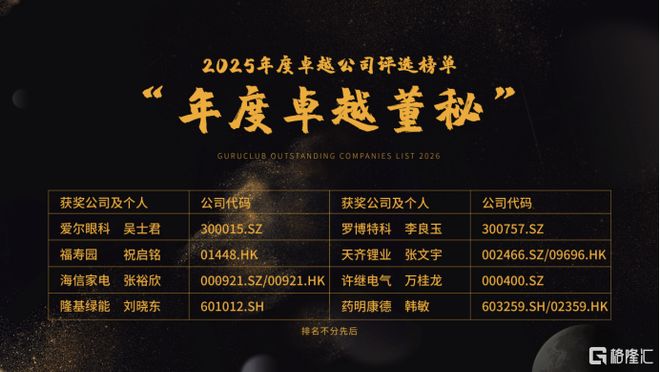
格隆汇“科技赋能·资本破局”线上分享会暨“金格奖”——“年度卓越董秘”奖项揭晓:爱尔眼科(300015.SZ)吴士君、福寿园(01448.HK)祝启铭等8位上榜
Ge Long Hui· 2025-12-22 08:50
Core Viewpoint - The "Golden Award" annual excellence company selection by Gelonghui highlights outstanding companies and their secretaries, emphasizing the importance of corporate governance and investor relations in the market [1][2]. Group 1: Award Winners - Eight individuals received the "Annual Excellence Secretary" award, including Wu Shijun from Aier Eye Hospital, Zhu Qiming from Fushouyuan, Zhang Yuxin from Hisense Home Appliances, Liu Xiaodong from Longi Green Energy, Li Liangyu from Robotech, Zhang Wenyu from Tianqi Lithium, Wan Guilong from XJ Electric, and Han Min from WuXi AppTec [1]. - The award recognizes secretaries for their exceptional performance in corporate governance, equity management, information disclosure, and investor relations [1]. Group 2: Evaluation Process - The selection process for the awards involved quantitative data analysis and expert review to determine the final results [1]. - The "Golden Award" aims to create a valuable reference for investors by ranking listed companies and unicorns across various stock exchanges, including the Hong Kong Stock Exchange, Shanghai Stock Exchange, Shenzhen Stock Exchange, New York Stock Exchange, and NASDAQ [2].