
XIAOMI(01810)

Search documents
江苏等15省国补上线京东秒送,春节换新机立享15%国补优惠
Yang Zi Wan Bao Wang· 2026-01-27 06:24
Core Insights - JD's instant retail platform, JD Seconds, has fully adopted the national subsidy program for 2026, launching in 15 provinces including Beijing, Shanghai, and Guangdong, allowing consumers to purchase 3C digital products with efficient delivery services [1][2] Group 1: National Subsidy Program - The subsidy allows consumers to receive a 15% discount on product sales prices, with maximum subsidies of 1500 yuan for computers and 500 yuan for mobile phones, tablets, and wearable devices [1] - Popular brands such as Apple, Xiaomi, Huawei, OPPO, and Lenovo are included in the subsidy program, offering various hot-selling models [1] Group 2: Delivery and Service Enhancements - Consumers purchasing subsidized products will receive delivery from specially trained JD Seconds riders, who provide on-site signing and activation assistance [2] - Over 10,000 brand specialty stores have integrated into this service system to enhance consumer experience [2] Group 3: Investment and Support - Since the implementation of the national "Two New" policy in 2024, JD has continuously invested resources to ensure effective subsidy deployment, with nearly 30 billion yuan allocated to support rural consumption growth by 2025 [2]




小米申请并联电池均衡方法专利提升电池均衡效率
Jin Rong Jie· 2026-01-27 05:10
Core Insights - Beijing Xiaomi Mobile Software Co., Ltd. has applied for a patent titled "Balancing Method, Device, Equipment, and Computer-Readable Storage Medium for Parallel Batteries," with publication number CN121395615A, and the application date is July 2024 [1] - The patent pertains to the field of communication technology, specifically focusing on the balancing method for parallel batteries, which includes determining the first battery's charge difference from the second battery under certain conditions [1] Company Overview - Beijing Xiaomi Mobile Software Co., Ltd. was established in 2012 and is located in Beijing, primarily engaged in software and information technology services [1] - The company has a registered capital of 148.8 million RMB [1] - According to Tianyancha data, the company has invested in 4 enterprises, participated in 150 bidding projects, and holds 5000 patent records, along with 123 administrative licenses [1]
突发!美得州把 26 家中国科技公司拉黑
是说芯语· 2026-01-27 03:09
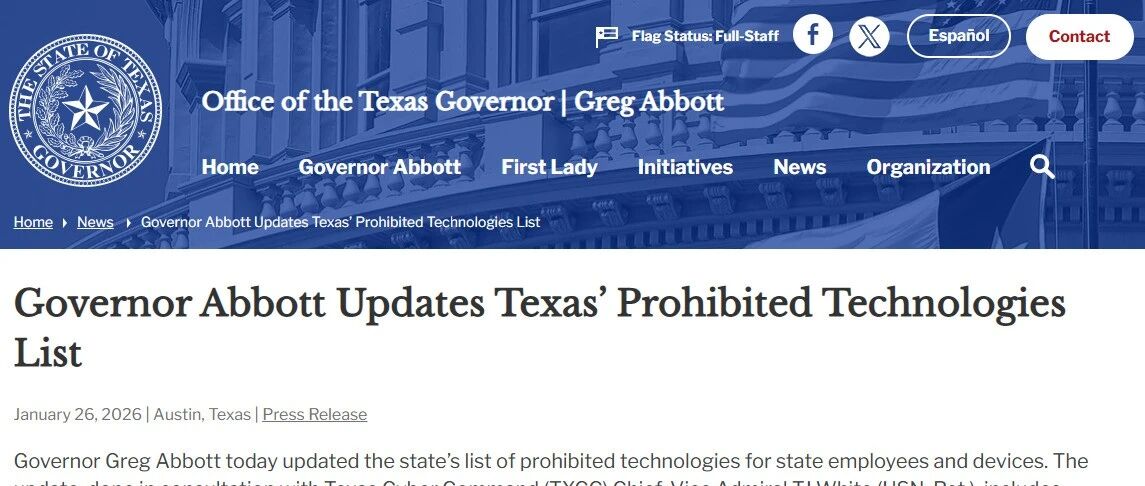
Core Viewpoint - Texas Governor Greg Abbott has expanded the list of prohibited technologies, adding 26 Chinese tech companies and AI platforms, to mitigate security risks associated with foreign adversaries [1][3][4]. Group 1: Prohibited Technologies - The updated list includes various AI institutions such as Zhipu AI, Baichuan Intelligence, and MiniMax, as well as hardware manufacturers like Hisense and tech companies including ByteDance, Baidu, Alibaba, CATL, and TP-Link [1][6][7]. - The Texas Cyber Command (TXCC) is responsible for assessing threats and identifying high-risk technologies to protect sensitive information [1][5][6]. Group 2: Security Concerns - Governor Abbott expressed concerns about hostile actors using AI and other technologies to harvest user data, manipulate users, and compromise their safety [4][5]. - The TXCC aims to prevent cyber attacks that could lead to the exfiltration of sensitive information to malicious entities globally [5][6]. Group 3: Implementation and Oversight - The prohibition is based on a threat assessment conducted by TXCC, which was established in June 2023 as the largest state-level cybersecurity department in the U.S. [6][1]. - The directive to expand the prohibited technologies list was communicated through a letter to key state officials, emphasizing the need for vigilance against foreign threats [4][5].




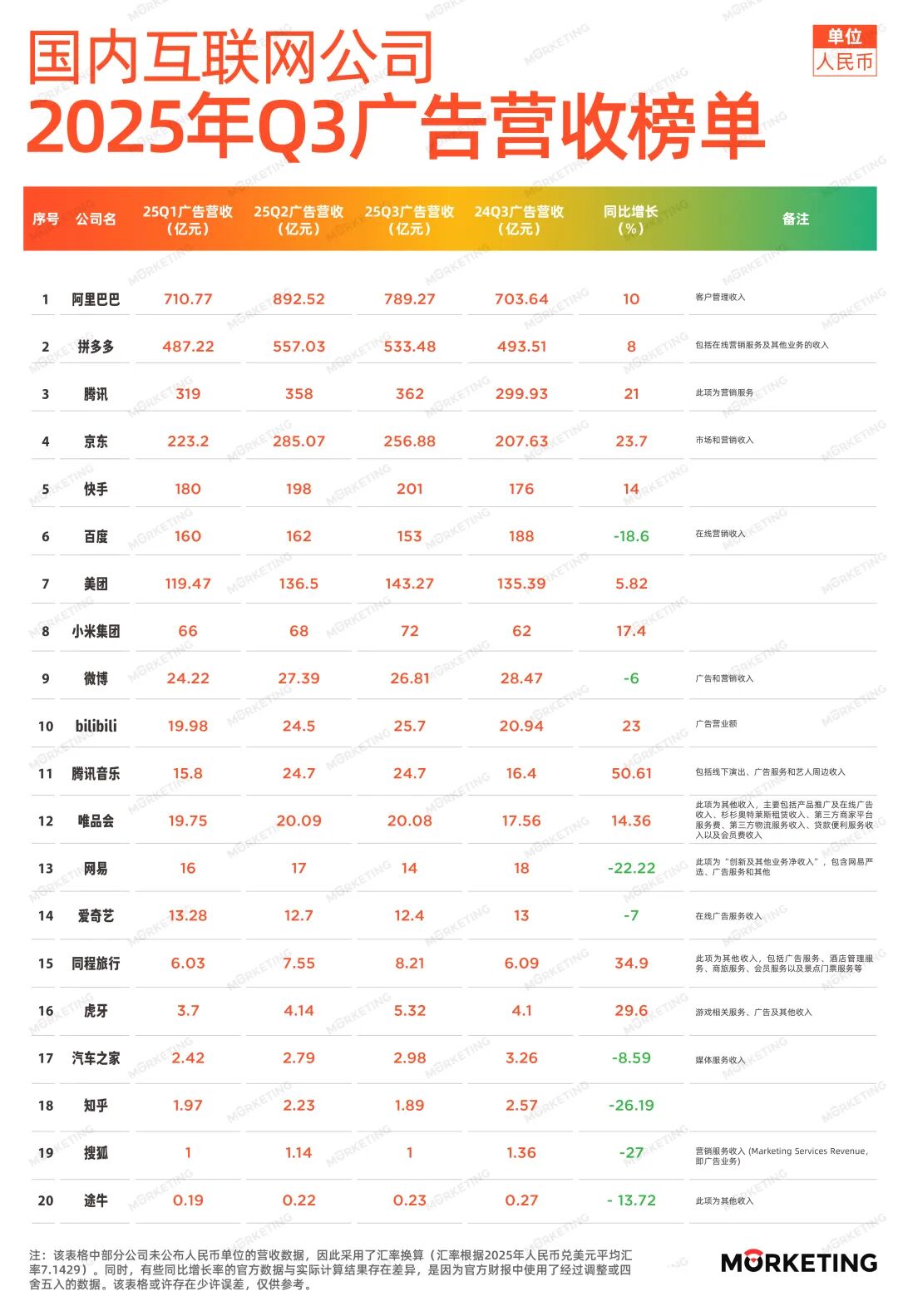
20家互联网公司2025年Q3广告营收:效率、生态与技术,正在重写平台增长逻辑
3 6 Ke· 2026-01-27 02:47
Core Insights - The Chinese internet advertising industry has transitioned from a phase of "incremental traffic acquisition" to a focus on "efficiency extraction from existing resources" [1][2] - The new rule emerging from this differentiation is that technology determines efficiency, efficiency drives revenue, and ecosystem shapes the landscape [2] Group 1: Advertising Revenue Performance - Alibaba's advertising revenue for Q3 2025 reached 789.27 billion yuan, a 10% year-on-year increase and a slight 2.1% quarter-on-quarter growth, maintaining its leading position in the industry [5] - Pinduoduo's online marketing service revenue was 533.48 billion yuan, an 8% year-on-year increase but a 1.2% quarter-on-quarter decline, indicating a strategic focus on long-term ecosystem development [6][7] - Tencent's marketing service revenue grew by 21% to 362 billion yuan, showcasing the effectiveness of its technology-driven approach [7][8] - JD.com's market and marketing revenue increased by 23.7% to 256.88 billion yuan, driven by the growth of its food delivery business and AI-enabled advertising solutions [10] - Bilibili's advertising revenue reached 25.7 billion yuan, with a 23% year-on-year growth, attributed to the maturation of its user base [11] Group 2: Challenges Faced by Mid-Tier Platforms - Baidu's online marketing revenue fell by 18.6% to 153 billion yuan, primarily due to budget cuts from advertisers and the restructuring of search scenarios by AI [12][14] - Zhihu's advertising revenue declined by 26.19%, reflecting a mismatch between its high-knowledge user base and consumer conversion needs [15] - Automotive media service revenue for Che168 dropped by 8.59%, as traditional advertising models struggle against the evolving strategies of new energy vehicle companies [16] Group 3: Industry Trends and Future Outlook - The differentiation in advertising revenue among internet companies in Q3 2025 signifies a reconstruction of internet marketing value logic, focusing on traffic depth, transaction closure, and technology adaptation [16] - Platforms achieving growth typically exhibit a combination of extensive traffic, ecosystem closure, and deep integration of AI technology, while declining platforms often lack these comprehensive advantages [16] - The future of internet marketing will prioritize platforms that can achieve ecosystem synergy, embedded technology, and full-link value delivery, moving away from traditional single-channel models [16]



港股上下争持,恒指收升16点
Guodu Securities Hongkong· 2026-01-27 02:35
Group 1: Market Overview - The Hang Seng Index closed at 26,765.52, up 16 points or 0.06%, after fluctuating throughout the day, with a high of 26,911 and a low of 26,619 [3][4] - The total market turnover was 261.699 billion, with a net outflow of 0.826 billion from northbound trading [3] - Among the 88 blue-chip stocks, 46 rose while 39 fell, indicating mixed performance in the market [3] Group 2: Macro & Industry Dynamics - The current geopolitical environment is favorable for Hong Kong, enhancing its role as a "super connector" for companies looking to shift from traditional markets to China and Asia [7] - The Hong Kong government has received over 30 applications for company relocations since implementing the mechanism in May last year, with 14 approved, indicating positive market response [8] - The People's Bank of China emphasized the need for proactive macro policies to address economic uncertainties and enhance financial stability [10] Group 3: Company News - Zijin Mining announced a plan to acquire Allied Gold Corporation for approximately 5.5 billion CAD (about 280 billion RMB), expanding its footprint in the gold mining sector [12] - TianShu Intelligent Chip released a roadmap for its fourth-generation architecture, aiming to surpass Nvidia's offerings, with significant performance improvements reported [13] - JD Technology's shopping AI, JoyGlance, has launched on Rokid's smart glasses, marking a significant advancement in AI-driven shopping technology [15]

QuestMobile 2025-2026年度核心趋势报告价值榜
QuestMobile· 2026-01-27 02:12
Core Insights - The article presents the 2025 China Internet Value List, highlighting the leading applications in various sectors based on user scale and growth rates, particularly focusing on the AIGC (Artificial Intelligence Generated Content) sector and its rapid expansion [2][3]. User Scale Rankings - The top applications by average monthly active users (MAU) from October 2024 to September 2025 include: - WeChat: 109,455.43 million - Taobao: 96,273.09 million - Alipay: 92,643.15 million - Douyin: 88,686.16 million - Gaode Map: 88,685.78 million [5][6]. User Growth Rankings - The top applications with significant user growth (MAU over 50 million) include: - DeepSeek (AIGC): 14,455.28 million, newly launched - 080 (AIGC): 17,204.20 million, with a growth rate of 309.86% - Delta Action (Shooting Game): 5,114.65 million, with a growth rate of 188.57% [9]. Smart TV User Scale - The leading smart TV brands by active device count as of September 2025 are: - Xiaomi: 5,953.76 million - Hisense: 4,615.66 million - Skyworth: 4,423.28 million [11]. OTT Application User Scale - The top OTT applications by active device count include: - Galaxy Qiyi: 12,831.20 million - CIBN Cool Media: 12,483.30 million - Mango TV: 6,548.21 million [12]. AI Application Rankings - The top AI applications by user scale in September 2025 include: - Wenxin Assistant (Baidu AI): 34,729.5 million - 080 (AIGC): 17,204.2 million - Ant Financial Assistant: 8,962.9 million [14]. Advertising Platforms - The leading advertising platforms by user count are: - Tencent Ads: 126,889.06 million - Alibaba Mama: 119,293.23 million - Giant Star Engine: 108,723.63 million [33][34]. Consumer Brand Online Private Domain Traffic - The top consumer brands by online private domain user scale include: - Huawei: 40,563.44 million - Oppo: 26,934.89 million - VIVO: 23,626.35 million [21].

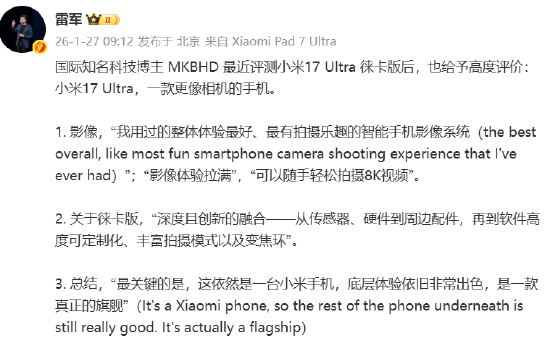
雷军分享国际博主MKBHD评测小米17 Ultra徕卡版:一款更像相机的手机
Xin Lang Cai Jing· 2026-01-27 01:43
Core Viewpoint - The Xiaomi 17 Ultra, particularly the Leica version, has received high praise from renowned tech blogger MKBHD, highlighting its exceptional camera capabilities and overall flagship experience [2][5][7]. Group 1: Camera Performance - MKBHD describes the Xiaomi 17 Ultra as having "the best overall, like most fun smartphone camera shooting experience that I've ever had," emphasizing its superior imaging capabilities [2][7]. - The device allows users to easily shoot 8K videos, showcasing its advanced video recording features [2][7]. Group 2: Leica Integration - The Leica version of the Xiaomi 17 Ultra is noted for its "deep and innovative integration," which includes enhancements from the sensor and hardware to accessories and highly customizable software with rich shooting modes and a zoom ring [2][7]. Group 3: Overall Experience - MKBHD concludes that despite its advanced camera features, it remains fundamentally a Xiaomi phone, with an excellent underlying experience, affirming it as a true flagship device [2][5][7].
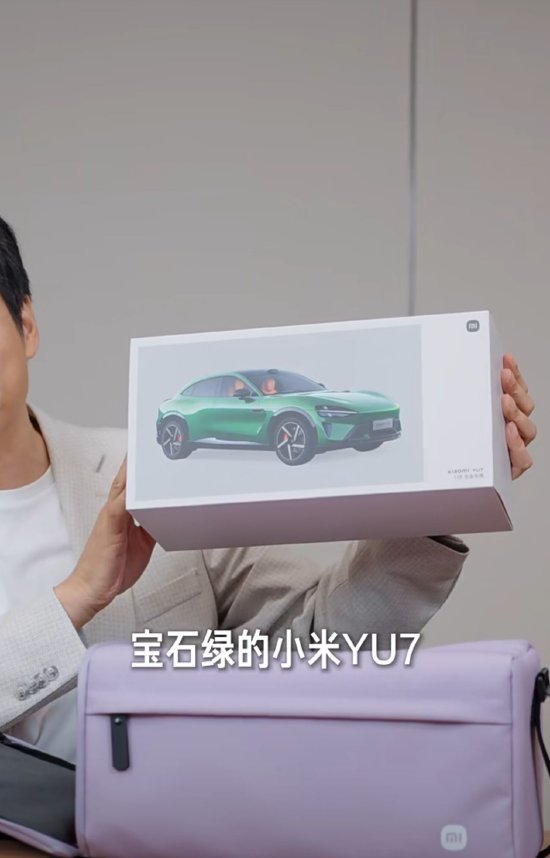
雷军晒给员工新春礼物:包含车模盲盒,现场拆出宝石绿小米YU7车模
Xin Lang Cai Jing· 2026-01-27 01:27
新浪科技讯 1月27日上午消息,小米集团创始人、董事长、CEO雷军近日发布视频,展示为小米同事们 准备的新春礼物。 他介绍,新春礼物包括一个吐司包、贺卡、车模盲盒和新春礼盒。雷军透露,车模盲盒中包括小米 SU7、小米YU7、小米SU7 Ultra三种车模。雷军现场拆出了宝石绿的小米YU7车模。 他介绍,新春礼物包括一个吐司包、贺卡、车模盲盒和新春礼盒。雷军透露,车模盲盒中包括小米 SU7、小米YU7、小米SU7 Ultra三种车模。雷军现场拆出了宝石绿的小米YU7车模。 另外,新春礼盒内含红包、对联和窗花等。视频最后,雷军祝福大家马年吉祥,2026年一定会更好。 责任编辑:宋雅芳 另外,新春礼盒内含红包、对联和窗花等。视频最后,雷军祝福大家马年吉祥,2026年一定会更好。 责任编辑:宋雅芳 新浪科技讯 1月27日上午消息,小米集团创始人、董事长、CEO雷军近日发布视频,展示为小米同事们 准备的新春礼物。 ...
智通港股沽空统计|1月27日
智通财经网· 2026-01-27 00:24
Group 1 - The top short-selling ratios are recorded for China Resources Beer (100.00%), Anta Sports (100.00%), and Li Ning (100.00%) [1][2] - The highest short-selling amounts are for Pop Mart (1.209 billion), Xiaomi Group (1.075 billion), and Alibaba (0.974 billion) [1][2] - The highest deviation values are for CRRC (42.51%), Li Ning (38.82%), and Ping An Insurance (30.07%) [1][2] Group 2 - The top short-selling amounts list includes Pop Mart (1.209 billion), Xiaomi Group (1.075 billion), and Alibaba (0.974 billion) with respective short-selling ratios of 28.53%, 19.43%, and 8.66% [2] - The top short-selling ratio rankings show China Resources Beer, Anta Sports, and Li Ning all at 100.00% with short-selling amounts of 19.28 thousand, 9.50 thousand, and 10.09 thousand respectively [2] - The deviation values indicate that CRRC has a significant deviation of 42.51%, followed by Li Ning at 38.82% and Ping An at 30.07% [2][3]



港股公司开年以来回购总额突破117亿港元
Zheng Quan Ri Bao· 2026-01-26 23:27
Core Insights - The Hong Kong stock market has seen a significant increase in share buybacks by leading companies, with 108 companies participating and a total buyback amount exceeding 11.7 billion HKD as of January 26, 2026, primarily driven by major players like Tencent and Xiaomi [1][2] - In contrast, the overall buyback scale in the Hong Kong market is shrinking, with fewer companies participating compared to the previous year, and the total buyback amount only reaching 50% of last year's figures, indicating a clear market differentiation [1][3] Group 1: Leading Companies' Buyback Activities - Tencent Holdings has been a major contributor, having spent 6.358 billion HKD to repurchase 10.205 million shares, leading the market in buyback amounts [2] - Xiaomi Group follows closely with a buyback amount of 2.25 billion HKD, and has announced an additional buyback plan of up to 2.5 billion HKD, demonstrating strong commitment to share repurchase [2] Group 2: Market Dynamics and Trends - The technology sector has emerged as the core area for buybacks, attributed to its relatively low historical valuations and strong cash flows, allowing leading companies to signal confidence in their long-term prospects through buybacks [3][4] - The differentiation in buyback participation is influenced by multiple factors, including policy changes that have lowered barriers for leading companies, while smaller companies face challenges such as unstable earnings and cash flow constraints [4][5] Group 3: Policy and Market Environment - The Hong Kong Stock Exchange's 2024 stock buyback reform has removed many previous restrictions, enhancing the flexibility and convenience of buyback operations for companies [6] - The macroeconomic environment has improved, with a noticeable trend of global capital flowing back to Chinese assets, contributing to better liquidity in the Hong Kong market [6][7] Group 4: Strategic Considerations for Companies - Companies are increasingly using buybacks as a means to optimize capital structure, enhance shareholder returns, and retain key talent, reflecting a strategic approach to long-term value management [7] - The decision to repurchase shares is based on careful assessments of undervaluation, with a focus on using free cash flow to avoid additional debt and ensure funds are available for operational expansion and R&D [7]