XIAOMI(01810)

Search documents
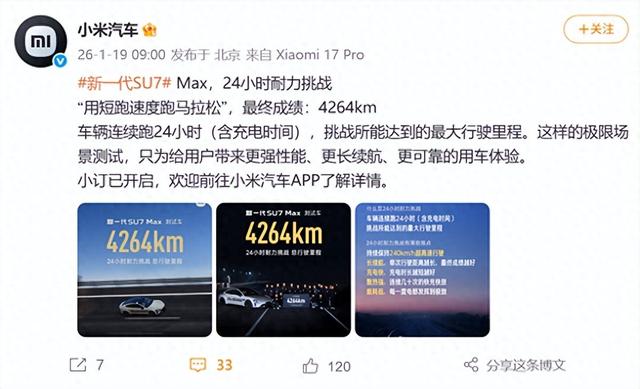
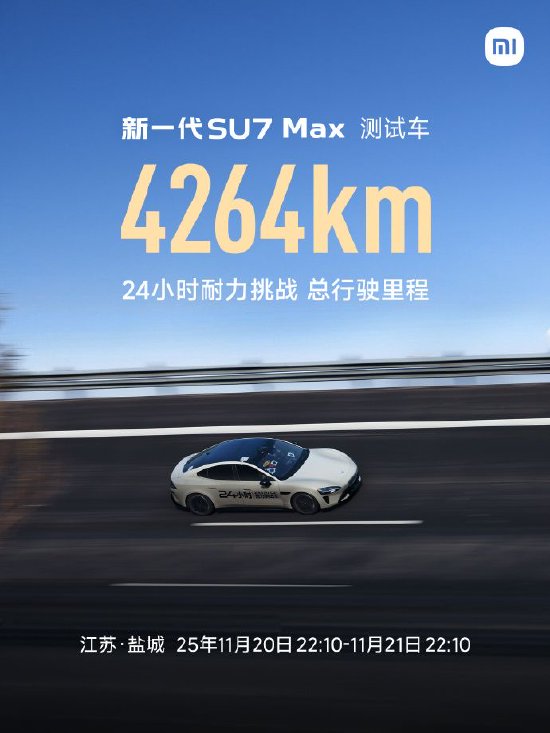
用短跑速度跑马拉松!小米SU7 Max 24小时耐力挑战:斩获4264km
Xin Lang Cai Jing· 2026-01-19 02:44
Core Insights - Xiaomi's new generation SU7 Max achieved a total driving distance of 4264 km in a 24-hour endurance challenge, showcasing its long-range capabilities and efficiency in charging and energy consumption [1] Group 1: Vehicle Performance - The 24-hour endurance challenge required the vehicle to maintain a high-speed driving of 240 km/h while demonstrating long-range capabilities [1] - The challenge also tested the vehicle's charging efficiency, heat dissipation, and energy consumption control [1] Group 2: Product Launch and Pricing - Xiaomi's founder and CEO Lei Jun indicated that the new SU7 is progressing well, with some units expected to be displayed in stores before the Spring Festival [3] - The new model has a pre-sale price range of 229,900 to 309,900 yuan, with an official launch expected in April 2026 [3] Group 3: Technical Specifications - The new SU7 Max features advanced battery technology, with the standard and Pro versions upgraded to a 752V silicon carbide high-voltage platform, while the Max version approaches a 900V platform at 897V [5] - The Pro version has a CLTC comprehensive range that exceeds 900 km, reaching 902 km, while the Max version offers a range of 835 km and the standard version provides 720 km [5] Group 4: Battery and Charging - The Max version is equipped with a 101 kWh CATL ternary lithium battery, achieving a CLTC comprehensive range of 835 km [7] - In practical tests, the vehicle can recharge 670 km of range in just 15 minutes at a charging station, with a fast charge from 10% to 80% taking only 20 minutes [7]

贾国龙再发声:“从来不存在两岁的西蓝花”;马斯克向OpenAI微软索赔千亿美元;欧盟多国考虑对930亿欧元美国商品加征关税...
Sou Hu Cai Jing· 2026-01-19 02:25
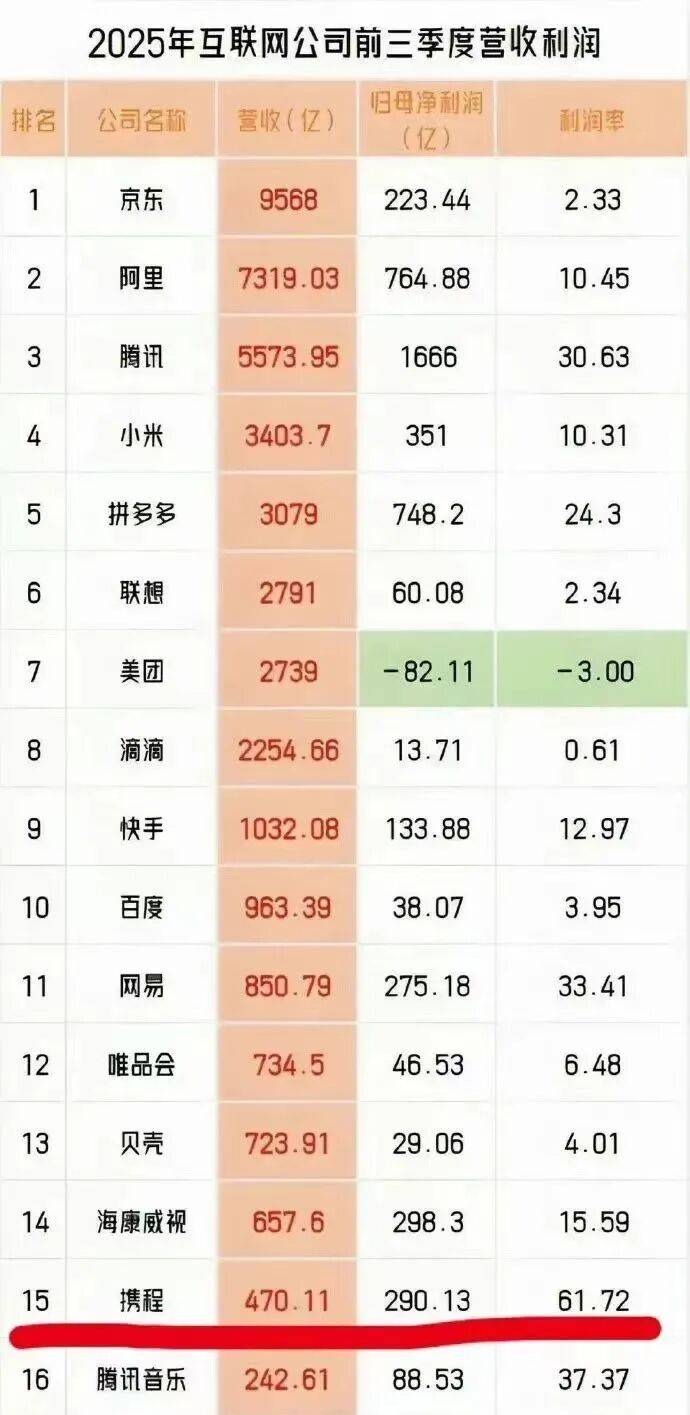
Group 1: Internet Company Revenue and Profit - JD.com leads the revenue chart with 956.8 billion, followed by Alibaba at 731.9 billion and Tencent at 557.4 billion [1] - Alibaba's net profit stands at 76.5 billion, significantly higher than JD.com's 22.3 billion, while Tencent shows a strong profit of 166.6 billion [1] - The profit margin for Tencent is notably high at 30.63%, compared to Alibaba's 10.45% and JD.com's 2.33% [1] Group 2: Market Trends and Insights - The data indicates a competitive landscape among major internet companies, with varying revenue and profit margins suggesting different business strategies and operational efficiencies [1] - The significant profit margins of Tencent may indicate a focus on high-margin services, while JD.com and Alibaba are still scaling their operations [1] Group 3: Financial Performance Overview - The overall financial performance of the top internet companies reflects a diverse range of growth strategies, with some companies prioritizing revenue growth while others focus on profitability [1] - The financial results for the third quarter of 2025 highlight the ongoing evolution of the internet sector in China, with implications for future investment opportunities [1]


小米汽车:新一代SU7 Max 24小时耐力挑战成绩为4264km
Xin Lang Cai Jing· 2026-01-19 01:53
Group 1 - The core announcement is that Xiaomi's new generation SU7 Max has achieved a remarkable endurance challenge result of 4264 km in 24 hours, emphasizing its performance capabilities [1][4] - The vehicle's testing involved continuous driving for 24 hours, including charging time, to showcase its maximum driving range [1][4] - This extreme testing scenario aims to provide users with enhanced performance, longer endurance, and a more reliable driving experience [1][4]
44家港股公司回购 小米集团-W回购2.19亿港元
Zheng Quan Shi Bao Wang· 2026-01-19 01:37
Summary of Key Points Core Viewpoint - On January 16, 44 Hong Kong-listed companies conducted share buybacks, totaling 31.23 million shares and an aggregate amount of HKD 426 million [1]. Group 1: Buyback Details - Xiaomi Group-W repurchased 5.90 million shares for HKD 219.14 million, with a highest price of HKD 37.200 and a lowest price of HKD 37.080, bringing its year-to-date buyback total to HKD 1.45972 billion [2]. - Sunny Optical Technology repurchased 1.13 million shares for HKD 74.89 million, with a highest price of HKD 66.600 and a lowest price of HKD 65.900, accumulating a year-to-date buyback total of HKD 457.32 million [2]. - Xiansheng Pharmaceutical repurchased 4.43 million shares for HKD 51.63 million, with a highest price of HKD 11.773 and a lowest price of HKD 11.520, totaling HKD 93.58 million in year-to-date buybacks [2]. Group 2: Ranking by Buyback Amount - The highest buyback amount on January 16 was from Xiaomi Group-W at HKD 219.14 million, followed by Sunny Optical Technology at HKD 74.89 million [1]. - Other notable buybacks included Xiansheng Pharmaceutical and Juzhibio, with significant amounts as well [1]. Group 3: Ranking by Buyback Volume - Xiaomi Group-W led in buyback volume with 5.90 million shares, followed by Dingdang Health with 5.21 million shares and Xiansheng Pharmaceutical with 4.43 million shares [1].
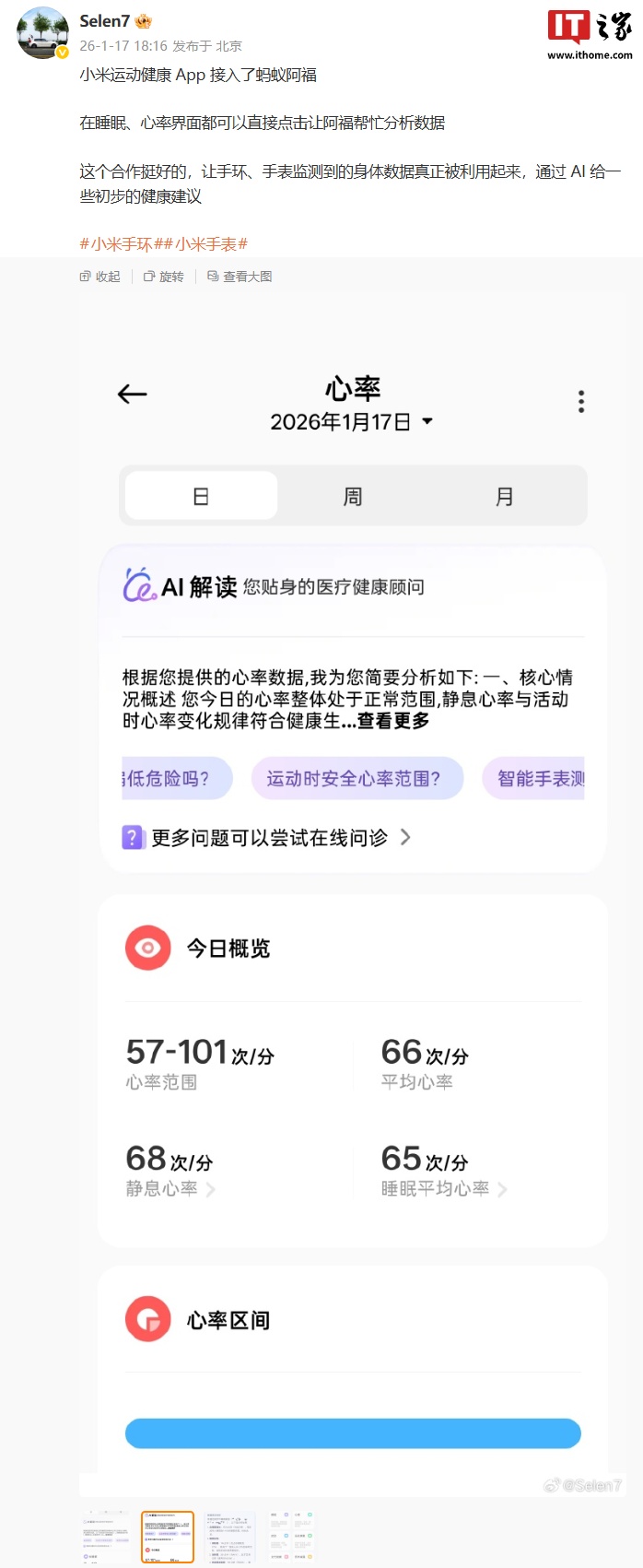
小米运动健康 App 接入蚂蚁阿福,支持 AI 初步健康建议
Xin Lang Cai Jing· 2026-01-19 01:31
IT之家 1 月 18 日消息,据小米中国区智能硬件市场负责人 @Selen7 分享,小米运动健康 App 接入了蚂蚁阿福,在睡眠、心率界面都可以直接点击让阿福分 析数据,并支持通过 AI 给一些初步的健康建议。 小米中国区智能硬件市场负责人 @Selen7 分享的配图来看,目前支持的问诊分类包括睡眠、心理、皮肤、运动康复、女性健康、营养减重。 机感染等问题 动损伤等问题 营养减重 提供科学减重 案、营养评估 化饮食指导和 营养干预等 % 女性健康 咨询月经异常,妇科 炎症、子宫疾病和卵 巣疾病等问题 据IT之家此前报道,去年 12 月 15 日,蚂蚁集团宣布旗下 AI 健康应用 AQ 品牌升级为"蚂蚁阿福",并发布 App 新版本。蚂蚁阿福声明:阿福的问答结果中没有任何广告推荐、不存在商业排名,也不受任何其他商业 因素干扰。 IT之家 1 月 18 日消息,据小米中国区智能硬件市场负责人 @Selen7 分享,小米运动健康 App 接入了蚂蚁阿福,在睡眠、心率界面都可以直接点击让阿福分 析数据,并支持通过 AI 给一些初步的健康建议。 小米中国区智能硬件市场负责人 @Selen7 分享的配图来看,目前支持的 ...
智通港股回购统计|1月19日



智通财经网· 2026-01-19 01:13
Group 1 - The article reports on stock buybacks conducted by various companies on January 16, 2026, with Xiaomi Group-W (01810) having the largest buyback amount of 219 million yuan for 5.90 million shares [1][2] - Other notable buybacks include Sunyu Optical Technology (02382) with 1.13 million shares repurchased for approximately 74.9 million yuan and Xiansheng Pharmaceutical (02096) with 4.43 million shares for about 51.6 million yuan [1][2] - The total number of shares repurchased by Xiaomi Group-W represents 0.71% of its total share capital, while Sunyu Optical Technology's buyback accounts for 0.64% of its total share capital [2][3] Group 2 - The buyback activity reflects a trend among companies to return capital to shareholders, with several companies like Country Garden Services (06098) and Baidu-W (02423) also engaging in significant buybacks [1][2] - The buyback amounts and share counts vary significantly across companies, with some like Weigao Group (01066) and Yunda Automotive (03669) showing higher percentages of total share capital repurchased, at 6.68% and 1.27% respectively [2][3] - The data indicates a diverse range of industries participating in buybacks, including technology, healthcare, and consumer services, suggesting a broad interest in enhancing shareholder value across sectors [1][2]
智通港股沽空统计|1月19日
智通财经网· 2026-01-19 00:27
Core Insights - The highest short-selling ratios were recorded for AIA Group (81299), Anta Sports (82020), and JD Health (86618), all at 100.00% [1] - The top three companies by short-selling amount were Alibaba (09988) at 1.951 billion, Pop Mart (09992) at 1.469 billion, and Xiaomi (01810) at 1.406 billion [1] - The highest deviation values were noted for Ping An Insurance (82318) at 61.20%, Tencent Holdings (80700) at 48.74%, and AIA Group (81299) at 34.93% [1] Short-Selling Ratio Rankings - AIA Group (81299) had a short-selling amount of 178,200 and a ratio of 100.00% with a deviation of 34.93% [2] - Anta Sports (82020) had a short-selling amount of 632,800 and a ratio of 100.00% with a deviation of 16.25% [2] - JD Health (86618) had a short-selling amount of 118,700 and a ratio of 100.00% with a deviation of 15.45% [2] - Tencent Holdings (80700) had a short-selling amount of 4.5844 million with a ratio of 96.50% and a deviation of 48.74% [2] - Ping An Insurance (82318) had a short-selling amount of 4.7952 million with a ratio of 90.76% and a deviation of 61.20% [2] Short-Selling Amount Rankings - Alibaba (09988) recorded a short-selling amount of 1.951 billion with a ratio of 14.77% and a deviation of 0.58% [2] - Pop Mart (09992) had a short-selling amount of 1.469 billion with a ratio of 24.66% and a deviation of 0.25% [2] - Xiaomi (01810) had a short-selling amount of 1.406 billion with a ratio of 19.02% and a deviation of -1.96% [2] - Tencent Holdings (00700) had a short-selling amount of 955 million with a ratio of 7.50% and a deviation of -3.65% [2] - Meituan (03690) had a short-selling amount of 528 million with a ratio of 14.05% and a deviation of -2.09% [2] Short-Selling Deviation Rankings - Ping An Insurance (82318) had a short-selling amount of 4.7952 million with a ratio of 90.76% and a deviation of 61.20% [2] - Tencent Holdings (80700) had a short-selling amount of 4.5844 million with a ratio of 96.50% and a deviation of 48.74% [2] - AIA Group (81299) had a short-selling amount of 178,200 with a ratio of 100.00% and a deviation of 34.93% [2] - Kanglong Chemical (03759) had a short-selling amount of 94.5761 million with a ratio of 38.49% and a deviation of 31.58% [2] - JD Group (89618) had a short-selling amount of 115,230 with a ratio of 88.32% and a deviation of 31.46% [2]




未来的机会在这里!任泽平带你看前沿科技
泽平宏观· 2026-01-18 16:05
Core Insights - The article emphasizes the importance of practical learning experiences in the field of investment and technology, highlighting the value of direct engagement with leading companies and experts in various industries [2][7][19]. Schedule Overview - The schedule for 2026 includes visits to major tech companies and universities, such as NVIDIA, Tesla, and Stanford University, focusing on cutting-edge technologies and innovations [3][4][5]. - Specific events include closed-door research meetings on AI and technology trends, as well as visits to companies like Huawei, BYD, and others in the robotics and AI sectors [18][19][57]. Company Engagement - The program aims to connect entrepreneurs with top executives and scientists to gain insights into strategic decisions and technological advancements [7][19]. - Participants will explore various sectors, including AI, robotics, and new energy, through hands-on experiences and discussions with industry leaders [19][57]. Learning Philosophy - The initiative promotes a philosophy of "reading extensively and traveling widely," encouraging participants to learn from real-world applications and innovations in technology [2][38]. - The focus is on fostering a mindset of long-term thinking and ethical business practices among entrepreneurs [2][40].




雷军:新一代SU7已经开始小订
Bei Jing Ri Bao Ke Hu Duan· 2026-01-18 14:56
Group 1 - The core message is that Lei Jun has announced the commencement of small orders for the new generation SU7, with further details available on the Xiaomi Auto app [1][3]
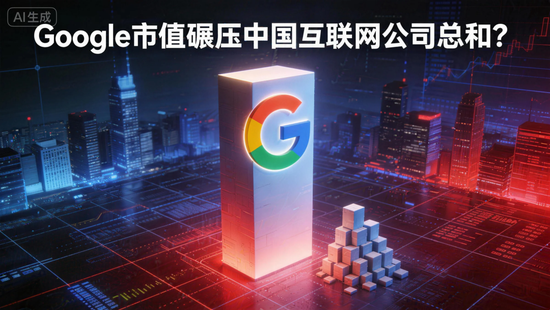
中国所有互联网公司市值加起来,竟然不如一个 Google?劝劝巨头们 别再卷了 通过免费打压行业对手追求垄断
Xin Lang Cai Jing· 2026-01-18 13:23
Core Viewpoint - The market capitalization of Google (Alphabet) is approximately $4 trillion, while the combined market capitalization of China's top internet companies is only about $1.8 trillion, indicating a significant disparity in valuation and market perception [25][28][30]. Market Capitalization Comparison - As of the end of 2025 or early 2026, the estimated market capitalizations of major companies are as follows: - Google (Alphabet): ~$40,000 million - Tencent: ~$5,917 million - Alibaba: ~$3,333 million - Xiaomi: ~$1,987 million - Pinduoduo: ~$1,486 million - Meituan: ~$975 million - NetEase: ~$852 million - JD: ~$471 million - Trip.com: ~$383 million - Kuaishou: ~$345 million - Tencent Music: ~$302 million - The total market capitalization of the top 10 Chinese internet companies is estimated to be around $17,000–20,000 million, which is more than 2.2 times less than that of Google [28][3][25]. Competitive Landscape - The primary issue in the Chinese internet sector is not a lack of effort but rather a misdirection in competitive strategies, focusing excessively on user acquisition, subsidies, and speed, leading to a dangerous cycle of competition [30][5]. - This competitive model, which relies on free services to gain scale and eliminate competitors, is damaging long-term sustainability in the industry [31][32]. Impact on Entrepreneurship - The current environment is systematically clearing out entrepreneurs, reducing their roles to mere tools for larger platforms, and stifling genuine innovation [34][37]. - The lack of reasonable pricing, stable profits, and long-term investment in research and development is leading to fewer companies being profitable and surviving [35][36]. Employment Challenges - The concentration of the industry into a few dominant platforms is contributing to job losses, with monopolistic structures eliminating positions rather than technological advancements like AI [39][10]. - As industry profits shrink, salaries are also compressed, leading to fewer job opportunities for young people [11][39]. Comparison with Google - Google’s strength lies not in the number of applications but in its focus on foundational capabilities, allowing ecosystem partners to thrive and generating productivity-based revenue rather than merely capturing attention [40][41]. - The competitive landscape in China, characterized by internal strife, hinders the emergence of globally competitive companies [41][42]. Future Outlook - If the current competitive practices continue, the industry may end up with a few platforms and many dependent entities, leading to a degraded ecosystem rather than a mature industry [42][45]. - A healthy internet ecosystem should support entrepreneurship and job creation, rather than relying solely on free services as a competitive tool [44][51].