
LI AUTO-W(02015)

Search documents
C-IASI发布理想i8等4款车型测评结果
Zhong Guo Qi Che Bao Wang· 2026-01-21 06:08
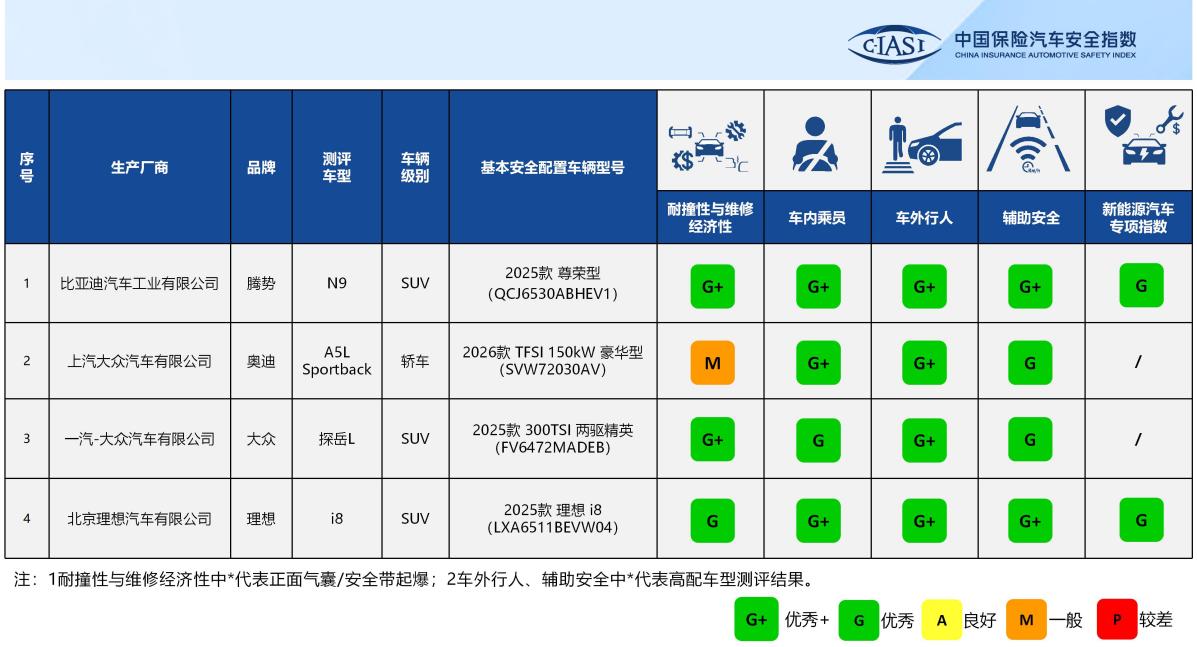
Core Viewpoint - The China Insurance Automotive Safety Index evaluates four vehicle models based on principles of professionalism, impartiality, scientific rigor, independence, and public welfare, with results to be officially released on January 21, 2026 [1] Group 1: Vehicle Models Evaluated - The evaluation includes four models: Tengshi N9, Audi A5L Sportback, Volkswagen Taos L, and Li Auto i8, comprising three SUVs (Tengshi N9, Volkswagen Taos L, Li Auto i8) and one sedan (Audi A5L Sportback), with two models being electric vehicles (Tengshi N9, Li Auto i8) [1] Group 2: Safety Ratings - In terms of crashworthiness and repair economy, two models received an excellent+ (G+) rating, one model received an excellent (G) rating, and one model received a mediocre (M) rating [2] - For structural crashworthiness, Tengshi N9 and Volkswagen Taos L received excellent ratings, while for repairability, Audi A5L Sportback, Volkswagen Taos L, and Li Auto i8 received excellent ratings [2] - Volkswagen Taos L received an excellent rating for repair economy, and three models (Tengshi N9, Volkswagen Taos L, Li Auto i8) received excellent ratings for collision compatibility [2] Group 3: Passenger Safety Ratings - All four models received excellent or above ratings for passenger safety, with three models achieving excellent+ (G+) ratings [3] - In various collision scenarios, all four models received excellent ratings, and 100% of the models received excellent ratings for roof strength and seat/headrest performance [3] Group 4: Pedestrian and Auxiliary Safety Ratings - All four models received excellent+ (G+) ratings for pedestrian safety [4] - In terms of auxiliary safety, all models received excellent (G) or above ratings, with two models achieving excellent+ (G+) ratings [4] - All four models are equipped with AEB (Automatic Emergency Braking) and emergency rescue service (E-call) features, with a 100% installation rate [4] Group 5: New Energy Vehicle Index - The two electric vehicle models received excellent (G) ratings in the New Energy Vehicle Index [5] - The China Insurance Automotive Safety Index aims to promote the development of safer and more competitive new models for consumers, continuing to expand the range of tested vehicles [5]


美股大跌,科技股全线下挫,热门中概股普跌
Di Yi Cai Jing Zi Xun· 2026-01-20 23:31
Group 1 - The global market risk appetite has significantly decreased following President Trump's renewed tariff threats towards Europe, leading to a sell-off in major stock indices [2][3] - The Dow Jones Industrial Average fell by 870.74 points, a decline of 1.76%, closing at 48,488.59 points; the S&P 500 dropped by 143.15 points, down 2.06%, at 6,796.86 points; and the Nasdaq Composite decreased by 561.07 points, a 2.39% drop, ending at 22,954.32 points, marking the worst single-day performance since October 10 of the previous year [2] - Major tech stocks experienced declines, with Nvidia down 4.32%, Apple down 3.45%, and Microsoft down 1.16%, among others [2] Group 2 - The CBOE Volatility Index (VIX), often referred to as the "fear index," rose to a two-month high, reflecting increased market anxiety [3] - Trading volume on U.S. stock markets reached approximately 20.6 billion shares, significantly above the 20-day average of 17.01 billion shares, indicating concentrated selling pressure [3] - Analysts suggest that the current geopolitical tensions regarding tariffs are more of an emotional shock rather than a fundamental change that would trigger a deep market correction [3] Group 3 - The global bond market is also experiencing spillover effects, with upward pressure on some European government bonds due to potential increases in defense spending [4] - The yield on the U.S. 10-year Treasury note reached a high of 4.313%, the highest since late August, closing at 4.287% after a rise of 5.6 basis points [5] - Market expectations for interest rate cuts by the Federal Reserve have been adjusted downward, with projections for a reduction of approximately 47 basis points in 2026, down from 53 basis points at the end of the previous year [5] Group 4 - Netflix reported fourth-quarter revenue of $12.1 billion, exceeding market expectations of $11.97 billion, with adjusted earnings per share of $0.56, also slightly above forecasts [6] - The company anticipates full-year revenue for 2026 to reach between $50.7 billion and $51.7 billion, with expectations for advertising revenue to potentially double in the future [6] - Following the announcement, Netflix's stock price fell by 4.9% in after-hours trading, influenced by merger financing and market sentiment [7] Group 5 - Gold prices surged significantly, with spot gold rising approximately 2% to $4,757.33 per ounce, reaching a historical high of $4,756.93 during the session [7] - Silver prices experienced a slight decline of 0.3%, settling at $94.38 per ounce, after hitting a record high of $95.87 [7] - Oil prices showed volatility, with light crude oil futures for February delivery rising by $0.90 to $60.34 per barrel, a 1.51% increase [8]



36氪说了一些2026款L9升级方向, 理想将重头资源押于此
理想TOP2· 2026-01-20 16:32
Core Insights - The article discusses Li Auto's ambitious growth plans for 2026, targeting a 40% increase in sales, which translates to approximately 550,000 units sold [1] - The upgraded L9 model features a battery capacity exceeding 70 kWh, a range of over 400 kilometers, and significant enhancements in size and chassis design [1] - Industry insiders predict that the L9 could achieve sales of over 100,000 units [1] Group 1 - Li Auto is focusing resources on the next-generation L9 model while streamlining its range of extended-range vehicles [1] - A new all-electric SUV is set to launch in 2026, with a product focus returning to extended-range vehicles [1] - The company anticipates that its market share in the 200,000+ price segment will not return to the 40%+ levels seen in 2022 and 2023, but aims to regain a leading position in market share by 2026 [1] Group 2 - The i6 model is expected to have a production capacity of 3,000 units per month [1] - Li Auto is undergoing a systematic review of its offline sales network, with plans to close underperforming retail locations and not renew contracts [1]

Inquiry Into Tesla's Competitor Dynamics In Automobiles Industry - Tesla (NASDAQ:TSLA)
Benzinga· 2026-01-20 15:00
Core Insights - The article provides a comprehensive evaluation of Tesla in comparison to its competitors in the automobile industry, focusing on financial indicators, market positioning, and growth potential [1] Company Overview - Tesla is a vertically integrated battery electric vehicle manufacturer and developer of artificial intelligence software, with a diverse vehicle lineup including luxury sedans, SUVs, and trucks [2] - The company aims to deliver approximately 1.8 million vehicles globally in 2024 and also engages in battery sales, solar energy solutions, and operates a fast-charging network [2] Financial Metrics Comparison - Tesla's Price to Earnings (P/E) ratio is 301.72, significantly higher than the industry average, indicating a premium valuation [5] - The Price to Book (P/B) ratio of 18.19 also exceeds the industry average by 6.32x, suggesting a premium relative to book value [5] - Tesla's Price to Sales (P/S) ratio stands at 16.12, which is 11.27x the industry average, indicating potential overvaluation based on sales performance [5] - The Return on Equity (ROE) for Tesla is 1.75%, which is 2.81% above the industry average, reflecting efficient equity utilization for profit generation [5] - Tesla's EBITDA is $3.66 billion, slightly below the industry average, which may indicate financial challenges [5] - The gross profit of Tesla is $5.05 billion, also below the industry average, suggesting lower revenue after production costs [5] - The company demonstrates robust revenue growth of 11.57%, surpassing the industry average of 0.91%, indicating strong sales expansion [5] Debt to Equity Ratio - Tesla has a debt-to-equity (D/E) ratio of 0.17, which is lower than its top four peers, indicating a stronger financial position and less reliance on debt financing [9]


【整车主线周报】12月零售符合预期,看好26年景气度向上
东吴汽车黄细里团队· 2026-01-20 14:07
Investment Highlights - The passenger car sector is expected to see a recovery in Q1 2026 due to the implementation of subsidy policies, with a focus on high-end electric vehicles that are less sensitive to policy changes, such as Jianghuai Automobile, Geely, Great Wall Motors, BAIC Blue Valley, Seres, and Li Auto [2][7] - For exports, priority should be given to leading companies with established overseas systems and proven execution capabilities, including BYD, Great Wall Motors, Chery, Leap Motor, Xpeng, SAIC Motor, and Changan Automobile [2][7] Heavy Truck Sector - In 2025, wholesale heavy truck sales reached 1.144 million units, up 26.8% year-on-year, with domestic sales of 799,000 units, up 32.8%, and exports of 341,000 units, up 17.2% [3][37] - The expected domestic sales for heavy trucks in 2026 is optimistic, projected at 800,000 to 850,000 units, a 3% increase year-on-year [3][37] - Recommended leading heavy truck companies include China National Heavy Duty Truck Group, Weichai Power, Foton Motor, FAW Jiefang, and CIMC Vehicles [3][37] Bus Sector - The implementation of the vehicle replacement policy in 2026 is slightly better than expected, with bus sales in 2025 projected at 38,000 units, a 25% increase year-on-year [3][37] - For 2026, bus sales are expected to grow to 40,000 units, a 5% increase year-on-year, supported by the number of buses over eight years old that need replacement [3][37] - Recommended leading bus companies include Yutong Bus, King Long Motor, and Zhongtong Bus [3][37] Motorcycle Sector - The motorcycle industry is projected to achieve total sales of 19.38 million units in 2026, a 14% increase year-on-year, with large-displacement motorcycles expected to reach 1.26 million units, a 31% increase [4][34] - Domestic sales of large-displacement motorcycles are expected to grow slightly to 430,000 units in 2026, a 5% increase year-on-year, while exports are projected to reach 830,000 units, a 50% increase [4][34] - Recommended leading motorcycle companies include Chunfeng Power and Longxin General [4][34]






卡倍亿:在新能源汽车领域,公司已进入比亚迪等整车厂商的供应链
Zheng Quan Ri Bao· 2026-01-20 12:16
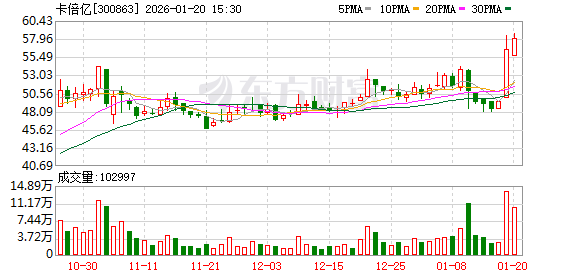
Group 1 - The company, Kabeiyi, has entered the supply chains of major electric vehicle manufacturers including BYD, Tesla, Geely, NIO, Li Auto, Xpeng, and Xiaomi in the new energy vehicle sector [2]

理想推出7年低月供方案,部分车型前三年免息,这波操作实在吗?
Xin Lang Cai Jing· 2026-01-20 10:41
Core Insights - Li Auto has launched a 7-year low monthly payment car purchase plan, offering interest-free benefits for the first three years on the MEGA and L8 models, which appears to lower the entry barrier for potential buyers [1][2] - The 7-year financing option is relatively rare in the industry, as the mainstream financing term has typically been 5 years, making this a significant move for the company [1][2] Financing Details - The key highlight of the new plan is the interest-free period for the first three years, which significantly reduces the initial repayment pressure for buyers [1][2] - However, the long-term financing option generally results in higher total interest payments, and even with the initial interest-free period, the total expenditure over seven years is likely to exceed that of a 5-year plan [1][2] - Only the MEGA and i8 models qualify for the 3-year interest-free financing, while popular models like the L6 and L7 do not [1][2] Market Context - This move by Li Auto is seen as a necessary response to increasing competition in the industry, as other companies like Tesla and Xiaomi have already introduced similar 7-year financing options [1][2] - The new financing plan aims to alleviate concerns regarding down payments and monthly payments for potential buyers, making it more attractive for families with limited budgets [1][2] - Consumers are advised to focus on the total cost of ownership rather than being misled by low monthly payments, emphasizing the importance of financial planning [1][2]
理想汽车7年超低月供购车方案公布:首付3.25万元起,月供低至2578元
Feng Huang Wang· 2026-01-20 04:23
Core Viewpoint - The announcement of a 7-year low monthly payment car purchase plan by Li Auto and Xiaomi indicates a competitive strategy to attract customers in the electric vehicle market, highlighting the trend of offering extended financing options to enhance affordability [1] Group 1: Li Auto - Li Auto officially announced a 7-year ultra-low monthly payment car purchase plan starting from January 20, 2026, with a down payment as low as 32,500 yuan and monthly payments starting at 2,578 yuan [1] - The Li MEGA and Li i8 models have exclusive 7-year loan plans, offering interest-free payments for the first 3 years, with monthly payments starting at 2,857 yuan [1] Group 2: Xiaomi - Xiaomi Auto announced a 7-year low-interest policy starting from January 16, with a down payment of 49,900 yuan and monthly payments starting at 2,593 yuan for the Xiaomi YU7 model [1]

理想汽车旗下驱动技术公司注册资本增至3亿元
Zheng Quan Ri Bao· 2026-01-19 12:39
Group 1 - The core point of the article is that Jiangsu Ideal Drive Technology Co., Ltd. has increased its registered capital from 180 million to 300 million yuan [2] - The company is fully owned by Jiangsu Ideal Automotive Intelligent Technology Co., Ltd., which is a subsidiary of Ideal Automotive [2]
理想汽车旗下驱动技术公司增资至3亿,增幅约67%
Sou Hu Cai Jing· 2026-01-19 03:19
Core Viewpoint - Jiangsu Ideal Drive Technology Co., Ltd. has increased its registered capital from 180 million RMB to 300 million RMB, representing an increase of approximately 67% [1] Company Information - The company was established in April 2023 and is legally represented by Cha Zheng [1] - Its business scope includes technology services, development, consulting, exchange, transfer, promotion, manufacturing of automotive parts and components, and import and export of goods [1] - The company is wholly owned by Jiangsu Ideal Automotive Intelligent Technology Co., Ltd., a subsidiary of Ideal Automotive [1]