
LI AUTO-W(02015)

Search documents
理想汽车发布首款AI眼镜
Zheng Quan Ri Bao· 2025-12-04 16:35
Core Insights - Li Auto has officially launched its first AI glasses, Livis, marking a significant crossover from the smart automotive sector to smart wearable devices [2][3] - Livis features a lightweight design at 36 grams, with a continuous operational time of 18.8 hours, and includes advanced functionalities such as a 12-megapixel camera and electronic image stabilization [2] - The launch aligns with Li Auto's "All-in-AI" strategy, aiming to position the company as a leading player in the global AI sector, with a projected R&D expenditure of 12 billion yuan by 2025, of which over 6 billion yuan will be dedicated to AI [3] Industry Trends - The smart glasses market is heating up, with major players like Meta and Xiaomi expected to release new products, leading to a predicted shipment volume of 2.846 million units in China by 2025, representing a 116.4% year-on-year growth [4] - The move by automotive companies into the AI glasses space signifies a shift towards becoming "full-scenario lifestyle service providers," extending the mobility ecosystem beyond just transportation [4] - Industry experts suggest that Li Auto's foray into AI glasses is a strategic step to enhance its product matrix and tap into the growing demand for integrated smart experiences among consumers [3][4]


因信息量太大+这几天在北京线下交流导致无法深入全面分析理想AI眼镜
理想TOP2· 2025-12-04 14:54
Core Viewpoint - The article discusses the recent developments and discussions surrounding the Ideal AI glasses, highlighting the need for further analysis and information gathering due to the rapid influx of news in the AI sector [1]. Group 1: Discussion Angles - The practicality of the first generation of Ideal AI glasses and the target audience for these products [2] - Perspectives from Li Xiang and other Ideal representatives on the long-term significance of AI glasses, including direct quotes from original materials [2] - Future iteration directions for Ideal glasses, comparison with mainstream industry players, and the product standards relative to competitors, including perceived advantages and disadvantages [2] - The potential market size for AI glasses, the necessity for Ideal to enter this market, and the appropriateness of the current timing for entry, as well as the relevance of AI glasses for automotive companies aiming for long-term survival [2] - Sales expectations for the first generation of Ideal glasses and the current status of these sales [2] - Collaboration between Ideal and Zeiss, including considerations for overseas markets and ambitions for the next 1-2 years [2]

理想Livis入局!车企跨界AI眼镜,能否避开同质化陷阱?
Guo Ji Jin Rong Bao· 2025-12-04 14:26
Core Insights - The launch of the AI glasses "Livis" by Li Auto marks the company's entry into the competitive smart glasses market, with a starting price of 1999 yuan and a promotional price of 1699 yuan until December 31 [2][4] - Livis is designed as a wearable device that integrates AI capabilities, aiming to enhance user interaction with both the glasses and Li Auto's vehicles [5][6] Product Features - Livis features a 1200-megapixel ultra-wide-angle camera, weighs 36 grams, and has a battery life of 18.8 hours, with wireless charging capabilities [2] - The glasses come equipped with Zeiss lenses and offer various customization options, including photochromic and sunglasses versions [2] AI Integration - The glasses are powered by Li Auto's self-developed MindGPT-4o multimodal model, enabling voice interaction, visual Q&A, and memory Q&A functionalities [2][6] - Li Auto positions Livis as a key component of its "human-vehicle-home" intelligent ecosystem, extending the smart experience beyond the vehicle [6] Competitive Landscape - The smart glasses market is highly competitive, with established players like Rokid, Xiaomi, and Baidu already present, making it challenging for Li Auto to gain market share [6][7] - Li Auto's strategy includes leveraging vehicle integration as a unique selling point, allowing users to access vehicle information and control functions through the glasses [6][8] Market Challenges - Concerns about the safety of using smart glasses while driving have been raised, as they may distract drivers similarly to mobile phone usage [7][8] - The potential user base for Livis is limited compared to internet giants with extensive ecosystems, raising questions about the glasses' market penetration among Li Auto's approximately 1 million vehicle owners [8]
理想汽车-W(02015):理想汽车三季报点评:MEGA召回短期影响盈利,转型具身智能战略打开公司远期空间
Changjiang Securities· 2025-12-04 14:12
Investment Rating - The investment rating for the company is "Buy" and is maintained [6][8]. Core Insights - In Q3 2025, the company achieved sales of 93,000 vehicles, a year-on-year decrease of 39.0%, with revenue of 27.36 billion yuan, down 36.2% year-on-year. The vehicle gross margin was 15.5%, a decline of 5.4 percentage points year-on-year. Despite short-term impacts from the MEGA recall, the company's product advantages and brand design remain strong, with a clear future model plan and ongoing optimization of direct sales channels. The "dual-energy strategy" is expected to further enhance the company's competitive edge, indicating significant future sales potential [2][4][6]. Summary by Relevant Sections Sales and Revenue Performance - In Q3 2025, the company sold 93,000 vehicles, with an average selling price of approximately 278,000 yuan. The sales volume decreased by 39.0% year-on-year and 16.1% quarter-on-quarter. The revenue for Q3 2025 was 27.36 billion yuan, with vehicle sales revenue at 25.87 billion yuan, reflecting a year-on-year decline of 37.4% [6][8]. Profitability Metrics - The company reported a net loss attributable to shareholders of 620 million yuan in Q3 2025, compared to a profit in the previous year. The adjusted net profit (Non-GAAP) was a loss of 360 million yuan. The gross margin for Q3 was 16.3%, with a vehicle gross margin of 15.5%, primarily impacted by the MEGA recall costs [4][6]. Future Outlook - The company expects Q4 2025 deliveries to be between 100,000 and 110,000 vehicles, a year-on-year decline of 30.7% to 37.0%. The projected revenue for Q4 is between 26.5 billion and 29.2 billion yuan, down 34.2% to 40.1% year-on-year. For the full year 2025, the expected delivery volume is between 397,000 and 407,000 vehicles, a decrease of 20.7% to 18.7% year-on-year [6][8]. Strategic Developments - The company is enhancing its dual-energy vehicle lineup and expanding its direct sales network, with 551 retail centers across 157 cities as of October 2025. The company has also opened its first overseas retail center in Tashkent, Uzbekistan, selling models such as the L9, L7, and L6 [6][8].
理想汽车-W(02015):港股研究|公司点评|理想汽车-W(02015.HK):理想汽车点评:11月销量3.3万辆,看好公司管理及战略转型后带来销量及经营改善
Changjiang Securities· 2025-12-04 14:12
Investment Rating - The investment rating for the company is "Buy" and is maintained [7]. Core Views - In November 2025, the company achieved sales of 33,181 units, representing a year-on-year decline of 31.9% but a month-on-month increase of 4.5%. Cumulatively, sales from January to November reached 362,000 units, down 18.1% year-on-year. The forecast for December sales is between 35,000 and 45,000 units, indicating a year-on-year decline of 40.1% to 23.0% but a month-on-month increase of 5.6% to 35.8% [2][4][7]. - The company is expected to enhance its product competitiveness with the upcoming L series model upgrades and the launch of the pure electric SUV i9, alongside its expansion into overseas markets, which could significantly increase sales potential [7]. - The company's "Dual Energy Strategy" is progressing well, with over 10,000 supercharging stations nationwide. As of the end of November 2025, there were 3,614 supercharging stations and 20,027 charging piles, nearing the target of 4,000 supercharging stations by year-end [7]. - The company is continuously improving its intelligent driving technology, with the OTA 8.1 update scheduled for early December, enhancing user experience through new features [7]. - The product matrix is expanding with the introduction of multiple models, including four range-extended electric SUVs and two high-voltage pure electric SUVs, which is expected to further boost sales [7]. - The company has established 544 retail centers across 157 cities and is expanding its presence in international markets, with the first overseas retail center opening in Uzbekistan [7]. - The company is projected to achieve net profits of 1.21 billion, 5.69 billion, and 8.48 billion yuan for the years 2025 to 2027, with corresponding PE ratios of 112.3X, 23.9X, and 16.0X [7].
理想汽车(LI)盘前涨超1% 机构指公司纯电车型展现出强劲势头
Xin Lang Cai Jing· 2025-12-04 14:03
Core Viewpoint - Li Auto (LI) shows strong momentum in its electric vehicle models, with total orders for the Li i8 and i6 exceeding 100,000 units [1] Group 1: Company Performance - Li Auto's stock price increased by over 1%, reaching $17.62 at the time of reporting [1] - The company is implementing a dual battery supplier model for the i6 starting in November to address supply chain constraints [1] - The monthly production capacity for the i6 is expected to steadily increase to 20,000 units by early next year [1] Group 2: Product Development - The launch of Li Auto's first AI glasses, Livis, has garnered significant attention from the industry and market [1]
理想汽车范皓宇:AI眼镜Livis是公司最强智能附件 穿戴机器人部门短期只做这一个终端
Mei Ri Jing Ji Xin Wen· 2025-12-04 13:35
Core Insights - The launch of the AI glasses Livis by the company is a significant step towards establishing itself as a leader in the AI sector, with a focus on creating a new ecosystem around AI technology [1][3][5] - The company aims to develop a range of wearable robots, with Livis being the first generation product, and plans to introduce more advanced models in the future [4][5][8] Product Overview - Livis AI glasses are priced starting at 1999 yuan and feature capabilities such as photography, video recording, voice calls, music playback, and an AI assistant for various functions [1] - The glasses are equipped with custom Zeiss lenses, emphasizing quality and affordability [1] Strategic Vision - The company’s chairman has expressed ambitions to become a leading global AI enterprise within the next three to five years, focusing on embodied intelligence [2][3] - The company has restructured its organization to support the development of wearable robots, indicating a long-term commitment to this technology [4] Technology and Development - The AI glasses leverage a foundational model that supports various terminals, including robots and other devices, showcasing an integrated approach to technology development [5][6] - The company has invested significant resources in R&D for the AI glasses, ensuring high standards in quality control and technology integration [5][6] Market Context - The AI glasses market is experiencing rapid growth, with a reported 23.1% increase in online retail sales for smart wearable products in the first ten months of the year [7] - The company is aware of the competitive landscape but focuses on solving fundamental user problems rather than market share [8] Future Plans - The company plans to continue developing non-display AI glasses and eventually introduce models with displays, collaborating with Zeiss for these advancements [5] - The initial sales expectations for Livis are moderate, targeting existing customers and tech enthusiasts, with a focus on iterative improvements based on user feedback [8]

蔡司扩展现实事业部与理想汽车推出新一代智能眼镜
2 1 Shi Ji Jing Ji Bao Dao· 2025-12-04 13:12
Core Viewpoint - The collaboration between Zeiss and Li Auto marks a significant expansion into the smart glasses market for Li Auto, leveraging Zeiss's optical technology and Li Auto's expertise in artificial intelligence [1][4]. Group 1: Collaboration Details - The partnership aims to develop cutting-edge smart glasses products that offer exceptional visual clarity and an advanced AI-driven interactive experience [3]. - Each pair of Li Auto's AI glasses, Livis, will feature high-quality Zeiss lenses, which will carry the Zeiss laser mark symbolizing precision and quality [3]. - The product line includes various lens options such as blue light blocking lenses, custom lenses, and Superb custom lenses to cater to diverse consumer needs [3]. Group 2: Strategic Intent - Zeiss has demonstrated its commitment to developing extended reality (XR) solutions, with dedicated teams working on related products and technologies since 2018 [4]. - The establishment of the Zeiss Extended Reality division in October 2025 will allow for better integration of XR capabilities and innovation, providing high-quality XR vision correction lenses and optical system solutions [4]. - Zeiss's long-term strategic layout in the XR field is underscored by its collaboration with Li Auto, showcasing its commitment to creating superior optical solutions for smart glasses [4]. Group 3: Product Availability - The Livis smart glasses will be available for purchase starting December 3, 2025, through the Li Auto app, JD.com, and various retail centers [5]. - An online fitting service will be offered, allowing users to upload their prescriptions for quick processing and shipping [5]. - The collaboration will extend beyond the domestic market, aiming to develop next-generation optical technologies for smart glasses globally [5]. Group 4: Company Background - Zeiss, founded in 1846, is a leading multinational technology company in the optical and optoelectronic industry, recognized for its high-quality lenses and ophthalmic instruments [5]. - Li Auto, established in 2015, focuses on creating safer, more comfortable, and convenient products and services for family users, with a range of smart electric vehicles [6].

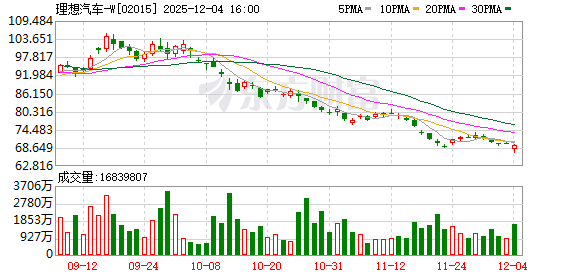
汽车股普遍下滑 广汽集团(02238)跌3.86% 市场对行业短期前景愈发谨慎
Xin Lang Cai Jing· 2025-12-04 11:25
Core Viewpoint - The automotive sector is experiencing a general decline, with several major companies reporting significant stock price drops, indicating a cautious outlook for the industry's short-term prospects due to unexpectedly rapid weakening of market demand and increasing risk signals for 2026 [1] Group 1: Stock Performance - GAC Group (02238) fell by 3.86% - Li Auto-W (02015) decreased by 3.37% - NIO-SW (09866) dropped by 2.41% - Beijing Automotive (01958) declined by 2.34% - Xpeng Motors-W (09868) saw a decrease of 2.25% - Leap Motor (09863) fell by 1.23% - Seres (09927) decreased by 1.12% [1] Group 2: Industry Outlook - There is an increasing caution regarding the short-term outlook for the automotive industry due to a faster-than-expected decline in market demand - According to CMB International, after a concentrated release in Q4, the first quarter of 2026 may return to a seasonal low, suggesting investors should navigate structural market conditions while remaining cautious and attentive to short-term fluctuations [1]


【券商聚焦】第一上海维持理想汽车(02015)买入评级 指产品换代周期后26年销量将恢复增长
Xin Lang Cai Jing· 2025-12-04 11:25
Core Viewpoint - Ideal Automotive (02015) is projected to experience a decline in vehicle sales revenue in Q3 2025, with a significant drop of 37.4% compared to Q3 2024, and a 10.4% decrease from Q2 2025, indicating potential challenges in maintaining revenue growth in the near term [1][3]. Group 1: Financial Performance - The vehicle sales revenue for Q3 2025 is estimated at RMB 259 billion (approximately USD 36 billion), down from RMB 413 billion in Q3 2024 [1][3]. - The vehicle gross margin for Q3 2025 is projected to be 15.5%, a decrease from 20.9% in Q3 2024 and 19.4% in Q2 2025. Excluding the estimated costs related to the recall of the Ideal MEGA, the gross margin would be 19.8% [1][3]. Group 2: Product Development and Market Strategy - Ideal Automotive's electric models, particularly the Ideal i8 and i6, are showing strong demand, with total orders exceeding 100,000 units [1][3]. - Starting in November, Ideal Automotive will implement a dual battery supplier model for the i6 to address supply chain constraints, with plans to increase monthly production capacity to 20,000 units by early next year [1][3]. - The L series is set for a new redesign in 2026, focusing on a streamlined SKU setup to enhance market coverage and supply efficiency, while also improving luxury feel and user experience [2][4]. Group 3: Future Projections - Following the product upgrade cycle, the company anticipates a recovery in sales growth, with projected sales of 400,000 units in 2025, 490,000 units in 2026, and 670,000 units in 2027. Corresponding revenues are expected to be RMB 1,122 billion, RMB 1,345 billion, and RMB 1,715 billion respectively [2][4]. - The net profit attributable to the parent company is forecasted to be RMB 11 billion in 2025, RMB 28 billion in 2026, and RMB 58 billion in 2027 [2][4]. - The company is expected to achieve a price-to-sales ratio of 1.2 in 2026, leading to a target stock price of USD 20.69 (HKD 87.85), indicating an upside potential of 15% and 26% from current prices [2][4].