
LI AUTO-W(02015)

Search documents
理想汽车盘前续涨超1% 近日发布首款AI智能眼镜Livis
Jin Rong Jie· 2025-12-05 09:59
Core Viewpoint - Li Auto (LI.US) has seen a stock increase of 0.86% yesterday and a further rise of 1.48% in pre-market trading today, reaching $17.85. The company officially launched its first AI smart glasses, Livis, priced starting at 1999 yuan, with a government subsidy of 15% available for orders placed before December 31, reducing the price to 1699 yuan. The Livis glasses weigh 36 grams, have a battery life of 18.8 hours, and come with a charging case that supports wireless charging and a Type-C charging port [1]. Company Summary - Li Auto's stock performance shows a positive trend with a 0.86% increase yesterday and a 1.48% increase in pre-market trading today, indicating investor confidence [1]. - The launch of Livis smart glasses marks a significant product expansion for Li Auto, showcasing its entry into the AI technology market [1]. - The pricing strategy includes a government subsidy, making the product more attractive to consumers, which could drive sales [1]. - The specifications of Livis, including its lightweight design and long battery life, position it competitively in the smart glasses market [1].

美股异动丨理想汽车盘前续涨超1% 近日发布首款AI智能眼镜Livis
Ge Long Hui A P P· 2025-12-05 09:40
Core Viewpoint - Li Auto (LI.US) continues to show positive stock performance, with a pre-market increase of 1.48% following the launch of its first AI smart glasses, Livis, priced starting at 1999 yuan [1] Company Summary - Li Auto's stock closed at $17.59 on December 4, 2023, and opened at $17.51 on December 5, 2023, with a pre-market price of $17.85 [1] - The company reported a trading volume of 4.9262 million shares and a total market capitalization of $17.754 billion [1] - The Livis smart glasses weigh 36 grams, have a battery life of 18.8 hours, and come with a charging case that supports wireless charging [1] - A government subsidy of 15% is available for orders placed before December 31, reducing the price to 1699 yuan [1] Financial Metrics - The stock's price-to-earnings (P/E) ratio is 27.06 (trailing twelve months) and 16.41 (forward) [1] - The price-to-book (P/B) ratio stands at 1.727, with a total share count of 1.009 billion [1] - The stock has a 52-week high of $33.12 and a low of $17.265, indicating significant price volatility [1]

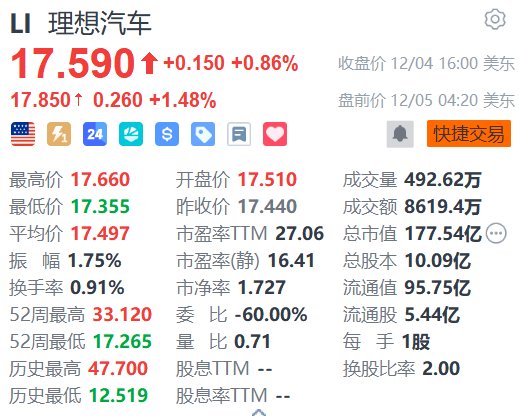
理想汽车累计交付量突破150万辆
Xin Lang Ke Ji· 2025-12-05 05:50
Group 1 - The core message is that Li Auto has achieved a significant milestone by surpassing 1.5 million cumulative vehicle deliveries [1][4][5] - The achievement reflects the choices of 1.5 million different families, highlighting the diverse lifestyles and experiences associated with the brand [5][3] - The company expresses gratitude for the support from its customers and looks forward to creating the next milestone together [5][3] Group 2 - The announcement was made via social media, specifically on Weibo, indicating the company's engagement with its audience [4][6] - The milestone is positioned as a collaborative achievement between the company and its customers, emphasizing community and shared experiences [5][3] - The company aims to continue its growth trajectory and maintain its focus on long-term strategies in the SUV market [6]
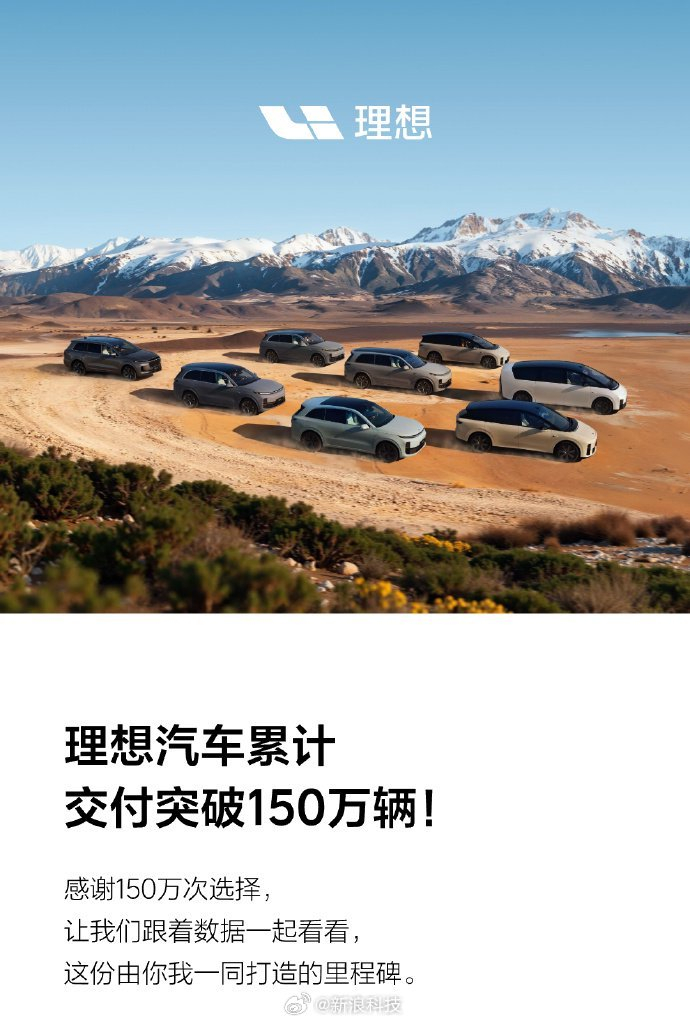
理想汽车2年8个月建成20000根超充桩
Zhong Guo Zhi Liang Xin Wen Wang· 2025-12-05 05:08
Group 1 - The core point of the article is that Li Auto has successfully established its 20,000th supercharging pile in Sanya, marking significant growth in its charging infrastructure since the launch of its first supercharging stations in April 2023 [1] - As of December 1, 2025, Li Auto has built a total of 3,040 5C charging piles, 10,258 4C charging piles, and 6,861 2C charging piles across the country [1] - Li Auto has constructed 3,614 supercharging stations, covering 31 provinces and over 260 cities, with an average of 4 new supercharging stations added daily and approximately 28 new charging piles added weekly [3] Group 2 - The company has achieved a national highway coverage rate of 70% with over 1,000 high-speed supercharging stations, connecting the busiest 18 highways and popular tourist routes such as the G318 Sichuan-Tibet line and Xinjiang [3] - In first and second-tier cities, Li Auto has established a 10-minute charging lifestyle circle, with core areas achieving an average coverage radius of 3 kilometers [3] - Li Auto's supercharging stations utilize fully liquid-cooled supercharging terminals, offering three power levels (5C, 4C, and 2C) to accommodate different vehicle needs, with over 7,000 4C charging piles and 6,000 2C charging piles available for all electric vehicle brands, totaling over 21 million charging services provided [4]
理想汽车发布AI眼镜Livis,可语音控车续航18.8小时
Zhong Guo Jing Ying Bao· 2025-12-05 04:47
Core Viewpoint - Li Auto has officially launched its first AI glasses, Livis, marking a significant expansion from the smart automotive sector into the smart wearable device market [1] Group 1: Product Features - Livis glasses weigh 36 grams and can operate continuously for 18.8 hours under typical usage scenarios [1] - The glasses are equipped with a 12-megapixel camera and features such as EIS electronic stabilization and automatic horizon correction [1] Group 2: Integration with Automotive Technology - Livis can execute voice commands through the "Li Xiang Classmate" system, allowing users to perform tasks like turning on the air conditioning and heating the steering wheel without needing to use their phones [1] Group 3: Strategic Vision - The Senior Vice President of Product at Li Auto, Fan Haoyu, stated that the company has been exploring smart device forms that can naturally and continuously accompany users, emphasizing that glasses are the most natural interaction entry point due to their long wear time [1]

汽车企业,压力来了!年终行情悬而未决,淘汰赛鸣笛!|人民智行
Zheng Quan Shi Bao Wang· 2025-12-05 03:01
Core Viewpoint - The Chinese automotive market faces significant uncertainty as it transitions into the "post-subsidy era," with many companies expressing concerns about market conditions and competition intensifying [1][2][5]. Group 1: Market Conditions - By the end of 2025, the anticipated "tail effect" in the automotive market remains uncertain, with many companies unprepared for year-end sales targets [2][5]. - The withdrawal of local replacement subsidies and the adjustment of the new energy vehicle purchase tax from full exemption to a 50% reduction are expected to increase purchase costs for consumers [2][5]. - The overall automotive sales in China from January to October reached 27.687 million units, reflecting a year-on-year growth of 12.4% [5]. Group 2: Competitive Landscape - Companies are increasingly adopting "bottom-line" subsidy strategies to boost year-end sales, which may raise sales costs and challenge smaller brands with limited profit margins [3][4]. - The competition is expected to become more transparent and brutal, focusing on product strength, cost control, and user experience as the market moves away from policy-driven growth [5][9]. - The market is predicted to see a significant divide, with leading companies leveraging scale advantages and brand influence, while smaller brands may struggle with cash flow and product iteration [8][10]. Group 3: Future Outlook - The automotive industry is entering a phase where only a few strong brands are likely to survive, with predictions suggesting that in the future, only five dominant brands will remain in the market [10][11]. - The shift away from policy reliance is expected to allow companies to focus on technological innovation and service upgrades, fostering healthier industry development [10][11].


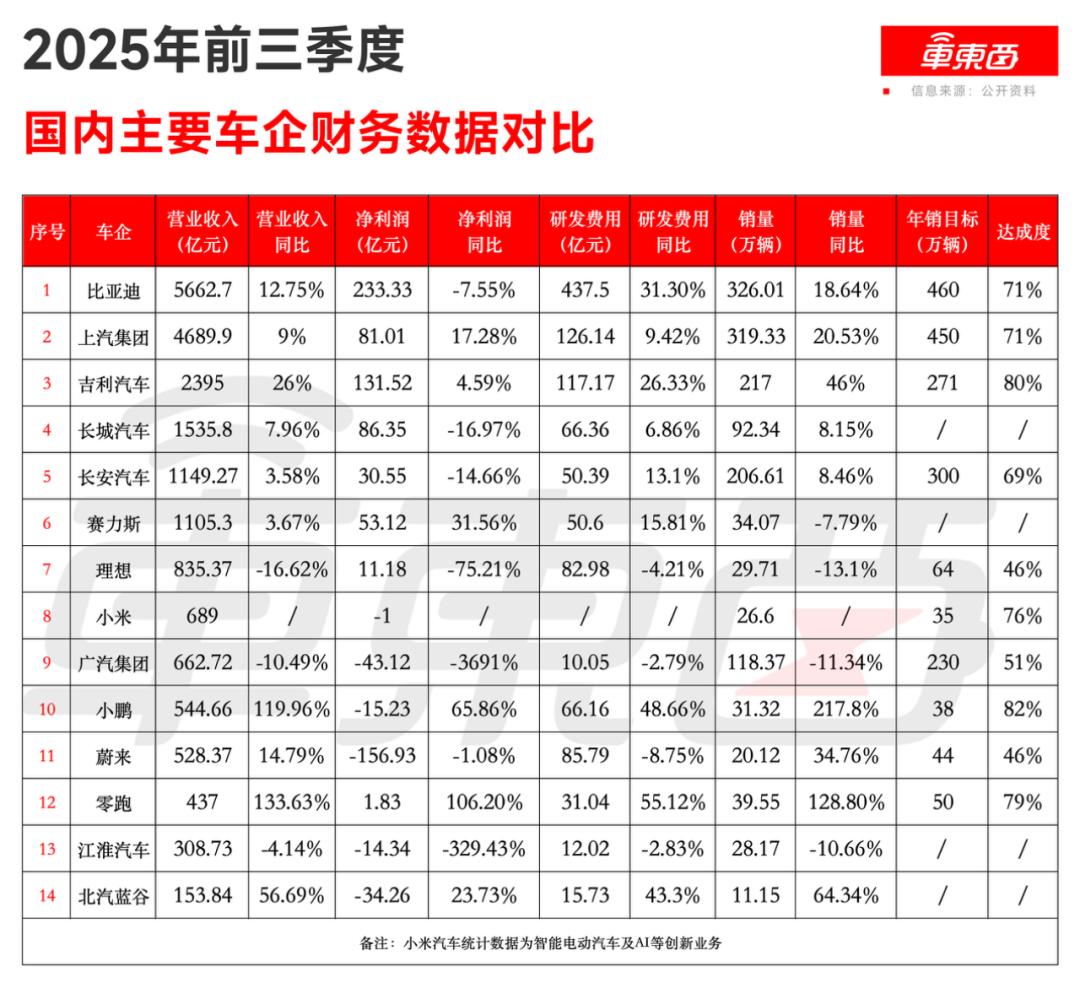
比亚迪赚走6成利润,6家新势力亏掉107亿,14大车企前三季度业绩锐评
3 6 Ke· 2025-12-05 02:56
Core Insights - The financial reports of 14 major domestic car manufacturers for the first three quarters of 2025 show a total revenue of 2.07 trillion yuan and a net profit of 364 billion yuan, resulting in a net profit margin of only 1.76% [2][6][22]. Group 1: Financial Performance - Among the traditional car manufacturers, eight companies reported a combined net profit exceeding 471 billion yuan, with BYD leading with a net profit of 233 billion yuan, accounting for 64% of the total net profit of the 14 companies [4][8]. - Geely's revenue reached 239.5 billion yuan, a 26% increase year-on-year, with a net profit of 131.52 billion yuan, benefiting from its accelerated transition to new energy vehicles [8][22]. - The new energy vehicle sector is experiencing significant losses, with six new entrants collectively losing 107 billion yuan, while only Seres, Li Auto, and Leap Motor reported profits [4][6][22]. Group 2: Revenue and Profit Comparison - BYD's revenue was 566.27 billion yuan, a 12.75% increase, while its net profit decreased by 7.55% [5][7]. - SAIC Group reported a revenue of 468.99 billion yuan and a net profit of 81.01 billion yuan, both showing growth [11][22]. - NIO's revenue was 528.37 billion yuan, with a significant net loss of 156.93 billion yuan, highlighting the challenges faced by the company [22][24]. Group 3: R&D Investment - BYD led in R&D investment with 437.5 billion yuan, a 31.3% increase, indicating a commitment to technological expansion despite a slight decline in net profit [25][29]. - Geely's R&D expenditure was 117 billion yuan, up 26%, reflecting its focus on innovation [29][32]. - NIO, despite its losses, invested 85.79 billion yuan in R&D, maintaining a strong commitment to technology development [32][36]. Group 4: Sales Performance - The total sales volume for the 14 companies reached 15 million units, with BYD, SAIC, Geely, and others achieving significant growth [37][41]. - BYD sold 3.26 million vehicles, a year-on-year increase of 18.64%, while SAIC's sales reached 3.19 million units, growing by 20.53% [38][45]. - New entrants like Leap Motor and Xpeng saw substantial sales increases, with Leap Motor's sales up 128.8% and Xpeng's up 217.8% [49][50]. Group 5: Market Dynamics - The competitive landscape in the automotive industry is intensifying, with companies facing pressures from supply chain costs, rapid technological changes, and the need for substantial R&D investments [52]. - The performance of these 14 companies reflects a growing divide in profitability, with only a few achieving a balance between revenue growth and profit margins [22][52].



年终行情悬而未决,“后补贴时代”车市淘汰赛鸣笛
Zheng Quan Shi Bao· 2025-12-05 02:32
Core Viewpoint - The Chinese automotive market faces uncertainty as it transitions into the "post-subsidy era," with increased competition and policy changes impacting sales expectations for the end of 2025 [1][2][5]. Group 1: Market Conditions - Many car manufacturers are uncertain about their sales expectations for December, with some executives stating they are unprepared for the challenges ahead [2]. - The withdrawal of local trade-in subsidies and the upcoming reduction in purchase tax for electric vehicles are significant factors contributing to the market's unpredictability [2][6]. - The cumulative sales of automobiles in China from January to October reached 27.687 million units, reflecting a year-on-year growth of 12.4% [6]. Group 2: Competitive Landscape - The automotive industry is entering a new phase where competition will focus on product quality, cost control, and user experience, marking a shift away from reliance on subsidies [1][4][10]. - The introduction of "bottom-line" subsidy schemes by companies like Xiaomi and NIO indicates a strategic response to pressure from declining sales and inventory management [3][4]. - The market is expected to see a significant differentiation among brands, with larger companies better positioned to absorb profit pressures compared to smaller firms [8][9]. Group 3: Future Outlook - Analysts predict that the automotive market will experience a decline in sales pressure due to macroeconomic factors and policy changes, leading to a more stable and mature phase for the electric vehicle sector [8][10]. - The competition will intensify, with companies needing to innovate and improve efficiency to survive, as traditional factors like technology and cost control become critical in consumer decision-making [9][10]. - The industry is anticipated to undergo a significant reshaping, with only a few strong brands likely to survive in the long term, as indicated by industry leaders [11].
卖车的理想,用AI眼镜试探“具身智能”
Bei Ke Cai Jing· 2025-12-05 01:32
Core Viewpoint - Li Auto has launched its first AI glasses, Livis, priced from 1999 yuan, marking a significant exploration in the field of embodied intelligence [2][4]. Group 1: Product Features and Positioning - Livis is positioned as an important accessory for Li Auto, with Chairman Li Xiang stating it is "the best AI accessory" [2]. - Unlike other automakers focusing on humanoid robots, Li Auto has opted for AI glasses as its entry into the embodied intelligence sector [3]. - Livis emphasizes user experience with a weight of 36 grams, balanced design, and a battery life of 18.8 hours [8]. - The glasses do not feature optical displays or independent terminals, nor do they use Qualcomm chips, focusing instead on lightweight design and long battery life [7]. Group 2: Technological Integration and Functionality - Livis is equipped with a self-developed embedded operating system, Livis OS, and features enhanced interaction with vehicles [9]. - The glasses allow users to remotely unlock and control their vehicles, with future capabilities including summon and automatic parking [9]. - Li Auto defines Livis as a "wearable robot," indicating its role beyond just being an accessory for vehicles [10]. Group 3: Market Strategy and Competition - The company has modest expectations for the first generation of Livis, aiming for high conversion rates among its 1.4 million vehicle owners while also seeking to expand beyond this user base [11]. - Li Auto faces competition from traditional tech companies with broader user bases in the AI glasses market [12]. - The starting price of 1999 yuan positions Livis as a strategic product to capture market share in the AI glasses sector [13]. Group 4: Future Vision and Challenges - Li Xiang envisions the next decade focused on developing embodied intelligence, integrating it with existing machines to enhance their capabilities [14]. - The company sees AI glasses as a starting point in the embodied intelligence field, with aspirations to become a leading player in the next 3-5 years [16]. - Despite the potential for commercialization, challenges remain in technology, regulations, user acceptance, and market perception [17]. - Li Auto must balance its transition towards embodied intelligence with its core automotive business [18].
年终行情悬而未决 “后补贴时代”车市淘汰赛鸣笛
Zheng Quan Shi Bao· 2025-12-04 22:21
Core Viewpoint - The Chinese automotive market faces uncertainty as it transitions into the "post-subsidy era," with increased competition and policy changes impacting sales expectations for the end of 2025 [1][2]. Group 1: Market Dynamics - Many car manufacturers are uncertain about their sales expectations for December, with some indicating a lack of preparedness for the end-of-year sales push [2]. - The withdrawal of local trade-in subsidies and the adjustment of the new energy vehicle purchase tax from full exemption to a 50% reduction are significant factors affecting consumer purchasing decisions [2][3]. - The market is moving away from reliance on policy support, entering a phase where product quality and user experience will be the primary competitive factors [1][6]. Group 2: Competitive Landscape - The competition among car manufacturers is expected to intensify, with a focus on product strength, cost control, and user experience as key differentiators [1][9]. - Smaller brands may struggle to absorb increased sales costs associated with "bottom-line" subsidy schemes, leading to potential operational challenges [4][9]. - The market is predicted to undergo significant differentiation, with leading companies leveraging scale and brand influence to maintain competitiveness [8][10]. Group 3: Industry Trends - The automotive industry is witnessing a shift towards a more transparent and direct competition environment, with a potential "淘汰赛" (elimination race) for less competitive players [10][11]. - Companies that can innovate and maintain service quality are likely to thrive, while those lacking core technology and cost control may face difficulties [10][11]. - The overall sentiment indicates that the automotive market will see a consolidation of strong brands, with predictions that only a few dominant players will remain in the long term [11].