
CITIC Securities Co., Ltd.(06030)

Search documents
2025券商IPO业务收官:行业集中度高企,头部券商优势更加凸显
中国基金报· 2025-12-31 16:10
Core Viewpoint - The competition landscape for IPO underwriting in the A-share market has solidified, with leading brokerages maintaining a stronghold while smaller firms carve out niches in specific segments [1] Group 1: IPO Underwriting Landscape - The top five brokerages accounted for approximately 50% of the total IPO underwriting in 2025, indicating a high concentration in the industry [1] - The leading brokerages in IPO underwriting for 2025 are Guotai Junan (19), CITIC Securities (17), CITIC Jianou (12), China Merchants Securities (10), and Huatai United (9) [1] Group 2: Science and Innovation Board - The Science and Innovation Board (STAR Market) raised a total of 633.71 billion yuan, nearly half of the total IPO fundraising for the year, highlighting its significance for financing technology and emerging industries [2] - CITIC Securities led the STAR Market with an underwriting scale of 168.95 billion yuan, capturing a market share of 44.64% [2] - Notable projects such as Moore Threads contributed significantly to CITIC Securities' underwriting scale, while Huatai United's project with Muxi Co. accounted for 92% of its STAR Market underwriting [2] Group 3: Growth in Other Markets - In the Growth Enterprise Market (GEM), Guotai Junan and China Merchants Securities showed a strong advantage, followed closely by CITIC Securities, Shenwan Hongyuan, and CICC [4] - The top five brokerages for GEM IPO underwriting in 2025 were Guotai Junan (6), China Merchants Securities (4), CITIC Securities (3), Shenwan Hongyuan (3), and CICC (2) [4] Group 4: North Exchange Market - The North Exchange Market continued to focus on serving innovative small and medium-sized enterprises, with the top five brokerages being China Merchants Securities, Huatai United, Dongfang Securities, Guotou Securities, and Guojin Securities [6] Group 5: Regulatory Environment - The China Securities Association's evaluation of securities firms' investment banking quality in 2025 showed that 12 firms received an A rating, with five firms maintaining this rating for two consecutive years, indicating stable business quality management [7] - The shift of over half of last year's A-rated firms to B or C ratings reflects the dynamic optimization of the evaluation system and the ongoing trend of strict regulation and compliance in the securities industry [7] Group 6: Outlook for 2026 - The IPO market is expected to remain active in 2026, with a steady growth pace and structural optimization, particularly in the dual innovation sector [9] - Hard technology companies in fields such as semiconductors, artificial intelligence, quantum computing, commercial aerospace, and biomedicine are anticipated to increase their presence in the capital market [9] - The competition among brokerages is expected to intensify, with a focus on serving technological innovation and industrial upgrades, as well as the evolving competitive landscape between leading firms and niche players [9]



2025券商IPO承销收官,头部券商优势凸显,行业集中度继续高企
Zheng Quan Shi Bao· 2025-12-31 15:04
Group 1 - The core viewpoint of the article highlights the competitive landscape of the IPO market in A-shares for 2025, indicating that leading brokerage firms maintain a strong position while smaller firms find opportunities in niche segments [1] - The top five brokerage firms accounted for nearly half of the total IPO projects in the market, reflecting a high concentration in the industry [1][4] - The dual innovation board is identified as a key platform for financing technology and emerging industries, raising a total of 633.71 billion yuan, which constitutes nearly half of the annual IPO fundraising total [4] Group 2 - In the 2025 A-share IPO underwriting rankings, CITIC Securities led with 270 projects, followed by Guotai Junan with 19 projects, and CITIC Jianou with 12 projects [2] - For the Sci-Tech Innovation Board, CITIC Securities dominated with an underwriting scale of 168.95 billion yuan, capturing over 44% of the market share [4][5] - The top five underwriters for the Growth Enterprise Market included Guotai Junan and China Merchants Securities, with underwriting amounts of 57.61 billion yuan and 45.46 billion yuan, respectively [6] Group 3 - The Beijing Stock Exchange continued to enhance its service for innovative small and medium-sized enterprises, adding 26 new companies to the market in 2025 [7] - The leading underwriters for the Beijing Stock Exchange included China Merchants Securities and Huatai United, with underwriting amounts of 192 million yuan and 14.78 million yuan, respectively [8] Group 4 - The regulatory environment remains stringent, with the China Securities Association publishing the 2025 evaluation results for securities firms' investment banking business quality, reflecting a dynamic optimization of the evaluation system [9][10] - A total of 12 brokerage firms received an A-class rating, with five firms maintaining this rating for two consecutive years, indicating stable business quality management capabilities [10] Group 5 - Looking ahead to 2026, the IPO market is expected to remain active with a steady growth rhythm, characterized by structural optimization and an increase in financing for dual innovation enterprises [11][12] - The focus will be on hard technology sectors such as semiconductors, artificial intelligence, and biomedicine, with an anticipated increase in the number of listings from companies in these fields [12]
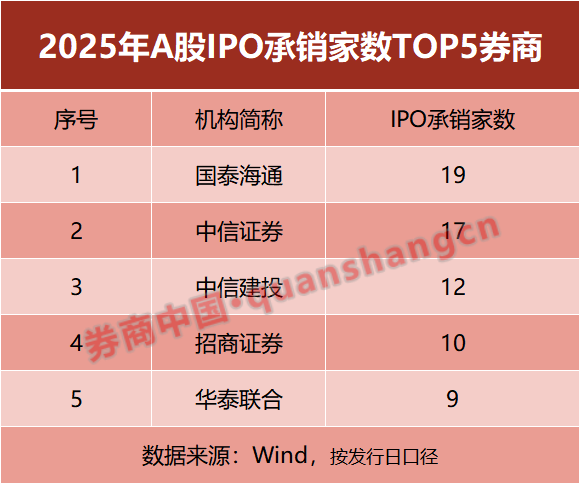
2025券商IPO承销收官!头部券商优势凸显,行业集中度继续高企
券商中国· 2025-12-31 14:38
Core Viewpoint - The competition landscape among securities firms in the A-share IPO market has solidified with the successful listings of companies like Hengdongguang and Xinguoyi, marking the end of the 2025 A-share IPO season [1] Group 1: Overall Market Dynamics - Leading securities firms maintain a strong competitive edge, while smaller firms have made breakthroughs in niche segments. The top five firms account for nearly half of the total IPO projects in the market [2] - In 2025, the top five securities firms by IPO underwriting numbers are Guotai Haitong (19), CITIC Securities (17), CITIC Jianou (12), China Merchants Securities (10), and Huatai United (9) [3] Group 2: Differentiated Competition - The dual innovation board is a key platform for financing technology and emerging industries, raising a total of 633.71 billion yuan, which constitutes nearly half of the annual IPO fundraising total. This area is highly competitive among securities firms [4] - CITIC Securities leads the Sci-Tech Innovation Board with an underwriting scale of 168.95 billion yuan, capturing over 44% of the market share. Notable projects like Moore Threads contributed significantly to this figure [4] - The top five firms for the Sci-Tech Innovation Board in terms of underwriting numbers are CITIC Securities (7), CITIC Jianou (3), CICC (3), Huatai United (2), and others [5] - For the Growth Enterprise Market, Guotai Haitong and China Merchants Securities have a notable lead with 6 and 4 projects respectively, and underwriting amounts of 57.61 billion yuan and 45.46 billion yuan [6] Group 3: Regulatory Environment - The China Securities Association released the 2025 evaluation results for securities firms' investment banking business, indicating a focus on quality control and compliance. Twelve firms received an A rating, with five firms maintaining this rating for two consecutive years [9] - The dynamic optimization of the evaluation system reflects the ongoing trend of strict regulation and compliance in the securities industry [9] Group 4: Outlook for 2026 - The IPO market is expected to remain active in 2026, with a structural optimization characterized by stable volume and improved quality. The dual innovation sector is anticipated to see an expansion in financing and quality [10] - Hard technology companies in sectors such as semiconductors, artificial intelligence, quantum computing, commercial aerospace, and biomedicine are expected to increase their presence in the capital market [10] - The competition among securities firms will intensify, focusing on serving technological innovation and industrial upgrades, with a continued evolution in the competitive landscape between leading firms and niche market leaders [10]




并购提速!头部券商持续领跑
券商中国· 2025-12-31 14:38
在上市公司控制权变更领域,根据Wind全球并购库数据统计,2025年首次披露上市公司控制权变更交易183 单,相较2023年、2024年分别增长357.50%、144.00%。 在此过程中,各证券公司纷纷加大对并购业务的投入,头部效应仍十分明显。 许可类重组审核通过口径,8家券商市占率78%,华泰联合证券排名第一 在沪深北交易所并购重组委审议方面,2025年,上交所共召开23次并购重组审核委员会会议,深交所共召开17 次并购重组审核委员会会议,北交所召开1次并购重组审核委员会会议,合计审议通过40单行政许可类重组交 易,涉及独立财务顾问49家次,担任超过1单交易独立财务顾问身份的券商共有8家。数据显示,重组业务"领 头羊"华泰联合证券、中信建投证券、中信证券领跑市场, 具体如下: | 排名 | 机构名称 | 重组委审议通过 | | --- | --- | --- | | | | 車数 | | 1 | 华泰联合证券 | 8 | | 2 | 中信建投证券 | 7 | | 3 | 中信证券 | | | 4 | 乐方计车 | 4 | | 4 | 国泰海通证券 | 4 | | 4 | 中等公司 | 4 | | 7 | ...

中信证券(06030) - 有关向H 股股东派发2025年中期股息的安排及股息货币选择的公告
2025-12-31 14:00
香港交易及結算所有限公司及香港聯合交易所有限公司對本公告的內容概不負責,對其準確性或完整性亦不發表 任何聲明,並明確表示,概不對因本公告全部或任何部分內容而產生或因倚賴該等內容而引致的任何損失承擔任 何責任。 6030 有關向 H 股股東派發 2025 年中期股息的安排及股息 貨幣選擇的公告 茲題述中信証券股份有限公司(「本公司」)日期為2025年12月1日之通函及2025年第一次 臨時股東大會(「臨時股東大會」)通告,及日期為2025年1 2月1 9日的公告(「該公告」), 內容有關(其中包括)本公司派發2025年中期股息(「中期股息」)。 港幣實際派發金額按照臨時股東大會召開日前五個工作日中國人民銀行公佈的人民幣兌 換港幣平均基準匯率計算。經本公司最終測算,人民幣兌港幣匯率應為人民幣1元: 港幣 1.1019元,經調整後每10股派息港幣金額調整為港幣3.1956元。 向H股股東派發中期股息的安排 該公告內中期股息派發的其餘安排如下: – H股股東資格及股權登記日:2026年1月6日(星期二)營業時間結束時名列本公司股東名冊 之H股股東。 - 1 - 敬請股東留意該公告及本公司刊發相關股息或分派(公告表格) ...
中国证券业协会公布2025年券商投行等三项业务排名
Sou Hu Cai Jing· 2025-12-31 13:07
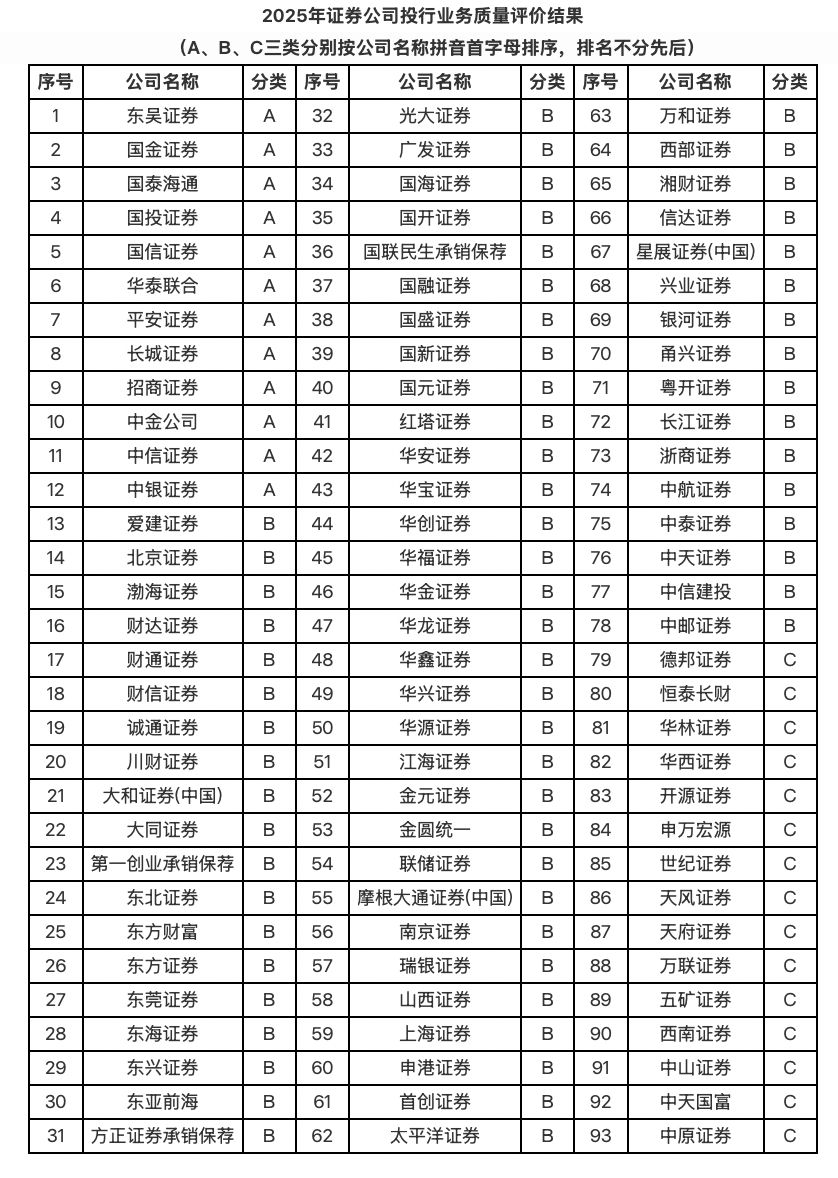
Core Insights - The China Securities Association released the rankings for securities firms in 2025, reflecting their performance in investment banking, financial advisory, and bond business quality [1][2] Group 1: Evaluation Results - A total of 93 securities firms were evaluated for their investment banking quality, with 12 classified as A, 66 as B, and 15 as C [2][5] - The A-rated firms include Dongwu Securities, Guojin Securities, Guotai Junan, Guotou Securities, Guoxin Securities, Huatai United, Ping An Securities, Changcheng Securities, China Merchants Securities, CICC, CITIC Securities, and Bank of China Securities [6][11] Group 2: Financial Advisory Evaluation - The financial advisory business evaluation included 30 firms, with 5 rated A, 19 rated B, and 6 rated C [6][7] - A-rated financial advisory firms are Huatai United, Galaxy Securities, CICC, CITIC Jianan, and CITIC Securities [7] Group 3: Bond Business Evaluation - The bond business evaluation involved 95 firms, resulting in 14 rated A, 62 rated B, and 19 rated C [10][11] - A-rated bond firms include Caixin Securities, Dongwu Securities, Guojin Securities, Guotai Junan, Guoxin Securities, Ping An Securities, and others [10] Group 4: Future Directions - The China Securities Association aims to guide firms to enhance their professional capabilities and service quality, shifting from price competition to value competition [11]



中集车辆接待17家机构调研,包括睿远基金、中信证券、长江证券、西南证券等
Jin Rong Jie· 2025-12-31 13:03
Group 1 - The core viewpoint of the news is that CIMC Vehicles has been actively engaging with various investment institutions to address investor concerns regarding its performance fluctuations and to highlight its strategic initiatives in the North American market and global southern markets [1][2]. Group 2 - CIMC Vehicles conducted investor meetings from December 1 to December 26, 2025, with 17 institutions, including Ruiyuan Fund and CITIC Securities [1]. - The company's latest stock price is 9.15 yuan, down 0.52 yuan or 5.38% from the previous trading day, with a total market capitalization of 17.148 billion yuan [1]. - The rolling P/E ratio of the automotive manufacturing industry is 27.12, with a median of 20.46, while CIMC Vehicles has a P/E ratio of 19.84, ranking 7th in the industry [1]. - For the first three quarters of 2025, CIMC Vehicles reported a non-recurring net profit attributable to shareholders of 622 million yuan, impacted by geopolitical issues and trade wars affecting market structure [1]. - The company has localized its manufacturing and delivery of semi-trailers in North America, including box-type and refrigerated semi-trailers [1]. - In the global southern market, CIMC Vehicles experienced a revenue increase of 15.79% and a sales volume increase of 21.39% in the first three quarters of 2025, with a gross margin increase of 2.6 percentage points [2]. - The company has sold over 30,000 units of the CIMC-Shaanxi Automobile "Three Good Development" model and established 15 "Three Good Centers" nationwide [2]. - As of September 30, 2025, CIMC Vehicles had 29,809 shareholders, a decrease of 5,707 from the previous count, with an average holding value of 575,300 yuan and an average holding of 62,900 shares [2].
2025券商IPO业务收官 头部券商优势更加凸显
Zhong Guo Zheng Quan Bao· 2025-12-31 12:42
中证报中证网讯(记者 赵中昊)伴随着蘅东光、新广益成功登陆资本市场,2025年A股IPO收官,券商 IPO竞争格局落定。总体看,头部券商稳固领先,中小券商细分赛道突围。从核心业务指标来看,行业 集中度高企态势持续,Wind数据显示,前5名券商合计承销IPO项目64家,占全市场承销家数约五成。 券商差异化竞争格局日益凸显。Wind数据显示,双创板块是IPO支持科技与新兴产业融资的核心载体, 合计募资633.71亿元(按发行日口径,下同),占全年IPO募资总额近一半,成为券商必争之地。其 中,科创板依旧呈现头部集中态势,中信证券以168.95亿元承销规模、44.64%的市场份额领跑所有券 商。明星科技企业的标杆拉动效应再度彰显,其中摩尔线程单项目即为中信证券贡献近72亿元承销规 模;华泰联合承销的沐曦股份项目规模近42亿元,占其科创板承销业务总规模的92%。 据Wind数据,北交所持续深化服务创新型中小企业的核心定位,承销排名前五的券商依次为招商证 券、华泰联合、东方证券、国投证券、国金证券。 近日,中国证券业协会2025年证券公司投行业务质量评价结果公布,12家券商获得A类评价,较去年增 加1家。其中,国泰海通 ...
YiwealthSMI|东方财富登顶榜首,趣味、专业兼顾的投教内容获青睐
Di Yi Cai Jing· 2025-12-31 12:13
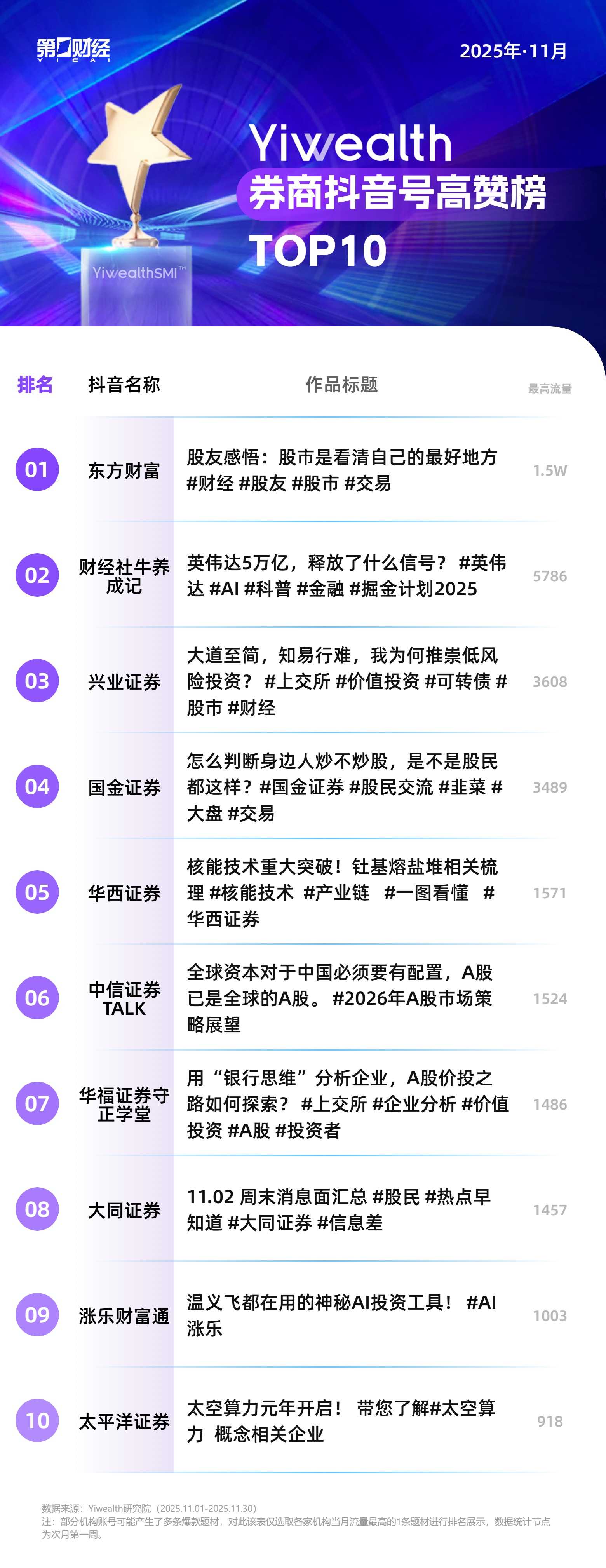
Group 1 - The Securities Social Media Index (SMI) for November 2025 shows a stable top tier, with significant ranking changes among brokerages [1] - The top three positions are held by Dongfang Caifu, CITIC Securities, and Guojin Securities, with Dongfang Caifu rising from second to first place and Guojin Securities jumping from eighth to third [1] - New entrants to the list include Guotai Haitong, Hu'an Securities, Kaiyuan Securities, and Huafu Securities, while firms like Debang Securities and Shanxi Securities dropped out [1] Group 2 - The Douyin high-praise list for November highlights emotional, trending, and practical content, with Dongfang Caifu's post on investment behavior resonating emotionally, achieving 15,000 likes [2] - Guojin Securities used a humorous approach to engage users by discussing characteristics of stock investors, which also garnered significant attention [2] - Other notable content includes analyses on Nvidia's market value and nuclear technology breakthroughs, indicating a growing interest in educational and global perspectives among users [2] Group 3 - Video content from brokerages focuses on brand promotion and in-depth research, with CITIC Securities discussing A-share market strategies for 2026, receiving nearly 1,000 likes [6] - Hongta Securities analyzed new opportunities in the consumer industry related to the "Double Eleven" shopping festival, providing a comprehensive investment overview [6] Group 4 - The public account rankings emphasize important market information and investment foresight, with CITIC Securities' extensive report on 2026 trends achieving over 100,000 reads, showcasing the demand for in-depth research [12] - The content reflects a shift in investor needs, focusing on emotional resonance and understanding rather than just investment advice, highlighting the importance of engaging and relatable communication [15]

中信证券资产管理有限公司增持中广核电力3049.4万股 每股作价约2.94港元
Zhi Tong Cai Jing· 2025-12-31 11:08
香港联交所最新资料显示,12月30日,中信证券资产管理有限公司增持中广核电力(01816)3049.4万股, 每股作价2.9394港元,总金额约为8963.41万港元。增持后最新持股数目约为20.36亿股,最新持股比例 为18.24%。 ...