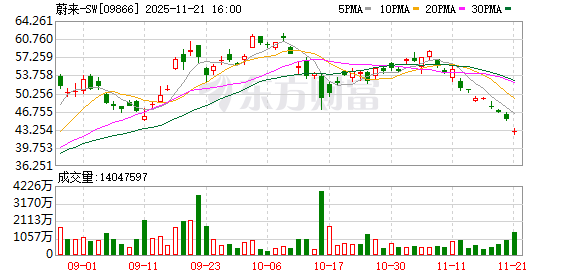
NIO(09866)

Search documents
港股收盘(11.24) | 恒指收涨1.97% 科技股表现强势 快手-W(01024)劲升逾7%
智通财经网· 2025-11-24 08:52
Core Viewpoint - The expectation for a rate cut by the Federal Reserve in December has increased, leading to a rise in Hong Kong stock indices, with the Hang Seng Index closing up 1.97% at 25,716.5 points, and a total trading volume of 302.64 billion HKD [1] Group 1: Market Performance - The three major indices in Hong Kong collectively rose, with the Hang Seng Index gaining over 2% at one point during the day [1] - The Hang Seng Technology Index increased by 2.78%, closing at 5,545.56 points [1] - The trading volume for the day reached 302.64 billion HKD [1] Group 2: Blue-Chip Stocks - Alibaba-W (09988) saw a significant increase of 4.67%, closing at 154.5 HKD, contributing 104.44 points to the Hang Seng Index [2] - Kuaishou-W (01024) rose by 7.11%, while NetEase-S (09999) increased by 5.87%, contributing 21.51 points and 26.03 points to the index respectively [2] Group 3: Sector Performance - Technology stocks rebounded, with Kuaishou rising over 7% and NetEase nearly 6% [3] - AI applications are gaining traction, with notable increases in stocks related to AI, such as Chuangmeng Tiandi (01119) up 9.38% and Innovation Qizhi (02121) up 8.83% [3] - Military stocks performed strongly, with China Shipbuilding Defense (00317) rising by 13.07% [4] Group 4: Automotive Sector - The automotive sector saw widespread gains, with GAC Group (02238) increasing by 12.03% and Beijing Automotive (01958) rising by 5.91% [5] - The Guangzhou Auto Show featured 93 new car launches, with nearly 60% being new energy vehicles [6] Group 5: Lithium and Semiconductor Stocks - Lithium stocks continued to decline, with Ganfeng Lithium (01772) down 5.66% [7] - Semiconductor stocks showed weakness, with Hua Hong Semiconductor (01347) falling by 4.91% [7] Group 6: Notable Stock Movements - Innovation Industry (02788) debuted with a significant increase of 32.76%, closing at 14.59 HKD [9] - Silver诺医药-B (02591) surged by 31.15% after being included in the Hang Seng Composite Index [10] - Miniso (09896) faced pressure post-earnings, with a decline of 4.84% despite a revenue increase of 28.2% [11]



Nio Takes Critical Step for Its Next Growth Phase
The Motley Fool· 2025-11-24 07:14
Core Insights - Nio is experiencing significant growth driven by its new sub-brands, Firefly and Onvo, with October deliveries increasing by 92.6% year-over-year and year-to-date deliveries up nearly 42% [1][2] Group 1: Brand Performance and Market Strategy - The Firefly brand, launched recently, delivered 5,912 vehicles in October, representing about 14% of Nio's total monthly deliveries, indicating substantial growth potential [2] - Firefly is designed with global markets in mind, particularly targeting the compact car segment, which constitutes approximately 17% of global annual sales, with Europe accounting for a third of that market [2][4] Group 2: International Expansion - Nio is focusing on right-hand-drive markets with no punitive tariffs on Chinese EVs, having recently exported its first right-hand-drive vehicles to Singapore, with plans to enter Thailand and Great Britain next year [3][5] - The company is adapting its digital system interface for European consumer preferences, although it faces challenges from tariffs that have increased vehicle prices [4] Group 3: Competitive Landscape - Nio's expansion into right-hand-drive markets reflects the pressure to improve financials amid a price war in its home market, with Chinese automakers expected to export 7.5 million vehicles this year, up from 1 million at the beginning of the decade [5] - The move also positions Nio closer to entering the U.S. market, which is currently protected by high tariffs, as domestic automakers recognize the competitive threat posed by Chinese EVs [7][9] Group 4: Production and Capacity Utilization - Exporting vehicles helps Nio utilize production capacity during a period of industry overcapacity, while also preparing for broader international expansion [8]


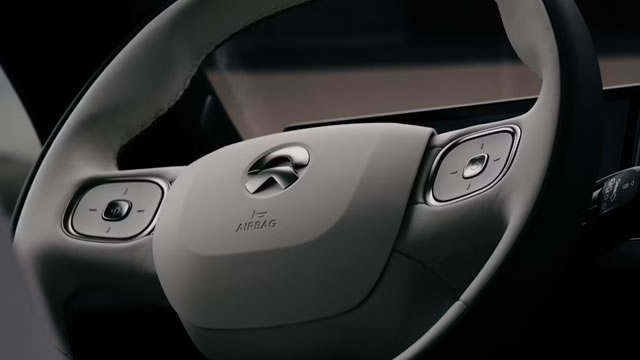
马麟:蔚来“三个坚持”助推产业提质升级
Zhong Guo Qi Che Bao Wang· 2025-11-24 07:10
Core Viewpoint - The future growth of the Chinese automotive industry hinges on companies becoming true innovation leaders, which is essential for maintaining competitive advantage in the global market [2] Group 1: Product, Technology, and Energy Collaboration - The automotive industry is at a transformative intersection of information technology, energy, and automotive sectors, with China leveraging its market scale, supply chain, talent base, and institutional environment to lead global development [3] - NIO plans to implement a multi-brand strategy by 2025, establishing three brands: NIO, Lido, and Firefly, to cover a wider price range and meet diverse consumer demands [3] - As of October 2025, NIO has delivered over 910,000 vehicles, with a record monthly delivery of over 40,000 units in October [3] Group 2: Technological Advancements - NIO has developed a comprehensive R&D system covering key areas such as chips, batteries, electric drives, and intelligent driving systems, with over 63 billion yuan invested in R&D over the past decade and more than 999 global patent applications [4] - The self-developed 5nm intelligent driving chip, NX9031, has been implemented, making NIO one of only two companies globally to have self-developed driving chips integrated into vehicles [4] - NIO has invested over 18 billion yuan in charging and battery swap infrastructure, establishing over 3,500 battery swap stations and completing over 90 million charging and swapping services [4] Group 3: Strategic Initiatives for Automotive Power - NIO's strategy includes three key principles: focusing on independent R&D of core technologies, systematic infrastructure development, and differentiated development paths through a multi-brand strategy [5] - The emphasis on independent R&D is crucial for establishing a sustainable competitive advantage in the global market for smart electric vehicles [5] - Infrastructure development is seen as a public foundation that enhances industry efficiency and promotes the adoption of smart electric vehicles [5] Group 4: Vision for the Future - The "14th Five-Year Plan" outlines a new development blueprint for the Chinese automotive industry, with companies like NIO committed to long-term independent R&D to transition China from a major automotive nation to a strong automotive nation [6]

股票市场概览:资讯日报:纽约联储行长鸽派言论提振市场情绪-20251124
Guoxin Securities Hongkong· 2025-11-24 06:39
Market Overview - The Hang Seng Index closed at 25,220, down 2.38% for the day and 5.09% for the week, but up 25.72% year-to-date[3] - The Hang Seng Technology Index fell 3.21% to 5,395, with a year-to-date increase of 20.76%[3] - The Hang Seng China Enterprises Index decreased by 2.45% to 8,920, with a year-to-date rise of 22.36%[3] - The Shanghai Composite Index dropped 2.45% to 3,835, with a year-to-date increase of 14.41%[3] Sector Performance - The lithium battery sector saw significant declines, with Ganfeng Lithium down over 12% and Tianqi Lithium down over 11%[9] - Semiconductor stocks also performed poorly, with Innolux down over 8% and SMIC and Hua Hong Semiconductor both down over 6%[9] - Xiaomi-related stocks rose against the trend, driven by the launch of Xiaomi's enhanced smart driving system[9] U.S. Market Insights - On November 21, U.S. markets saw all major indices rise, with the Dow Jones gaining approximately 1.1%[9] - The probability of a 25 basis point rate cut by the Federal Reserve in December increased from under 40% to over 70% following dovish comments from New York Fed President Williams[9] - Notable movements in large tech stocks included Google up 3.53% and Nvidia down 0.96%[9] Japanese Market Trends - The Nikkei 225 index fell 2.4%, with a cumulative decline of 3.5% over the past week[13] - Japanese semiconductor stocks faced significant drops, with Tokyo Electron down 7.14% and Advantest down 12.10%[13] - The Japanese government announced a $135 billion economic stimulus plan, adding pressure to the yen and government bonds[13]





ET9、全新ES8迎OTA升级 新增巡航红绿灯显示
Zhong Guo Zhi Liang Xin Wen Wang· 2025-11-24 04:52
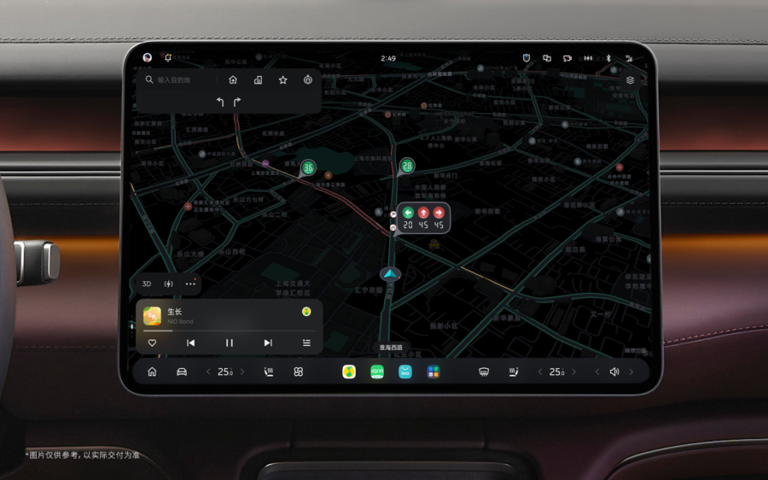
Group 1 - NIO has released the Cedar 1.3.5 version update for ET9 and the new ES8, focusing on upgrades in smart cockpit, NOMI, and driving experience [1] - The "Cruise Traffic Light Display" feature allows vehicles to show the status and countdown of nearby traffic lights on the map interface even when not in navigation mode, enhancing driving safety and reducing energy consumption [3] - The NOMI in-car assistant has added support for four AI hats, each with unique experiences, unlocking special features and expressions when worn [5] Group 2 - The iPhone digital key has been optimized, allowing UWB digital key functionality to work for hours after the phone's battery is depleted, without needing to use NFC [5] - A new welcome sound toggle has been introduced, giving users the option to enable or disable the default welcome sound effect through vehicle settings [5] - The ET9 has introduced a "Full Active Suspension Jumping Escape" feature, which helps the vehicle escape from difficult terrains by adjusting the vehicle height and controlling power output [5] - A "Rear Seat Anti-Motion Sickness Mode" has been added, which displays a dynamic effect on the screen to reduce dizziness by minimizing perceptual conflicts [5]
中国汽车制造商_11 组数据;11 大趋势(2025 年 10 月总结)
2025-11-24 01:46
Summary of Key Points from the Conference Call on China Auto Manufacturers Industry Overview - The conference call focused on the **China Auto Manufacturers** industry, particularly the performance of **New Energy Vehicles (NEVs)** and traditional internal combustion engine (ICE) vehicles in October 2025. Core Insights and Arguments 1. **NEV Market Performance**: - October 2025 saw a **-8% month-over-month (MoM)** decline in domestically produced NEV passenger vehicle (NEV-PV) sales, although there was a **+1% year-over-year (YoY)** increase, which missed expectations [1][9]. - Local Chinese brands maintained a high NEV market share of **84.3%**, increasing by **+1.2 percentage points (ppt) MoM** [6]. 2. **ICE Vehicle Sales**: - The penetration of ICE vehicles increased to **42.4%**, up **+0.8 ppt MoM** [2]. - Chinese brands' ICE market share rose by **+1.7 ppt MoM** to **35.4%**, while foreign brands (German, Japanese, US) experienced declines [3]. 3. **Market Share Changes**: - **Xiaomi, Nio, and Seres** gained BEV market shares with increases of **+1.3 ppt, +1.0 ppt, and +0.8 ppt** respectively, while **Tesla and BYD** lost market shares of **-4.9 ppt and -2.6 ppt** [2]. - **Geely and Chery** gained PHEV market shares by **+1.2 ppt and +0.3 ppt** respectively, while **GWM and BYD** lost shares [2]. 4. **Tesla's Performance**: - Tesla's domestic insurance retail sales dropped **-61% MoM** and **-34% YoY** to **27,367 units**. Wholesales were **61,497 units**, down **-32% MoM** and **-10% YoY** [4][19]. - Tesla's inventory levels increased, indicating potential overstock issues [5]. 5. **Inventory Levels**: - Overall inventory for major OEMs rose from **2.3 months** at the end of September to **2.7 months** at the end of October [5]. - NEV inventory also increased by **0.3 months MoM** to **1.7 months** [5]. Additional Important Insights 1. **Export Performance**: - The export volume of NEVs reached **35,491 units**, reflecting a **+84% MoM** and **+28% YoY** increase, indicating strong international demand [4]. 2. **Sales Data**: - Total domestically produced NEV PV sales for October 2025 were **1,189,321 units**, with a **1% YoY increase** but an **8% MoM decrease** [9]. 3. **Market Dynamics**: - The competitive landscape is shifting, with local brands gaining ground against established players like Tesla and BYD, suggesting a potential long-term trend favoring domestic manufacturers [2][3]. 4. **Analyst Certification and Disclosures**: - The report includes important disclosures regarding potential conflicts of interest and the analysts' certifications, emphasizing the need for investors to consider these factors in their decision-making [7][26]. This summary encapsulates the key points discussed in the conference call, highlighting the current state and trends within the Chinese auto manufacturing industry, particularly focusing on NEVs and ICE vehicles.



MSCI中国指数调整即将生效……盘前重要消息还有这些
证券时报· 2025-11-24 00:13
Key Points - MSCI announced the inclusion of 26 new Chinese stocks and the removal of 20 stocks from the MSCI China Index, effective after the market close on November 24, 2025 [2] - The Ministry of Finance and the People's Bank of China have included electronic savings bonds in the scope of personal pension products to support the development of a multi-tiered pension insurance system [3] - Sixteen hard technology-themed funds have been approved, including seven AI ETFs and three chip ETFs, indicating an influx of capital into the sector [4] - The first large-capacity all-solid-state battery production line in China has been completed, with plans for small-scale production tests and a target for mass production between 2027 and 2030 [5] - Alibaba and Meituan are set to release their financial reports on November 25 and November 28, respectively, along with reports from leading electric vehicle companies [6][7] - The Federal Reserve will release its Beige Book this week, with expectations of interest rate decisions from New Zealand and South Korea [8] Company News - Hillstone Networks expects to achieve large-scale sales and product delivery of its new generation security products equipped with ASIC chips by Q1 2026 [10] - Zhongjin Lingnan plans to acquire a 6.7784% stake in Zhongjin Copper and a 10.3333% stake in Zhongjin Rongsheng for a total consideration of 742 million yuan [11] - Jinfeng Technology is planning to acquire at least a 51% stake in Guangdong Lanyuan Technology, which will enhance its growth and profitability [12] - Nenghui Technology signed a contract for a new energy power battery assembly with an estimated total price of 100 million yuan [13] - JinkoSolar announced the mass production of its Tiger Neo 3.0 module, achieving a production efficiency of over 24.8% and a total order of 15 GW [14] - Qingmu Technology's subsidiary plans to acquire control of Vitalis, enhancing its competitiveness in the health supplement sector [16] - Jiahua Technology is planning to acquire a controlling stake in Shudun Technology, with stock suspension expected [17] Market Insights - China Merchants Securities maintains a cautious outlook, citing weak trading signals and mixed fundamental indicators [19] - CITIC Securities notes the market is in a "three-phase overlap," suggesting a wait-and-see approach until key economic meetings in December [20]


补齐“标准缺位”短板 汽车芯片认证审查升级
Shang Hai Zheng Quan Bao· 2025-11-23 18:02
Core Viewpoint - The automotive industry is experiencing a significant demand for high-reliability and high-safety chips due to the ongoing development of automotive intelligence, necessitating a unified quality evaluation system for the large-scale application of domestic automotive chips [1] Industry Pain Points - The automotive chip industry is facing challenges such as non-unified standards, high verification costs, insufficient testing coverage, and a lack of trust systems, which have emerged as the industry transitions from technical validation to large-scale implementation [2][3] - Different admission requirements among automakers lead to repeated testing and adaptation for the same chip, increasing both development costs and time for chip manufacturers and automakers alike [2] - The absence of a comprehensive review mechanism covering the entire "chip-system-vehicle" chain makes it difficult to meet quality, safety, and reliability needs, particularly affecting small and medium-sized chip design companies [3] Multi-layered Effects - The upgraded "2.0 version" of the automotive chip certification review system aims to establish a unified trust foundation for the automotive chip industry, potentially reducing costs and enhancing efficiency [4] - The new system includes nine modules and sixty indicators, covering ten categories of automotive chips in five domains of new energy vehicles, promoting systematic and standardized certification [4] - For chip manufacturers, this system acts as a valuable "pass" that significantly lowers communication and repeated testing costs when entering various automaker supply chains [4][5] Industry Development Acceleration - The domestic automotive chip industry is entering a new phase of rapid development, driven by the increasing requirements for computing power, perception capabilities, and system safety from automakers [6] - Automakers are accelerating the iteration and mass production of self-developed chips, with companies like NIO and XPeng making significant advancements in their chip technologies [6] - New players in the smart driving chip sector are emerging, with companies like Chipida achieving substantial production milestones and entering the supply chains of major automakers [6] Future Outlook - The upgrade of the automotive chip certification review system is expected to provide better quality assurance for domestic automotive chips and facilitate smoother collaboration among automakers, chip manufacturers, and ecosystem partners [7] - As the system is further promoted, the domestic automotive chip industry is likely to enhance its quality, efficiency, and innovation capabilities, gaining a stronger position in the global smart driving development wave [7]
蔚来创始人、董事长、CEO李斌:新能源汽车已成市场主流 换电模式引领行业变革
Zheng Quan Ri Bao· 2025-11-23 16:37
Core Insights - The golden era of pure electric large three-row SUVs has arrived, driven by technological breakthroughs and improved infrastructure, marking a fundamental shift in the market dynamics of the automotive industry [2] - The development of pure electric technology has addressed the core pain point of range anxiety, with the new ES8 capable of over 600 kilometers on a single charge, meeting daily usage needs [2] - The transition from range-extended to pure electric models is evident, with manufacturers previously focused on range-extended technology now launching pure electric products, indicating a consensus on the technological direction within the industry [2] Infrastructure and User Experience - NIO has established over 3,500 battery swap stations and more than 8,000 charging and battery swap stations, creating the world's largest intelligent electric vehicle battery swap network [3] - The user experience will significantly improve once the number of battery swap stations reaches 5,000 to 10,000, with the current network density in Guangdong providing unparalleled convenience compared to other energy replenishment methods [3] Industry Collaboration and Market Trends - NIO's network layout focuses on enhancing the private car user experience, differing from other companies, and 85% of the energy is made available for use by other brands, fostering a collaborative environment for industry development [4] - The Chinese smart electric vehicle industry has transitioned from policy-driven to market-driven, with a penetration rate of over 57% for new energy vehicles in October, indicating that they have become mainstream [4] - The upcoming adjustments to the new energy vehicle purchase tax policy are expected to have a limited impact, as the industry has developed deep market capabilities [4] - NIO will continue to invest in full-stack technology for smart electric vehicles, emphasizing the importance of succeeding in China as a pathway to success in other markets [4]