XPENG-W(09868)

Search documents
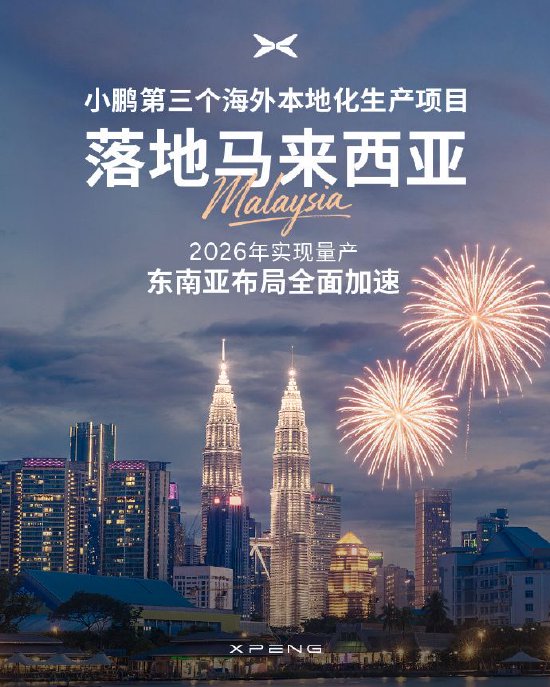
小鹏汽车与马来西亚EPMB集团签署合作协议,项目将于2026年实现量产
Xin Lang Cai Jing· 2025-12-15 07:43
Core Viewpoint - Xpeng Motors has signed a cooperation agreement with EPMB Group to initiate a localized production project in Malaysia, marking its third such project globally after Indonesia and Austria, with plans for mass production by 2026 to serve the ASEAN right-hand drive vehicle market [1][3]. Group 1 - The project aims to establish a strategic hub for the ASEAN right-hand drive vehicle market [3]. - Xpeng Motors has entered the top six electric vehicle brands in Malaysia from January to October this year, surpassing numerous automotive brands [4]. - The Xpeng X9 model achieved the highest sales in the high-end electric MPV segment in Malaysia in September, demonstrating strong competitive performance in the local market [4]. Group 2 - Xpeng Motors plans to further promote its localization strategy in Southeast Asia to provide better products and services to regional consumers [4].

港股异动 | 汽车股走势疲软 12月首周乘用车销量承压 市场情绪处于低位
智通财经网· 2025-12-15 07:41
Group 1 - The automotive stocks are experiencing a downturn, with GAC Group down 3.02% at HKD 3.85, Li Auto down 2.66% at HKD 65.75, and Xpeng Motors down 2.05% at HKD 73.9 [1] - According to the China Passenger Car Association, retail sales of narrow passenger vehicles are projected to be approximately 2.225 million units in November 2025, representing a year-on-year decline of 8.1% and a month-on-month decrease of 1.1%, marking the first year-on-year negative growth in retail sales for the automotive market in 2023 [1] - From December 1 to 7, retail sales in the passenger car market reached 297,000 units, a year-on-year decrease of 32% compared to the same period last year and an 8% decline compared to the previous month [1] Group 2 - CITIC Securities believes that the Central Economic Work Conference emphasizes the importance of domestic demand, aiming to build a strong domestic market and optimize the implementation of the "two new" policies, with a clear indication that the national subsidy policy will continue into 2026 [1] - Recent data shows that leading automotive companies are experiencing weaker month-on-month sales, and the anticipated "tail effect" from year-end stocking has not materialized, with some regions suspending trade-in subsidies, leading to low market sentiment [1] - The firm remains optimistic about the high-end development of domestic passenger vehicles, a strong new vehicle cycle, and the overseas expansion of leading new energy vehicle companies [1]

小鹏汽车正式启动马来西亚本地化生产项目 2026年实现量产
Feng Huang Wang· 2025-12-15 07:14
2025年1-11月,小鹏汽车海外交付量达39,773辆,同比增幅高达95%,显示出强劲的市场扩张势头。截 至目前,小鹏汽车销售服务网络已覆盖全球52个国家和地区,海外销售服务网点增至321个。此外,小 鹏汽车在全球已设立9大研发中心,为持续创新注入核心动力。 凤凰网科技讯12月15日,小鹏汽车官方宣布,小鹏汽车与马来西亚大型制造业上市公司EPMB集团签署 合作协议,正式启动马来西亚的本地化生产项目。这是继印尼、奥地利之后,小鹏在全球布局的第三个 本地化生产项目。按计划,项目将于2026年实现量产,旨在打造服务整个东盟右舵车市场的战略枢纽。 据官方介绍,今年1-10月,小鹏汽车成功跻身马来西亚当地纯电品牌销量前六。其中,小鹏X9在9月拿 下马来西亚高端电动MPV销量冠军。 ...

小鹏汽车第三个海外本地化生产项目将落地马来西亚
Mei Ri Jing Ji Xin Wen· 2025-12-15 07:02
每经AI快讯,据小鹏汽车微信公众号12月15日消息,近日,小鹏汽车与马来西亚大型制造业上市公司 EPMB集团签署合作协议,正式启动其在马来西亚的本地化生产项目。这是继印尼、奥地利之后,小鹏 在全球布局的第三个本地化生产项目。按计划,项目将于2026年实现量产,旨在打造服务整个东盟右舵 车市场的战略枢纽。 ...
小鹏汽车正式启动其在马来西亚的本地化生产项目
Zheng Quan Shi Bao Wang· 2025-12-15 06:55
人民财讯12月15日电,小鹏汽车15日宣布,与马来西亚大型制造业上市公司EPMB集团签署合作协议, 正式启动其在马来西亚的本地化生产项目。这是继印尼、奥地利之后,小鹏在全球布局的第三个本地化 生产项目。按计划,项目将于2026年实现量产,旨在打造服务整个东盟右舵车市场的战略枢纽。 ...
小鹏汽车与EPMB签署车辆组装协议
Xin Lang Cai Jing· 2025-12-15 06:07
12月15日,马来西亚汽车零部件制造商EPMB公告称,全资子公司与小鹏汽车已于12月12日签署协议, 将在马来西亚共同开展特定车辆项目的研发、制造、生产及组装合作,子公司将为小鹏汽车组装G6车 型及X9车型(含X9车型的增程电动汽车版本),G6车型计划于2026年3月31日前投产,X9车型计划于 2026年5月25日前投产。 ...
汽车行业反“内卷”卖车须明码标价
Xin Jing Bao· 2025-12-15 03:59
Core Viewpoint - The National Market Supervision Administration has released a draft guideline aimed at regulating price behaviors in the automotive industry, targeting false promotions and disguised price reductions, to promote price transparency and fair competition [1][4]. Group 1: Guidelines and Regulations - The guideline requires car manufacturers to establish a pricing strategy based on production costs and market demand, implementing full-chain price management across vehicle sales and financial services [2][4]. - It specifies that car sales must be clearly marked, prohibiting misleading pricing tactics such as false "manufacturer suggested retail prices" and "limited-time discounts" [3][4]. - The guideline aims to prevent price fraud, misleading pricing, and other unfair practices that disrupt market order and harm consumer rights [1][3][5]. Group 2: Industry Response - Major automotive companies like BYD, BAIC Group, and Xpeng Motors have expressed support for the guideline, committing to adhere to clear pricing and eliminate below-cost selling practices [8][9]. - BYD emphasized the guideline's role in maintaining fair competition and protecting consumer rights, pledging to optimize its pricing management and compliance systems [8][9]. - Xpeng Motors highlighted the importance of a healthy market environment for innovation, stating that the guideline will help refocus on value creation through technology, quality, and service [9]. Group 3: Market Context - The automotive industry has faced severe "involution" competition, leading to declining profitability and prompting regulatory bodies to signal a return to rational market development [6][7]. - The guideline is seen as a continuation of efforts to curb irrational price wars that have negatively impacted the health of the automotive supply chain [6][7]. - The China Automobile Dealers Association has noted that the guideline aims to stabilize retail market prices and enhance transparency in new car pricing [7].



8点1氪丨被罗永浩指责收高价“祸害客人”,涉事酒店回应;全国劳动力人口平均年龄达39.66岁;马斯克或成全球首位万亿美元富豪
3 6 Ke· 2025-12-14 23:57
Group 1: Company Performance - Huayi Brothers has reported a cumulative loss of 8.2 billion yuan over the past seven years, with its current market value being less than one-tenth of its peak [3] - In Q3, Huayi Brothers achieved a revenue of 62.6 million yuan, a year-on-year decline of 31.61%, and a net loss attributable to shareholders of 39.5 million yuan [3] - Lululemon's stock price has dropped by 46.40% this year, resulting in a market value loss of approximately 25 billion USD, leading to the resignation of CEO Calvin McDonald [8] Group 2: Industry Developments - The average age of the labor force in China has reached 39.66 years, indicating a gradual maturity in the aging process of the population [2] - The global largest automotive safety testing center has been put into operation in Ningbo, Zhejiang, featuring multiple Guinness World Records [6] - The National Market Supervision Administration has issued guidelines prohibiting car manufacturers from selling vehicles at a loss, aiming to enhance price compliance in the automotive industry [4] Group 3: Strategic Moves - Kweichow Moutai has introduced a volume control policy to alleviate financial pressure on distributors, halting product distribution until January 1, 2026 [4] - SpaceX is reportedly seeking to go public with a target valuation of approximately 1.5 trillion USD, which could make Elon Musk the world's first trillionaire [2] - OpenAI has adjusted its compensation policy to prevent talent outflow by removing the "vesting cliff" for stock options [11]






12月首周国内乘用车销量承压,出海持续加速
SINOLINK SECURITIES· 2025-12-14 12:37
Investment Rating - The report suggests a focus on opportunities arising from the themes of international expansion and smart technology, particularly in the automotive sector [1]. Core Insights - Short-term domestic demand is low, with retail sales of passenger vehicles declining year-on-year. However, exports of passenger vehicles have shown strong growth, indicating that international markets will be a long-term focus for the industry [1][12]. - The smart technology and robotics sectors are accelerating, with significant advancements in intelligent driving and AI integration in vehicles [15][18]. - The report recommends investing in companies like BYD, Geely, and Li Auto for international expansion, and companies like Horizon Robotics and Top Group for smart technology and robotics [1][18]. Summary by Sections Weekly Perspective - Domestic demand is weak, with November retail sales of passenger vehicles down 15.8% year-on-year. The report notes that the expected policy incentives have not yet materialized, contributing to this decline [11]. - Passenger vehicle exports reached 594,000 units in November, a 50% increase year-on-year, indicating a robust international market [12]. Industry Data Tracking - The Shanghai Composite Index decreased by 0.08%, while the automotive index increased by 0.16% this week. Notable stock performances included Superjet Co. (+39.0%) and Huamao Technology (+28.5%) [2][19]. - In November, wholesale passenger vehicle sales were 2.991 million units, a 1.7% increase year-on-year, while new energy vehicle sales were 1.694 million units, up 17.6% [4][34]. Industry Dynamics - The report highlights the rapid development of smart technology in vehicles, with over 60% penetration of L2 and above driving assistance systems in the market. The trend towards AI-driven smart cockpits is also noted [15]. - Robotics technology is advancing, with new products being launched by domestic manufacturers, indicating a shift towards commercialization in this sector [16][18].



十大关键词回顾2025年中国汽车市场
Xin Lang Cai Jing· 2025-12-14 10:06
Core Insights - The Chinese automotive industry is undergoing a structural transformation in 2025, shifting from price competition to technology-driven growth, and from domestic focus to global expansion, marking a new development stage [1] Group 1: Price War Aftermath - The price war in the automotive industry has entered its third year, with profit margins dropping to 4.5% in the first three quarters of 2025, below the 6% average of downstream industrial enterprises [3] - There are signs of easing in the price war, indicating a shift from vicious competition to rational development, as companies recognize that quality, service, and technological innovation are essential for long-term success [3] Group 2: 60-Day Payment Terms - Major automotive companies have adopted a 60-day payment term, reflecting a significant change in the industry ecosystem and addressing long-standing payment issues that strained supply chains [6] - This shift enhances the credit system within the supply chain, allowing suppliers to invest more in innovation and quality improvement, thus fostering a healthier industry environment [6] Group 3: 5-Second Acceleration Standard - A new regulation proposes that new vehicles must achieve a 0-100 km/h acceleration time of no more than 5 seconds, marking a fundamental shift in competitive logic within the automotive industry [9] - This standard encourages companies to focus on safety, user experience, and practical technology rather than extreme performance metrics [9] Group 4: 50% Penetration Rate of New Energy Vehicles - By November 2025, new energy vehicles accounted for 53.6% of domestic passenger car sales, indicating a shift from policy-driven to market-driven growth in the sector [11] - This milestone signifies that new energy vehicles have become mainstream, reshaping the industry landscape and prompting traditional automakers to accelerate their electrification strategies [11] Group 5: Subsidy Phase-Out - The phase-out of subsidies for new energy vehicles is set to begin in 2026, transitioning the industry from reliance on government support to market-driven growth [14] - This change is expected to enhance market competition and compel companies to improve product quality and cost control [14] Group 6: New Normal in Exports - In 2025, China's automotive exports are projected to exceed 6.8 million units, maintaining the top position globally for the third consecutive year, with a significant increase in new energy vehicle exports [16] - The export model is evolving from product trade to a more integrated approach involving industry chain and technology exports [16] Group 7: Smart Driving Popularization - 2025 marks the year of smart driving technology's widespread adoption, with significant advancements in urban navigation assistance systems [19] - Regulatory measures are being implemented to ensure safety and compliance, balancing innovation with social responsibility [19] Group 8: Joint Venture Counterattack - Traditional joint venture brands are launching a "localization 2.0" strategy to regain market share in the new energy era, focusing on deep localization and embracing electrification [21] - This strategy enhances competition and provides consumers with more quality choices while integrating the supply chain into the local ecosystem [21] Group 9: Battery Safety Concerns - Battery safety issues have escalated to a regulatory priority, with new standards mandating thermal monitoring and warning systems for battery packs [24] - These regulations aim to enhance safety and accountability in the industry, pushing companies to prioritize safety investments [24] Group 10: Retreat of Hidden Door Handles - The decline of hidden door handles reflects a broader industry reconsideration of "over-design" in automotive engineering, emphasizing safety and practicality over aesthetics [27] - New regulations require mechanical release functions for door handles, signaling a shift towards user-centric design principles [27]