
AKESO(09926)

Search documents
港股创新药ETF(159567)跌1.44%,成交额14.02亿元
Xin Lang Cai Jing· 2025-07-07 07:14
Group 1 - The Hong Kong Innovative Drug ETF (159567) closed down 1.44% on July 7, with a trading volume of 1.402 billion yuan [1] - The fund was established on January 3, 2024, with a management fee of 0.50% and a custody fee of 0.10% [1] - As of July 4, 2024, the fund's latest share count was 1.995 billion shares, with a total size of 3.203 billion yuan, reflecting a 404.69% increase in shares and a 747.72% increase in size year-to-date [1] Group 2 - The fund's liquidity showed a cumulative trading amount of 44.415 billion yuan over the last 20 trading days, with an average daily trading amount of 2.221 billion yuan [1] - Year-to-date, the cumulative trading amount reached 96.310 billion yuan over 122 trading days, with an average daily trading amount of 789 million yuan [1] - The current fund manager, Ma Jun, has managed the fund since its inception, achieving a return of 60.51% during the tenure [1] Group 3 - The top holdings of the Hong Kong Innovative Drug ETF include WuXi Biologics (11.47%), BeiGene (10.87%), and Innovent Biologics (9.60%), among others [2] - The fund's holdings are diversified across various companies in the innovative drug sector, with significant investments in both domestic and international firms [2]


周专题、周观点:从海外映射寻找下半年创新药新赛道-20250706
GOLDEN SUN SECURITIES· 2025-07-06 12:20
Investment Rating - The report maintains an "Overweight" rating for the pharmaceutical and biotechnology sector [9]. Core Insights - The pharmaceutical index increased by 3.64% during the week of June 30 to July 4, outperforming both the ChiNext and CSI 300 indices, indicating a positive market sentiment towards innovative drugs and brain-computer interface technologies [14][15]. - The report emphasizes the strong performance of PD-1 Plus drugs, which are seen as a driving force in the current market recovery, supported by significant business development (BD) deals and a favorable industry trend [2][15]. - The outlook for 2025 remains optimistic, focusing on innovative drugs, new technologies, and the restructuring of supply chains [3][16]. Summary by Sections 1. Industry Overview - The pharmaceutical sector is experiencing a rebound, with innovative drugs and brain-computer interfaces leading the charge. The report highlights the importance of PD-1 Plus drugs in this recovery [14][15]. 2. Innovative Drug Selection - PD-1 Plus drugs are gaining traction, with significant overseas collaborations and clinical trial advancements. The report notes that companies like Innovent Biologics and BeiGene are at the forefront of this trend [20][21]. - The report suggests focusing on companies with promising PD-1/IL-2 combinations and those that have successfully entered international markets [23]. 3. Investment Strategies - The report outlines a strategy focusing on core stocks in the innovative drug space, particularly those with strong growth potential and upcoming clinical data releases [3][17]. - Key companies to watch include Innovent Biologics, Zai Lab, and others involved in PD-1 Plus and related technologies [4][17]. 4. Market Performance - The report provides a comparative analysis of the performance of various indices, noting that the innovative drug index has outperformed the broader pharmaceutical index and the CSI 300 index since the beginning of 2025 [41][42]. - The report also highlights the performance of specific stocks within the innovative drug sector, indicating a positive trend for companies like Zai Lab and BeiGene [45]. 5. Future Outlook - The report anticipates continued optimism in the pharmaceutical sector, particularly around innovative drugs and new technologies such as AI in healthcare and rehabilitation robotics [3][16]. - The focus will be on identifying high-growth opportunities in the innovative drug space and leveraging the ongoing restructuring of supply chains [3][19].


创新药齐涨!康方生物市值破千亿
Zhong Guo Ji Jin Bao· 2025-07-04 11:26
Core Viewpoint - Multiple favorable policies have been released, leading to a collective surge in innovative drug stocks, with Kangfang Biotech's market capitalization surpassing HKD 100 billion [9][11]. Market Performance - On July 4, the Hang Seng Index initially dropped over 1.5% but later narrowed its losses, closing down 0.64% at 23,916.06 points, with a weekly decline of 1.52% [2]. - The total market turnover was HKD 267.8 billion, with southbound funds net buying HKD 6.68 billion [4]. - The healthcare sector index rose by 0.8%, while the materials sector index fell by nearly 1.2% [7]. Stock Highlights - Kangfang Biotech's stock price increased by 9.43% to HKD 116.10, with a total market value reaching HKD 104.2 billion [9][12]. - Other innovative drug companies also saw significant gains, including: - Boan Biotech up 8.55% - Cloudtop New Drug up 4.84% - WuXi AppTec up 4.31% [11][12]. Policy Impact - On July 1, the National Healthcare Security Administration and the National Health Commission released measures to support the high-quality development of innovative drugs, which are expected to expand market opportunities and encourage R&D efforts [12][13]. - The introduction of a commercial insurance innovative drug directory is seen as a significant exploration of an innovative payment system, injecting new vitality into the innovative drug ecosystem [13].

智通港股通活跃成交|7月4日
智通财经网· 2025-07-04 11:05
Core Insights - On July 4, 2025, Guotai Junan International (01788), Alibaba-W (09988), and SMIC (00981) were the top three stocks by trading volume in the Southbound Stock Connect, with trading amounts of 10.714 billion, 3.571 billion, and 3.184 billion respectively [1] - In the Southbound Stock Connect for the Shenzhen-Hong Kong Stock Connect, Guotai Junan International (01788), Alibaba-W (09988), and Xiaomi Group-W (01810) also led the trading volume, with amounts of 3.641 billion, 3.489 billion, and 2.435 billion respectively [1] Southbound Stock Connect (Shanghai-Hong Kong) - Top active companies by trading volume: - Guotai Junan International (01788): 10.714 billion, net buy of 91.5226 million [2] - Alibaba-W (09988): 3.571 billion, net sell of 334 million [2] - SMIC (00981): 3.184 billion, net buy of 37.2 million [2] - Xiaomi Group-W (01810): 3.087 billion, net sell of 370 million [2] - Meituan-W (03690): 2.379 billion, net sell of 270 million [2] - China Construction Bank (00939): 2.120 billion, net buy of 168 million [2] - XPeng Inc. (09868): 2.108 billion, net buy of 919 million [2] - Tencent Holdings (00700): 1.900 billion, net sell of 145 million [2] - CanSino Biologics (09926): 1.674 billion, net sell of 95.5519 million [2] - Dmall (02586): 1.249 billion, net buy of 30.1596 million [2] Southbound Stock Connect (Shenzhen-Hong Kong) - Top active companies by trading volume: - Guotai Junan International (01788): 3.641 billion, net buy of 50.5414 million [2] - Alibaba-W (09988): 3.489 billion, net sell of 1.153 billion [2] - Xiaomi Group-W (01810): 2.435 billion, net sell of 443 million [2] - SMIC (00981): 1.969 billion, net buy of 39.6 million [2] - Tencent Holdings (00700): 1.777 billion, net sell of 28.7313 million [2] - CanSino Biologics (09926): 1.675 billion, net buy of 19.5 million [2] - Meituan-W (03690): 1.660 billion, net buy of 96.5584 million [2] - XPeng Inc. (09868): 1.480 billion, net sell of 462.813 million [2] - Innovent Biologics (01801): 819 million, net buy of 18.2291 million [2] - China Mobile (00941): 622 million, net buy of 47.7507 million [2]




康方生物首个双抗ADC药物临床入组!恒生医疗ETF(513060)午后翻红涨近1%,近1周新增规模居同类第一
Sou Hu Cai Jing· 2025-07-04 05:46
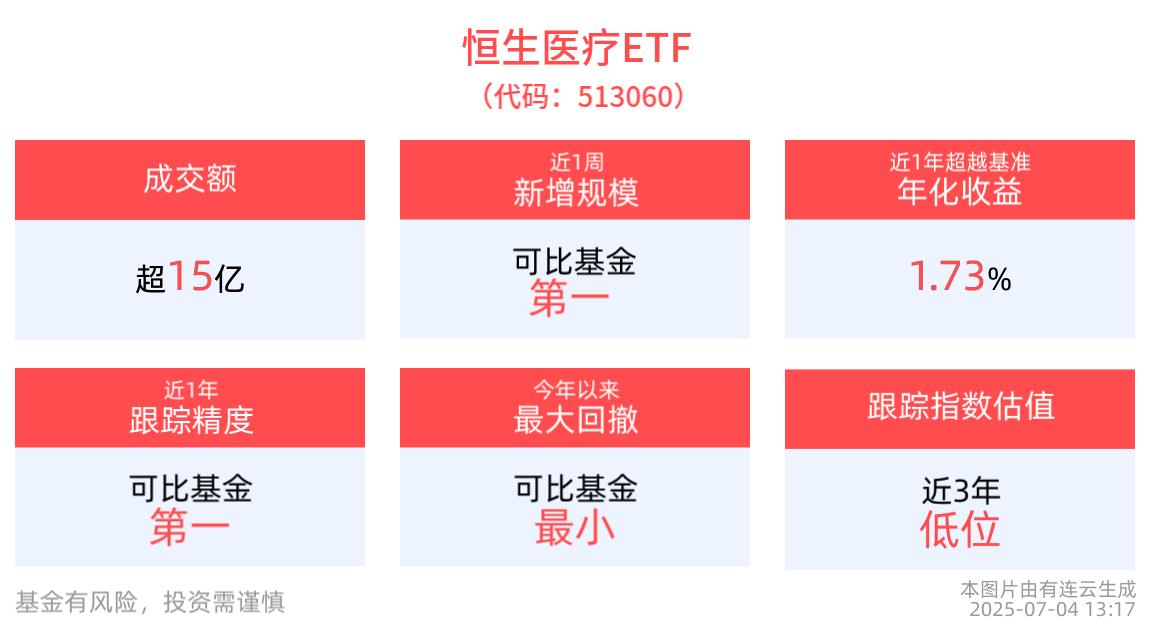
Core Viewpoint - The Hang Seng Healthcare Index (HSHCI) has shown strong performance, with significant gains in constituent stocks, indicating a positive trend in the healthcare sector [3]. Group 1: Market Performance - As of July 4, 2025, the HSHCI rose by 1.19%, with notable increases in stocks such as Huahao Zhongtian Pharmaceutical-B (02563) up 16.34% and Kangfang Biotech (09926) up 8.67% [3]. - The Hang Seng Healthcare ETF (513060) increased by 0.86%, with a latest price of 0.59 yuan, and has seen a cumulative increase of 3.57% over the past week [3]. - The ETF recorded a turnover rate of 18.66% during the trading session, with a transaction volume of 1.516 billion yuan, indicating active market participation [3]. Group 2: Investment Opportunities - Huatai Securities suggests that AI is expected to reshape drug development and healthcare service delivery, with increasing applications in the medical field, highlighting potential investment opportunities by 2025 [4]. - The Hang Seng Healthcare ETF has seen a significant growth in scale, with an increase of 191 million yuan over the past week, ranking in the top third among comparable funds [4]. - Leveraged funds are actively investing, with the latest financing buy-in amounting to 291 million yuan and a financing balance of 277 million yuan [4]. Group 3: Performance Metrics - The Hang Seng Healthcare ETF has achieved a net value increase of 18.78% over the past two years, with a maximum monthly return of 28.34% since inception [4]. - The ETF has outperformed its benchmark with an annualized excess return of 1.73% over the past year, and a Sharpe ratio of 1.85 as of June 27, 2025 [4]. - The ETF has the lowest drawdown among comparable funds, with a relative drawdown of 0.45% year-to-date [4]. Group 4: Fee Structure and Valuation - The management fee for the Hang Seng Healthcare ETF is 0.50%, and the custody fee is 0.15% [5]. - The ETF's tracking error over the past year is 0.069%, the highest tracking precision among comparable funds [5]. - The latest price-to-earnings ratio (PE-TTM) for the HSHCI is 27.68, indicating a valuation below 90.41% of the historical data over the past three years, suggesting it is at a historical low [5]. Group 5: Index Composition - The top ten weighted stocks in the HSHCI account for 58.46% of the index, including companies like Innovent Biologics (01801) and BeiGene (06160) [5].
港股医药ETF(159718)近一年上涨近70%,医疗创新ETF(516820)多只成分股飘红,机构:关注国产公司出海机遇
Xin Lang Cai Jing· 2025-07-04 03:10
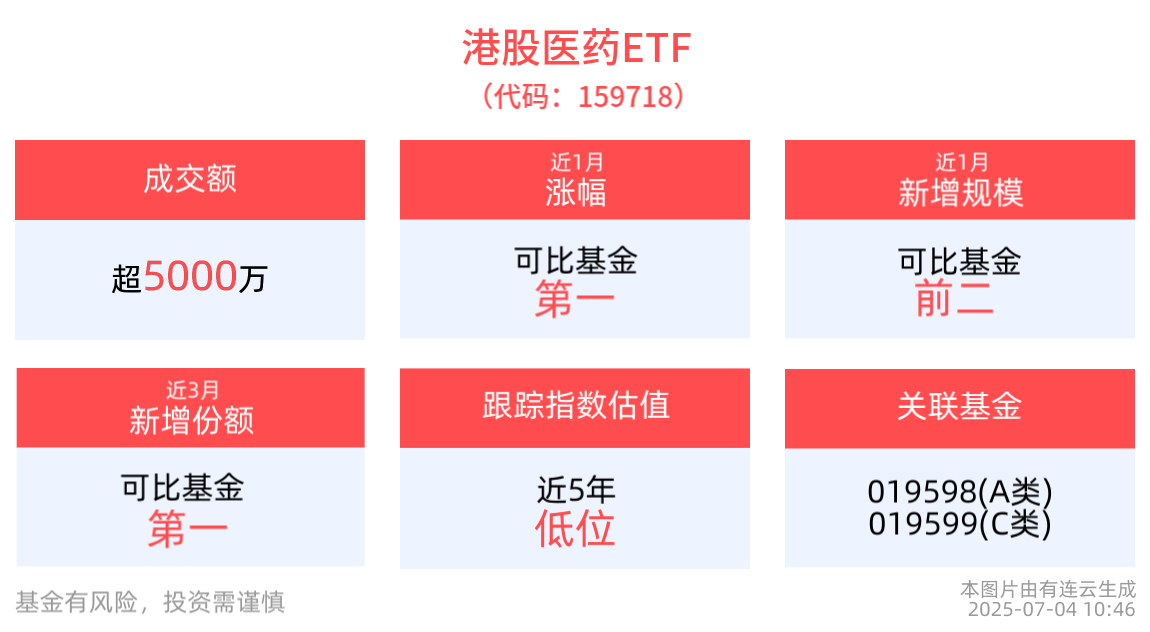
Core Viewpoint - The pharmaceutical sector is experiencing significant movements, particularly with AstraZeneca exploring a potential $15 billion deal with SMMT, indicating strong interest in the PD(L)1*VEGF market, which is expected to grow substantially by 2030 [1][2]. Group 1: Market Performance - As of July 4, 2025, the CSI Hong Kong Stock Connect Pharmaceutical and Healthcare Composite Index (930965) shows mixed performance among its constituent stocks, with Kangfang Biotech (09926) leading with a 3.86% increase [1]. - The Hong Kong Pharmaceutical ETF (159718) has seen a net value increase of 67.88% over the past year, currently priced at 0.86 yuan [1]. - The CSI Pharmaceutical and Medical Device Innovation Index (931484) has risen by 0.01%, with notable gains from stocks like Baillie Gifford (688506) and Kanghong Pharmaceutical (002773) [5][10]. Group 2: AstraZeneca's Strategic Moves - AstraZeneca is in discussions with SMMT regarding a potential $15 billion transaction, reflecting its strong positioning in the oncology sector and the need for a quality IO asset [1]. - The company is expected to generate 14 billion yuan in operating cash flow by 2025, with half available for business development and acquisitions, indicating a robust financial position to pursue significant transactions [1]. Group 3: PD(L)1*VEGF Market Insights - The PD(L)1*VEGF market is projected to reach $100 billion by 2030, with 42 approved indications, primarily in lung, stomach, kidney, bladder, liver, and head and neck cancers [2]. - Companies like Kangfang Biotech and Promis Biotech are exploring additional indications in China, suggesting a broadening of the PD(L)1*VEGF market [2]. - Other multinational corporations (MNCs) such as MSD, BMS, PFE, and ABBV are also likely to enter the PD(L)1*VEGF space, indicating a competitive landscape similar to the early days of PD(L)1 monoclonal antibodies [3].
康方生物冲击千亿市值,重磅药物完成首例受试者入组
2 1 Shi Ji Jing Ji Bao Dao· 2025-07-03 08:19
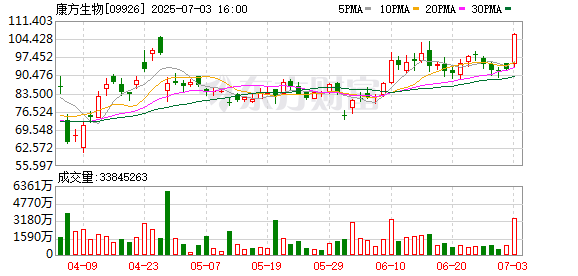
Company Overview - Kangfang Biopharma (09926.HK) experienced a significant stock price increase, rising over 14% to a record high of HKD 106.4 per share, with a market capitalization of approximately HKD 95 billion, nearing HKD 100 billion [2] - The company announced the completion of the first patient enrollment in the Phase Ia clinical trial for its first dual-target antibody-drug conjugate (ADC), AK146D1, aimed at treating advanced solid tumors [2] - AK146D1 targets Trop2 and Nectin4, which are promising tumor targets, and is the first dual-target ADC to enter clinical trials, with approvals from the FDA, TGA, and the National Medical Products Administration [2] Product Development - Kangfang Biopharma has developed over 50 innovative drug candidates for major diseases, with 24 candidates in clinical trials, including 15 dual-target/multi-target ADCs [3] - The company is the only one globally with two approved tumor immunotherapy dual antibodies, namely Cardunili (PD-1/CTLA-4 dual antibody) and Yivolisi (PD-1/VEGF dual antibody) [3] Market Outlook - According to a report by Frost & Sullivan, the Chinese anti-tumor drug market is expected to grow significantly, with a projected market size of RMB 398.5 billion from 2023 to 2026, reflecting a compound annual growth rate (CAGR) of 14.0% [4] - By 2030, the market size is anticipated to reach RMB 581.7 billion, with a CAGR of 9.9% from 2026 to 2030 [4]
港股午评|恒生指数早盘跌0.96% 恒生生物科技指数逆市大涨
智通财经网· 2025-07-03 04:07
Group 1: Market Overview - The Hang Seng Index fell by 0.96%, down 232 points, closing at 23,989 points, while the Hang Seng Tech Index decreased by 1.20% [1] - The Hong Kong stock market saw a trading volume of HKD 130.6 billion in the morning session [1] Group 2: Pharmaceutical Sector - The National Healthcare Security Administration and the National Health Commission released measures to support the high-quality development of innovative drugs, indicating that innovative drugs remain a key investment theme [1] - The Hang Seng Biotechnology Index surged by 2.79% [1] - Ascentage Pharma-B (06855) rose by 8%, Kelun-Biotech (06990) increased by 7%, and Zai Lab (09688) gained 5.21% [1] - Kangfang Biotech (09926) saw a rise of over 11% as its first dual-antibody ADC drug AK146D1 entered clinical enrollment [2] - Innovent Biologics (01801) increased by over 6% following the approval of its drug Ma Shidu Peptide for commercialization [3] - CStone Pharmaceuticals-B (02616) rose by over 11% after disclosing two dual-specific antibody drug targets, CS2013 and CS2015 [4] - Sihuan Pharmaceutical (02096) gained 4.43% after its new generation anti-VEGF monoclonal antibody "Suvetizumab" was approved for market [5] Group 3: Other Sectors - Gaming stocks continued to rise, with Macau's June gaming revenue exceeding expectations, and Citigroup predicts growth momentum will continue in the second half of the year [5] - MGM China (02282) increased by 2.6%, and Melco International Development (00200) rose by 1.75% [5] - Wheelock Properties (01997) gained 7.32% as Hong Kong's retail sales value rebounded in May, leading Morgan Stanley to upgrade the company's rating [5] - Global New Material International (06616) rose by over 5% as the acquisition of Merck's surface solutions business is nearing completion [6] - Giant Star Legend (06683) increased by over 3% after its subsidiary invested USD 8 million in the Starlight New Economy Industry Fund [7] - Kingsoft (03888) fell nearly 7% as its new game "Unrestricted Machine" entered public testing, with market attention on its performance [8]


创新药概念港股涨幅扩大 康方生物涨10%
news flash· 2025-07-03 03:00
创新药概念港股涨幅扩大。截至发稿, 基石药业(02616.HK)涨12%, 康方生物(09926.HK)涨10%, 信 达生物(01801.HK)涨7%, 荣昌生物(09995.HK)涨6%。 ...
港股概念追踪 | 重磅文件印发!A股创新药闻声大涨3% 机构称创新药资产重估仍将继续(附概念股)
智通财经网· 2025-07-01 09:30
Core Viewpoint - The recent policy measures introduced by the National Healthcare Security Administration and the National Health Commission aim to support the high-quality development of innovative drugs in China, addressing key challenges in the industry from research to market access [1][4]. Group 1: Policy Measures - The new measures include 16 targeted initiatives designed to tackle the difficulties in research, payment, and hospital access for innovative drugs, which are seen as a significant boost for the domestic pharmaceutical innovation engine [1][2]. - The policy encourages commercial health insurance to establish investment funds for innovative drug research, addressing long-term funding shortages [2]. Group 2: Research and Development - The measures allow for the opening of national unified medical insurance data, providing pharmaceutical companies and research institutions with access to critical data resources, which will help in efficiently identifying research targets and optimizing development pipelines [1][3]. - Companies can now apply for "point-to-point" policy guidance from the insurance department as soon as their new drug application is accepted, clarifying key elements for market access [2]. Group 3: Payment and Market Access - The introduction of a "commercial health insurance innovative drug directory" provides a new pathway for high-value innovative drugs that may not fit into basic medical insurance coverage, allowing for price confidentiality and exemption from certain regulations [3]. - The measures state that medical institutions cannot restrict the allocation of innovative drugs based on "drug proportion" or the number of drugs in the directory, enhancing the chances for high-value innovative drugs to enter hospitals [3]. Group 4: Market Outlook - The innovative drug sector is expected to continue its upward trend, driven by a recognition of the commercial model and the long-term value of leading companies, with a positive outlook for the industry’s fundamentals [5][7]. - The current market environment is characterized by a revaluation of research assets, with a focus on data asset pricing rather than business development (BD) pricing, indicating that high-quality research data will attract reasonable market valuations [6]. Group 5: Company Highlights - Heng Rui Medicine (恒瑞医药) is projected to achieve a revenue of 27.985 billion yuan in 2024, reflecting a 22.6% increase, with innovative drug sales expected to rise from 38.1% of total revenue in 2022 to 46.3% in 2024 [8]. - Three Life Pharmaceuticals (三生制药) has made significant strides in international collaboration, with a recent deal with Pfizer valued at up to $6.15 billion, showcasing the clinical value of its dual antibody platform [9].