
BABA(09988)

Search documents
深夜中概股拉升,虎牙飙涨22%,美股军工股大涨,脑再生跳水30%
21世纪经济报道· 2026-01-08 15:43
Market Overview - The U.S. stock market opened lower on January 8, with the Dow Jones up 0.34%, S&P 500 up 0.01%, and Nasdaq down 0.51% [1] - Major tech stocks mostly declined, with Nvidia and Intel dropping over 2%, and Apple and Facebook down over 1% [3] - Military stocks surged, with Northrop Grumman rising over 9% and Lockheed Martin up over 7%, following President Trump's proposal to increase U.S. military spending from $1 trillion to $1.5 trillion for FY2027 [3] Commodity Market - Silver prices fell significantly, with spot silver down over 5% and COMEX silver down over 4%. The gold-silver ratio has dropped below 60, currently around 59, marking a ten-year low [3] - International oil prices saw an increase, with Brent crude rising nearly 2% to $61 per barrel and WTI crude up 1.95% to $57 per barrel [3] Employment and Economic Indicators - The number of initial jobless claims in the U.S. was recorded at 208,000, slightly below the forecast of 212,000, with the previous value revised from 199,000 to 200,000 [4] - Analysts expect the Federal Reserve to potentially lower interest rates by about 150 basis points by 2026, with a focus on balancing employment and inflation [4] Federal Reserve Outlook - Various institutions have differing views on the Fed's interest rate decisions for the year, with JPMorgan and UBS predicting only one rate cut, while Goldman Sachs and Wells Fargo expect two cuts. Some banks believe there will be no cuts at all [5]






1月8日港股通净卖出49.01亿港元





Zheng Quan Shi Bao Wang· 2026-01-08 15:16
Market Overview - On January 8, the Hang Seng Index fell by 1.17%, closing at 26,149.31 points, with a total net sell of HKD 4.901 billion through the southbound trading channel [1][3] - The total trading volume for the southbound trading was HKD 117.906 billion, with a net sell of HKD 4.901 billion [1] Trading Activity - In the Shanghai-Hong Kong Stock Connect, the trading volume was HKD 70.891 billion, with a net sell of HKD 3.968 billion; in the Shenzhen-Hong Kong Stock Connect, the trading volume was HKD 47.015 billion, with a net sell of HKD 0.933 billion [1] - The most actively traded stock in the Shanghai-Hong Kong Stock Connect was Alibaba-W, with a trading volume of HKD 57.22 billion, followed by the Tracker Fund of Hong Kong and SMIC, with trading volumes of HKD 48.64 billion and HKD 33.52 billion, respectively [1] Net Buy/Sell Analysis - Tencent Holdings had the highest net buy amount of HKD 0.585 billion, despite a closing price drop of 1.36% [1] - The Tracker Fund of Hong Kong recorded the highest net sell amount of HKD 4.631 billion, closing down by 1.28% [1] - In the Shenzhen-Hong Kong Stock Connect, Alibaba-W also led in trading volume with HKD 37.64 billion, while Xiaomi Group-W had the highest net buy of HKD 0.494 billion, closing down by 0.37% [2]
港股通1月8日成交活跃股名单
Zheng Quan Shi Bao Wang· 2026-01-08 15:07
Market Overview - On January 8, the Hang Seng Index fell by 1.17%, with southbound capital totaling HKD 117.906 billion, comprising HKD 56.503 billion in buying and HKD 61.403 billion in selling, resulting in a net sell of HKD 4.901 billion [1] Southbound Trading Activity - The southbound trading through Stock Connect (Shenzhen) had a total turnover of HKD 47.015 billion, with buying at HKD 23.041 billion and selling at HKD 23.974 billion, leading to a net sell of HKD 0.933 billion [1] - The southbound trading through Stock Connect (Shanghai) recorded a total turnover of HKD 70.891 billion, with buying at HKD 33.461 billion and selling at HKD 37.429 billion, resulting in a net sell of HKD 3.968 billion [1] Active Stocks - Alibaba-W had the highest trading volume among southbound stocks, with a total turnover of HKD 94.86 billion, followed by the Tracker Fund of Hong Kong and SMIC, with turnovers of HKD 65.30 billion and HKD 55.70 billion respectively [1] - The top net buying stocks included Xiaomi Group-W with a net buy of HKD 10.72 billion, Tencent Holdings with HKD 8.64 billion, and SMIC with HKD 5.63 billion [1] - The stock with the highest net sell was the Tracker Fund of Hong Kong, with a net sell of HKD 62.84 billion, followed by Hang Seng China Enterprises and Southern Hang Seng Technology with net sells of HKD 28.78 billion and HKD 12.88 billion respectively [1] Continuous Net Buying and Selling - Xiaomi Group-W, Tencent Holdings, and SMIC were among the eight stocks that appeared on both the Shenzhen and Shanghai Stock Connect active lists, with Xiaomi Group-W having a total turnover of HKD 41.07 billion and a net buy of HKD 10.72 billion, while Tencent Holdings had a turnover of HKD 45.90 billion and a net buy of HKD 8.64 billion [2] - Over a continuous period, Xiaomi Group-W, Alibaba-W, and Goldwind Technology saw net buying for more than three days, with Xiaomi Group-W leading with a total net buy of HKD 46.84 billion [2] - Conversely, China Mobile and Hua Hong Semiconductor experienced continuous net selling, with net sells of HKD 31.39 billion and HKD 6.88 billion respectively [2]
Chinese Stock Charts Reach a Turning Point. What to Watch.
Barrons· 2026-01-08 14:26
Core Viewpoint - Alibaba, NetEase, and H World Group are experiencing positive technical indicators, suggesting potential bullish trends in their stock performance [1] Company Summaries - **Alibaba**: The company is showing strong technical signals, indicating a favorable outlook for investors [1] - **NetEase**: Similar to Alibaba, NetEase is also displaying bullish technical indicators, which may attract investor interest [1] - **H World Group**: The hotel operator is witnessing positive technical trends, suggesting a potential rise in stock value [1]
目标直指绝对第一:阿里为淘宝闪购按下份额扩张“加速键”
华尔街见闻· 2026-01-08 13:09
一次 " 力出一孔 " 的战略下注 此次闭门会释放的信号异常清晰 —— 市场份额第一, 成为淘宝闪购内部 绝对目标 。 而 阿里此次将目标锁定在 "市场份额第一",并非激进冒险,而是 一种 理性商业 考量 下 的 必然 选择。 在即时零售赛道的激烈角逐中, 阿里巴巴 终于亮出了最明确的底牌。 在 FY26Q3财报前瞻 交流中 ,阿里首次将淘宝闪购 2026年的核心目标直白定调为—— 市场份额增长 ,终极目标是拿下即时零售市场的 "绝对第一" 。 这一表态几乎没有留下 模糊地带 ,也彻底打消了市场此前关于阿里是否会对闪购业务 "战略性收缩"的疑虑。 这一决策 有着充分的行业背景 。商务部研究院在《即时零售行业发展报告( 2025)》中预计, 2026年我国即时零售市场规模将突破1万亿元,2030年 有望达到2万亿元,"十五五"期间年均增速达12.6% 。 即时零售,已从零售体系中的补充形态,演变为确定性最强的新增长引擎之一。 更重要的是,行业格局正处于 被重塑的关键阶段。淘宝闪购在此时选择全面加码,意味着阿里在即时零售领域的战略定位已经发生转变: 从 " 参与竞争 ",升级为"必须赢得竞争" 。 围绕万亿级市场 ...

图解丨南下资金逆势净买入小米、腾讯和中芯国际
Ge Long Hui· 2026-01-08 11:56
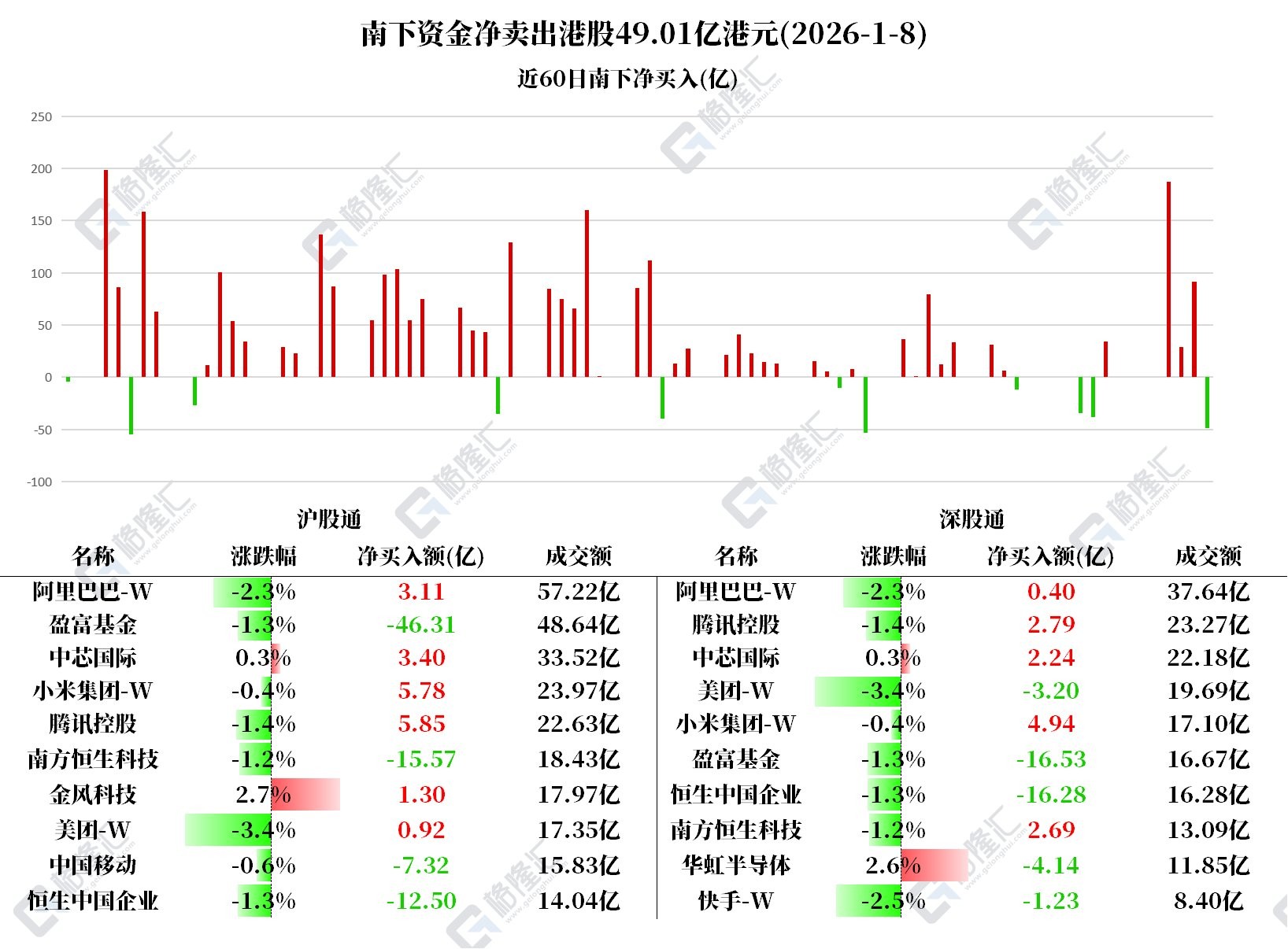
Group 1 - The net outflow of southbound funds from Hong Kong stocks today amounted to HKD 4.9 billion, with notable net purchases in Xiaomi Group (HKD 1.072 billion), Tencent Holdings (HKD 0.863 billion), SMIC (HKD 0.563 billion), Alibaba (HKD 0.35 billion), and Goldwind Technology (HKD 0.13 billion) [1] - The net sales included significant amounts in the Tracker Fund of Hong Kong (HKD 6.284 billion), Hang Seng China Enterprises (HKD 2.878 billion), Southern Hang Seng Technology (HKD 1.288 billion), China Mobile (HKD 0.732 billion), Hua Hong Semiconductor (HKD 0.413 billion), Meituan (HKD 0.227 billion), and Kuaishou (HKD 0.122 billion) [1] - Southbound funds have recorded six consecutive days of net purchases in Xiaomi, totaling HKD 4.6844 billion, and five consecutive days of net purchases in Alibaba, totaling HKD 2.46627 billion; conversely, there have been four consecutive days of net sales in China Mobile, totaling HKD 3.13893 billion [1] Group 2 - In the Shanghai Stock Connect, Alibaba saw a decline of 2.3% with a net purchase of HKD 0.311 billion, while Tencent experienced a drop of 1.3% with a net outflow of HKD 4.631 billion [4] - SMIC had a slight increase of 0.3% with a net purchase of HKD 0.34 billion, and Xiaomi Group saw a decrease of 0.4% with a net purchase of HKD 0.578 billion [4] - Goldwind Technology increased by 2.7% with a net purchase of HKD 0.13 billion, while China Mobile decreased by 0.6% with a net outflow of HKD 0.732 billion [4]

图解丨北水加仓小米超10亿港元,连续4日卖出中国移动
Ge Long Hui· 2026-01-08 11:47
Group 1: Investment Trends - Net purchases included Xiaomi Group at 1.072 billion, Tencent Holdings at 863 million, SMIC at 563 million, Alibaba at 350 million, and Goldwind Technology at 130 million [1] - Net sales included the Tracker Fund at 6.284 billion, Hang Seng China Enterprises at 2.878 billion, Southern Hang Seng Technology at 1.288 billion, China Mobile at 732 million, and Hua Hong Semiconductor at 413 million [1] - Southbound funds have recorded six consecutive days of net purchases for Xiaomi, totaling 4.6844 billion HKD, and five consecutive days for Alibaba, totaling 2.46627 billion HKD [1] Group 2: Stock Performance - Alibaba-W saw a decline of 2.3% with a net purchase of 311 million and a transaction volume of 5.722 billion [4] - Tencent Holdings experienced a drop of 1.4% with a net purchase of 585 million and a transaction volume of 2.263 billion [4] - Goldwind Technology increased by 2.7% with a net purchase of 130 million and a transaction volume of 1.797 billion [4] Group 3: Company Insights - Tencent Holdings is viewed positively for its monetization capabilities among moderate to heavy users, despite short-term competition concerns in the music sector [5] - SMIC's acquisition of 49% of the shares in SMIC North is expected to positively impact both short-term and long-term shareholder value, with a projected increase in net profit of over 120 million USD by 2026 [5] - Alibaba's recent communication indicates significant progress in its Taobao Flash Sale initiative, with a clear strategy for market share growth and increased investment [5] Group 4: Analyst Ratings - Daiwa has upgraded Goldwind Technology's rating to "Outperform" with a target price raised to 17 HKD [6]


中国万亿市值公司之变:四家新贵晋级 两大增长逻辑
2 1 Shi Ji Jing Ji Bao Dao· 2026-01-08 11:41
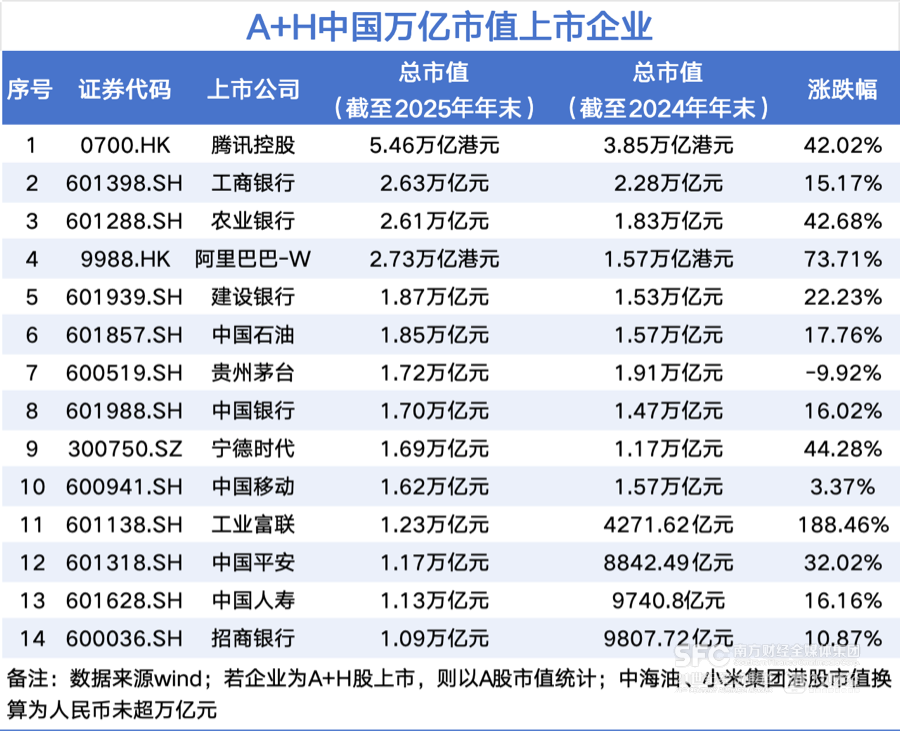
Core Insights - The number of companies with a market capitalization exceeding 1 trillion yuan in mainland China has increased to 14 by the end of 2025, with a total market value increase of over 9 trillion yuan, reflecting a growth rate of over 50% [1][2] Group 1: New Trillion-Yuan Companies - Four new companies have joined the trillion-yuan market cap club: Industrial Fulian, China Ping An, China Life, and China Merchants Bank, with four headquartered in Shenzhen [3][4] - Industrial Fulian has seen a remarkable market cap increase of approximately 188%, while the other three companies in the financial sector have experienced more modest growth rates: China Ping An at 32.02%, China Life at 16.16%, and China Merchants Bank at 10.87% [4][5] Group 2: Market Trends and Dynamics - The rise of these companies reflects two core market dynamics: explosive growth in the technology sector and valuation recovery in the financial sector [5] - Industrial Fulian's rapid growth is attributed to its comprehensive involvement in the AI industry chain, with a significant revenue increase of 38.4% year-on-year, reaching 603.93 billion yuan in the first three quarters of 2025 [6] - China Life has reported a total premium exceeding 700 billion yuan, with a 41% increase in total investment income, while China Ping An has established a strong competitive barrier through its extensive customer base and technology capabilities [7] Group 3: Performance of Major Players - Tencent and Alibaba have also seen significant market cap increases, with both companies adding over 1 trillion Hong Kong dollars to their valuations, driven by AI advancements and a recovery in their core businesses [8][10] - Tencent's market cap reached 5.46 trillion Hong Kong dollars by the end of 2025, with a stock price increase of over 40%, while Alibaba's market cap rose to 2.73 trillion Hong Kong dollars [10][11] Group 4: Banking Sector Insights - The banking sector has shown signs of valuation recovery, with Agricultural Bank of China achieving a notable stock price increase of over 50% and breaking the long-standing "price-to-book" ratio below 1 [12][13] - Agricultural Bank's revenue for the first three quarters of 2025 was 550.88 billion yuan, with a net profit of 220.86 billion yuan, reflecting a year-on-year increase of 3.03% [12][13]



“市场绝对第一”,阿里巴巴最新宣布!盈利+流动性双驱动,港股互联网ETF(513770)连续吸金超5亿元
Xin Lang Cai Jing· 2026-01-08 11:31
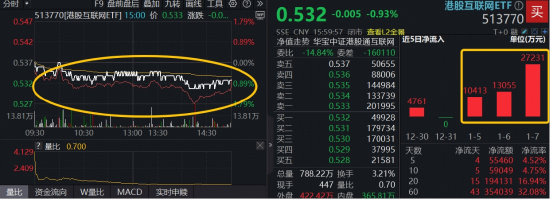
Market Overview - The Hong Kong stock market continued its downward trend on January 8, with the Hang Seng Index and Hang Seng Tech Index both falling over 1% [1][9] - Major tech stocks such as Meituan, Alibaba, and Tencent experienced declines, while Bilibili saw a rise of over 2% [1][9] - The Hong Kong Internet ETF (513770) closed down 0.93%, indicating a persistent premium and a positive attitude from buyers, with over 500 million yuan net inflow in the last three days [1][9] Alibaba Developments - Alibaba announced significant progress in its Taobao Flash Sales in the latest quarter and plans to increase investments to achieve market leadership [3][11] - Forecasts suggest that the market share of Taobao Flash Sales will continue to grow strongly by Q4 2025, with a faster reduction in losses compared to competitors [3][11] - The Ministry of Commerce predicts that China's instant retail market will exceed 1 trillion yuan by 2026 and reach 2 trillion yuan by 2030 [3][11] AI Advancements - Alibaba's Amap has upgraded its "Street Scanning List" with new features, leveraging self-developed world model technology to introduce a "Flying Street View" function [3][11] - Industry experts believe Amap is building a continuously evolving "true" digital asset pool, positioning itself as a super hub in the AI era [3][11] - The profitability cycle of the AI industry is expected to drive growth for major internet companies like Alibaba and Tencent, with a projected 34% EPS growth for the Hang Seng Tech Index by 2026 [3][11] Capital Inflows - Since the beginning of the year, southbound funds have significantly purchased Hong Kong stocks, with a net inflow of 30.78 billion HKD in the first three trading days of 2026 [4][12] - Major beneficiaries include Xiaomi, which received a net inflow of 3.148 billion HKD, and Alibaba, which saw over 2 billion HKD in net purchases [4][12] - Goldman Sachs forecasts that southbound fund inflows will reach a new high of 200 billion USD in 2026, driven by the current 37% premium of AH shares, highlighting the valuation advantages of Hong Kong stocks [4][12] Market Outlook - According to Guangfa Securities, the rise in Hong Kong assets is supported by fundamentals, with signs of structural recovery in profitability starting from the second half of 2024 [4][12] - The shift from liquidity-driven growth to a combination of profitability and liquidity is anticipated, especially with the decline of food delivery subsidies and the emergence of AI-driven advertising and cloud services as new growth points [4][12] - The Hong Kong Internet ETF and its linked funds track the CSI Hong Kong Internet Index, with major holdings in Alibaba, Tencent, and Xiaomi, accounting for over 78% of the top ten weighted stocks [4][12] Top Holdings in Hong Kong Internet ETF - Tencent Holdings (0700.HK) - 15.42% [5][13] - Alibaba (0988.HK) - 14.50% [5][13] - Xiaomi Group (1810.HK) - 13.11% [5][13] - Meituan (3690.HK) - 12.03% [5][13] - Kuaishou (1024.HK) - 4.24% [5][13]
阿里业绩前瞻:淘宝闪购2026年首要目标是份额增长 继续加大投入
Zheng Quan Ri Bao Wang· 2026-01-08 11:18
Core Insights - Alibaba's Taobao Flash Purchase has made significant progress in the latest quarter, with a clear investment strategy aimed at achieving market leadership by 2026 [1] - The growth momentum of Taobao Flash Purchase continues to be strong, with improvements in order structure and an increase in high-value customer transactions [2] Group 1: Growth Performance - In the December quarter, Taobao Flash Purchase's GMV share continued to grow, with an average order value (AOV) also on the rise, indicating a stable order share and improved order structure [2] - The platform achieved a peak daily order volume of 120 million in August, with monthly active buyers surpassing 300 million, rapidly climbing to a leading market position [2] - The focus for the next phase will be on high-value user engagement and retail category development, with new services enhancing overall user experience [2] Group 2: Non-Food Retail Acceleration - Taobao Flash Purchase's non-food retail business is accelerating, showing significant growth in collaboration with Hema and Tmall Supermarket [4] - After integrating with Taobao Flash Purchase, Hema's daily order volume exceeded 2 million, with a year-on-year growth of over 70% [4] - The platform is creating a unique experience by integrating Tmall's brand offerings, Hema's community coverage, and Tmall Supermarket's logistics network into a "30-minute delivery" model [4] Group 3: Loss Reduction and Investment Confidence - Taobao Flash Purchase's fourth-quarter losses are projected at 20 billion, with a faster reduction in losses compared to competitors, boosting confidence in sustainable investment [5] - Efficiency improvements are driven by user structure optimization, order structure optimization, and fulfillment cost optimization [5] - Alibaba plans to continue increasing investments in Taobao Flash Purchase to achieve market leadership, with a focus on high-value users and non-food retail [5]