
BABA(09988)

Search documents
两个马年:中国互联网的十二年轮回
Hua Xia Shi Bao· 2026-02-21 10:58
Core Insights - The article discusses the cyclical nature of significant technological advancements in China, particularly focusing on the emergence of WeChat Red Packets in 2014 and the anticipated rise of AI Red Packets in 2026, highlighting the impact of these innovations on mobile payment and user engagement [2][15][19]. Group 1: Historical Context - In 2014, WeChat introduced the Red Packet feature, which unexpectedly transformed the mobile payment landscape in China, allowing WeChat to catch up with Alipay in user engagement [5][6]. - The introduction of the Red Packet feature led to a massive increase in user engagement, with families participating in Red Packet exchanges during the Spring Festival, significantly boosting WeChat's user base [6][8]. - Over the past twelve years, the mobile internet landscape has evolved, with various platforms competing for user attention during the Spring Festival, showcasing a shift from simple monetary exchanges to more complex social interactions [9][13]. Group 2: Current Trends and Future Outlook - In 2026, the focus shifts to AI Red Packets, with major companies like ByteDance, Alibaba, Tencent, and Baidu investing over 4.5 billion yuan to capture the next generation of user engagement [15][18]. - The strategy for AI Red Packets involves integrating AI with everyday services, such as food delivery and ticket booking, to create a more habitual use of AI technology among users [16][20]. - The article suggests that the next significant technological breakthrough will require a universally relatable scenario, similar to how WeChat Red Packets popularized mobile payments [19][22]. Group 3: User Engagement and Retention - Historical data indicates that while Red Packets attract users, they do not guarantee long-term retention, as evidenced by the low retention rates following significant investments by companies like Baidu and Kuaishou [10][11][12]. - The article emphasizes the importance of user engagement metrics post-Spring Festival, indicating that the success of AI Red Packets will depend on users' willingness to interact with AI technology in their daily lives [24].




AI“百模大战”,春节爆发!
Xin Lang Cai Jing· 2026-02-21 10:02
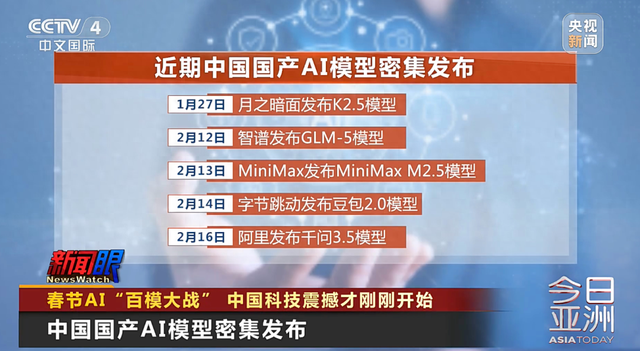
Group 1 - The core viewpoint is that China's technology industry has initiated an AI "hundred model war," with a series of domestic AI models being released and upgraded, indicating that the impact of Chinese technology on the world is just beginning [1][17]. - Multiple Chinese tech companies, including Moonlight Dark Side, Zhiyu, and Xiyu Technology, have launched new generation AI large models since before the Spring Festival, with ByteDance releasing the Doubao Model 2.0 series on February 14, enhancing its ability to perform complex real-world tasks [3][5]. - The Seedance 2.0 video generation model was officially launched by ByteDance, showcasing its capabilities during the 2026 Spring Festival Gala, where it animated a traditional Chinese ink painting, demonstrating advanced motion and camera control [7][9]. Group 2 - The release of Seedance 2.0 has sparked global discussions, with industry insiders noting that the focus on video and image generation models represents the next stage of AI technology, with breakthroughs occurring sooner than previously expected [11]. - The recent upgrades in domestic AI models emphasize the development of "AI agents," which are designed to perform more complex tasks beyond basic language communication, resembling intelligent assistants [13]. - Alibaba released the new base model Qianwen 3.5 on February 16, which supports mixed visual and text pre-training and significantly enhances capabilities in problem-solving, spatial reasoning, and video understanding [15]. Group 3 - Following the release of domestic models, several Chinese chip companies announced compatibility with these models, indicating that they can run effectively on their chips, achieving expected performance levels [15][17]. - Huawei's Ascend chips are providing training support for domestic large models, showcasing China's rapid progress in AI despite export controls, with innovations emerging from demand-driven needs [17].
智通ADR统计 | 2月21日
智通财经网· 2026-02-20 23:59
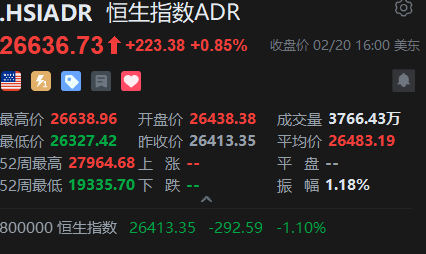
Group 1 - Major blue-chip stocks mostly rose, with HSBC Holdings closing at HKD 137.775, up 2.59% from the previous close in Hong Kong [2] - Tencent Holdings closed at HKD 531.758, an increase of 1.87% from the previous close in Hong Kong [2] Group 2 - Tencent Holdings reported a latest price of HKD 522.000, down HKD 11.000 or 2.06%, with an ADR price of HKD 531.758, showing an increase of HKD 9.758 compared to the Hong Kong stock price [3] - Alibaba Group (W) had a latest price of HKD 147.100, down HKD 7.600 or 4.91%, with an ADR price of HKD 150.874, reflecting an increase of HKD 3.774 compared to the Hong Kong stock price [3] - HSBC Holdings had a latest price of HKD 134.300, up HKD 0.100 or 0.07%, with an ADR price of HKD 137.775, indicating an increase of HKD 3.475 compared to the Hong Kong stock price [3]



今日财经要闻TOP10|2026年2月20日
Sou Hu Cai Jing· 2026-02-20 11:50
Market Performance - The Hang Seng Index closed down 1.10%, while the Hang Seng Tech Index fell by 2.91% on the first trading day after the Spring Festival, with a total market turnover of 165.37 billion HKD [6][9] - Notable stock movements included a significant rise in Zhihui (02513.HK) by 42.72%, reaching a market capitalization of over 320 billion HKD, and MINIMAX-WP (00100.HK) increasing by 14.52% [6][9] - Conversely, major tech stocks like Baidu (09888.HK) and Alibaba (09988.HK) saw declines of over 5% [6][9] Sector Trends - Oil, artificial intelligence, and robotics sectors showed strong performance despite the overall market decline, while sectors such as film and entertainment, internet healthcare, and online retail struggled [6][9] - The AI application and robotics concept stocks were highlighted as outperformers in a generally bearish market environment [1][6] Trade Agreements - The U.S. and Indonesia have finalized a reciprocal trade agreement aimed at expanding market access for U.S. goods, with Indonesia agreeing to eliminate tariffs on over 99% of U.S. exports [6] - The agreement includes approximately 33 billion USD in commercial cooperation, covering energy, aviation, and agricultural products [6] Economic Indicators - Federal Reserve Governor Stephen Milan revised down his expectations for significant interest rate cuts this year, citing stronger-than-expected employment data and persistent inflation [7] - Milan's updated stance suggests a potential reduction of 1 percentage point from the current rate of 3.5% to 3.75% [7]


港股收盘(02.20) | 恒指收跌1.1% 马年春晚点燃机器人概念 “大模型双雄”再创新高
智通财经网· 2026-02-20 08:33
Market Overview - After the Spring Festival holiday, Hong Kong stocks faced pressure, with the Hang Seng Index dropping 1.1% to 26,413.35 points, and a total trading volume of 165.37 billion HKD [1] - The Hang Seng Tech Index fell 2.91%, while the Hang Seng China Enterprises Index decreased by 1.22% [1] Blue-Chip Stocks Performance - PetroChina (00857) led blue-chip gains, rising 3.7% to 9.52 HKD, contributing 11.57 points to the Hang Seng Index [2] - Other notable blue-chip performances included Henderson Land (00012) up 3% and Midea Group (00300) up 2.73%, while Alibaba (09988) fell 4.91%, dragging the index down by 101.66 points [2] Sector Highlights - The technology sector was a major drag on the market, with Alibaba down nearly 5% and Tencent down over 2% [3] - Robotics stocks surged, with Yujian (02432) up 21.4% following a successful Spring Festival performance, while AI model stocks also showed strong gains [3][4] - Oil stocks rose due to escalating geopolitical tensions, with WTI crude oil prices reaching a high of 66.70 USD per barrel [6] Investment Insights - Analysts suggest that the robotics industry's advancements are crucial for its transition from experimental to practical applications, with significant growth expected from 2021 to 2025 [4] - The AI model sector is transitioning from free trials to paid subscriptions, indicating a shift towards sustainable monetization [4] Notable Stock Movements - SOTON (02498) reported a significant reduction in net losses for 2025, achieving profitability in Q4, which contributed to a 9.24% increase in stock price [8] - COSCO Shipping Energy (01138) rose 6.34% amid expectations of increased tanker profitability due to geopolitical tensions [9] - Stone Four Pharmaceutical Group (02005) issued a profit warning, predicting a 45%-60% decline in profits for 2025 due to various market pressures [10]

香港黄金交易所︰金价仍处牛市初中期 今年第二、三季有望挑战每盎司6000美元水平
Zhi Tong Cai Jing· 2026-02-20 08:24
Group 1 - The chairman of the Hong Kong Gold Exchange, Zhang Dexi, believes that gold prices have established a solid foundation over the past few years and are currently in the early to mid-stage of a bull market, with a potential challenge to reach $6,000 per ounce in the second and third quarters of this year [1] - The Shanghai Gold Exchange's participation in the newly established "Hong Kong Gold Central Clearing System" is expected to enhance delivery reliability, and the realization of interconnectivity between the mainland and Hong Kong gold markets is anticipated to be imminent [1] - The Hong Kong Gold Exchange plans to collaborate with Alibaba Group's subsidiary, Yabo Technology, to develop an international precious metals trading platform, settlement system, and digital goods blockchain, with the platform expected to be completed within six months and integrated into the central clearing system [1]
深度|千问免单卡,史上规模最大的“草船借箭”
Sou Hu Cai Jing· 2026-02-20 06:51
Core Insights - The competition in the AI sector is intensifying, with major products like Qianwen, Yuanbao, and Doubao vying for user engagement through innovative marketing strategies [2] - Qianwen's "免单卡" (Free Order Card) initiative, backed by a 3 billion yuan subsidy, serves as a modern interpretation of the "草船借箭" (Borrowing Arrows with Straw Boats) strategy, effectively leveraging Alibaba's ecosystem for user acquisition and brand recognition [3][4] Group 1: Marketing Strategy and User Engagement - Qianwen's Free Order Card acts as a bait to attract users, resulting in over 10 million AI orders within 9 hours and 40 billion interactions in 6 days, showcasing the effectiveness of low-cost marketing [3][4] - The initiative successfully converted AI interaction into real consumer behavior by integrating with over 300,000 stores in Alibaba's ecosystem, thus enhancing user experience and engagement [4][6] - The campaign also capitalized on the festive season and social sharing, leading to over 51 million new users, with 60% coming from social media [4] Group 2: Value Creation and Ecosystem Impact - The Free Order Card not only benefits users with discounts but also democratizes access to AI technology, with significant engagement from rural areas and older demographics [5] - Local businesses experienced a surge in orders, with some stores reporting over 1,400 backlogged orders, highlighting the initiative's role in driving sales during peak seasons [5][6] - Qianwen's strategy serves as a catalyst for activating Alibaba's entire ecosystem, enhancing user activity across various business lines and validating the "AI + ecosystem" operational model [6] Group 3: Challenges and Future Considerations - Despite its success, Qianwen faced challenges related to system capacity and delivery logistics, with peak requests exceeding design limits, leading to user experience issues [7] - The initiative raises concerns about user retention, as many new users may be attracted solely by incentives, posing a challenge for long-term engagement [8] - The industry must focus on converting short-term user acquisition into lasting relationships by improving product experience and expanding AI application scenarios [8] Conclusion - Qianwen's Free Order Card exemplifies a modern marketing approach that disrupts traditional models, leveraging a 3 billion yuan subsidy to unlock significant market value and shift AI technology into everyday use [9] - The initiative has redefined competitive dynamics in the AI sector, moving the focus from technical specifications to user habit formation [9]

港股科网股开年大跌,恒生科技也变“老登”?
Di Yi Cai Jing Zi Xun· 2026-02-20 05:58
Core Viewpoint - The Hong Kong technology sector is experiencing significant downward pressure, with major stocks like Alibaba, Baidu, and Tencent facing declines, while some AI and chip-related new stocks are performing well [2][3][4]. Group 1: Market Performance - On February 20, the Hang Seng Technology Index fell over 2.5% to a new low of 5222 points, marking a five-month adjustment [2]. - Alibaba's stock dropped more than 4%, Baidu's fell over 6%, and Tencent's decreased by over 2% [2]. - In contrast, some new stocks related to AI and chips, such as Zhiyu (智谱), MINIMAX, and Lanke Technology (澜起科技), continued to rise and hit new highs [2]. - The Hang Seng Technology Index closed at 5245 points, down 2.28%, with a trading volume of 22.5 billion HKD, while the Hang Seng Index fell 0.61% to 26,544 points, with a trading volume of 91.7 billion HKD [2]. Group 2: Investor Sentiment and Concerns - Analysts note that competition in delivery and red envelope services is intense around the Spring Festival, leading to investor concerns about the return on AI investments [3]. - There is a prevailing sentiment that the technology sector will remain weak until March when companies like Tencent report earnings, potentially leading to stock buybacks and stabilization [3][4]. - Concerns are growing regarding the effectiveness of AI infrastructure investments, as costs have risen significantly compared to the previous year, while profits and revenues have not increased proportionately [3][4]. Group 3: Future Outlook - Short-term pressures on technology stocks are expected to persist, but as stock prices reflect negative factors, a bottom may form [4]. - Potential catalysts for a rebound include favorable policies and interest rate cuts from the Federal Reserve [4]. - Analysts anticipate that after earnings announcements, companies in the tech sector may restart buybacks, providing some support for stock prices [4].
港股午评:恒指收跌0.61% AI应用、机器人概念股逆势走强
Xin Lang Cai Jing· 2026-02-20 04:25
Market Overview - After the Spring Festival holiday, Hong Kong stocks experienced a decline on the first trading day of the Year of the Horse, with the Hang Seng Index and the Hang Seng Tech Index opening lower [1] - The Hang Seng Index closed down 0.61%, while the Hang Seng Tech Index fell by 2.28% [1] - The total market turnover was HKD 91.755 billion [1] Sector Performance - Oil, artificial intelligence, and robotics stocks showed strength against the market trend [1] - Conversely, sectors such as film and entertainment, internet healthcare, online retail, and major tech stocks exhibited weak performance [1] Individual Stock Movements - Zhihui (02513.HK) surged by 19.09% [1] - MINIMAX-WP (00100.HK) increased by 10.04% [1] - China Petroleum & Chemical Corporation (00857.HK) rose by 4.58% [1] - Baidu (09888.HK) declined by 5.67% [1] - Alibaba (09988.HK) fell by 3.75% [1] - Bilibili (09626.HK) dropped by 5.12% [1]
香港黄金交易所与阿里成员公司合作开发国际贵金属交易平台及结算系统
智通财经网· 2026-02-20 02:45
Core Viewpoint - The Hong Kong Gold Exchange (HKGE) is collaborating with Alibaba's subsidiary, Yabo Technology, to develop an international precious metals trading platform and settlement system, including blockchain for digital commodities [1] Group 1: Collaboration and Development - HKGE and Yabo Technology will work on a platform that encompasses spot and futures trading, digital gold, B2C transactions, and an OTC clearing center [1] - The collaboration aims to unify risk management and regulatory oversight across all systems involved [1] Group 2: Institutional Governance and Transparency - Over the past year, HKGE has optimized its institutional governance and increased transparency for institutions [1] - The exchange has actively engaged with international financial institutions, gold merchants, and e-commerce platforms, meeting with over 30 international gold companies in recent months to discuss cooperation and membership opportunities [1]