NTES(09999)

Search documents
知名巨头“80后”总经理张栋突然辞职,曾是网易“大将”,年薪337万元高过老板史玉柱,接任者是她!公司股价年内暴涨200%
Mei Ri Jing Ji Xin Wen· 2025-10-29 06:57
Core Points - Zhang Dong, a prominent figure in China's gaming industry and former general manager of Giant Network, has resigned for personal reasons, effective immediately [1][3] - Liu Wei has been appointed as the new general manager of Giant Network, returning to the role after previously serving as CEO [3][9] Company Overview - Zhang Dong's annual salary was 3.37 million yuan, significantly higher than the chairman Shi Yuzhu's 1.19 million yuan [5][6] - Zhang Dong held 10,000 shares in the company and will continue to manage his holdings according to relevant regulations [3] Management Changes - Liu Wei, born in 1968, has a long history with Giant Network, having served in various roles since 2006, including president and co-CEO [7][9] - Liu Wei's return is expected to focus on nurturing young core talent within the company [9] Financial Performance - For the first three quarters of 2025, Giant Network reported revenue of 3.37 billion yuan, a year-on-year increase of 51.8%, and a net profit of 1.42 billion yuan, up 32.3% [10] - The third quarter alone saw revenue of 1.71 billion yuan, a remarkable increase of 115.6%, and a net profit of 640 million yuan, up 81.2% [10] - The company has successfully launched new products, such as "Supernatural Action Group," which has exceeded expectations and is driving future growth [10][11] Product and Market Development - Established product lines continue to perform well, with the "Journey" IP enhancing user engagement and monetization [11] - The company is integrating AI technology into its core gaming business, with innovations in gameplay and interaction [12]


2025胡润百富榜:马化腾排第3,丁磊财富大涨60%,蔡浩宇排第60
3 6 Ke· 2025-10-28 23:52
Core Insights - The 2025 Hurun Rich List highlights significant wealth growth among key figures in the gaming industry, including Zhang Yiming of ByteDance, Ma Huateng of Tencent, Ding Lei of NetEase, and Cai Haoyu of miHoYo [1][3]. ByteDance - Zhang Yiming, founder of ByteDance, ranks second with a wealth of approximately 470 billion RMB, reflecting a growth of 120 billion RMB (+34%) from the previous year [3]. - ByteDance's gaming division has shown a strong recovery, launching several successful titles, including "Decisive Peak" which has over 1.5 billion global registered users and 110 million monthly active users [3][5]. - The company is expanding its global presence with the upcoming "GameTop" platform, which focuses on casual gaming and social experiences [5]. Tencent - Ma Huateng, founder of Tencent, maintains the third position with a wealth of 465 billion RMB, an increase of 150 billion RMB (+48%) [6]. - Tencent's Q2 2025 revenue reached 184.5 billion RMB, a 15% year-on-year growth, with the gaming sector driving significant revenue, particularly from "Honor of Kings" and "Peacekeeper Elite" [6][8]. - The company is also enhancing its AI capabilities, with its AI assistant "Yuanbao" ranking among the top native AI applications in China [6]. NetEase - Ding Lei, CEO of NetEase, ranks sixth with a wealth of 320 billion RMB, up 120 billion RMB (+60%) from last year [9]. - NetEase's gaming revenue for Q2 2025 was 22.8 billion RMB, a 13.7% increase, driven by popular titles like "Fifth Personality" and "Dream Journey" [9][11]. - The company has invested heavily in R&D, reaching 4.4 billion RMB in Q2 2025, indicating a strong commitment to innovation [9]. miHoYo - Cai Haoyu, founder of miHoYo, ranks 60th with a wealth of 81 billion RMB, experiencing an 11% increase despite a drop in ranking [14]. - miHoYo continues to maintain strong performance with its flagship titles "Genshin Impact" and "Honkai" series, with "Honkai: Star Rail" seeing a 192% revenue increase following a major update [14][13]. - The company is also venturing into AI with the launch of an AI-driven game, "Whispers of the Stars," indicating a strategic shift towards integrating AI in gaming [14]. Xiaomi - Lei Jun, CEO of Xiaomi, saw the highest wealth increase among the listed entrepreneurs, with a growth of 196 billion RMB (+151%), bringing his total wealth to 326 billion RMB [14]. - Xiaomi's gaming subsidiary, Xishanju, is celebrating its 30th anniversary, although it reported a 10% decline in revenue for its online gaming segment in the first half of 2025 [14][17].


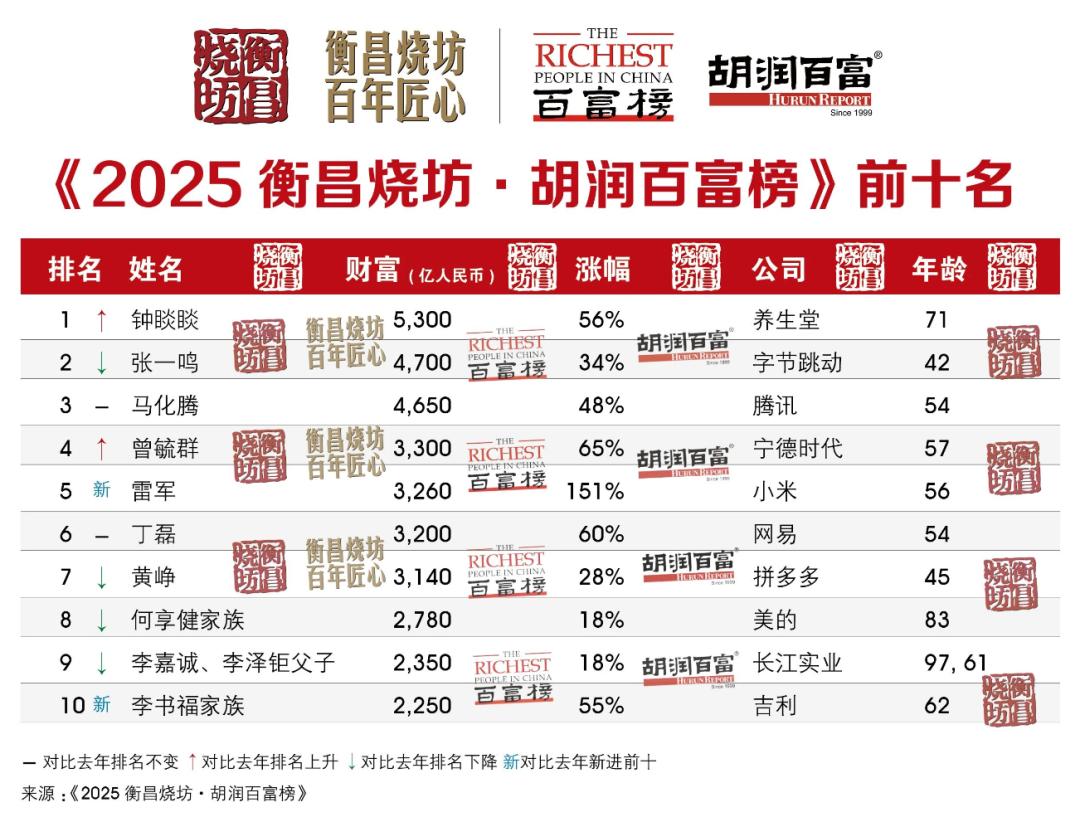
中国前十大富豪,浙商包揽四席
Shang Hai Zheng Quan Bao· 2025-10-28 23:21
Core Insights - The 2025 Hurun Rich List reveals that 1,434 individuals with wealth exceeding 5 billion RMB have been included, marking an increase of 31% from the previous year. The total wealth of these entrepreneurs approaches 30 trillion RMB, reflecting a 42% growth year-on-year [1] Group 1: Wealth Growth and Rankings - Zhong Shanshan, aged 71, retains the title of China's richest person for the fourth time with a wealth of 530 billion RMB, an increase of 190 billion RMB or 56% from last year [2][3] - The top ten list sees two newcomers: Lei Jun from Xiaomi and Li Shufu from Geely, with the threshold for entry raised by 60 billion RMB to 225 billion RMB [3] - Zhang Yiming, founder of ByteDance, ranks second with a wealth of 470 billion RMB, up 120 billion RMB or 34% year-on-year, despite losing the title of richest person [4] - Ma Huateng of Tencent ranks third with a wealth of 465 billion RMB, an increase of 150 billion RMB or 48% [4] - The wealth of Zeng Yuqun from CATL rises to 330 billion RMB, marking a 130 billion RMB increase or 65% [5] - Lei Jun's wealth surged by 196 billion RMB or 151%, placing him fifth with 326 billion RMB [5] Group 2: Industry Performance - The automotive and battery sectors, particularly in electric vehicles, have shown significant growth, benefiting from favorable policies and global demand [7] - The consumer electronics sector has thrived due to the popularity of short videos and sustained global demand for smart hardware [7] - The new consumption sector has seen a rise in innovative business models, with notable growth in the blind box economy represented by Pop Mart [7] Group 3: Regional Distribution - The distribution of entrepreneurs by region shows a "3+2+3" pattern, with Shanghai, Shenzhen, and Beijing leading in entrepreneur density. Shanghai tops the list with 152 individuals, an increase of 40 from last year [11]


胡润发布百富榜 深圳147位企业家上榜
Sou Hu Cai Jing· 2025-10-28 12:10
Core Insights - The Hurun Research Institute's "Hurun Rich List" reveals that Zhong Shanshan, founder of Nongfu Spring, has become China's richest person for the fourth time, with a wealth increase of 190 billion yuan, totaling 530 billion yuan, setting a new record for the wealth of a Chinese billionaire [1][5] - Lei Jun, founder of Xiaomi, saw his wealth increase by nearly 200 billion yuan, driven by explosive growth in Xiaomi's automotive sector and high-end smartphone profitability [1][11] - The number of entrepreneurs on the list reached a historical high of over 1,400, a 30% increase from last year, largely due to a significant stock market rebound and the emergence of new faces in the technology sector [4][8] Regional Insights - Shanghai, Shenzhen, and Beijing are the top three regions for entrepreneur density, with Shanghai leading at 152 entrepreneurs, followed by Shenzhen with 147, and Beijing with 146 [3][4] - The number of entrepreneurs from Shanghai increased by 40, Shenzhen by 39, and Beijing by 31 compared to last year, indicating a strong growth trend in these regions [3][4] Wealth Growth by Sector - Significant wealth growth was observed in sectors such as new energy vehicles, consumer electronics, new consumption, computing power, biomedicine, and securities services [6][10] - In the new energy vehicle sector, notable figures like Zeng Yuqun of CATL saw wealth growth of nearly 70%, with his total wealth reaching 330 billion yuan [6][11] - The biopharmaceutical sector also experienced substantial wealth increases, with entrepreneurs like Zhong Huijuan of Hansoh Pharma seeing a wealth increase of over 600 billion yuan [10] New Faces and Trends - The list featured 376 new faces, a sevenfold increase from last year, primarily from industrial products, health, and consumer goods sectors, while real estate moguls have largely disappeared from the rankings [8][9] - The emergence of "new quality productivity" entrepreneurs is notable, with five out of the top ten billionaires characterized by their focus on new energy, smart technology, and high-end manufacturing [8][9] AI and Technology Sector - The AI sector has produced new billionaires, with figures like Chen Tian Shi of Cambrian rising by nearly 150 billion yuan, entering the top 20 [9] - The growth in AI and computing power is expected to continue, with significant investments and advancements in technology driving valuations higher [9][11]



网易游戏广州高管人事大地震,杭州少壮派要上位?
Xin Lang Cai Jing· 2025-10-28 11:58
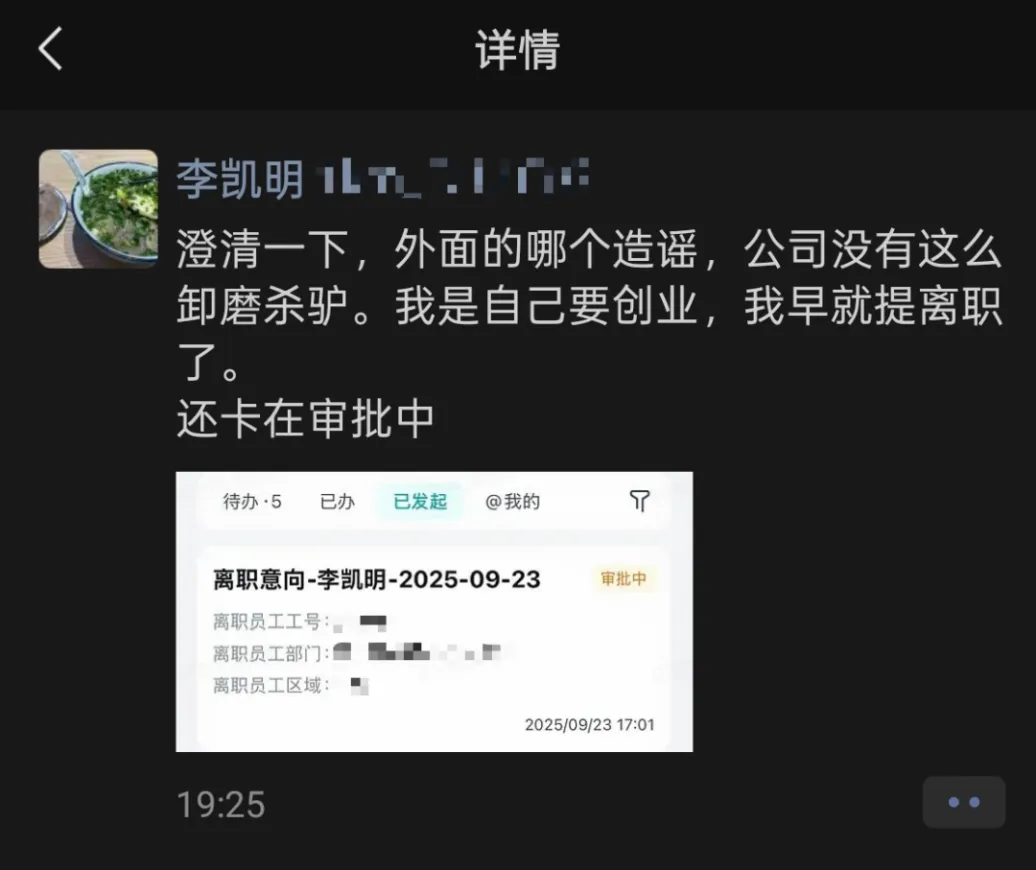
Core Insights - A significant leadership shakeup is occurring at NetEase Games, with multiple high-ranking executives departing, indicating unprecedented organizational changes within the company [1][2][4][6] Group 1: Executive Departures - Li Kaiming, head of NetEase Interactive Entertainment's 10th division, announced his departure for personal career development, marking him as the third senior executive to leave this year [1][2] - Other notable departures include Lin Yunfeng, president of the Dreamland division, and Xuanzi, producer of "World Beyond," suggesting a trend of restructuring similar to last year's disbandment of the Tianxia division [2][4] - The departures reflect a broader trend of leadership changes, particularly among executives overseeing key business areas such as competitive gaming, anime, and strategy games [2][6] Group 2: Organizational Changes - The leadership changes are centered in the Guangzhou headquarters, which has historically been the cradle of NetEase's gaming empire, indicating a potential shift in focus towards the Hangzhou region [4][7][16] - The company is reportedly consolidating its operations in Hangzhou, where the LeiHuo division has seen significant success, contributing approximately 50% to NetEase's total gaming revenue [13][15] - The restructuring aims to inject new energy into the organization by replacing long-standing executives with younger leaders who can better connect with the new generation of players [17][22] Group 3: Performance and Challenges - The Guangzhou divisions have faced significant setbacks, including the failure of the martial arts open-world game "The Legend of the Condor Heroes," which suffered a nearly 80% user attrition rate post-launch [9][10] - The 10th division also faced challenges, with the cancellation of the single-player project "Ten Thousand People Long Song: Three Kingdoms" after four years of development due to poor market feedback [11] - In contrast, the Hangzhou operations have thrived, with successful titles like "Nirvana in Fire Mobile" and "Eternal Return" establishing a strong market presence and contributing to the company's growth [12][13] Group 4: Strategic Shifts - The leadership changes reflect a strategic pivot from product-driven approaches to data-driven methodologies, emphasizing user profiling, monetization models, and predictive analytics in game development [21][22] - The company is focusing on a dual strategy of "data + rhythm" to enhance resource efficiency and mitigate the impact of individual project failures on overall business performance [22] - This shift is expected to lead to a more structured approach to game development, ensuring that new projects are backed by comprehensive market analysis and clear commercialization paths [21][22]
科技赋能未来!网易伏羲亮相2025青科会,展示游戏AI前沿实践
Sou Hu Cai Jing· 2025-10-28 09:24
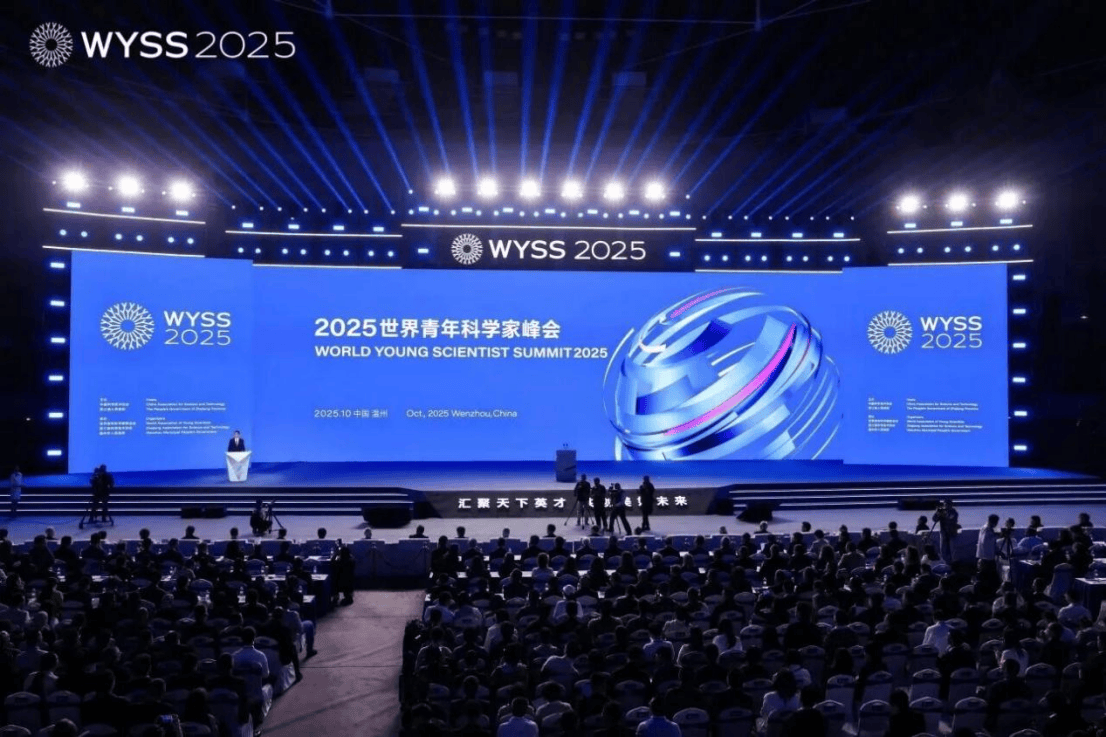
Core Insights - The 2025 World Youth Scientist Summit, co-initiated by the China Association for Science and Technology and the Zhejiang Provincial Government, took place in Wenzhou, Zhejiang, attracting nearly 800 scientists, venture capitalists, and entrepreneurs from 47 countries and regions, making it a significant platform for technological exchange and future connections [1] - NetEase Fuxi showcased cutting-edge technologies such as game AI, embodied intelligence, and collective intelligence at the summit, drawing widespread attention from academia and industry [1][10] Group 1: Event Highlights - The "Dominion Helmet" project, developed by NetEase Fuxi in collaboration with Ruiling Technology and Yushu Technology, gained significant attention at the event, utilizing a non-invasive brain-computer interface to capture brainwave signals, allowing users to control multiple robots through thought [2][3] - The event featured a high volume of visitors at NetEase Fuxi's booth, where attendees experienced the charm of human-computer interaction through video displays and interactive experiences, reflecting on the transformation of gaming concepts into tangible technological breakthroughs [5] Group 2: AI Innovations in Gaming - NetEase Fuxi introduced several AI-driven innovations in gaming, including: 1. AI teammates in the mobile game "Naraka: Bladepoint," which is the industry's first voice AI teammate feature, enabling AI to understand commands, engage in conversation, and participate in battles [7] 2. The industry's first photo and text-based character customization feature, allowing diverse character designs through various input methods [7] 3. Highly intelligent NPCs that utilize LLM technology for multi-modal interaction and memory capabilities, enhancing player immersion and game dynamics [7] - AI is also enhancing social interactions within games, as demonstrated in "Naraka: Bladepoint," where AI optimizes player connections through friend and team recommendations based on existing social relationships [8] Group 3: Broader Applications of AI - NetEase Fuxi is expanding the application of game AI technologies into other sectors, exemplified by the Lingdong unmanned excavator, which addresses challenges in the mining industry such as safety risks and operational efficiency [9] - The company emphasizes that while AI can optimize existing functionalities, the creation of new gameplay experiences stems from human insight into user needs and trends, highlighting the irreplaceable role of human creativity in innovation [9] Group 4: Future Directions - The integration of game AI into real-world applications signifies a shift towards enhancing industrial efficiency and user experience, as showcased by the "Dominion Helmet" and other AI innovations [10] - NetEase Fuxi aims to continue advancing game AI technologies, fostering human-machine collaboration to explore broader possibilities in various fields [10]
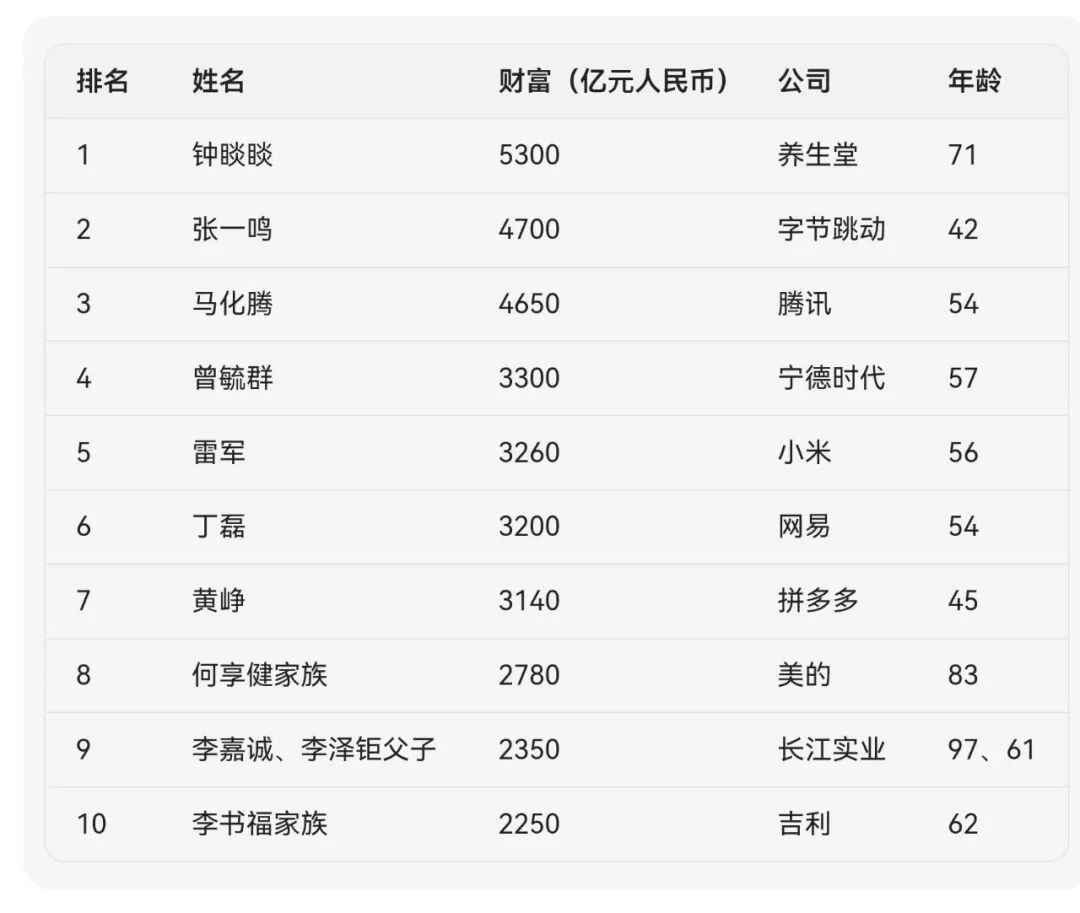
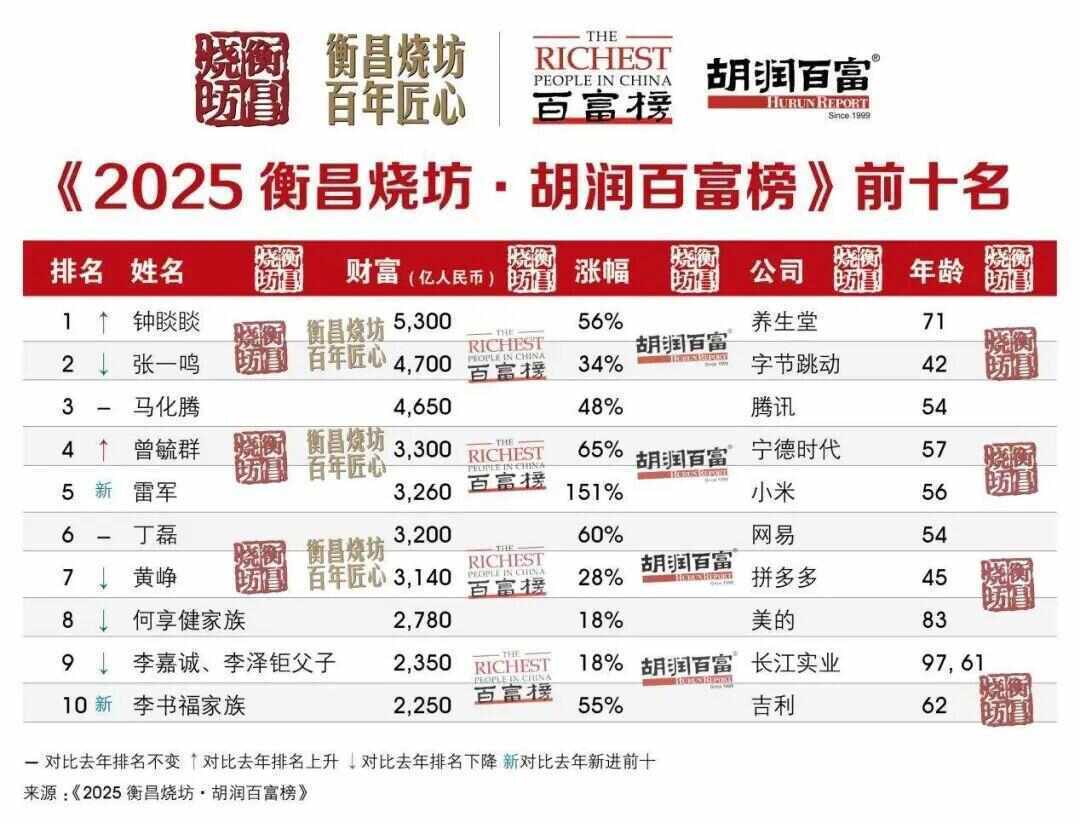
2025胡润百富中国富豪榜TOP10:钟睒财富5300亿第四次成中国首富,张一鸣4700亿退居第二,马化腾4650亿第三,雷军3260亿第五
Ge Long Hui· 2025-10-28 08:10
Core Insights - The 2025 Hurun Rich List was released, featuring 1,434 entrepreneurs with personal wealth exceeding 5 billion RMB, marking a 31% increase from last year (+340 individuals) [1] - The total wealth of these individuals approached 30 trillion RMB, reflecting a 42% growth from the previous year (+9 trillion RMB) [1] Group 1: Notable Wealth Increases - Zhong Shanshan, founder of Nongfu Spring, saw his wealth increase by 190 billion RMB, reaching 530 billion RMB, making him the richest person in China for the fourth time and setting a new record for wealth in the country [1] - Zhang Yiming, founder of ByteDance, experienced a wealth increase of 120 billion RMB, driven by advancements in AI, although he fell to second place with a total of 470 billion RMB [1][3] - Ma Huateng, founder of Tencent, had a wealth increase of 150 billion RMB, maintaining third place with a total of 465 billion RMB [1][5] Group 2: Fastest Growing Entrepreneurs - Lei Jun of Xiaomi was named the "growth king," with a wealth increase of 196 billion RMB, attributed to explosive growth in Xiaomi's automotive business and breakthroughs in high-end smartphone profitability [1] - Wang Ning of Pop Mart, aged 38, saw his wealth grow by 154.5 billion RMB, thanks to the global popularity of Labubu [1] - Chen Tian Shi of Cambricon experienced a wealth increase of 148 billion RMB, driven by rapid performance growth following the rollout of AI chips [1]



54岁丁磊财富达3200亿元,年增1200亿元涨幅60%,网易掌门排名稳居第六
Xin Lang Zheng Quan· 2025-10-28 07:24
Core Insights - The 2025 Hurun Rich List reveals that NetEase founder Ding Lei's wealth has reached 320 billion RMB, an increase of 120 billion RMB or 60% from the previous year, maintaining his position at 6th place [1][2] Company Performance - NetEase's net revenue for the previous year was 105.3 billion RMB, showing a year-on-year growth of 1.7% [1] - The net profit for NetEase was 29.7 billion RMB, remaining stable compared to the previous year [1] - The gaming business continues to be the primary revenue source for NetEase, accounting for nearly 80% of total revenue [1] Investment and Dividends - NetEase's investment in research and development reached a record high of 17.5 billion RMB, marking a 6% increase year-on-year, and has exceeded 10 billion RMB for five consecutive years [1] - Ding Lei distributed approximately 6 billion RMB in dividends over the past year [1]
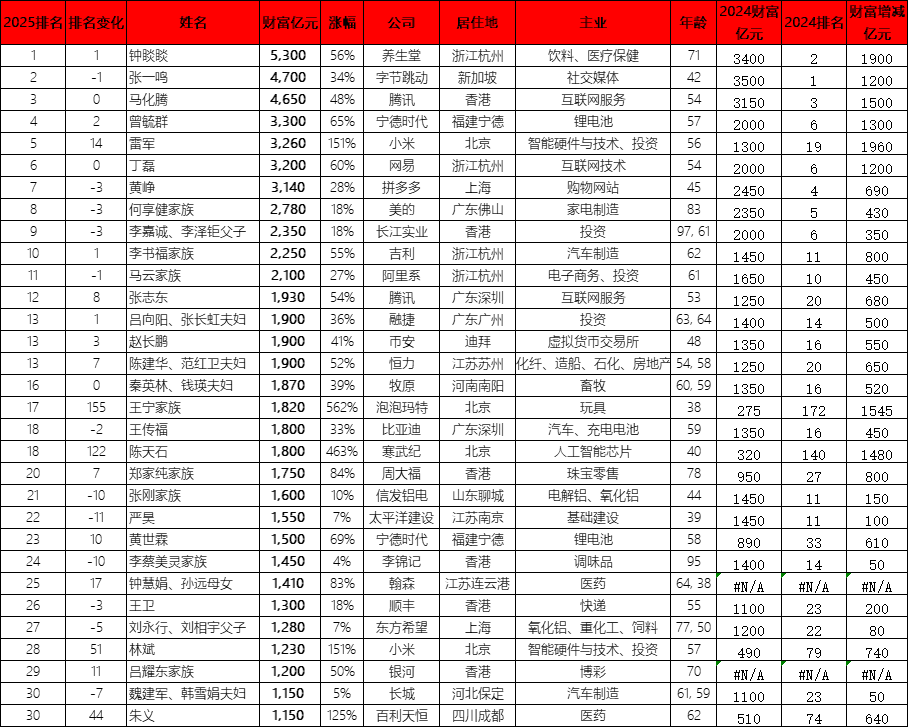
农夫山泉创始人钟睒睒成中国首富,字节跳动创始人张一鸣退居第二,2025胡润百富榜发布→
Sou Hu Cai Jing· 2025-10-28 05:08
Core Insights - The 2025 Hurun Rich List was released, marking the 27th consecutive year of publication, with the wealth calculation deadline set for September 1, 2025. Zhong Shanshan, founder of Nongfu Spring, became the richest person in China for the fourth time with a wealth of 530 billion RMB [1][5]. Summary by Category Wealth Rankings - Zhong Shanshan's wealth increased by 190 billion RMB, reaching 530 billion RMB, setting a new record for the richest person in China [5][11]. - Zhang Yiming, founder of ByteDance, ranked second with a wealth of 470 billion RMB, an increase of 120 billion RMB, driven by advancements in AI [6][11]. - Ma Huateng, founder of Tencent, maintained third place with a wealth of 465 billion RMB, growing by 150 billion RMB due to performance in gaming, advertising, and fintech [6][11]. Overall Wealth Growth - The total wealth of listed entrepreneurs reached nearly 30 trillion RMB, a 42% increase from the previous year, adding 9 trillion RMB [3][12]. - A total of 1,434 individuals with wealth exceeding 5 billion RMB made the list, a 31% increase from last year [2][3]. Market Performance - As of September 1, 2025, major stock indices showed significant growth: Shenzhen Composite Index up 54%, Shanghai Composite Index up 36%, and Hang Seng Index up 42% [3][12]. - The rise in wealth among entrepreneurs is attributed to a recovery in the stock market and the realization of undervalued companies, leading to a re-evaluation of their market value [3][12]. New Entrants - The list featured 376 new faces, a sevenfold increase from the previous year, with notable newcomers including Xu Gaoming and Xu Dongbo from Laopu Gold, and Li Qibin and Qi Yan from Card Game [9][12]. - The top new entrants include founders of popular tea brands and other emerging companies, reflecting a diverse range of industries [9][12]. Geographic Distribution - The distribution of listed entrepreneurs shows a "3+2+3" pattern, with Shanghai, Shenzhen, and Beijing leading in density. Shanghai topped the list with 152 individuals, followed by Shenzhen with 147 and Beijing with 146 [12]. - The increase in the number of entrepreneurs in Shanghai and Shenzhen is primarily due to the recovery of the A-share market and the concentration of industries such as semiconductors and biomedicine in these regions [12].
钟睒睒,再次登顶!雷军,时隔十年闯进前五!2025胡润百富榜揭晓→
证券时报· 2025-10-28 04:59
Core Insights - The 2025 Hurun Rich List reveals a total of 1434 individuals with wealth exceeding 5 billion RMB, an increase of 340 from the previous year, with total wealth nearing 30 trillion RMB, marking a 42% growth compared to last year [1][3]. Group 1: Wealth Rankings - Zhong Shanshan, founder of Nongfu Spring, tops the list with a wealth of 530 billion RMB, marking his fourth time as China's richest person and setting a new record for wealth [1][4]. - Zhang Yiming, founder of ByteDance, ranks second with 470 billion RMB, having seen a wealth increase of 120 billion RMB, or 34% [5]. - Ma Huateng of Tencent holds the third position with 465 billion RMB, reflecting a 48% increase in wealth [5]. - Zeng Yuqun of CATL ranks fourth with 330 billion RMB, a 65% increase [5]. - Lei Jun of Xiaomi, with a wealth of 326 billion RMB, experienced the highest growth rate of 151%, marking his return to the top five after ten years [5]. Group 2: Newcomers and Growth Sectors - A total of 376 newcomers made the list, a sevenfold increase from last year, with the top newcomer being Xu Gaoming of Laopu Gold, with a wealth of 69.5 billion RMB [8]. - The sectors showing significant performance include new energy vehicles, consumer electronics, new consumption, computing power, and biomedicine [9][11]. - In the new energy vehicle sector, both Lei Jun and Zeng Yuqun saw substantial wealth increases, driven by favorable policies and global market demand [9]. Group 3: Regional Distribution - The top ten cities account for 60% of the total number of listed entrepreneurs, with the Yangtze River Delta region having 483 individuals, representing 34% of the total [12]. - Shenzhen has 147 entrepreneurs on the list, with a combined wealth of 2.9 trillion RMB, while Beijing has 146 individuals with a total wealth of 3.1 trillion RMB [12].