Cambricon(688256)

Search documents
2026年电子行业十大预测
2026-01-04 15:35
Summary of Key Points from the Conference Call Industry Overview - The conference call focuses on the **2026 Electronic Industry Predictions**, particularly in the **cloud computing** and **AI** sectors, highlighting significant trends and developments expected in the coming years [2][3][4]. Key Insights and Arguments Cloud Computing Sector - The **domestic cloud computing** sector, especially **domestic computing power**, is anticipated to experience substantial growth by the end of 2026, with major wafer fabs expected to release ample capacity, alleviating previous supply constraints [2][3]. - **ByteDance's** data consumption has shown remarkable growth, increasing from approximately **15-16 trillion** in May 2025 to over **50 trillion** by December 2025, indicating strong demand for domestic computing power [2]. - The **demand for domestic computing power** is projected to exceed **100 trillion** by mid-2026, setting a solid foundation for the performance of domestic computing companies [2][3]. - Leading companies like **Cambricon** and **Hygon** are expected to dominate in capacity supply and local government bidding, benefiting from the rising demand for inference chips, with **ASIC chips** likely to become as significant as **GPU** chips [2][3]. - The **domestic CS market** is under increasing pressure for localization, with local suppliers like **Shenghe Jingwei** expected to capture more market share in supercomputing nodes [2][3]. Edge Computing Sector - The **edge computing (SOC)** sector is set to benefit from the AI innovation wave, with smart hardware products such as glasses and robots expected to see significant development opportunities [4]. - The emergence of **multi-modal applications** (e.g., smart assistants) is anticipated to drive adjustments in app developers' permission management, leading to a diverse market landscape in 2026 [4]. 3D DRAM Technology - Despite slower-than-expected progress in the **3D DRAM** supply chain in 2025, optimism remains for 2026, with collaborations between **Zhaoyi Innovation** and leading companies indicating potential breakthroughs and new application scenarios [5]. Upcoming Trends and Technologies - Several key technology and product trends are expected in the second half of 2025, including the launch of specialized 3D hardware for mobile and automotive applications, which will enhance edge computing and storage capabilities [6][7]. - The **AI terminal devices** market is projected to gain traction, with major North American clients like **OpenAI** planning to introduce smart terminal products, potentially driving hardware sales and a replacement wave [7]. - The **domestic wafer foundry industry** is also highlighted, with leading companies like **SMIC** and **Huahong** expanding capacity, ensuring that the N2 process will no longer be a bottleneck for computing power development by 2026 [7]. Power Supply and Infrastructure - The **power density** in data centers is rapidly increasing, with **HVDC** (High Voltage Direct Current) expected to become a core focus in 2026, facilitating electrification upgrades and creating new growth opportunities [8][9]. - Upgrades in server power supply technology are anticipated to enhance the value of embedded modules and advanced cooling technologies, with companies like **Oulutong** and **Weiergao** positioned to benefit [9]. New Infrastructure and Advanced Packaging - The **new infrastructure** sector is expected to see significant growth in 2026, particularly in the **PCB** segment, with new products like **CO2 laser drilling** and advanced packaging set to achieve full-scale production [10][11]. - Advanced packaging products are expected to gradually achieve mass production among leading packaging and testing manufacturers, indicating a shift from demo machines to essential products in the next two years [11]. Additional Important Insights - The conference call emphasizes the importance of monitoring developments in the electronic industry, particularly in cloud computing, edge computing, and new infrastructure, as these areas are poised for significant growth and investment opportunities in the near future [2][3][4][5][6][7][8][9][10][11].




高盛唱多百度:昆仑芯分拆上市解锁公司价值,未来比肩寒武纪、摩尔线程和壁仞科技
Zhi Tong Cai Jing· 2026-01-04 15:27
Core Viewpoint - Baidu's stock price surged following the announcement of Kunlun Chip's application for a separate listing on the Hong Kong Stock Exchange, with Goldman Sachs highlighting the potential for value unlocking through this asset separation [1] Group 1: Kunlun Chip Sales Growth - Goldman Sachs estimates that Kunlun Chip's total sales will reach approximately RMB 3.5 billion in 2025 and RMB 6.5 billion in 2026, primarily driven by Baidu's AI cloud infrastructure [2] - By the end of 2026, external sales are expected to account for 14% of Baidu Cloud's total revenue, alongside a recurring subscription business that currently constitutes nearly 30% of cloud revenue, together representing 43% of total revenue for Baidu Cloud in 2026 [2] Group 2: Peer Valuation Reference - Competitors such as Cambricon and Moore Threads are projected to have sales multiples of 40x and over 100x for 2026, while Wall Street's newly listed Biren Technology reached a market value of HKD 80 billion shortly after its IPO [3] Group 3: Impact on Baidu - Baidu's revenue from Kunlun Chip's sales will be included in its AI infrastructure cloud revenue, with strong growth anticipated in the AI accelerator-related cloud business driven by robust subscription revenue and rapid growth in external sales of Kunlun Chip [4] - The valuation of Baidu's 59% stake in Kunlun Chip is estimated to range from USD 3 billion to USD 11 billion, corresponding to a total valuation of USD 5 billion to USD 18 billion for Kunlun Chip, which represents 6% to 23% of Baidu's current market value [4] - If a 40x sales multiple is applied for 2026, the valuation of Baidu's stake could reach USD 22 billion, accounting for 45% of its latest market value [4] Group 4: Future Points of Interest for Baidu - Monitoring updates on Kunlun Chip's new orders, product upgrades, and progress towards independent listing will highlight the asset's value [6] - Updates on shareholder return policy revisions in Q1 2026 [6] - Insights from recent investor meetings regarding asset value unlocking initiatives [6] - Progress related to major listings in Hong Kong and southbound trading [6]

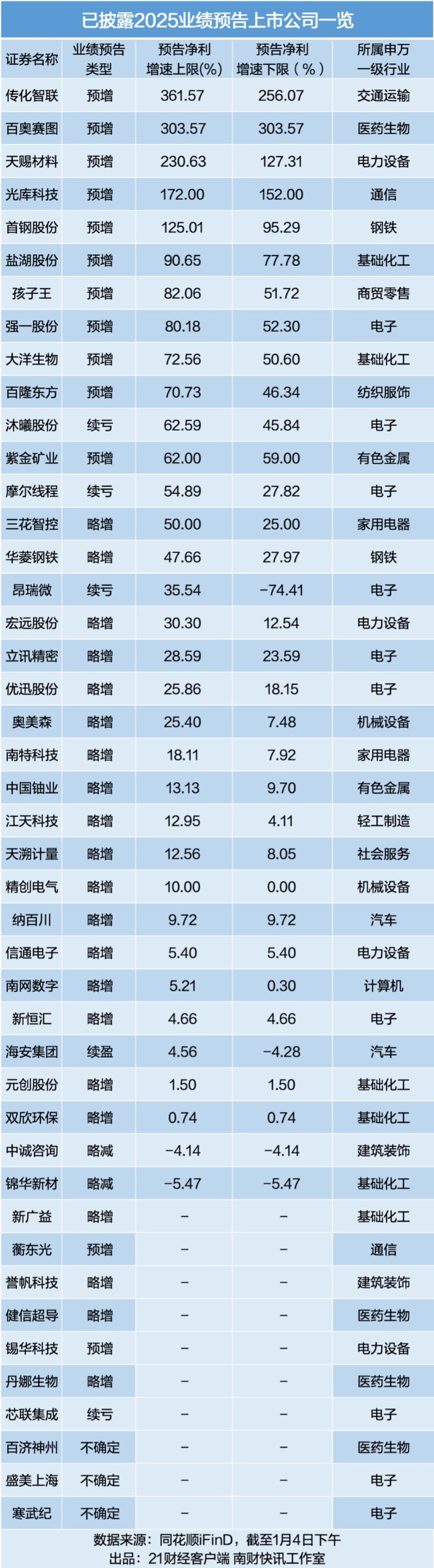
最高预增超360%!44家A股公司披露2025年度业绩预告,近八成预喜
2 1 Shi Ji Jing Ji Bao Dao· 2026-01-04 12:10
值得注意的是,传化智联(002010.SZ)以高达256.07%至361.57%的净利润预计增幅,暂列目前"预增 王"。公司预计2025年归母净利润为5.4亿至7亿元。公告显示,业绩大幅增长除因主营业务取得良好增 长外,也受益于转让部分子公司股权确认的投资收益及回购子公司股权提升持股比例等因素。 传统制造业在此轮业绩预告中表现尤为亮眼。钢铁行业方面,首钢股份(000959.SZ)预计2025年归母 净利润为9.2亿元至10.6亿元,同比增长95.29%至125.01%,增速上限在已披露公司中位居前列。公司表 示,业绩增长得益于产品结构优化、高端化发展及"极低成本"管理理念的贯彻。 同样属于钢铁板块的华菱钢铁(000932.SZ)在消化了补缴环保税及滞纳金约6.57亿元的情况下,依然 预计净利润增长27.97%至47.66%。对此,公司解释,主要得益于降本增效以及高端化、绿色化、智能 化、精益化四化转型等工作的开展。 以电子、医药生物为代表的高景气赛道则呈现批量报喜的态势。其中,电子行业的强一股份 (688809.SH)预计净利润增长52.30%至80.18%;医药行业的百奥赛图(688796.SH)则凭借海外 ...





公司问答丨寒武纪:公司产品是针对AI领域内多样化应用场景而设计、研发的通用型智能芯片 对视觉、语音等各类AI技术具备较好的普适性
Ge Long Hui· 2026-01-04 07:07
格隆汇1月4日|有投资者在互动平台向寒武纪提问:目前我们看到互联网领域的主要潜在客户,比如阿 里、腾讯、百度,都已经推出了自研芯片,字节也有团队在研发,市场有消息明年可能会有产品流片并 进入应用。面对客户自研趋势,公司现有以及未来规划的算力芯片,和这些互联网客户的自研产品相 比,主要优势体现在哪些方面? 寒武纪回复称,互联网企业研发人工智能芯片主要是围绕其主营业务 或针对特定应用场景完成完整或较为完整的行业解决方案。公司是智能芯片领域全球知名的新兴公司, 能提供云边端一体、软硬件协同、训练推理融合、具备统一生态的系列化智能芯片产品和平台化基础系 统软件。公司产品是针对人工智能领域内多样化应用场景而设计、研发的通用型智能芯片,对视觉、语 音、自然语言处理、传统机器学习技术等各类人工智能技术具备较好的普适性,可为多个行业领域客户 提供不同尺寸、多场景的差异化产品,满足客户的差异化需求。 ...
百度持有的昆仑芯值多少?高盛:若类比寒武纪估值,相当于百度市值的45%
Hua Er Jie Jian Wen· 2026-01-04 03:40
Core Viewpoint - Goldman Sachs highlights that Baidu's chip division, Kunlun Chip, has officially submitted its listing application in Hong Kong, marking a significant step in unlocking asset value for Baidu [1][2]. Group 1: Listing and Ownership Structure - Kunlun Chip submitted its listing application to the Hong Kong Stock Exchange on January 1, 2026, through a global offering that includes both public and institutional placements [2]. - As of August 2025, Baidu holds a 59% controlling stake in Kunlun Chip, which is expected to remain a subsidiary post-listing, allowing Baidu to unlock market value while maintaining control over its core computing infrastructure [2]. Group 2: Financial Projections - Goldman Sachs projects that Kunlun Chip's revenue will reach approximately 6.5 billion RMB in 2026, with external sales expected to grow significantly, accounting for 14% of total cloud sales [7]. - The revenue structure is anticipated to shift towards more recurring and high-value subscription services, which could represent 43% of Baidu Cloud's total revenue by 2026 [7]. Group 3: Valuation Insights - If Kunlun Chip is valued similarly to Cambricon at a 40x price-to-sales ratio, Baidu's 59% stake could be worth up to $22 billion, representing 45% of Baidu's current market capitalization [1][12]. - A conservative valuation range for Kunlun Chip's 100% equity is estimated between $5 billion and $18 billion, translating to a value of $3 billion to $11 billion for Baidu's stake, which is 6% to 23% of its current market cap [12]. Group 4: Competitive Landscape - Comparisons with peers like Cambricon and Moore Threads indicate that these companies are trading at 40x to over 100x their projected 2026 sales, suggesting significant potential for Kunlun Chip's valuation [8]. - Goldman Sachs notes that Kunlun Chip's sales are expected to surpass those of Moore Threads and Wallen Technology by 2026, although it may lag behind Cambricon [8]. Group 5: Investment Implications and Catalysts - Goldman Sachs maintains a "Buy" rating on Baidu with a target price of $155, indicating confidence in Baidu's transition from traditional advertising to non-search business driven by AI [9]. - Key catalysts to watch include announcements regarding new orders or product upgrades for Kunlun Chip, updates on shareholder return policies, and progress on the listing in Hong Kong [13].
【投融资视角】启示2025:中国集成电路行业投融资及兼并重组分析(附投融资汇总、兼并重组等)
Qian Zhan Wang· 2026-01-04 03:19
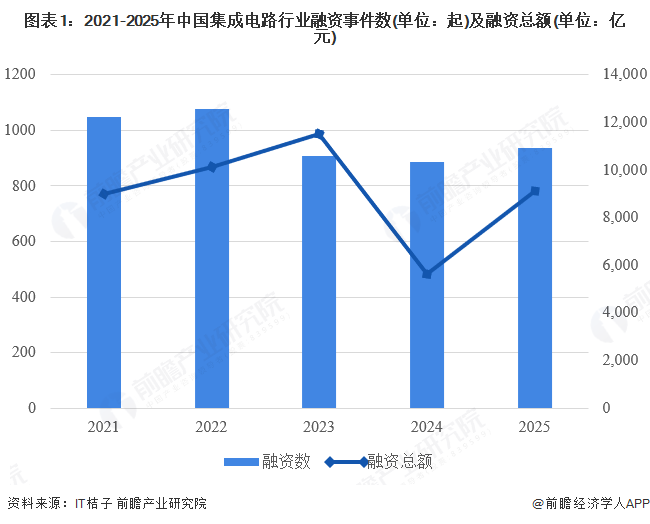
Industry Overview - The Chinese integrated circuit industry has seen a significant number of financing events, with over 1,000 events in both 2021 and 2022, indicating a peak period for investment [1] - In 2023, the number of financing events decreased, but the total financing amount increased to 1.15 trillion yuan, while in 2024, the number of events slightly declined, and the total financing amount halved to approximately 562.39 billion yuan [1] - By 2025, the number of financing events is expected to recover slightly to 938, with a total financing amount of approximately 911.05 billion yuan [1] Financing Events Summary - Major financing events in the Chinese integrated circuit industry for 2025 include various rounds of investment across different companies, with amounts often undisclosed [2][5][7] - Notable investments include 100 million yuan in Yanan Weiyan Technology and 1.43 billion yuan in Hongxing Zhixin, showcasing the active investment landscape [5][7] Financing Rounds Analysis - The most common financing round in the integrated circuit industry over the past five years has been the B round, with early-stage rounds like angel, Pre-A, and A rounds significantly outpacing later rounds [8] - Strategic investments have also been prevalent, indicating a strong interest in building long-term industry ecosystems [8] Regional Financing Distribution - Financing activities are heavily concentrated in eastern coastal provinces such as Guangdong, Jiangsu, and Zhejiang, with Jiangsu showing particularly high financing scales [9] - In contrast, provinces like Shandong and Henan have seen a significant decrease in financing events, while regions like Jilin and Tibet have almost no financing activity [9] Sector-Specific Financing Insights - The integrated circuit industry can be segmented into memory, logic chips, microprocessors, and analog chips, with memory leading with 374 financing events, significantly higher than logic chips (113 events), microprocessors (75 events), and analog chips (18 events) [13] - This reflects the strong demand for domestic alternatives in the memory sector and varying levels of investor interest across different segments [13] Representative Companies' Investment Activities - Key companies in the integrated circuit sector, such as Xinyuan Co., have made substantial investments in various startups to enhance their technological capabilities and strengthen their competitive edge [15][16][17][18] - For instance, Xinyuan Co. has invested 500 million yuan in Xinyuan Technology (Shanghai) and 100 million yuan in Xinyuan Microelectronics (Nanjing) [16] Mergers and Acquisitions - The competitive landscape among Chinese integrated circuit companies is characterized by numerous mergers and acquisitions, primarily focusing on horizontal integration to expand market share and achieve technological synergies [19][20] - Recent notable acquisitions include Huadian Co. acquiring 15% of Shengwei Ce Electronics and Xinyuan Co. acquiring 100% of Xinyuan Technology [20] Summary of Investment and M&A Trends - The investment activities in the Chinese integrated circuit industry are showing signs of recovery, with a notable increase in merger and acquisition events, indicating a dynamic market environment [22]



“易中天”“纪连海” A股的AI风 2026年吹向何方?
Zhong Guo Zheng Quan Bao· 2026-01-03 04:55
Core Insights - The article highlights the emergence of six leading technology stocks in the A-share market, referred to as "易中天" and "纪连海," which symbolize the strong performance of the AI, computing power, optical communication, and chip sectors in 2025 [1][3] Group 1: Market Trends - In 2025, global AI technology entered a phase of large-scale application, with China experiencing accelerated penetration of "AI+" driven by policy support and industrial upgrades [3] - The stocks represented by "易中天" (New Yisong, Zhongji Xuchuang, Tianfu Communication) focus on optical modules and communication devices, while "纪连海" (Hanwujing, Industrial Fulian, Haiguang Information) centers on AI chips and computing hardware [3] - The strong performance of these stocks reflects a clear investment logic, with "易中天" benefiting from the urgent demand for high-speed optical modules due to global computing power construction [3][4] Group 2: Performance and Valuation - Many companies experienced a "Davis Double Play" moment in 2025, with Q3 performance significantly exceeding expectations, validating the authenticity and sustainability of AI demand [4] - Market funds showed strong consistency, with public funds and northbound capital driving the trading volume of these sectors to remain at the forefront of the market [5] Group 3: Future Outlook - In 2026, the AI industry is expected to transition from infrastructure construction to application landing and ecological competition, leading to structural differentiation within the AI sector [6] - The demand for 800G optical modules is projected to continue growing rapidly, with significant advancements in 1.6T technology and the initiation of 3.2T module development [6] - As computing costs decrease, AI applications in vertical industries such as finance, healthcare, education, and manufacturing are anticipated to accelerate, potentially leading to the emergence of new "application-oriented leaders" in the A-share market [6][7]




2025年度科创板排行榜
Wind万得· 2026-01-01 22:38
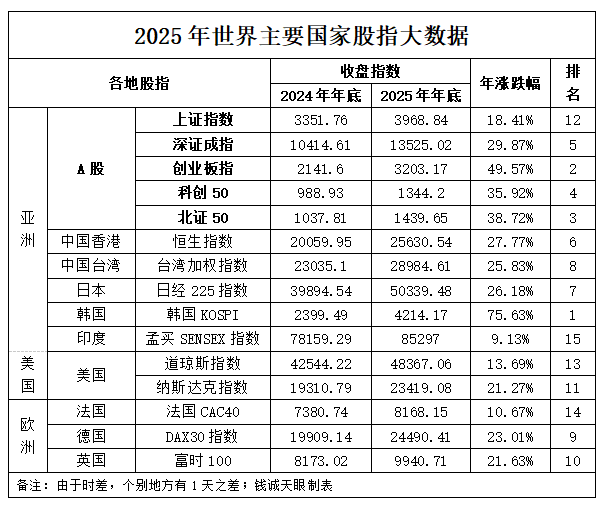
Market Sector - The Sci-Tech 50 Index increased by 35.92% in 2025, ranking third among various sector indices, outperforming both the Shanghai 50 and Shenzhen 50 indices [1][3] - By the end of 2025, the total market capitalization of the Sci-Tech Board reached 11.12 trillion yuan, an increase of 4.4 trillion yuan from 6.72 trillion yuan at the end of 2024, representing a growth rate of 65.38%, which is higher than other sectors [3] - The total trading volume of the Sci-Tech Board in 2025 was 37.79 trillion yuan, with an average trading volume per stock of 629.82 million yuan, which is lower than the average trading volumes of the Shanghai and Shenzhen main boards and the ChiNext [5][6] - The average daily turnover rate for the Sci-Tech Board in 2025 was 3.37%, higher than that of the Shanghai main board but lower than that of the Shenzhen main board and ChiNext [7] - At the end of 2025, the price-to-book ratio of the Sci-Tech Board was 5.61 times, higher than that of the ChiNext and the Shanghai and Shenzhen main boards [11] - By the end of 2025, the financing balance of the Sci-Tech Board reached 270.33 billion yuan, an increase of 125.03 billion yuan from the beginning of the year [13] - The securities lending balance of the Sci-Tech Board at the end of 2025 was 0.925 billion yuan, an increase of 0.0466 billion yuan from the beginning of the year [15] Individual Stocks - By the end of 2025, SMIC led with a market capitalization exceeding 600 billion yuan, followed by Cambrian (571.615 billion yuan) and Haiguang Information (521.605 billion yuan), with three companies including Moore Threads (276.33 billion yuan), BeiGene (263.457 billion yuan), and Muxi (232.098 billion yuan) surpassing 200 billion yuan [17] - Excluding the significant fluctuations on the first day of new stock listings, Weiqi New Materials had the highest increase of 1820.29% in 2025, followed by Shijia Photon (442.55%), Pinming Technology (428.78%), and Dongxin Co. (427.51%) [21] - By the end of 2025, Cambrian had the highest financing balance at 15.121 billion yuan, followed by SMIC (13.691 billion yuan), Haiguang Information (7.221 billion yuan), and Lanke Technology (6.197 billion yuan) [23] - Haiguang Information had the highest securities lending balance at 34.2342 million yuan, followed by Cambrian (31.6128 million yuan) and SMIC (28.4114 million yuan), with Guodun Quantum and Tuojing Technology exceeding 20 million yuan in securities lending [25] Issuance - By the end of 2025, there were 600 companies listed on the Sci-Tech Board, with 18 new stocks successfully issued in 2025, a 20% increase from 15 in 2024 [28] - The companies issued in 2025 were distributed across four Wind Sci-Tech thematic industries, with the new generation information technology industry leading with 10 companies, followed by the biotechnology industry with 5 companies, and new materials and high-end equipment manufacturing industries with 1 company each [30] - Among the companies issued in 2025, 10 met the first standard for listing, which requires positive net profits for the last two years and a cumulative net profit of no less than 50 million yuan, or positive net profit for the last year and operating income of no less than 100 million yuan, with an expected market value of no less than 1 billion yuan [33] - In terms of geographical distribution, Beijing led with 5 companies, followed by Jiangsu with 3, with North China (Beijing) and East China (Jiangsu, Zhejiang, Fujian, Shanghai) accounting for over 70% [36] - The total IPO financing for Sci-Tech Board companies in 2025 was 37.844 billion yuan, a year-on-year increase of 187.83%, with 13 companies raising over 1 billion yuan, 4 companies raising between 500 million to 1 billion yuan, and 1 company raising under 500 million yuan [39] - In the IPO financing of 2025, Moore Threads led with 8 billion yuan, followed by Xi'an Yicai (4.636 billion yuan) and Muxi (4.197 billion yuan), with four companies raising over 2 billion yuan [43]






国产算力-英伟达Groq的重要性
2025-12-31 16:02
Summary of Key Points from Conference Call Records Industry and Company Involved - The discussion primarily revolves around the domestic computing power market in China, with a focus on ByteDance and its procurement strategies for computing power cards, particularly from domestic manufacturers like Huawei and Cambrian. Additionally, the impact of NVIDIA's acquisition of Groq and Meta's acquisition strategies are also discussed. Core Insights and Arguments - **ByteDance's Computing Power Demand**: ByteDance anticipates a significant increase in daily token consumption from 50 trillion at the end of 2025 to 400 trillion by 2026, indicating a surge in demand for computing power. However, the actual consumption of computing cards is expected to grow by 3 to 4 times due to parameter optimization effects [1][4]. - **Shift to Domestic Computing Cards**: With NVIDIA discontinuing older models, ByteDance plans to increase its procurement of domestic computing cards, particularly from Huawei's Ascend and Cambrian's new models. The expected total procurement amount for domestic computing cards is projected to be at least 600 to 700 billion yuan [1][4]. - **Market Trends for Domestic Computing Power**: The development trend for domestic computing power is confirmed to be positive and long-term. Major companies, including ByteDance, are already discussing procurement plans for 2026, with Cambrian showing excellent performance in model adaptation [1][5]. - **Growth Expectations for 2026**: The domestic computing power market is expected to grow by at least 100% in 2026, driven by ByteDance's strong demand for computing power. It is recommended to focus on domestic computing power as a foundational investment [1][6]. - **NVIDIA's Acquisition of Groq**: NVIDIA's acquisition of Groq enhances its technical capabilities, particularly with Groq's LPU architecture, which improves efficiency by computing directly on-chip without data transfer to storage. This acquisition helps NVIDIA address its shortcomings in TPU architecture and mitigates competition from Google [1][7]. - **Meta's Acquisition Strategy**: Meta's acquisition of Minus has not effectively enhanced its large model capabilities. Despite significant investments, Meta has fallen behind competitors like Alibaba and Deepseek, leading to a perception of strategic confusion and a decline in core competitiveness [1][2][8]. Other Important but Potentially Overlooked Content - **Performance of Domestic Manufacturers**: While Huawei's Ascend has shown average performance within ByteDance, Cambrian and other domestic manufacturers are expected to gain market share due to their superior adaptability and performance [1][4][5]. - **Investment Opportunities**: There is a recommendation to focus on quantifiable stocks related to domestic computing power, as the market outlook remains optimistic despite potential short-term fluctuations [1][5].

钱诚天眼:2025年创业板指暴涨50%,全球第二(一)
Sou Hu Cai Jing· 2025-12-31 12:46
2025年12月31日,A股在万众瞩目与喧嚣声中圆满收官。这一年,A股宛如一部跌宕起伏的史诗巨著, 每一页都写满了惊喜与挑战,每一行都镌刻着资本与科技的激情碰撞。 一、成绩斐然:指数全线飘红,市值再创新高 | | | | 2025 年世界主要国家股指大数据 | | | | | --- | --- | --- | --- | --- | --- | --- | | | 各地股指 | | 收盘指数 | | 年涨跌幅 | 排 | | | | 上证指数 | 2024年年底 | 2025年年底 | | 名 | | | A 股 | | | | | | | | | 深证成指 | 3351.76 10414.61 | 3968. 84 13525.02 | 18. 41% 29. 87% | 12 5 | | | | 创业板指 | 2141.6 | 3203. 17 | 49. 57% | 2 | | | | 科创 50 | 988. 93 | 1344. 2 | 35.92% | র্ব | | 型 | | 北证 50 | 1037. 81 | 1439.65 | 38.72% | 3 | | 示 | 中国香港 | 恒生指 ...