SPD BANK(600000)

Search documents
中国改革现场丨这家银行名叫“硬科技”
Yang Guang Wang· 2025-08-11 00:40
央广网北京8月11日消息(记者邢斯嘉 崔刚 吴琼)据中央广播电视总台中国之声《新闻和报纸摘 要》报道,资金短缺是科技企业初创期普遍面临的难题。全国首家以"硬科技"命名的专业支行,锚定初 创期、成长期的中小微科技企业,三年来贷款"贷"出了多个响当当的领域前沿。中国之声特别策划《中 国改革现场》本期推出《这家银行名叫"硬科技"》。 在陕西省汉中市汉核同位素药品研发生产基地厂房内,田海滨这位研发医用放射性同位素的科学 家,自企业2019年创立,终于获得了银行9000万元贷款支持。这笔钱意味着,他将可以进行多种医用同 位素国产化生产,为国内同位素药品生产厂家解决重要放射性原料"卡脖子"问题。 田海滨:传统银行我的设备抵押叫"非通用设备",审批的时候"风控"过不去。但是浦发科技是看我 们的未来,抵押物评估之后,大概能占到它整个投资额的将近一半多;从商业化的几款合作、意向订 单、产能、明年达产之后市场的格局情况,足够支撑还款能力。 张明:我们尽调了几个月的时间,我们认为应该去很好地支持科技能力、产业能力有重大价值、重 大作用的、现在看起来比较弱小的企业,真正把它们扶持起来。 张明告诉记者,专业专营机制是生存之本,更是破解 ...

科创债3个月发行超8800亿元中小机构、民企加速进场
Zheng Quan Shi Bao· 2025-08-10 17:41
Core Insights - The new policy for technology innovation bonds has led to a significant issuance of 883.16 billion yuan in just three months, with financial institutions accounting for nearly 36% of this total [1][2] - The issuance of technology innovation bonds has expanded to include more small and private enterprises, alongside the traditional dominance of central and state-owned enterprises [1][2] - The average coupon rate for newly issued technology innovation bonds is 1.9282%, with some bonds having rates as low as 0.01% [1][3] Issuance Details - From May 7 to August 10, a total of 700 technology innovation bonds were issued, amounting to 883.16 billion yuan, compared to 197 bonds totaling 208.11 billion yuan in the same period last year, indicating a significant policy impact [1][2] - Financial institutions have issued 314.27 billion yuan of the total, with banks leading at 230.3 billion yuan across 32 banks, including major players like Agricultural Bank of China and Industrial and Commercial Bank of China [2] - Securities companies have collectively issued 54.1 billion yuan, with the largest issuers being China Merchants Securities and CITIC Securities [2] Characteristics of New Bonds - The newly issued technology innovation bonds predominantly have longer maturities, with 76.23% of the total issuance being bonds with maturities of three years or more [3] - The majority of the bonds were issued by central and local state-owned enterprises, with 203 bonds from central SOEs and 369 from local SOEs, while private enterprises issued 94 bonds [3]





科创债3个月发行超8800亿元 中小机构、民企加速进场
Zheng Quan Shi Bao· 2025-08-10 17:37
Core Viewpoint - The new policy for technology innovation bonds (科创债) has led to a significant increase in issuance, with a total of 883.16 billion yuan in new bonds over the past three months, indicating a strong market response to regulatory support [1][2]. Group 1: Issuance Scale and Participants - The total issuance scale of technology innovation bonds reached 883.16 billion yuan, with financial institutions accounting for nearly 36% of this amount [1][2]. - Among the financial institutions, banks led the issuance with 230.3 billion yuan, followed by 38 securities companies that collectively issued 54.1 billion yuan [2]. - The participation of small and medium-sized institutions and private enterprises has increased, with various smaller banks and private equity firms also issuing technology innovation bonds [2]. Group 2: Characteristics of New Bonds - The average coupon rate for newly issued technology innovation bonds was 1.9282%, which is notably low compared to other credit bonds of similar ratings [3]. - A significant portion of the new bonds has a maturity of over three years, with 76.23% of the total issuance (673.22 billion yuan) falling into this category [3]. - The majority of the issuers are central and local state-owned enterprises, with 203 bonds issued by central state-owned enterprises and 369 by local state-owned enterprises [3].

固收周报20250810:“债不弱,股不强”格局下转债仍将扮演必要角色-20250810
Soochow Securities· 2025-08-10 13:47
Group 1: Report Industry Investment Rating - The report does not explicitly mention the industry investment rating [1] Group 2: Core Views of the Report - Maintain a relatively optimistic view of the convertible bond market in the second half of the year, due to the continuous imbalance between supply and demand and the "asset shortage" situation, the important role of convertible bonds in the asset portfolio, and the need to conduct high - low switching [1] - In the context of a slow - bull equity market, there are still opportunities for bank convertible bonds [1] - The top ten high - rating, medium - low - price convertible bonds with the greatest potential for par premium rate repair next week are Hexing Convertible Bond, Guangda Convertible Bond, etc. [1] Group 3: Summary According to the Directory 1. Week - to - Week Market Review 1.1. Equity Market Overall Rise, Most Industries Rise - From August 4th to 8th, the equity market rose overall, with the Shanghai Composite Index up 2.11%, the Shenzhen Component Index up 1.25%, the ChiNext Index up 0.49%, and the CSI 300 up 1.23%. The average daily trading volume of the two markets decreased by about 1121.60 billion yuan to 16748.23 billion yuan, a week - on - week decrease of 6.28% [6][8] - Among the 31 Shenwan primary industries, 25 industries closed up, with National Defense and Military Industry, Non - Ferrous Metals, etc. leading the gains [12] 1.2. Convertible Bond Market Overall Rise, Most Industries Fall - From August 4th to 8th, the CSI Convertible Bond Index rose 2.31%. Among the 29 Shenwan primary industries, 4 industries closed up, with Automobile, Social Services, etc. leading the gains. The average daily trading volume of the convertible bond market was 895.48 billion yuan, a significant increase of 72.55 billion yuan, a week - on - week change of 8.82% [15] - About 92.46% of convertible bond issues rose, and 51.72% of them had a gain of over 2% [15] - The overall market conversion premium rate rebounded, with an average daily conversion premium rate of 41.62%, an increase of 0.98 pct compared to last week [22] - 20 industries saw an expansion in the conversion premium rate, and 17 industries had an increase in conversion parity [28][33] 1.3. Stock - Bond Market Sentiment Comparison - From August 4th to 8th, the weekly weighted average and median of the convertible bond and underlying stock markets were positive, and the underlying stocks had a larger weekly gain. The trading volume of the convertible bond market increased by 5.07% week - on - week, and that of the underlying stock market decreased by 6.84% week - on - week. The trading sentiment of the underlying stock market was better [34] 2. Outlook and Investment Strategy - Maintain the previous view, be relatively optimistic about the convertible bond market in the second half of the year. In the context of a slow - bull equity market, there are still opportunities for bank convertible bonds [1][38] - The top ten high - rating, medium - low - price convertible bonds with the greatest potential for par premium rate repair next week are Hexing Convertible Bond, Guangda Convertible Bond, etc. [1]



银行半年报看点:非息收入成增长引擎
Zhong Guo Jing Ying Bao· 2025-08-10 13:37
Core Insights - The banking sector has shown robust performance in the first half of 2025, with several banks reporting significant growth in both asset size and operating income, with net profits for five banks increasing by over 10% year-on-year [1][2] Group 1: Financial Performance - Shanghai Pudong Development Bank reported an operating income of 90.559 billion yuan, a year-on-year increase of 2.62%, and a net profit of 29.737 billion yuan, up 10.19% [2] - Qingdao Bank's total assets reached 743.028 billion yuan, growing by 7.69% compared to the end of the previous year, with a net profit of 3.065 billion yuan, reflecting a 16.05% increase [2] - The asset quality of multiple banks remains stable, with Shanghai Pudong Development Bank's non-performing loan (NPL) balance decreasing by 608 million yuan, resulting in an NPL ratio of 1.31%, down 0.05 percentage points from the end of the previous year [2][3] Group 2: Market Conditions and Revenue Drivers - The growth in bank operating income is attributed to two main factors: a decline in deposit rates leading to lower funding costs, and a recovery in the capital markets boosting income from wealth management and other intermediary services [1][4] - The capital market's recovery has enhanced the attractiveness of bank wealth management products, contributing to increased non-interest income [4][5] - Analysts expect that as the market stabilizes and the impact of previous fee adjustments diminishes, banks will see a recovery in fee and commission income, particularly from wealth management services [5] Group 3: Future Outlook - Looking ahead, banks are expected to continue supporting economic growth, with loan and deposit activities driving asset and liability growth, and a focus on optimizing credit structures [1][6] - Despite facing some downward pressure on net interest margins, banks are likely to stabilize these margins through measures such as lowering deposit rates and managing high-interest deposits [6]

鑫闻界|A股银行半年业绩渐披露,5家净利增超10%,估值修复再获新空间?
Qi Lu Wan Bao· 2025-08-09 23:32
Core Viewpoint - The first half of 2025 has shown positive growth in revenue and net profit for several A-share listed banks, with a notable performance from Changshu Bank, indicating a potential revaluation of bank stocks and a favorable outlook for a "slow bull market" [2][9]. Group 1: Changshu Bank Performance - Changshu Bank reported a revenue of 6.062 billion yuan, a year-on-year increase of 10.1%, and a net profit of 1.969 billion yuan, up 13.51% [3]. - Non-interest income surged by 57.26%, driven by significant increases in fee and commission income (up 637.77%) and bond investment income (up 560.13%) [3]. - As of June 30, 2025, total assets reached 401.227 billion yuan, with loans and deposits growing by 4.4% and 8.46%, respectively [3][4]. Group 2: Asset Quality and Dividends - The non-performing loan (NPL) ratio stood at 0.76%, a slight decrease from the previous year, while the provision coverage ratio was 489.53% [4]. - Changshu Bank proposed a cash dividend of 0.15 yuan per share, totaling 497 million yuan, which is 25.27% of its net profit for the half-year [4]. Group 3: Other Banks' Performance - Other banks such as Hangzhou Bank, Ningbo Bank, and Shanghai Pudong Development Bank also reported net profit growth exceeding 10%, with Hangzhou Bank achieving a 16.67% increase [5][7]. - Shanghai Pudong Development Bank's net profit reached 29.737 billion yuan, reflecting a 10.19% year-on-year growth, with total loans and deposits increasing by 4.51% and 8.71%, respectively [5][7]. - Qingdao Bank and Ningbo Bank also reported positive growth in both revenue and net profit, with Qingdao Bank's net profit increasing by 16.05% [8]. Group 4: Market Performance and Outlook - The banking sector has seen an 18.10% increase in stock prices year-to-date, with Shanghai Pudong Development Bank leading with a 41.88% rise [9]. - Agricultural Bank of China has surpassed Industrial and Commercial Bank of China in market capitalization, reaching 2.14 trillion yuan [10][11]. - Analysts suggest that the combination of low valuations and high returns makes bank stocks attractive, with potential for over 60% price appreciation based on current dividend yields and asset quality [11][12].



国债利息收税的连锁反应
Hua Xia Shi Bao· 2025-08-09 05:47
Core Viewpoint - The introduction of VAT on interest income from newly issued government bonds, local government bonds, and financial bonds starting August 8 has led to a rise in the value of existing bonds compared to new ones, causing a shift in investment focus towards high-dividend stocks in the A-share market, particularly bank stocks [1][2][3]. Group 1: Bond Market Impact - New tax policy on interest income from bonds has resulted in a decline in the investment attractiveness of government bonds, leading to a short-term increase in bond market values [1]. - The long-term downtrend in interest rates has made traditional bond investments less appealing, prompting investors to seek alternative high-yield assets [2]. Group 2: A-share Market Dynamics - A-share market saw a significant rise, with the index increasing by 200 points in July, driven by insurance funds favoring high-dividend assets [1][2]. - Insurance funds have increasingly turned to bank stocks, with at least eight instances of shareholding increases in banks from January to May 2025, particularly by the Ping An group [2][3]. Group 3: Bank Stock Performance - Bank stocks have shown substantial growth, with Agricultural Bank surpassing Industrial and Commercial Bank in market capitalization as of August 6, 2025 [3]. - Year-to-date performance of major banks indicates significant gains, with Shanghai Pudong Development Bank up over 38% and Agricultural Bank close to 30%, outperforming the broader market indices [3][4]. Group 4: Future Considerations - The recent surge in bank stock prices may lead to a reevaluation of their investment value, potentially triggering a renewed interest in government bonds if bank stock prices exceed their investment attractiveness [5].

又一家银行“落子”金融科技
Zhong Guo Jing Ying Bao· 2025-08-09 05:39
Core Viewpoint - The establishment of Shanghai Pudong Development Bank's financial technology subsidiary, PuYin JinKe, marks a significant step in the bank's digital transformation strategy, aiming to enhance its technological capabilities and support its overall digitalization efforts [2][3]. Group 1: Company Overview - PuYin JinKe is fully owned by Shanghai Pudong Development Bank International Investment Co., Ltd. and aims to operate independently to foster innovation and reduce regulatory constraints [2]. - The company focuses on three main areas: providing IT shared services for group subsidiaries, supporting overseas branches in non-transactional business system development, and creating a platform for corporate clients to enhance financial and non-financial services [3]. Group 2: Strategic Goals - Shanghai Pudong Development Bank has set 2025 as a "Strategic Enhancement Year," with a focus on digital finance as a core driver for transformation, aiming to establish a benchmark for digitalization in the banking industry [3][4]. - The bank is actively developing a data center and an artificial intelligence center to accelerate the application of AI technologies, moving from scenario-based planning to large-scale implementation [4]. Group 3: Industry Trends - The trend of banks establishing financial technology companies is growing, with most major state-owned banks and several national joint-stock banks having already set up their own fintech subsidiaries [5]. - The core driving logic behind these fintech companies includes transitioning from "technology dependence" to "self-operating capabilities," enhancing technological autonomy, and exploring market opportunities for external technology output [6]. Group 4: Competitive Advantages - Bank-affiliated fintech companies benefit from high brand recognition, strong offline service capabilities, and prudent compliance risk management, making them more appealing to smaller banks seeking reliable solutions [7].

一场银行大收缩,正在悄然发生
虎嗅APP· 2025-08-09 03:01
Core Viewpoint - The establishment of bank fintech subsidiaries has not led to the expected growth and profitability, with many returning to their parent banks due to operational challenges and market competition [9][15][37]. Group 1: Industry Overview - The fintech subsidiary of SPDB, PuYin JinKe, opened in Shanghai on August 5, 2024, but this does not indicate a revival of bank tech subsidiaries, as the industry has seen a decline in new establishments since 2022 [4][6]. - Over the past decade, more than 20 banks have established fintech subsidiaries, driven by the need for improved cybersecurity and competition from internet financial companies [7][8]. - Despite initial hopes, these subsidiaries have struggled to generate independent revenue and often rely on their parent banks for survival [9][15]. Group 2: Financial Performance - Financial reports indicate that many fintech subsidiaries have failed to achieve profitability. For instance, ZhongYin JinKe reported a net profit of only 0.11 million yuan in the first half of 2024, while Financial One Account has accumulated losses of 7.33 billion yuan from 2017 to 2023 [18][19]. - The business model of these subsidiaries often leads to losses, as seen with XingYe ShuJin, which reported a net loss of 1.67 million yuan in the first half of 2019 [19]. Group 3: Market Dynamics - The fintech market has become increasingly competitive, with major players like Alibaba and Tencent dominating the financial cloud market, leaving bank subsidiaries struggling to gain market share [29]. - Regulatory changes have also impacted the ability of these subsidiaries to operate independently, as new guidelines restrict the outsourcing of core IT functions [26][27]. Group 4: Future Outlook - The trend of fintech subsidiaries returning to their parent banks is expected to continue, as their primary revenue source remains servicing the parent bank, which diminishes their independent operational significance [37][39]. - The lack of competitive advantage and the challenges in providing innovative solutions further complicate the sustainability of these subsidiaries [39][40].


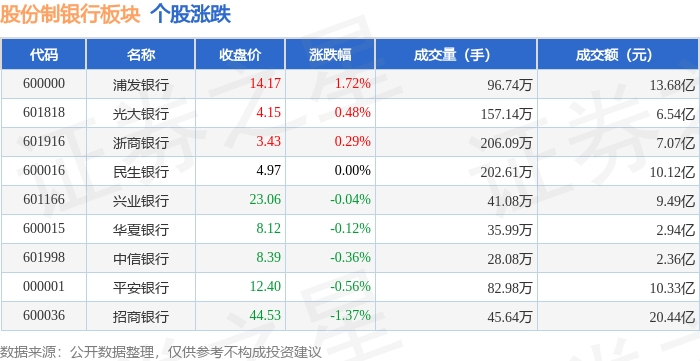
股份制银行板块8月8日跌0.24%,招商银行领跌,主力资金净流出3.65亿元
Zheng Xing Xing Ye Ri Bao· 2025-08-08 08:35
Group 1 - The banking sector experienced a decline of 0.24% on August 8, with China Merchants Bank leading the drop [1] - The Shanghai Composite Index closed at 3635.13, down 0.12%, while the Shenzhen Component Index closed at 11128.67, down 0.26% [1] - Among the listed banks, Shanghai Pudong Development Bank saw the highest increase of 1.72%, while China Merchants Bank had the largest decrease of 1.37% [1] Group 2 - The banking sector faced a net outflow of 365 million yuan from main funds, while retail investors contributed a net inflow of 363 million yuan [1] - Specific banks like Huaxia Bank and China Merchants Bank experienced significant net outflows from main funds, with China Merchants Bank seeing a net outflow of 239 million yuan [1] - Retail investors showed strong interest in several banks, with notable inflows into Huaxia Bank and China Merchants Bank, despite the overall outflow from main funds [1]