
SPD BANK(600000)

Search documents
让无形数据变有价资产推进数字金融 银行业积极“挖矿”
Zheng Quan Ri Bao· 2025-06-17 16:13
Core Viewpoint - Data is being recognized as the fifth production factor, significantly reshaping the balance sheets of commercial banks as they actively explore and incorporate data resources into their financial statements [1][2]. Group 1: Importance of Data Resource Integration - The integration of data resources into financial statements is crucial for commercial banks to accelerate digital transformation and enhance their ability to serve the real economy [1][2]. - The implementation of the "Interim Provisions on the Accounting Treatment of Corporate Data Resources" has provided a framework for converting data resources into data assets [2][3]. - The ongoing development of data resource integration is expected to accelerate as policies and evaluation methods improve [1][5]. Group 2: Current Practices and Examples - Several national joint-stock banks and city commercial banks have begun the process of integrating data resources into their financial statements, establishing standardized procedures for data inventory, rights confirmation, and valuation [3][4]. - For instance, as of the end of 2024, banks like Hengfeng Bank and China CITIC Bank reported data resource values of 1.01 million and 4.94 million respectively, while Everbright Bank's data resource scale exceeded 18 million [3][4]. Group 3: Challenges and Future Directions - Despite the initial steps taken, the scale of data resource integration in commercial banks remains limited compared to other industries, with the need for a unified and authoritative evaluation method being a significant challenge [5][8]. - The complexity of data resource valuation and the need for diverse assessment methods for different types of data are major hurdles in the integration process [9][8]. - The establishment of a comprehensive data asset valuation framework by the China Banking Association aims to address these challenges and facilitate the integration of data resources into financial statements [9][10]. Group 4: Collaborative Efforts for Advancement - Collaboration among government, industry associations, and enterprises is essential to advance the integration of data resources into financial statements [10][11]. - Recommendations include enhancing data lifecycle management, improving IT infrastructure, and fostering talent development to support data governance and accounting processes [10][11].






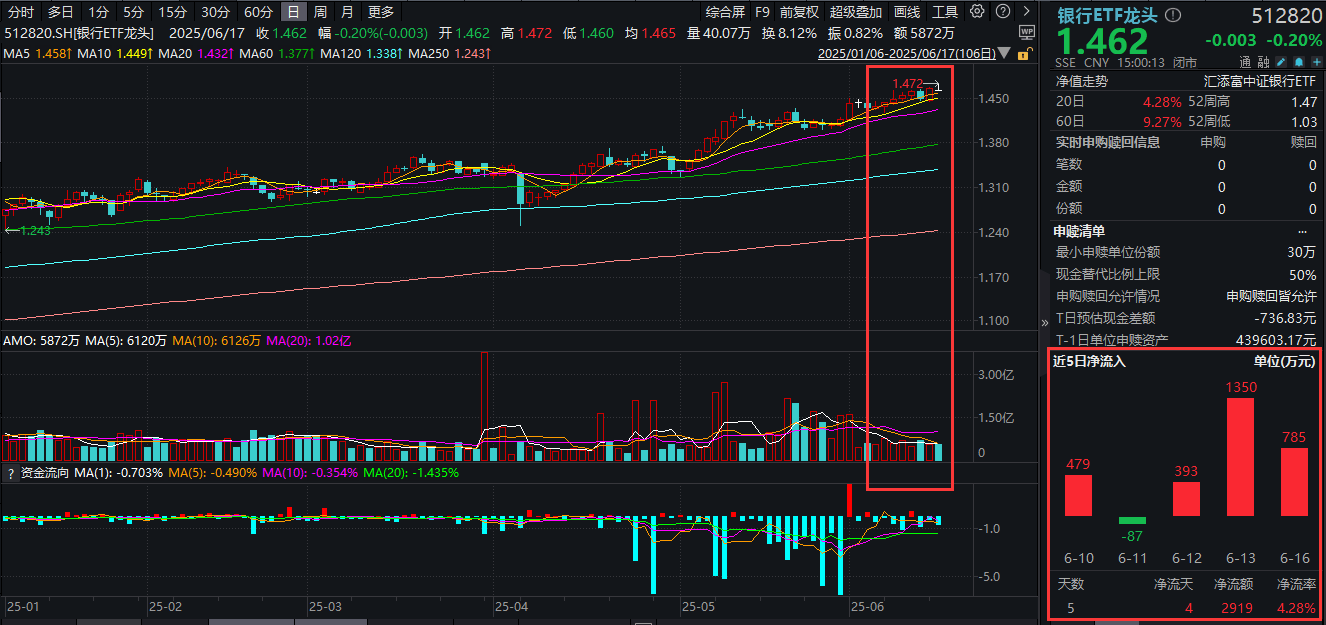
正式落地!两大行获注资超千亿元,银行ETF龙头(512820)冲高回落,连续3日累计吸金超2400万元!大火的银行板块还能上车吗?
Sou Hu Cai Jing· 2025-06-17 09:25
Core Viewpoint - The banking sector, particularly the leading bank ETF (512820), is experiencing a strong performance driven by high dividend yields and low valuations, making it an attractive investment opportunity [5][10][15]. Group 1: Market Performance - On June 17, the A-share market showed mixed trends, with the bank ETF (512820) experiencing a slight decline of 0.2% after reaching a historical high during the day [1]. - The bank ETF (512820) has attracted over 25 million yuan in capital inflow over the past three days, indicating strong investor interest in high-dividend sectors [1]. - The index of the bank ETF (512820) has seen a 15.33% increase over the past six months, outperforming the CSI 300 by 16.51% [5]. Group 2: Fundraising and Capital Injections - Recently, major banks like the Bank of Communications and Bank of China announced successful A-share stock issuances, raising 120 billion yuan and 165 billion yuan respectively, contributing to a total of 520 billion yuan in capital injections for the four major state-owned banks [5]. - This capital injection is expected to enhance the core Tier 1 capital adequacy ratio of state-owned banks, thereby improving their ability to support the real economy [5]. Group 3: Investment Appeal - The banking sector is characterized by high dividend yields and low valuations, making it more attractive compared to other industries [7][10]. - The current price-to-book ratio (PB) of the bank ETF (512820) is 0.68, indicating a significant undervaluation [12]. - The latest dividend yield for the bank ETF (512820) is 5.4%, which is competitive in the market [12]. Group 4: Future Outlook - There is strong momentum for long-term capital inflows into the banking sector from insurance funds, state-owned enterprises, and public funds, which is expected to support the valuation of bank stocks [8][15]. - The banking sector's fundamentals remain robust, with stable operations and sustainable dividends, which are likely to strengthen its high dividend characteristics [9][15].







融资更融“智” “蓝图”变“实景” 浦发银行上海分行助力申城人工智能高地建设
Jin Rong Shi Bao· 2025-06-17 06:12
Group 1 - Shanghai Wuwenxinqiong Intelligent Technology Co., Ltd. aims to become a leading computing power operator in the era of large models, having been established in May 2023 by a team from Tsinghua University [1] - Shanghai Pudong Development Bank (SPDB) has become the main cooperative bank for Wuwenxinqiong, providing credit support and tailored financial products to meet the company's R&D investment needs [1] - SPDB is collaborating with Wuwenxinqiong to explore advanced topics in AI technology applications in finance, focusing on intelligent risk control and wealth management AI assistants [1] Group 2 - Shanghai LingShu Intelligent Technology Co., Ltd. provides production operation management products and services for the manufacturing industry, utilizing cloud-native, big data, and low-code technologies [2] - SPDB has become the first financing partner for LingShu Intelligent, offering timely and precise financing support to alleviate the company's funding pressures and assist in its growth [2] - The bank has implemented loan discount policies to reduce interest for LingShu Intelligent, demonstrating its commitment to supporting the company's financial needs [2] Group 3 - SPDB has established the first AI-themed branch in Xuhui District, providing a platform for interaction and collaboration among AI enterprises [3] - The branch has hosted multiple "technology-finance" salons, attracting participation from various tech companies and fostering community engagement [3] - SPDB collaborates with local government think tanks and innovation platforms to enhance the service offerings for AI enterprises [3] Group 4 - SPDB has developed a "6G service" system in the technology finance sector, aiming to transition from a service provider to a growth co-builder for tech companies [4] - The bank employs a "tropical rainforest" service model, offering a comprehensive credit loan product system that supports tech enterprises throughout their lifecycle [4] - By leveraging intelligent technologies and platforms, SPDB aims to stimulate industrial clustering effects and contribute to Shanghai's goal of becoming a global technology innovation hub [4]
稳定币概念全天强势 银行股尾盘拉升
Mei Ri Shang Bao· 2025-06-16 22:25
Market Overview - A-shares experienced a low open and high close, with the Shanghai Composite Index rising by 0.35%, Shenzhen Component Index by 0.41%, and ChiNext Index by 0.66% [1] - The total market turnover reached 12,435 billion, with over 3,500 stocks in the market closing in the green [1] Stablecoin Concept - The stablecoin concept surged throughout the day, with the digital currency sector rising by 4.72%, making it the top-performing industry concept [2] - Notable stocks included Tianyang Technology and Sifang Jingchuang hitting the 20% limit up, while Lakala rose over 15% [2] - The positive sentiment is attributed to favorable policies boosting investor confidence, with long-term prospects for stablecoins expected to drive the virtual asset industry [3] Financial Sector Performance - The banking sector showed strong performance, with Qingnong Commercial Bank and Sunong Bank rising over 3%, and several banks reaching historical highs [4] - The People's Bank of China reported an increase in social financing scale and new RMB loans, indicating a robust financial environment [4] - Analysts suggest that bank stocks have strong earnings certainty and recommend focusing on their investment value due to stable fundamentals and low valuations [5] Real Estate Sector Activity - The real estate sector exhibited strong performance, with a 1.69% overall increase, and 81 out of 91 stocks rising [6] - Positive policy signals from the government aim to stabilize the real estate market, with measures to optimize existing policies and enhance market expectations [6][7] - The National Bureau of Statistics indicated that the real estate market is moving towards stabilization, supported by the implementation of various policies [7]





固定收益专题报告:银行转债缩量后,转债底仓怎么配?
Guoxin Securities· 2025-06-16 11:41
Report Industry Investment Rating There is no information provided in the report regarding the industry investment rating. Core View The report analyzes the situation of bank convertible bonds shrinking in the convertible bond market and explores possible bottom - position allocation ideas for convertible bond funds and other types of funds after the reduction of bank convertible bonds as large - cap bottom - position varieties. It provides suggestions for investors on how to choose bottom - position varieties based on the characteristics of convertible bond bottom - position varieties and market conditions [13]. Summary by Relevant Catalogs 1. Convertible Bond Bottom - Position Variety Overview - Pan - fixed - income + funds have a certain demand for convertible bonds. Convertible bond funds have an average convertible bond position of about 78%, and the convertible bond positions of first/second - level bond funds, balanced hybrid, and partial - debt hybrid funds are mostly maintained above 10% [1][15]. - At the industry level, public funds generally use convertible bonds from industries such as banks and power equipment as bottom - position varieties. Bank convertible bonds account for a large proportion in the convertible bond bottom - position varieties of public funds at all times, but the bottom - position varieties change with factors such as bond balance and market conditions [19][21]. 2. Overview of Bank Convertible Bonds - the "Major Holders" of Convertible Bond Bottom - Positions - **Purpose of Issuance**: Issuing convertible bonds is an important way for commercial banks to supplement core tier - 1 capital, and they need to achieve this through continuous conversion. Some bank convertible bonds have seen large shareholders convert at a premium to seize the opportunity to supplement core tier - 1 capital [2][28]. - **Characteristics**: Bank convertible bonds have high safety, can be pledged, and have high dividend yields of underlying stocks, almost no default risk, and strong anti - risk ability. They are also an important income - enhancement channel for stable accounts [2][33]. - **Scale Trend**: In recent years, there have been few bank convertible bond issuances, but the delisting rhythm has accelerated significantly. There are currently no new bank convertible bond issuances in the short term, and there are no new bank convertible bond pre - plans after the refinancing regulations [40][43]. 3. How to Allocate Subsequent Bottom - Position Varieties? - **Characteristics of Convertible Bond Bottom - Position Varieties**: Most bottom - position varieties have high ratings (AA and above), large market values (nearly 90% have a convertible bond balance of over 2 billion), and good anti - decline performance [3][46]. - **Analysis of "Possible Bottom - Position Varieties"**: - **Substituting with Other High - Rating Large - Cap Varieties**: Such as photovoltaic convertible bonds. Although there are relatively limited eligible targets, and photovoltaic convertible bonds have been increasingly favored by funds in recent quarters, whether each high - rating large - cap bond can be used as a bottom - position still needs comprehensive consideration [52][56]. - **Comparing with Public Fund Benchmarks**: Considering currently under - allocated varieties. However, in practice, most public funds' performance benchmarks do not contain convertible bond - related indices, and the conversion premium rate may be a significant interference factor [57][62]. - **Idea for Bottom - Position Selection**: - **For Convertible Bond Funds**: Consider individual bonds with a positive YTM and good credit quality of underlying stocks. Also, construct a convertible bond portfolio with low or negative correlations among some individual bonds [66][67]. - **For Non - Convertible Bond Funds**: When it is difficult to find suitable bottom - position varieties in the convertible bond market, consider switching to other types of bonds [71][72].

浦发银行济南分行成功举办卓信成长季“靠浦一夏 剧说成长”亲子剧场贵宾客户活动
Qi Lu Wan Bao· 2025-06-16 09:36
6月14日,济南珍珠泉礼堂内欢声笑语此起彼伏,浦发银行济南分行在这里成功举办"卓信成长季——靠浦一夏 剧说成长"亲子剧场贵宾客户活动。此次活动 特别邀请了1000位客户家庭成员到场,通过一场精彩的儿童舞台剧,为大家带来了一场充满爱与欢乐的亲子盛宴。 演出结束后,演员们来到大厅,与孩子们进行了亲切的互动合影。孩子们兴奋地围在演员身边,争相与自己喜爱的角色拍照留念,脸上洋溢着幸福的笑容。 家长们也纷纷拿出手机,记录下这一美好的瞬间。许多家长表示,这样的活动不仅让孩子们度过了一个愉快的周末,也让他们有机会与孩子一起享受亲子时 光,增进了彼此之间的感情。一位客户感慨地说:"浦发银行这次活动真的太贴心了,孩子们玩得非常开心。感谢银行精心组织,让我们感受到了浓浓的关 怀。" 此次"靠浦一夏 剧说成长"亲子剧场活动,是浦发银行济南分行践行"以客户为中心"服务理念的生动体现。活动不仅丰富了客户的业余生活,也进一步增强 了客户黏性和信任度。浦发银行济南分行将为客户提供更加优质、贴心的金融服务和非金融服务,与客户携手共创美好未来。 活动当天,孩子们怀揣着激动与期待,早早来到现场。演出以一个趣味互动——摸摸雪宝的鼻子开启,瞬间点燃 ...

浦发银行(600000) - 上海浦东发展银行股份有限公司关于2025年第一期无固定期限资本债券发行完毕的公告
2025-06-13 11:16
本公司董事会及全体董事保证本公告内容不存在任何虚假记载、误导性陈述 或者重大遗漏,并对其内容的真实性、准确性和完整性承担法律责任。 公告编号:临2025-030 证券代码:600000 证券简称:浦发银行 经中国人民银行和国家金融监督管理总局批准,上海浦东发展银行股份有限 公司(以下简称"公司")在全国银行间债券市场发行了"上海浦东发展银行股 份有限公司 2025 年第一期无固定期限资本债券"(以下简称"本期债券"),并在 上海清算所完成本期债券的登记、托管。 优先股代码:360003 360008 优先股简称:浦发优1 浦发优2 转债代码:110059 转债简称:浦发转债 上海浦东发展银行股份有限公司 关于2025年第一期无固定期限资本债券发行完毕的 公告 2025 年 6 月 13 日 上海浦东发展银行股份有限公司董事会 本期债券募集的资金将依据适用法律和监管机构的批准,用于补充公司其他 一级资本。 特此公告。 本期债券于 2025 年 6 月 10 日簿记建档,6 月 12 日发行完毕,发行总规模 为人民币 300 亿元,前 5 年票面利率为 2.03%,每 5 年调整一次,在第 5 年及之 后的每个付 ...
争夺千万富豪
投资界· 2025-06-13 07:22
Core Viewpoint - The article discusses the increasing popularity of family trusts among wealthy individuals in China, highlighting the shift in private banking services from asset accumulation to providing unique non-financial services and emotional value to retain high-net-worth clients [3][8][10]. Group 1: Private Banking Landscape - Private banking clients in China typically have investable assets exceeding 6 million yuan, with some banks setting higher thresholds, such as 10 million yuan at China Merchants Bank [3][5]. - The number of high-net-worth individuals in China with investable assets over 10 million yuan reached 3.16 million by the end of 2022, with an average investable asset of approximately 31.83 million yuan [5]. - The private banking sector has transitioned from "land grabbing" to "stock competition," focusing on existing clients as the market matures [3][20]. Group 2: Non-Financial Services - Non-financial services have become a core competitive advantage for private banks, with offerings including private jet bookings, Antarctic travel, and exclusive medical consultations [3][6][7]. - High-net-worth clients are increasingly attracted to unique experiences, such as customized concerts and exclusive travel opportunities, which enhance emotional value and client loyalty [4][6][7]. - Banks are investing heavily in providing high-end, scarce services to differentiate themselves in a competitive market [6][7]. Group 3: Family Trusts and Wealth Management - Family trusts and family offices are becoming focal points for private banks, especially for ultra-high-net-worth clients with assets exceeding 20 million yuan [10][11]. - Over 70% of high-net-worth individuals are preparing for wealth transfer, driven by concerns over asset protection and family dynamics [10][11]. - The family trust market in China is growing, with a reported balance of 643.58 billion yuan by the end of 2024 [11]. Group 4: Investment Trends - Wealthy clients are increasingly allocating assets to insurance products and precious metals like gold, especially in response to market volatility [15][19]. - The demand for exclusive investment products from top international asset management firms is rising among private banking clients, with minimum investment thresholds often set at 2 million yuan [14][19]. - Private banks are tailoring investment solutions to meet the specific needs of high-net-worth clients, often collaborating with various financial institutions [14][15]. Group 5: Client Retention and Competition - The private banking sector is experiencing a slowdown in client growth, leading to a focus on retaining existing clients and preventing asset outflows [20]. - The contribution of private banking clients to overall bank assets is significant, with a small percentage of clients holding a large portion of wealth [16][19]. - Banks are recognizing the comprehensive value of private banking clients, who often bring additional business opportunities through their enterprises [19][20].


银行股持续走强 多只银行可转债触发强赎
Zheng Quan Ri Bao· 2025-06-12 16:40
Core Viewpoint - The recent announcements from Nanjing Bank and other banks regarding the triggering of conditional redemption clauses for convertible bonds indicate a significant trend in the banking sector, driven by the recovery of bank stock valuations in a low-interest-rate environment [1][2][3]. Group 1: Triggering of Redemption Clauses - Nanjing Bank announced that its "Nanjing Convertible Bond" has triggered the conditional redemption clause, with the stock price exceeding 130% of the conversion price for 15 out of 19 trading days [2]. - Other banks, including Hangzhou Bank and Suzhou Bank, have also triggered similar redemption clauses for their convertible bonds this year [2][3]. - The trend of triggering redemption clauses is attributed to the strong performance of bank stocks, which have been bolstered by a focus on absolute returns and low volatility strategies attracting long-term capital [3]. Group 2: Supply Constraints in the Market - The supply of new convertible bonds is expected to remain low due to stringent regulatory requirements and the financial health of banks, with many banks currently trading below their net asset value [5]. - The low willingness of bondholders to convert their bonds into equity further complicates the situation, making forced redemption a crucial mechanism for banks to enhance their core Tier 1 capital [4][5]. - As a result, the market for bank convertible bonds is likely to experience a slowdown in issuance and a reduction in overall scale, while existing bonds may attract significant investor interest due to their scarcity [5].
银行入场布局 掘金8万亿银发经济新蓝海
Zhong Guo Jing Ying Bao· 2025-06-12 14:31
Group 1 - The core viewpoint of the articles emphasizes the growing importance of the silver economy in driving economic development, with a projected market size of 8 trillion yuan by the end of 2024, as the elderly population reaches 310 million, accounting for 22% of the total population [1][3][4] - Financial institutions are actively collaborating with local businesses to create a comprehensive financial consumption ecosystem targeting the elderly, covering various aspects of life such as food, travel, housing, entertainment, and healthcare [2][4] - Investment opportunities in the silver economy are categorized into three main types: rigid demand (daily necessities and healthcare), inclusive demand (community elderly care services and financial products), and upgraded consumption (elderly tourism and education) [3][4] Group 2 - Financial institutions are presented with significant business opportunities due to the expansion and upgrading of silver consumption, particularly in high-tech industries requiring financial services for incubation and mergers [4][5] - The government has introduced policies to stimulate consumption in the silver economy, including promoting aging-friendly transformations and developing new business models in areas like elderly tourism and health consumption [4][6] - Recommendations for financial institutions include developing products that integrate quality elderly services, leveraging technology for remote services, and enhancing financial services tailored to the elderly's needs [5][6]