Sinopec Corp.(600028)

Search documents
【智库研报】控量 改造 油转化——石化“反内卷”进行时
Zhong Guo Hua Gong Bao· 2025-08-30 01:45
Group 1 - The Ministry of Industry and Information Technology and other departments have initiated a nationwide assessment of outdated petrochemical production facilities, focusing on those that have been in operation for over 20 years [2][10] - The assessment aims to establish a comprehensive database and prepare for the upcoming elimination and renovation of outdated facilities, which is part of a broader effort to address supply surplus and enhance industry standards [2][5][10] - The petrochemical industry is currently facing significant supply surplus issues, with refining capacity exceeding 1 billion tons per year and utilization rates dropping to around 70% [6][9] Group 2 - The supply-side structural reform has entered its 2.0 phase, building on the initial reforms that began in 2015, which successfully addressed overcapacity in the steel and coal industries [3][5] - The current state of the petrochemical industry reflects a systemic overcapacity, with many products experiencing price declines and widespread losses among companies [5][8] - The government has set a target to reduce crude oil processing capacity to below 1 billion tons by the end of 2025, focusing on eliminating inefficient production capacities [9][11] Group 3 - The assessment of outdated facilities is expected to lead to targeted measures for upgrading or closing down inefficient plants, particularly those with capacities below 300 million tons [11] - The industry is encouraged to adopt new technologies and business models to transition towards greener and more efficient operations, with support from government policies [11][12] - A shift from oil-based products to specialty chemicals is emphasized, aiming for a balanced ratio of crude oil used for refining and chemical production [12][13]



中国油气勘探开发发展报告2025
国家能源局· 2025-08-29 08:09
Core Viewpoint - The article emphasizes the resilience of China's oil and gas industry amidst global economic recovery, geopolitical conflicts, and the transition to green energy, highlighting significant growth in exploration and production capabilities, particularly in unconventional oil and gas resources [5]. Group 1: Global Oil and Gas Exploration and Development Trends in 2024 - Global oil and gas exploration and development investment is projected to be approximately $554 billion, a decrease of 2.5% year-on-year, marking the first decline in four years [9]. - The number of new oil and gas discoveries has decreased, with 210 conventional oil and gas fields discovered, yielding recoverable reserves of 1.25 billion tons of oil equivalent, a decline attributed to reduced exploration success rates [10]. - Global crude oil production is expected to reach 4.8 billion tons, an increase of 41.6 million tons or 1% year-on-year, with unconventional and deepwater resources being the main contributors to this growth [12]. Group 2: China's Oil and Gas Exploration and Development Progress in 2024 - China's oil and gas exploration and development investment exceeded 400 billion yuan, with exploration investment nearing 90 billion yuan and development investment over 310 billion yuan [14]. - The newly proven geological reserves of oil and gas in China have continued to grow, with new oil reserves exceeding 1.1 billion tons for six consecutive years [15]. - China's total oil and gas production reached a historic high of 4.09 million tons, with crude oil production at 213 million tons and natural gas production at 246.5 billion cubic meters, marking a significant increase compared to 2018 [17]. Group 3: Market Mechanism and Policy Developments - The implementation of the Energy Law in November 2024 provides a legal framework for the oil and gas industry, emphasizing the need for increased exploration and development efforts to ensure energy security [41]. - The oil and gas market is undergoing reforms to encourage competition and attract more qualified operators into the exploration and development sector, enhancing the industry's competitiveness [42]. - A comprehensive supply guarantee system is being established, integrating top-level planning, major projects, and technological innovation to strengthen domestic oil and gas supply capabilities [43].



每天少赚近1.6亿元,“三桶油”上半年业绩为何集体失速?
Sou Hu Cai Jing· 2025-08-29 02:47
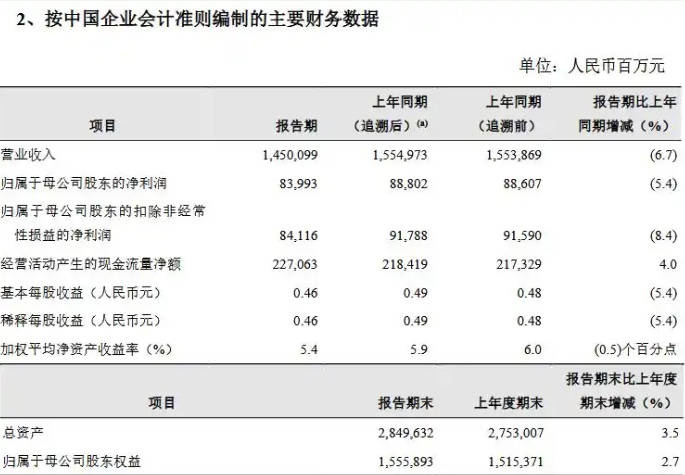
Core Viewpoint - The financial reports of China's three major oil companies, known as "Three Barrels of Oil," show a synchronized decline in overall performance for the first half of 2025, raising concerns in the industry [1][2]. Financial Performance Summary - China National Petroleum Corporation (CNPC) reported a net profit of 84.01 billion yuan, down 5.4% year-on-year [2][3]. - China Petroleum & Chemical Corporation (Sinopec) achieved a net profit of 21.48 billion yuan, a significant drop of 39.8% compared to the previous year [2][3]. - China National Offshore Oil Corporation (CNOOC) recorded a net profit of 69.53 billion yuan, down 13% year-on-year [2][3]. - The total profit of the three companies decreased by 29.05 billion yuan compared to the same period last year, averaging a loss of approximately 1.6 billion yuan per day [1]. Revenue and Price Trends - CNPC's revenue for the first half of 2025 was 1,450.99 billion yuan, a decrease of 6.7% year-on-year, with a Brent crude oil average price of $71.87 per barrel, down 14.5% from $84.06 per barrel in the previous year [2][3]. - Sinopec's revenue was 1,409.05 billion yuan, down 10.6% year-on-year, with basic earnings per share dropping by 40.2% [2][3]. - CNOOC's revenue was 207.61 billion yuan, reflecting an 8% decline year-on-year [2][3]. Sales Volume and Pricing Impact - In the first half of 2025, half of CNPC's eight major export products saw a decline in sales volume, particularly in polypropylene, gasoline, and diesel [4]. - The average selling prices of key products, including crude oil and diesel, fell by 12.3% and 9.4%, respectively [4]. - Sinopec attributed its profit decline to falling crude oil and product prices, leading to reduced inventory profits and lower domestic gasoline and diesel sales [4]. Industry Trends and Future Outlook - The oil and gas extraction and refining sectors are experiencing a "triple decline" in revenue, profit, and import-export volume, indicating increased industry differentiation [5]. - The overall petrochemical industry reported a revenue of 77.7 trillion yuan, down 2.6% year-on-year, with a continued trend of "increased volume, decreased price" in imports and exports [6]. - The total production and consumption of refined oil products have declined for the first time, influenced by the rise of new energy vehicles and liquefied natural gas [8]. - Companies are accelerating the development of non-oil businesses, with Sinopec reporting a 17% increase in non-oil business profits [8][9]. - Looking ahead, CNPC anticipates continued downward pressure on international oil prices due to a relaxed supply-demand balance in the market [8].
“三桶油”业绩集体下行,但分红825亿元
21世纪经济报道· 2025-08-28 14:05
Core Viewpoint - The performance of the "Big Three" oil companies (China National Petroleum Corporation, Sinopec, and China National Offshore Oil Corporation) has declined year-on-year due to the drop in international oil prices, but they have maintained high dividend payouts while focusing on cost reduction and business transformation [1][2]. Financial Performance - In the first half of the year, the combined operating revenue of the three companies reached approximately 3.07 trillion yuan, with a total net profit attributable to shareholders of 175.01 billion yuan, both showing a decrease compared to the same period last year [2]. - The decline in performance is attributed to factors such as oil prices, pressure on refined oil product prices, and a decrease in oil and gas product sales [2][3]. - Specifically, China National Petroleum Corporation, Sinopec, and China National Offshore Oil Corporation reported operating revenues of 1.45 trillion yuan, 1.41 trillion yuan, and 207.61 billion yuan, respectively, with net profits of 839.93 billion yuan, 214.83 billion yuan, and 695.33 billion yuan [3]. Oil Price Impact - The average international crude oil price fell by 14.7% year-on-year, with Brent crude averaging $71.7 per barrel [3]. - The average selling prices for crude oil for the three companies were $66.21, $67, and $69.15 per barrel, reflecting declines of 14.5%, 12.9%, and 13.9%, respectively [3]. Natural Gas Business Growth - The growth in natural gas sales has partially offset the negative impact of declining crude oil business for China National Petroleum Corporation and China National Offshore Oil Corporation, with sales revenues of 310.94 billion yuan (up 4.3%) and 27.75 billion yuan (up over 16%), respectively [4]. Production and Cost Management - China National Offshore Oil Corporation achieved a net production of nearly 385 million barrels of oil equivalent, a year-on-year increase of 6.1%, while China National Petroleum Corporation and Sinopec reported production increases of 2.0% each [5]. - All three companies have focused on optimizing capital expenditures, with capital expenditures for the first half of the year being 64.23 billion yuan, 43.8 billion yuan, and 57.6 billion yuan, respectively, all showing a decrease compared to the same period last year [7]. Dividend Payouts - Despite the performance decline, the three companies maintained high dividend levels, with total dividends exceeding 82.5 billion yuan, including 40.27 billion yuan from China National Petroleum Corporation, 10.67 billion yuan from Sinopec, and 31.60 billion yuan from China National Offshore Oil Corporation [8].
“三桶油”上半年业绩集体下行 纷纷大力布局新能源
2 1 Shi Ji Jing Ji Bao Dao· 2025-08-28 12:45
| 公司 | 营业收入(亿元) | 同比增幅 | 归母净利润(亿元) | 同时 | | --- | --- | --- | --- | --- | | 中国石油 | 14500. 99 | -6. 74 | 839. 93 | | | 中国石化 | 14090. 52 | -10. 60 | 214. 83 | | | 中国海油 | 2076. 08 | -8. 45 | 695. 33 | | ("三桶油"上半年业绩情况数据来源:上市公司公告) 财报显示,中国石油(601857.SH)、中国石化(600028.SH)和中国海油(600938.SH)今年上半年合计实现营业收入约3.07万亿元,累计实现归母净利润 为1750.09亿元。三家油气公司营业收入和归母净利润较去年同期均有所减少,这其中,中国石化业绩降幅较大,而中国石油也遭遇近五年来首次净利润下 滑。综合三家油气公司对半年报的分析,造成报告期内业绩波动的主要原因包括油价、成品油产品价格承压以及油气产品销量减少等因素。 不过,三家油气公司在报告期内仍然表现出了较强的经营韧性,并且在报告期内主动优化资本开支,强化成本管控以保持充足的现金流。在此情况下,21 ...
“三桶油”上半年业绩集体下行,纷纷大力布局新能源
2 1 Shi Ji Jing Ji Bao Dao· 2025-08-28 12:21
Core Viewpoint - The performance of the "Big Three" oil companies (China National Petroleum Corporation, Sinopec, and China National Offshore Oil Corporation) has declined year-on-year due to the average international oil price drop in the first half of the year, but they have maintained high dividends while focusing on cost reduction and business transformation [1][5]. Financial Performance - In the first half of the year, the combined operating revenue of the three companies was approximately 3.07 trillion yuan, with a total net profit attributable to shareholders of 175.01 billion yuan, both showing a decrease compared to the same period last year [2][4]. - China National Petroleum Corporation reported operating revenue of 1.45 trillion yuan, a year-on-year decline of 6.74%, and a net profit of 83.99 billion yuan, down 5.42% [2]. - Sinopec's operating revenue was 1.41 trillion yuan, down 10.60%, with a net profit of 21.48 billion yuan, a significant drop of 39.83% [2]. - China National Offshore Oil Corporation achieved operating revenue of 207.61 billion yuan, down 8.45%, and a net profit of 69.53 billion yuan, down 12.79% [2]. Impact of Oil Prices - The decline in profits was primarily attributed to falling oil prices, with the average Brent crude oil price at $71.7 per barrel, a decrease of 14.7% year-on-year [5]. - The average selling prices of crude oil for the three companies also fell, with China National Petroleum at $66.21 per barrel, Sinopec at $67 per barrel, and China National Offshore Oil Corporation at $69.15 per barrel, reflecting declines of 14.5%, 12.9%, and 13.9% respectively [5]. Operational Resilience - Despite the challenges, the companies demonstrated operational resilience by optimizing capital expenditures and enhancing cost control to maintain sufficient cash flow [3][8]. - The total dividends paid by the three companies exceeded 82.5 billion yuan, with China National Petroleum distributing 40.27 billion yuan, Sinopec 10.67 billion yuan, and China National Offshore Oil Corporation 31.60 billion yuan [10]. Strategic Focus - The companies are focusing on increasing reserves and production while reducing costs, with China National Offshore Oil Corporation achieving a net production of nearly 385 million barrels of oil equivalent, a year-on-year increase of 6.1% [6]. - Capital expenditures for the first half of the year were reduced, with China National Petroleum at 64.23 billion yuan, Sinopec at 43.8 billion yuan, and China National Offshore Oil Corporation at 57.6 billion yuan [8]. Non-Oil Business Development - The companies are also investing in non-oil businesses, with China National Petroleum reporting a 5.5% increase in profits from its non-oil business, and China National Offshore Oil Corporation planning to acquire 5 to 10 million kilowatts of renewable energy resources by 2025 [9].

中国石化(600028):增储上产成效显著 “反内卷”下龙头优势凸显
Ge Long Hui· 2025-08-28 12:08
Group 1 - The company reported a revenue of 1,409.05 billion yuan in H1 2025, a year-on-year decrease of 10.60%, and a net profit attributable to shareholders of 21.48 billion yuan, down 39.83% year-on-year [1] - In Q2 2025, the company achieved a revenue of 673.70 billion yuan, a year-on-year decline of 14.31%, with a net profit of 8.22 billion yuan, down 52.73% year-on-year [1] - The company's oil and gas equivalent production increased to 131.84 million barrels in Q2 2025, reflecting a year-on-year growth of 2.3% and a quarter-on-quarter increase of 0.7% [1] Group 2 - The average selling price of crude oil for the company in H1 2025 was 3,415 yuan per ton, a decrease of 12.9% year-on-year due to falling oil prices [1] - The exploration and production segment's EBIT (Earnings Before Interest and Taxes) was 11.89 billion yuan in Q2 2025, down 25.9% year-on-year and 12.8% quarter-on-quarter [1] - The company's refining segment processed 57.84 million tons of crude oil in Q2 2025, a decrease of 8.8% year-on-year, leading to a significant drop in profits [2] Group 3 - The refining segment's EBIT was 0.89 billion yuan in Q2 2025, a decline of 62.89% quarter-on-quarter due to lower product prices and reduced inventory profits [2] - The chemical segment reported an EBIT loss of 2.77 billion yuan in Q2 2025, an increase in losses of 2.24 billion yuan year-on-year and 1.45 billion yuan quarter-on-quarter [2] - The Ministry of Industry and Information Technology is expected to introduce a growth stabilization plan for the petrochemical industry, which may benefit the company by eliminating outdated production capacity [2] Group 4 - The company adjusted its profit forecast, expecting net profits of 45.97 billion yuan, 50.22 billion yuan, and 53.26 billion yuan for 2025, 2026, and 2027 respectively, with corresponding PE ratios of 15.35X, 14.05X, and 13.25X [3]
中石化易捷咖啡门店已突破千座,将持续深耕咖啡市场
Xin Lang Cai Jing· 2025-08-28 12:05
Core Insights - Sinopec Easy Joy Coffee has opened its 1000th store and first flagship store in Shanghai on August 28, marking a significant milestone in its expansion [1] - The coffee brand has established a presence in 23 provinces and 107 cities across China, leveraging over 8000 convenience store channels to sell freeze-dried and ready-to-drink coffee products [1] - The company aims to build a high-quality coffee service network nationwide, aspiring to become "China's largest travel coffee brand" [1] Company Overview - Easy Joy Coffee was founded in 2019 and benefits from Sinopec's extensive network of 31,000 gas stations and over 28,000 Easy Joy convenience stores [1] - The company has a significant membership base, utilizing private traffic to penetrate travel scenarios effectively [1] Future Strategy - The chairman of Sinopec Easy Joy Sales Co., Liu Zhihua, emphasized the commitment to deepening the coffee market and expanding the service network based on the "thousand-store" foundation [1]
上半年“三桶油”业绩集体遭遇滑铁卢
Xin Lang Cai Jing· 2025-08-28 09:43
Core Viewpoint - The financial performance of China's three major oil companies, known as "Three Barrels of Oil," has declined in the first half of 2023, with revenue and net profit showing year-on-year decreases due to falling international oil prices and other macroeconomic factors [1][3]. Financial Performance - China National Offshore Oil Corporation (CNOOC) reported a revenue of 207.61 billion yuan, down 8% year-on-year, and a net profit of 69.53 billion yuan, down 13% [1]. - China Petroleum & Chemical Corporation (Sinopec) achieved a revenue of 1.41 trillion yuan, down 10.6%, and a net profit of 21.48 billion yuan, down 39.8%, marking the largest decline among the three companies [1][3]. - China National Petroleum Corporation (PetroChina) reported a revenue of 1.45 trillion yuan, down 6.7%, and a net profit of 84.01 billion yuan, down 5.4% [1]. Oil Price Impact - The average Brent crude oil price was $71.87 per barrel, down 14.5% year-on-year, while the average price for West Texas Intermediate (WTI) was $67.60 per barrel, down 14.4% [1][3]. Production and Sales - CNOOC's oil price realization was $69.15 per barrel, down 13.9%, with oil liquid sales revenue of 143.99 billion yuan, down 10.7%, accounting for 83.8% of total oil and gas sales revenue [3]. - CNOOC's natural gas production increased by 12% to 516.2 billion cubic feet (approximately 14.62 billion cubic meters), with sales revenue up 16.3% to 27.75 billion yuan, but natural gas only accounted for 16.2% of total oil and gas sales revenue [3]. - PetroChina's oil and gas equivalent production reached 942 million barrels, up 2%, while Sinopec's production was 262.81 million barrels, also up 2% [7][8]. Cash Flow and Debt - CNOOC's operating net cash flow was 109.18 billion yuan, down 8%, while PetroChina's cash flow grew by 4% to 227.06 billion yuan, and Sinopec's increased by 44.4% to 61 billion yuan [5]. - CNOOC's debt-to-asset ratio was 29.5%, while PetroChina's was 38.5%, and Sinopec faced higher pressure with a debt-to-asset ratio of 54.1% [4]. Dividend and Capital Expenditure - Despite the decline in performance, all three companies continued to distribute dividends, with PetroChina paying 0.22 yuan per share, CNOOC 0.73 HKD per share, and Sinopec 0.088 yuan per share [11]. - CNOOC's capital expenditure was 57.6 billion yuan, down 8.8%, while PetroChina's was 64.23 billion yuan, with an expected total of 262.2 billion yuan for the year [11]. Transition to Green Energy - CNOOC expanded its green electricity usage, consuming over 500 million kilowatt-hours, and implemented various environmental initiatives [12]. - PetroChina's renewable energy projects included a 1.3 million kilowatt solar project and wind energy initiatives, while Sinopec focused on developing a network for alternative fuels [12].

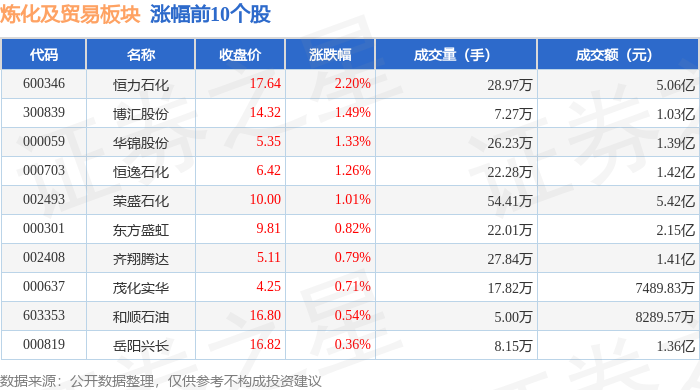
炼化及贸易板块8月28日涨0.27%,恒力石化领涨,主力资金净流出4.93亿元
Zheng Xing Xing Ye Ri Bao· 2025-08-28 08:42
Market Overview - The refining and trading sector increased by 0.27% on August 28, with Hengli Petrochemical leading the gains [1] - The Shanghai Composite Index closed at 3843.6, up 1.14%, while the Shenzhen Component Index closed at 12571.37, up 2.25% [1] Stock Performance - Hengli Petrochemical (600346) closed at 17.64, up 2.20% with a trading volume of 289,700 shares and a turnover of 506 million yuan [1] - Other notable performers included: - Bohai Chemical (300839) at 14.32, up 1.49% [1] - Huajin Chemical (000059) at 5.35, up 1.33% [1] - Hengyi Petrochemical (000703) at 6.42, up 1.26% [1] - Rongsheng Petrochemical (002493) at 10.00, up 1.01% [1] Capital Flow - The refining and trading sector experienced a net outflow of 493 million yuan from institutional investors, while retail investors saw a net inflow of 388 million yuan [2] - The sector's overall capital flow indicates a mixed sentiment among different investor types [2] Individual Stock Capital Flow - China Petroleum & Chemical (600028) had a net inflow of 71.12 million yuan from institutional investors, while it faced a net outflow of 70.12 million yuan from retail investors [3] - Huajin Chemical (000059) saw a net inflow of 6.47 million yuan from institutional investors, with a net outflow of 10.19 million yuan from retail investors [3] - Hengyi Petrochemical (000703) reported a net outflow of 12.30 million yuan from institutional investors, while retail investors had a net inflow of 902.77 million yuan [3]