
China Unicom(600050)

Search documents
“治”理变“智”理!武汉联通为江夏村民幸福“加码”
Zhong Guo Jing Ji Wang· 2025-05-07 09:23
Group 1: Economic Development and Digital Transformation - Jiangxia District in Wuhan has ranked first in the provincial county economic comprehensive ranking for eleven consecutive years and has been included in the national industrial top 100 districts for four years [1] - Wuhan Unicom is actively promoting the transformation of Jiangxia from an agricultural region to a strong agricultural area, focusing on digital rural pilot projects to enhance smart applications and modern governance [1] Group 2: Digital Party Building - Wuhan Unicom has initiated a pilot project in rural areas to enhance the management of party members and activities, addressing challenges such as the dispersion of rural party members [2] - The project includes a closed-loop network platform for collecting and responding to community needs, facilitating a more efficient service delivery system [2] Group 3: Safety and Security in Rural Areas - The company has implemented a comprehensive information feedback system using video monitoring and IoT devices to assist village committees in managing and caring for elderly residents [3] - A closed-loop elderly care model has been established, allowing for timely responses to emergencies and providing practical solutions to community issues [3] Group 4: Tourism Management - Wuhan Unicom has developed a comprehensive management platform that utilizes 5G technology to monitor various data points in rural tourism areas, enhancing visitor experience and safety [4] - The platform has indirectly boosted tourism revenue by over 20 million yuan through improved safety governance [4] Group 5: Agricultural Technology - The company has launched a digital project in Leiling Village, integrating various technologies for real-time monitoring of agricultural conditions, thus facilitating a shift from traditional farming to technology-driven practices [5] - The project includes automated irrigation and environmental monitoring, allowing farmers to optimize crop growth conditions [5]

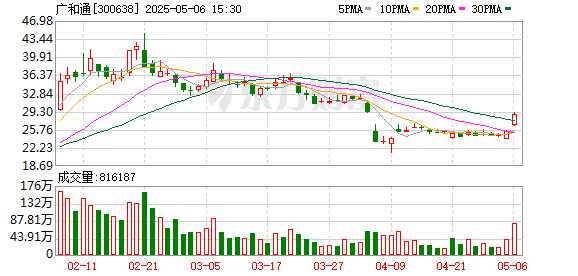
通信行业资金流入榜:广和通等8股净流入资金超亿元
Zheng Quan Shi Bao Wang· 2025-05-06 12:54
沪指5月6日上涨1.13%,申万所属行业中,今日上涨的有30个,涨幅居前的行业为计算机、通信,涨幅 分别为3.65%、3.59%。通信行业位居今日涨幅榜第二。跌幅居前的行业为银行,跌幅分别为0.13%。 通信行业资金流出榜 | 代码 | 简称 | 今日涨跌幅(%) | 今日换手率(%) | 主力资金流量(万元) | | --- | --- | --- | --- | --- | | 688313 | 仕佳光子 | 11.14 | 13.50 | -11185.56 | | 600941 | 中国移动 | 0.72 | 1.06 | -10553.64 | | 300570 | 太辰光 | 6.82 | 11.22 | -8451.44 | | 600522 | 中天科技 | 1.08 | 1.17 | -3375.26 | | 300502 | 新易盛 | 4.28 | 6.14 | -2352.35 | | 603602 | 纵横通信 | 1.87 | 3.56 | -2308.74 | | 601728 | 中国电信 | 1.17 | 0.17 | -1399.92 | | 688182 | 灿勤科技 | ...






中国联通(600050) - 中国联合网络通信股份有限公司关于召开2024年年度股东大会的通知
2025-05-06 09:45
证券代码:600050 证券简称:中国联通 公告编号:2025-022 召开地点:北京市西城区金融大街 21 号中国联通大厦 (五)网络投票的系统、起止日期和投票时间 网络投票系统:上海证券交易所股东大会网络投票系统 网络投票起止时间:自2025 年 5 月 27 日至2025 年 5 月 27 日 中国联合网络通信股份有限公司 关于召开2024年年度股东大会的通知 本公司董事会及全体董事保证本公告内容不存在任何虚假记载、误导性陈述 或者重大遗漏,并对其内容的真实性、准确性和完整性承担法律责任。 重要内容提示: 一、召开会议的基本情况 召开的日期时间:2025 年 5 月 27 日 上午 9 点整 采用上海证券交易所网络投票系统,通过交易系统投票平台的投票时间为股 东大会召开当日的交易时间段,即 9:15-9:25,9:30-11:30,13:00-15:00;通过 互联网投票平台的投票时间为股东大会召开当日的 9:15-15:00。 (六)融资融券、转融通、约定购回业务账户和沪股通投资者的投票程序 涉及融资融券、转融通业务、约定购回业务相关账户以及沪股通投资者的投 1 股东大会召开日期:2025年5月27日 ...
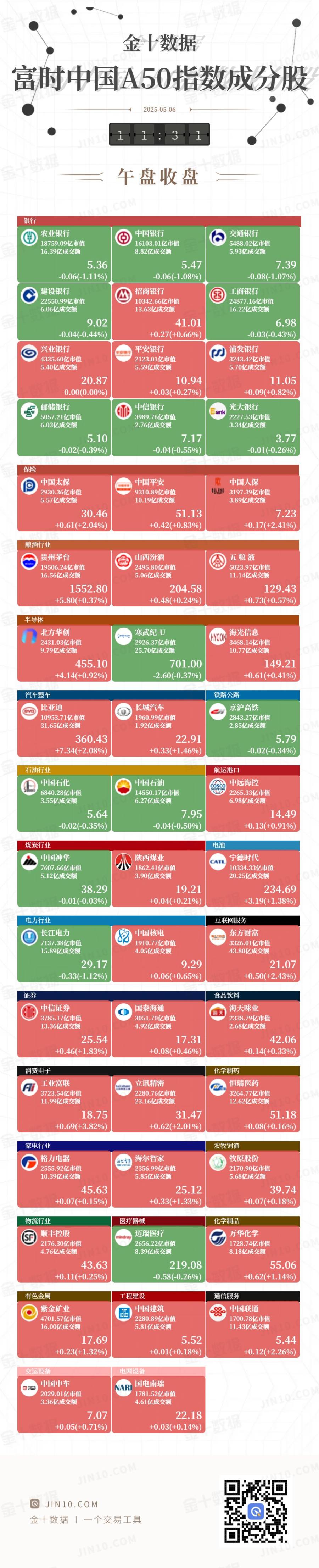
金十图示:2025年05月06日(周二)富时中国A50指数成分股午盘收盘行情一览:保险、白酒汽车板块上涨,银行、半导体板块涨跌不一,电力等板块走弱
news flash· 2025-05-06 03:40
Market Overview - The FTSE China A50 index components showed mixed performance with insurance and liquor sectors rising, while banking and semiconductor sectors had varied results, and the power sector weakened [1][4]. Insurance Sector - China Pacific Insurance, Ping An Insurance, and China Life Insurance had market capitalizations of CNY 293.04 billion, CNY 931.09 billion, and CNY 319.74 billion respectively, with trading volumes of CNY 557 million, CNY 1.019 billion, and CNY 389 million [3]. - China Pacific Insurance rose by 2.04%, Ping An by 0.83%, and China Life by 2.41% [3]. Liquor Industry - Kweichow Moutai, Wuliangye, and Shanxi Xinghuacun Fenjiu had market capitalizations of CNY 1,950.62 billion, CNY 249.58 billion, and CNY 502.40 billion respectively, with trading volumes of CNY 1.656 billion, CNY 506 million, and CNY 1.114 billion [3]. - Kweichow Moutai increased by 0.37%, Wuliangye by 0.24%, and Shanxi Xinghuacun by 0.57% [3]. Semiconductor Sector - Northern Huachuang, Cambricon Technologies, and Haiguang Information had market capitalizations of CNY 243.10 billion, CNY 292.64 billion, and CNY 346.81 billion respectively, with trading volumes of CNY 979 million, CNY 2.570 billion, and CNY 1.077 billion [3]. - Northern Huachuang rose by 0.92%, while Cambricon Technologies fell by 0.37% and Haiguang Information increased by 0.41% [3]. Automotive Sector - BYD, Great Wall Motors, and Beijing-Shanghai High-Speed Railway had market capitalizations of CNY 196.10 billion, CNY 284.33 billion, and CNY 1,095.37 billion respectively, with trading volumes of CNY 3.165 billion, CNY 192 million, and CNY 285 million [3]. - BYD increased by 2.08%, Great Wall Motors by 1.46%, while Beijing-Shanghai High-Speed Railway decreased by 0.34% [3]. Power Sector - China Yangtze Power, China Nuclear Power, and China Power had market capitalizations of CNY 713.74 billion, CNY 191.08 billion, and CNY 332.60 billion respectively, with trading volumes of CNY 1.589 billion, CNY 405 million, and CNY 4.380 billion [4]. - China Nuclear Power rose by 2.43%, while China Yangtze Power fell by 1.12% [4]. Other Sectors - Various sectors including food and beverage, electronics, and pharmaceuticals showed diverse performances with notable market capitalizations and trading volumes [4][5].




低增长迈入常态化 三大运营商转战AI求破局
Zhong Guo Jing Ying Bao· 2025-05-02 20:12
Core Insights - The three major telecom operators in China reported distinct financial results for Q1 2025, with China Mobile leading in revenue and profit, while China Telecom excelled in 5G user penetration [1][2][3] - The overall revenue growth for the telecom industry is slowing, with the operators entering a "stable" phase, focusing on high-quality development and profitability [2][3] Financial Performance - China Mobile reported revenue of 263.8 billion yuan and net profit of 30.6 billion yuan, nearly 1.3 times the combined revenue of China Telecom and China Unicom [1] - China Telecom's revenue reached 134.5 billion yuan with a net profit of 8.9 billion yuan, while China Unicom surpassed 100 billion yuan in revenue for the first time, achieving 103.35 billion yuan and a net profit of 2.61 billion yuan [1] - Revenue growth rates for Q1 2025 were 0.02% for China Mobile, 0.01% for China Telecom, and 3.88% for China Unicom, significantly down from 10.3%, 9.4%, and 9.2% in the same period of 2023 [3] User Metrics - China Mobile's total mobile users exceeded 1 billion, with 5G users reaching 578 million, accounting for 54% of the industry total [2] - China Telecom's 5G user penetration rate is 62%, while China Unicom's is below 50% [2] - In the fixed broadband market, China Mobile leads with 320 million users, followed by China Telecom with 173 million and China Unicom with 124 million [2] Profitability and Cost Management - Despite slowing revenue growth, net profits for the three operators showed slight increases: China Mobile up 3.45%, China Telecom up 3.1%, and China Unicom up 6.5% [4] - Operators are maintaining profitability through reduced capital expenditures and optimized cost structures, with total capital expenditures for 2025 projected at 289.8 billion yuan, down 9.1% year-on-year [4] Emerging Business Focus - The operators are shifting resources towards emerging fields such as computing power networks and AI to create a "second growth curve" [7][8] - China Telecom's computing power investment grew by 22%, with IDC revenue at 9.5 billion yuan and smart income surging by 151.6% [7] - China Unicom's cloud revenue reached 19.72 billion yuan, a 114% increase, while China Mobile plans to invest 37.3 billion yuan in computing power, representing 25% of its total capital expenditure for 2025 [7][8] Market Challenges - The telecom industry faces structural challenges in computing power demand, with a surplus in general computing power and a shortage in intelligent computing power [10] - The operators are also under pressure from competition with internet giants like Tencent and Alibaba, which are encroaching on the enterprise market [10][11] - The operators are attempting to build differentiated competitive advantages, but achieving significant revenue growth remains a challenge [11]

数字中国峰会观察:数实融合,激活制造业新动能
Zhong Guo Xin Wen Wang· 2025-04-30 13:46
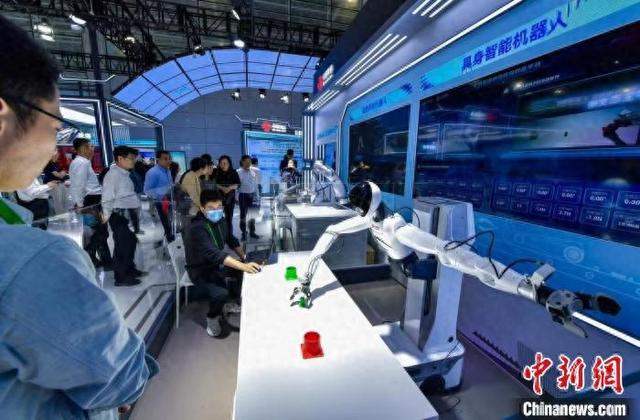
Group 1 - The integration of digital technologies such as artificial intelligence, industrial internet, and cloud computing is reshaping the production and operational models of the manufacturing industry in China [1][3] - China Unicom showcased a robotic system capable of precise identification and sorting of small parts, demonstrating advancements in machine vision and AI training optimization for factory operations [1][3] - The application of digital and intelligent technologies is deeply embedded in China's manufacturing sector, with significant improvements in efficiency and safety reported by various companies [3][4] Group 2 - The number of connected industrial devices on key industrial internet platforms in China has surpassed 100 million, serving approximately 4 million enterprises and covering all 41 major industrial categories [3][4] - The penetration rates for digital R&D design tools and CNC (computer numerical control) processes in key industrial enterprises reached 83.5% and 66.23% respectively by the end of March this year [3] - The future of manufacturing is expected to see profound changes in production factors, labor tools, and organizational systems due to the deep integration of AI across the entire production chain [4][5] Group 3 - The development of industrial AI is transitioning from general applications to specific use cases, leading to a symbiotic relationship between humans and machines in manufacturing [5] - The Chinese government plans to implement high-quality development actions for industrial internet platforms, focusing on creating a systematic platform ecosystem and promoting data-driven innovations in business processes [5] - The National Data Bureau aims to support enterprises in enhancing data utilization, leveraging technologies like IoT and edge computing to aggregate diverse data for innovative business models [5]
运营商行业专题报告:基本盘稳中有进,云数业务快速发展
Dongguan Securities· 2025-04-30 06:51
Investment Rating - The report maintains an "Overweight" rating for the telecommunications industry, indicating an expectation that the industry index will outperform the market index by more than 10% in the next six months [1]. Core Insights - The telecommunications operators are experiencing steady growth in their user base, with mobile phone users reaching 1.8 billion as of March 2025, an increase of 9.945 million from the previous year [5][12]. - The net profit for major operators such as China Mobile, China Telecom, and China Unicom grew by 3.45%, 3.11%, and 6.50% respectively in Q1 2025, despite a slowdown in traditional telecom business revenue growth [23]. - The operators are focusing on enhancing shareholder returns, with dividend payout ratios for 2024 set at 73% for China Mobile, 72% for China Telecom, and 60% for China Unicom, reflecting a commitment to increasing cash distributions to shareholders [30][33]. Summary by Sections 1. Performance and Dividend Growth - The user base continues to grow, with mobile phone users reaching 1.8 billion and 5G users at 1.068 billion as of March 2025, marking a net increase of 5.445 million [12][5]. - The operators' revenue and profit are showing steady growth, with China Mobile's revenue for 2024 projected at 1,040.759 billion yuan, a 3.1% increase [18]. - The dividend payout ratios are increasing, with China Mobile planning a total dividend of 5.09 HKD per share for 2024, a 5.4% increase from 2023 [33]. 2. Capital Expenditure and Cloud Business Growth - Capital expenditures are focusing on computing power, with China Mobile, China Telecom, and China Unicom planning capital expenditures of 151.2 billion, 83.6 billion, and 55 billion yuan respectively for 2025, reflecting a decrease from previous years [37][38]. - The cloud business is rapidly expanding, with China Mobile's cloud revenue expected to reach 100.4 billion yuan in 2024, a 20.4% increase [48]. - The operators are enhancing their cloud services, with China Telecom's cloud revenue projected to reach 113.9 billion yuan in 2025, a 17.1% increase [48]. 3. Vertical Applications and International Business Growth - The deployment of 5G applications is accelerating, with China Mobile's 5G private network revenue reaching 8.7 billion yuan in 2024, a 61% increase [61]. - All three major operators reported double-digit growth in international business revenue, with China Telecom, China Mobile, and China Unicom achieving growth rates of 15.4%, 10.2%, and 15.2% respectively in 2024 [66][67]. - The operators are actively participating in international collaborations to promote 5G-A commercial deployment, showcasing their technological advancements at global events [66].
“人工智能+”澎湃数字经济新引擎
Ke Ji Ri Bao· 2025-04-29 23:49
Group 1 - The core viewpoint emphasizes that artificial intelligence applications are becoming a crucial engine for accelerating the construction of a digital China, with this year being marked as the year of large-scale AI application [1][2] - Over a hundred AI intelligent robots showcased at the Digital China Construction Summit, covering various scenarios from home services to industrial manufacturing and urban management [1] - The chairman of China Telecom highlighted the significant reduction in computational and algorithmic barriers due to new open-source AI technologies, which promotes the accelerated popularization of large model applications [1] Group 2 - China Unicom's chairman stated the importance of strengthening AI foundational innovation, having developed over 40 industry-specific large models that significantly empower economic operations and urban governance [2] - The need for an open and win-win cooperation framework is essential for promoting the construction of a digital China, with key drivers including accessible computing power, open-source models, and data flow [2] - The chairman of China Telecom called for greater collaboration across industries to foster deeper and broader levels of open cooperation in AI innovation and development [2]

深耕主业 多点开花 上市企业加码研发投入
Zhong Guo Zheng Quan Bao· 2025-04-29 21:43
Core Insights - The 2024 annual reports of A-share listed companies reveal a significant increase in R&D investments, with many companies focusing on core business and innovation to enhance product competitiveness [1][2] - Leading companies in the new energy vehicle sector, such as BYD and CATL, have set new records for R&D spending, indicating a strong commitment to technological advancement [2][3] - The trend of embracing AI is evident as companies expand their investments in AI technologies to seize market opportunities [1][5] R&D Investment Trends - A total of 4,233 listed companies reported a combined R&D investment of 1,585.9 billion yuan in 2024, with 22 companies exceeding 10 billion yuan and 9 companies surpassing 20 billion yuan in R&D spending [1][2] - BYD leads the A-share market with an R&D investment of 54.16 billion yuan, followed by major players like China Construction, China Mobile, and China Petroleum [2] - Companies such as CATL, China CRRC, Midea Group, and Hikvision also reported record-high R&D investments, each exceeding 10 billion yuan [2][3] Diversification Strategies - Several companies are diversifying their investments while focusing on their core businesses, with a notable shift in strategic positioning to adapt to market changes [3][4] - 瑞斯康达 is enhancing its capabilities by transitioning from a "access network" supplier to a "core network" supplier, aiming to integrate software and hardware for smarter services [3] AI Investment Focus - Companies are increasingly investing in AI, with iFLYTEK reporting an R&D expenditure of 4.58 billion yuan in 2024, marking a 19.37% increase [5][6] - iFLYTEK is focusing on large model R&D and applications, while Hikvision is integrating AI technologies to enhance its digital product offerings [5][6] - Traditional manufacturing firms are also adopting AI, with 伯特利 establishing an AI R&D team to explore intelligent control systems [6]






数据资产入表元年 92家公司交出年度成绩单
Shang Hai Zheng Quan Bao· 2025-04-29 20:02
Group 1 - The year 2024 marks the formal inclusion of data assets in accounting practices, with 92 listed companies reporting a total of 2.495 billion yuan in data assets by the end of the year [1][2] - The number of companies reporting data assets has increased from 17 in the first quarter to 92 by the annual report, with the total value rising from 79 million yuan to 2.495 billion yuan [2] - Major contributors to data asset reporting include China Mobile, Cloud Horse, China Unicom, and China Telecom, each reporting over 100 million yuan in data assets [2][5] Group 2 - Data assets are primarily classified as intangible assets, with over 60 companies accounting for more than 1.3 billion yuan in this category, representing approximately 60% of the total [3] - The inclusion of data assets in financial statements helps companies optimize their financial reports, impacting asset scale and net profit [3] - Data asset reporting is seen as a foundation for digital transformation and exploring data trading and value-added services [3] Group 3 - The standardization and normalization of data asset reporting is a growing concern, as not all data resources qualify as assets [4] - Companies face challenges in distinguishing between data resources, products, and assets, necessitating a comprehensive approach to compliance and management [4] - Some companies have been cautious in reporting data assets, with instances of previously reported data being corrected or omitted in annual reports [5]
