
GYLS(600059)

Search documents
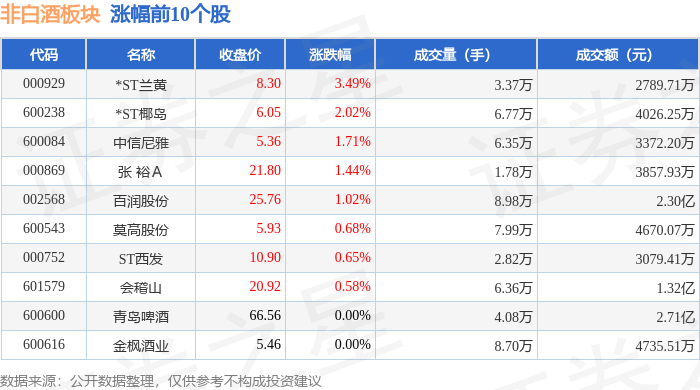
非白酒板块9月29日涨0.09%,*ST兰黄领涨,主力资金净流出728.81万元
Zheng Xing Xing Ye Ri Bao· 2025-09-29 08:39
Core Viewpoint - The non-liquor sector experienced a slight increase of 0.09% on September 29, with *ST Lanhuang leading the gains. The Shanghai Composite Index closed at 3862.53, up 0.9%, while the Shenzhen Component Index closed at 13479.43, up 2.05% [1]. Group 1: Stock Performance - *ST Lanhuang (000929) closed at 8.30, with a rise of 3.49% and a trading volume of 33,700 shares, amounting to a transaction value of 27.89 million yuan [1]. - *ST Yedao (600238) closed at 6.05, increasing by 2.02% with a trading volume of 67,700 shares, resulting in a transaction value of 40.26 million yuan [1]. - CITIC Nia (600084) closed at 5.36, up 1.71%, with a trading volume of 63,500 shares and a transaction value of 33.72 million yuan [1]. - Zhangyu A (000869) closed at 21.80, increasing by 1.44% with a trading volume of 17,800 shares, leading to a transaction value of 38.58 million yuan [1]. - Zhirun Co. (002568) closed at 25.76, up 1.02%, with a trading volume of 89,800 shares and a transaction value of 230 million yuan [1]. Group 2: Capital Flow - The non-liquor sector saw a net outflow of 7.29 million yuan from institutional investors, while retail investors experienced a net inflow of 28.35 million yuan [2]. - The main capital inflow was observed in Zhirun Co. (002568) with a net inflow of 6.48 million yuan from institutional investors, while Zhangyu A (000869) had a net inflow of 5.22 million yuan [3]. - Conversely, Chongqing Beer (600132) and *ST Yedao (600238) experienced net outflows of 1.65 million yuan and 1.72 million yuan from institutional investors, respectively [3].


黄酒行业深度:老树生新芽,行业向上空间大
2025-09-28 14:57
Summary of Huangjiu Industry Conference Call Industry Overview - The Huangjiu industry benefits from a favorable tax policy, with net profit margins superior to Baijiu under similar gross margins. Leading companies like Kuaijishan have achieved gross margins exceeding 60%, while Jimo Laojiu and Wuzhanmao have net profit margins of 18% and 15% respectively. If product structures stabilize and gross margins approach 70%-80%, net margins could easily reach 20% [1][2] Key Points and Arguments - **Market Size and Consumption Habits**: The Huangjiu market is relatively small, with consumption habits being regionally strong, primarily concentrated in Jiangsu, Zhejiang, and Shanghai. The lack of clear consumption scenarios, as Huangjiu is often viewed as a staple or cooking ingredient, poses a significant challenge for consumer education [1][4] - **High-End Development Strategies**: Leading companies are pushing for high-end development through product innovation and channel reform. For instance, Kuaijishan has launched the Benniang series, while both Kuaijishan and Guyuelongshan are actively promoting high-end strategies, achieving significant results through consumer engagement and high-end cultivation [1][5] - **Kuaijishan's Strategic Moves**: Since the shareholder change in 2022, Kuaijishan has restructured its organization, enhanced its sales team, and refined its product structure. The company has established a dual-brand strategy with Kuaijishan and Lanting, focusing on nationalization, high-end, and youth-oriented development [1][6] - **Current Policy Environment**: The current policy environment has a limited impact on Huangjiu, particularly high-end products like Lanting, which are not significantly affected by policy restrictions. However, the overall cautious consumption environment may slow the speed of new partnerships, although growth potential remains in the second half of the year [1][8] Challenges Facing the Industry - The Huangjiu industry faces challenges such as a small market size, strong regional consumption habits, and a lack of distinct consumption scenarios compared to Baijiu and beer, which have much larger market scales [4] Company Performance and Future Expectations - Kuaijishan's sales volume has reached last year's total, with the Lanting series benefiting from a high-profile strategy that provides profit margins for group buyers, leading to high channel enthusiasm. The 1,743 series has a clear positioning and good sales rhythm, expected to become a major profit source [3][9] - Guyuelongshan is integrating dispersed production facilities to reduce costs and improve efficiency. The company is also innovating products to attract younger consumers and expanding brand influence through platforms like Douyin [3][12] Future Growth Prospects - The Huangjiu industry shows a trend of upward development, with potential for significant improvement in net profit margins. If net profit margins gradually reach 20% or higher by 2026-2027, the industry could see a doubling of current profit levels [15][16] - New consumption attributes are emerging in the Huangjiu industry, with recent reforms attracting market attention. The upcoming peak season, especially around the Spring Festival, is expected to accelerate growth, supported by channel expansion and improved consumer demand [17]

古越龙山:走出江浙沪舒适区,同步拓展全国化和全球化
Cai Jing Wang· 2025-09-26 07:26
Core Insights - The company aims for over 6% growth in liquor sales and over 3% growth in profits for the year, focusing on high-end, youthful, global, and digital development strategies [1] Group 1: Strategic Focus Areas - The company emphasizes cultural and brand output by leveraging its historical resources and unique qualities to lead in high-end yellow wine [1] - The company plans to enhance production efficiency through technological empowerment, including the launch of a 5G smart factory and increased R&D investment [1] - The company is targeting new consumer groups by analyzing Z-generation consumption trends and innovating product categories to create new consumption scenarios [1] - The company is committed to expanding its market presence beyond the Jiangsu, Zhejiang, and Shanghai regions, where its current sales outside these areas account for 42% [1]

古越龙山(600059):深度报告:古往今来,越酒复兴
Changjiang Securities· 2025-09-24 15:23
Investment Rating - The report maintains a "Buy" rating for the company [11]. Core Insights - The yellow wine industry has seen a significant improvement in market concentration, with the top three companies (CR3) exceeding 40% in 2023, up from approximately 18% in 2016, indicating a more stable industry structure [3][7]. - The leading companies are actively exploring new consumption scenarios, demographics, and regions for yellow wine, which is expected to expand future market potential [3][7]. - The company is positioned to benefit from the activation of its system and the gradual release of brand potential, with anticipated growth contributions from the national market [9]. Company Overview - Zhejiang Guyue Longshan Shaoxing Wine Co., Ltd. is a leading player in the Chinese yellow wine industry and the first listed company in this sector. It owns several well-known brands, including Guyue Longshan, Shen Yonghe, and Daughter Red [6][19]. - The company has experienced various development phases since its establishment, with significant revenue growth expected as it activates its internal systems and enhances brand potential [6][20]. Industry Analysis - The yellow wine industry has not fully capitalized on the branding cycle over the past decade, with the average ex-factory price of yellow wine increasing from 10.4 yuan/liter in 2016 to 12.8 yuan/liter in 2024, reflecting a compound annual growth rate (CAGR) of only 2.7% [7][41]. - The industry is now stabilizing, with leading companies achieving strategic synergies and entering a new price increase cycle for traditional flagship products by 2025 [7][51]. Company Strategy - The company has established a development strategy focused on "premiumization, youthfulness, globalization, and digitalization" [8][55]. - It has enhanced its product offerings through collaborations with Jiangnan University, improving the health and flavor quality of its yellow wine [56]. - The company is expanding its sales network across major cities in China, with a focus on refined management and regional breakthroughs planned for 2025 [8][55]. Financial Forecast and Valuation - The company is projected to achieve earnings per share (EPS) of 0.24 yuan and 0.26 yuan for the years 2025 and 2026, respectively, corresponding to price-to-earnings (PE) ratios of 40 and 37 times [9].
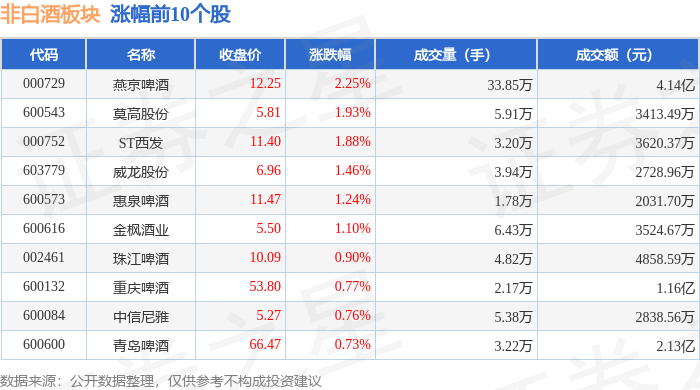
非白酒板块9月24日涨0.2%,燕京啤酒领涨,主力资金净流出7238.88万元
Zheng Xing Xing Ye Ri Bao· 2025-09-24 08:39
Market Overview - On September 24, the non-liquor sector increased by 0.2% compared to the previous trading day, with Yanjing Beer leading the gains [1] - The Shanghai Composite Index closed at 3853.64, up 0.83%, while the Shenzhen Component Index closed at 13356.14, up 1.8% [1] Non-Liquor Sector Performance - The following companies in the non-liquor sector showed notable performance: - Xianjing Beer (Code: 000729) closed at 12.25, up 2.25% with a trading volume of 338,500 shares and a turnover of 414 million yuan [1] - Caogao Co. (Code: 600543) closed at 5.81, up 1.93% with a trading volume of 59,100 shares and a turnover of 34.13 million yuan [1] - ST Xifa (Code: 000752) closed at 11.40, up 1.88% with a trading volume of 32,000 shares and a turnover of 36.20 million yuan [1] - Weilang Co. (Code: 603779) closed at 6.96, up 1.46% with a trading volume of 39,400 shares and a turnover of 27.29 million yuan [1] - Huichuan Beer (Code: 600573) closed at 11.47, up 1.24% with a trading volume of 17,800 shares and a turnover of 20.32 million yuan [1] Capital Flow Analysis - On the same day, the non-liquor sector experienced a net outflow of 72.39 million yuan from institutional investors, while retail investors saw a net inflow of 68.12 million yuan [2] - The following companies had significant capital flows: - Yanjing Beer (Code: 000729) had a net inflow of 8.75 million yuan from institutional investors, while retail investors contributed a net inflow of 33.91 million yuan [3] - ST Xifa (Code: 000752) had a net inflow of 1.24 million yuan from institutional investors, but a net outflow from retail investors [3] - Zhujiang Beer (Code: 002461) had a net inflow of 1.20 million yuan from institutional investors and a net inflow from retail investors [3]


大众品板块2025年中报业绩综述:分化依旧,把握结构性景气
Minsheng Securities· 2025-09-18 13:45
Investment Rating - The report provides a positive investment rating for the low-alcohol and beverage sectors, recommending specific companies based on their performance and market positioning [2]. Core Insights - The report emphasizes the structural recovery in the consumer goods sector, highlighting the importance of channel dynamics and product innovation in driving growth [2][25]. - It identifies key players in the beer segment, such as Yanjing Beer and Zhujiang Beer, which are expected to outperform due to their strong regional presence and operational efficiency [2][11]. - The report also notes the challenges faced by the seasoning and food supply sectors, particularly due to weak downstream demand, but suggests potential for recovery as the restaurant industry stabilizes [2][26]. Summary by Sections Beer Sector - The beer sector experienced a revenue of 41.73 billion yuan in the first half of 2025, with a year-on-year growth of 2.8% [7]. - Major companies like Qingdao Beer and China Resources Beer showed mixed performance, with Qingdao Beer achieving a revenue increase of 1.9% [11][12]. - The report highlights the impact of channel structure on revenue performance, with companies like Yanjing and Zhujiang benefiting from a higher proportion of non-immediate sales channels [11][12]. Yellow Wine Sector - The yellow wine sector reported a revenue of 1.93 billion yuan in the first half of 2025, reflecting a year-on-year growth of 3.4% [26]. - Kuaijishan, a leading player, achieved a double-digit growth rate of 11% in the same period, driven by its high-end and youth-oriented strategies [26][27]. - The report indicates a trend of market share concentration among leading companies, with Kuaijishan and Guyue Longshan capturing a larger portion of the market [31]. Seasoning and Food Supply Sector - The seasoning and food supply sector faced revenue pressure due to weak restaurant demand, but companies that successfully launched new products or expanded channels showed resilience [2][26]. - The report suggests that a recovery in restaurant demand could lead to increased supply chain needs, benefiting leading companies in the sector [2][26]. Beverage Sector - The beverage sector is highlighted for its high growth potential, particularly for companies like Dongpeng Beverage, which is expanding its national presence [2]. - The report recommends focusing on companies that are effectively navigating the competitive landscape and capitalizing on emerging consumer trends [2][26].



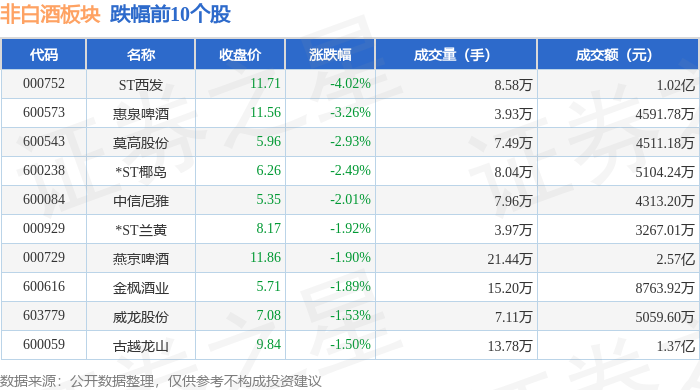
非白酒板块9月18日跌1.24%,ST西发领跌,主力资金净流出1.63亿元
Zheng Xing Xing Ye Ri Bao· 2025-09-18 08:52
Market Overview - On September 18, the non-liquor sector declined by 1.24% compared to the previous trading day, with ST Xifa leading the drop [1] - The Shanghai Composite Index closed at 3831.66, down 1.15%, while the Shenzhen Component Index closed at 13075.66, down 1.06% [1] Stock Performance - The following stocks in the non-liquor sector experienced notable declines: - ST Xifa: Closed at 11.71, down 4.02% with a trading volume of 85,800 shares and a turnover of 102 million yuan [1] - Huichuan Beer: Closed at 11.56, down 3.26% with a trading volume of 39,300 shares and a turnover of 45.92 million yuan [1] - Mogao Co.: Closed at 5.96, down 2.93% with a trading volume of 74,900 shares and a turnover of 45.11 million yuan [1] - Other notable declines include ST Yedao, CITIC Nia, and ST Lanhua [1] Capital Flow - The non-liquor sector saw a net outflow of 163 million yuan from institutional investors, while retail investors contributed a net inflow of 133 million yuan [1] - The following stocks had significant capital flow: - Qingfeng Wine Industry: Net inflow from retail investors of 348,580 yuan, but a net outflow from institutional investors of 3.34 million yuan [2] - CITIC Nia: Net inflow from retail investors of 527,680 yuan, with a net inflow from institutional investors of 1.38 million yuan [2] - ST Lanhua: Experienced a net outflow of 7.01 million yuan from institutional investors, but a net inflow of 195,260 yuan from retail investors [2]


黄酒半年报丨古越龙山“一哥”地位险被超 会稽山增收难增利
Xin Jing Bao· 2025-09-16 09:43
Group 1: Market Competition - The competition among the three listed yellow wine companies is intensifying, with Gu Yue Long Shan's revenue lead over Kuaiji Mountain narrowing year by year [2][3] - In the first half of this year, Gu Yue Long Shan achieved a revenue of 0.76 billion yuan more than Kuaiji Mountain, but Kuaiji Mountain surpassed Gu Yue Long Shan in net profit [2][3] - Kuaiji Mountain's revenue grew by 11.03% year-on-year in the first half of this year, marking three consecutive years of double-digit growth, although its net profit growth slowed to 3.41% [2][6] Group 2: Financial Performance - Gu Yue Long Shan reported a revenue of 0.893 billion yuan, a slight increase of 0.40%, while its net profit decreased by 4.72% to 90.31 million yuan [3][4] - Kuaiji Mountain's net profit growth has been affected by a significant increase in sales expenses, which reached 0.215 billion yuan, up 53.69% year-on-year [6][7] - Jin Feng Wine's revenue declined by 9.04% to 0.216 billion yuan, with a loss of 7.136 million yuan, although the loss has narrowed compared to previous periods [5] Group 3: Strategic Initiatives - The yellow wine industry is focusing on high-end, youthful, and national strategies to capture market share, with both Gu Yue Long Shan and Kuaiji Mountain launching products aimed at younger consumers [8][9] - Kuaiji Mountain has increased its marketing efforts, including collaborations with celebrities to promote its products, which has led to significant sales during promotional events [6][7] - Jin Feng Wine is also pursuing a high-end and youthful brand strategy but acknowledges that the full effects of these initiatives will take time to materialize [9] Group 4: Regional Sales Dynamics - In the competitive Jiangsu and Zhejiang markets, Gu Yue Long Shan and Kuaiji Mountain are experiencing fluctuating sales, with Gu Yue Long Shan's revenue in Zhejiang at 0.259 billion yuan and Kuaiji Mountain's at 0.518 billion yuan [10] - Jin Feng Wine's performance in its home market of Shanghai has seen a decline, with a revenue drop of 6.38% [10] Group 5: Future Outlook - Analysts believe that the push for high-end and youthful products, along with national expansion, will require sustained investment and time to cultivate new markets and consumers [11] - The current price range of yellow wine is around 20 yuan, indicating potential for product upgrades, but there are uncertainties regarding market acceptance of high-end products [11]
古越龙山“一哥”地位险被超,会稽山增收难增利
Xin Jing Bao· 2025-09-16 09:11
Group 1: Industry Overview - The competition in the yellow wine market is intensifying, with leading companies like Guyue Longshan and Kuaijishan narrowing the revenue gap [1][2] - Yellow wine accounts for less than 2% of the total alcoholic beverage market, indicating significant future growth potential [1] - The industry is currently in a market cultivation phase, with major players seeking to break through through nationalization, youth-oriented strategies, and premiumization [1][7] Group 2: Company Performance - Guyue Longshan reported a revenue of 8.93 billion yuan in the first half of the year, a slight increase of 0.40%, but its net profit decreased by 4.72% to 903.07 million yuan [2][3] - Kuaijishan achieved a revenue of 8.17 billion yuan, marking an 11.03% year-on-year growth, while its net profit increased by 3.41% to 938.77 million yuan [2][5] - Jinfeng Winery experienced a revenue decline of 9.04% to 2.16 billion yuan and reported a loss of 7.14 million yuan, although the loss has narrowed compared to previous periods [3][4] Group 3: Financial Analysis - Kuaijishan's sales expenses surged by 53.69% to 2.15 billion yuan, significantly outpacing its revenue growth, which raises concerns about profit margins [5][6] - Jinfeng Winery's cash flow from operating activities was negative 43.92 million yuan, indicating ongoing financial challenges [4] - The financial performance of Kuaijishan's online subsidiaries showed losses, highlighting the risks associated with aggressive marketing strategies [6] Group 4: Market Strategies - Both Guyue Longshan and Kuaijishan are focusing on product innovation aimed at younger consumers, with new product lines introduced to attract this demographic [7][9] - The companies are also pursuing national expansion, but face challenges in penetrating markets outside their traditional strongholds in Jiangsu, Zhejiang, and Shanghai [8][9] - The current pricing strategy positions yellow wine as a more affordable option compared to other alcoholic beverages, suggesting room for product upgrades [9]
黄酒半年报丨古越龙山“一哥”地位险被超,会稽山增收难增利
Bei Ke Cai Jing· 2025-09-16 09:09
Group 1: Industry Overview - The competition in the yellow wine market is intensifying, with the revenue gap between the leading company, Guyue Longshan, and the second-ranked company, Kuaijishan, narrowing year by year [1][2] - The yellow wine industry has a small market size, accounting for less than 2% of the total alcoholic beverage market, indicating significant future market potential [1] Group 2: Company Performance - Guyue Longshan reported a revenue of 893 million yuan in the first half of the year, a year-on-year increase of 0.40%, while its net profit decreased by 4.72% to 90.31 million yuan [2][3] - Kuaijishan achieved a revenue of 817 million yuan, a year-on-year growth of 11.03%, and a net profit of 93.88 million yuan, up 3.41% [2][3] - Jinfeng Wine experienced a revenue decline of 9.04% to 216 million yuan and reported a loss of 7.14 million yuan, although the loss has narrowed compared to previous periods [3][4] Group 3: Financial Dynamics - Kuaijishan's sales expenses reached 215 million yuan, a significant increase of 53.69%, which has impacted its profit margins despite revenue growth [6][7] - The company has been investing in advertising and promotions, including collaborations with celebrities, which has led to increased sales but also higher costs [6][7] Group 4: Market Strategies - Both Guyue Longshan and Kuaijishan are focusing on product innovation aimed at younger consumers, with new product lines being introduced to capture this demographic [8][10] - The companies are also pursuing national expansion strategies, although they face challenges in penetrating markets outside their traditional strongholds in Jiangsu, Zhejiang, and Shanghai [9][10] Group 5: Consumer Trends - The yellow wine industry is experiencing a shift towards high-end and younger consumer segments, but the transition is proving challenging and requires time for market acceptance [11] - The current main price range for yellow wine is around 20 yuan, which is significantly lower than that of white wine, suggesting room for product upgrades [11]