CNRE(600111)

Search documents
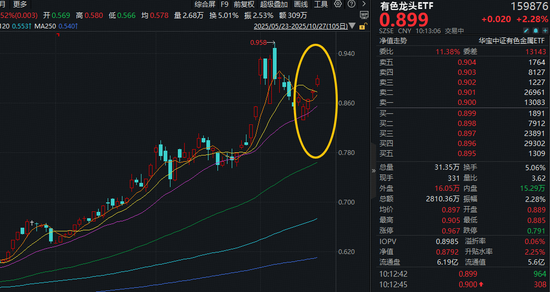
北方稀土拉升5%,跻身A股吸金榜TOP5!有色龙头ETF(159876)盘中涨近3%,日k线或已走出 “上行台阶”
Xin Lang Ji Jin· 2025-10-27 02:33
Core Viewpoint - The non-ferrous metal sector is experiencing significant gains, with the non-ferrous metal leader ETF (159876) showing a rise of 2.28% and a trading volume exceeding 280 million yuan, indicating a potential increase in market activity [1][3] Market Performance - The non-ferrous metal sector has seen a net inflow of over 5.5 billion yuan from major funds, ranking second among 31 primary industries [3] - Key stocks such as Xiamen Tungsten, Northern Rare Earth, and Jiangxi Copper have shown substantial gains, with Xiamen Tungsten hitting the daily limit and others rising over 5% [1][3] Technical Analysis - The recovery of the 10-day moving average suggests that short-term bullish forces are strong enough to push prices above this key level, indicating a favorable short-term market sentiment [1] - A significant volume increase accompanying the recovery of the 10-day moving average would enhance the reliability of this bullish signal [1] Policy and Economic Environment - The Ministry of Industry and Information Technology and seven other departments have issued a "Work Plan for Stable Growth in the Non-Ferrous Metal Industry (2025-2026)," marking a new phase of institutional support and structural prosperity for the industry [3] - The Federal Reserve has initiated a new round of interest rate cuts, which may improve global liquidity conditions, creating new opportunities for the non-ferrous metal sector [3] Supply and Demand Dynamics - The supply of non-ferrous metals is limited while demand is expected to increase, leading to a tight balance between supply and demand [4] - The shift in demand drivers from real estate and infrastructure to the new energy sector has significantly altered the demand structure for copper and aluminum, with new energy now accounting for over 15% and 20% of copper and aluminum demand, respectively [4] Future Outlook - Non-ferrous metals are positioned as key commodities in the current bull market, driven by long-term capital expenditure cycles and increasing global manufacturing investment [4] - The combination of domestic macroeconomic recovery expectations and strategic resource reserve demands under globalization trends further strengthens the outlook for non-ferrous metals [4] Investment Strategy - A diversified investment approach through the non-ferrous metal leader ETF (159876) and its associated funds is recommended to capture the sector's beta performance while mitigating risks [6] - The ETF tracks the CSI Non-Ferrous Metal Index, which includes significant weights in copper (27.6%), gold (14.5%), aluminum (13.1%), rare earths (10.4%), and lithium (8.4%) [6]


战略小金属价值重估进行时,推荐关注稀土及钴等战略金属
HUAXI Securities· 2025-10-26 05:55
Investment Rating - Industry rating: Recommended [3] Core Insights - The report emphasizes the strategic revaluation of key metals, particularly focusing on rare earths and cobalt [24] - Nickel prices are expected to be supported due to tightened supply expectations following Indonesia's new regulation reducing the approval cycle for mining plans from three years to one year [26][27] - Cobalt prices have continued to rise, with expectations of increasing supply tightness further driving prices up [30][33] - Antimony supply is expected to remain tight, providing a bottom support for antimony prices [34] - Lithium carbonate prices are projected to remain strong due to ongoing demand and inventory depletion [16] - China's dominance in rare earth supply is reinforced by stricter export controls, which are expected to support rare earth prices [18] - Tin supply remains uncertain due to ongoing challenges in overseas supply, which is expected to support tin prices [19] - Tungsten prices are supported by a tightening supply situation, with production rates slowing down [20] - Uranium supply tightness is anticipated to continue, supporting uranium prices [21] Summary by Sections Nickel and Cobalt Industry Update - Indonesia's new regulation on mining approvals is expected to tighten future ore supply, supporting nickel prices [26] - As of October 24, LME nickel price was $15,085 per ton, up 1.04% from October 17 [26] - Cobalt prices have risen significantly, with electrolytic cobalt reaching 408,500 CNY per ton, a 6.94% increase [30] Antimony Industry Update - Domestic antimony prices have decreased, but long-term supply tightness is expected to support prices [34] - China's antimony production is projected to dominate global supply, accounting for 60% of the total [34] Lithium Industry Update - Lithium carbonate prices have increased, with a market average of 73,700 CNY per ton as of October 24 [16] - Demand from the battery sector continues to drive price support [16] Rare Earth Industry Update - China's strict export controls on rare earths are expected to tighten supply and support prices [18] - The report highlights the importance of China's role in the global rare earth supply chain [18] Tin Industry Update - Tin prices are supported by supply uncertainties, particularly from Myanmar and Indonesia [19] - As of October 24, LME tin price was $35,925 per ton, up 2.42% from October 17 [19] Tungsten Industry Update - The tungsten supply situation is tightening, with production rates slowing down [20] - Prices for tungsten concentrate have increased, reflecting supply constraints [20] Uranium Industry Update - The report indicates a continued tight supply situation for uranium, supporting price stability [21] - Recent production guidance reductions from major suppliers are expected to impact future supply [21]


小金属板块10月24日涨2.32%,厦门钨业领涨,主力资金净流入5.35亿元
Zheng Xing Xing Ye Ri Bao· 2025-10-24 08:21
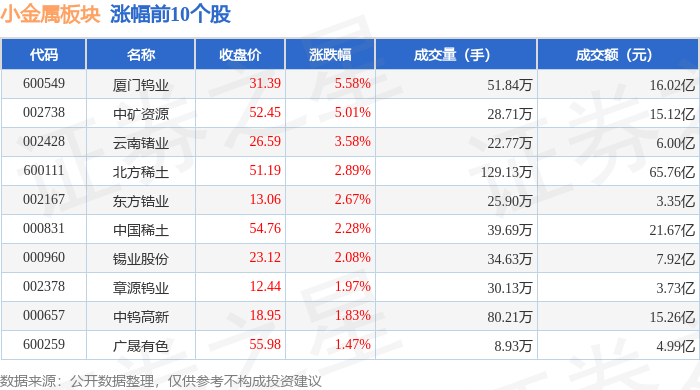
Core Insights - The small metals sector experienced a rise of 2.32% on October 24, with Xiamen Tungsten leading the gains [1] - The Shanghai Composite Index closed at 3950.31, up 0.71%, while the Shenzhen Component Index closed at 13289.18, up 2.02% [1] Small Metals Sector Performance - Xiamen Tungsten (600549) closed at 31.39, up 5.58%, with a trading volume of 518,400 shares and a transaction value of 1.602 billion [1] - Zhongkuang Resources (002738) closed at 52.45, up 5.01%, with a transaction value of 1.512 billion [1] - Yunnan Tin (002428) closed at 26.59, up 3.58%, with a transaction value of 600 million [1] - Northern Rare Earth (600111) closed at 51.19, up 2.89%, with a transaction value of 6.576 billion [1] - Other notable performers include China Rare Earth (000831) and Xiyang Co. (600259), with increases of 2.28% and 1.47% respectively [1] Capital Flow Analysis - The small metals sector saw a net inflow of 535 million from main funds, while retail funds experienced a net outflow of 216 million [2] - Main funds showed significant net inflows in Northern Rare Earth (2.68 million) and Xiamen Tungsten (1.35 million) [3] - Retail funds had notable outflows in Xiamen Tungsten and China Rare Earth, indicating a shift in investor sentiment [3]


123家公司预告前三季度业绩 96家预增
Zheng Quan Shi Bao Wang· 2025-10-24 01:54
Core Insights - A total of 123 companies have announced their performance forecasts for the first three quarters, with 96 companies expecting profit increases, representing 78.05% of the total [1] - The overall proportion of companies reporting positive forecasts is 85.37%, with 9 companies expecting profits and 11 and 3 companies forecasting profit declines and losses, respectively [1] - Among the companies expecting profit increases, 44 are projected to have net profit growth exceeding 100%, while 41 companies are expected to see growth between 50% and 100% [1] Company Performance - Xinda Co. is expected to have the highest net profit growth, with a median increase of 3009.81% for the first three quarters [2] - Chuangjiang New Material and Shuo Bei De are projected to have median net profit growth of 2150.09% and 1285.82%, ranking second and third, respectively [2] - The average increase in stock prices for companies expected to double their profits since July is 25.57%, outperforming the Shanghai Composite Index [2] Industry Insights - The sectors with the most companies expecting profit increases include electronics, basic chemicals, and non-ferrous metals, with 10, 7, and 5 companies, respectively [1] - The main board, ChiNext, and STAR Market have 28, 8, and 8 companies, respectively, that are expected to double their profits [1] Stock Performance - Among the stocks, Northern Rare Earth has seen the largest increase since July, with a cumulative rise of 99.80% [2] - In terms of capital flow, the stocks with significant net inflows in the past five days include Shengyi Electronics, Yahua Group, and Guangdong Mingzhu, with net inflows of 189.65 million, 105.79 million, and 66.45 million, respectively [2] - Conversely, Northern Rare Earth, Shenghe Resources, and Chuangjiang New Material experienced significant net outflows, with amounts of 2478.92 million, 881.76 million, and 771.45 million, respectively [2]


中国稀土集团:严格落实出口管制政策
Zheng Quan Shi Bao Wang· 2025-10-23 12:01
Core Viewpoint - The China Rare Earth Group held an economic operation analysis meeting for Q3 2025, outlining key tasks for Q4, emphasizing strict adherence to export control policies and enhancing production stability [1] Group 1: Key Tasks for Q4 - The company will focus on strict implementation of export control policies and conducting operations in compliance with laws [1] - There will be an emphasis on stabilizing production and supply to ensure operational continuity [1] - The company aims to enhance governance levels through state-owned enterprise reform initiatives [1] Group 2: Innovation and Development - The company plans to strengthen technological innovation to boost development momentum [1] - Project advancement will be prioritized to accelerate the pace of development [1] Group 3: Risk Management - The company will focus on risk prevention to establish a solid foundation for development [1]
解密主力资金出逃股 连续5日净流出653股
Zheng Quan Shi Bao Wang· 2025-10-23 09:52
Core Insights - As of October 23, a total of 653 stocks in the Shanghai and Shenzhen markets have experienced a net outflow of main funds for five consecutive days or more, indicating a significant trend of capital withdrawal from these stocks [1] Group 1: Stocks with Longest Net Outflow - Tianma Technology has the longest streak of net outflow, with 27 consecutive days [1] - Enwei Pharmaceutical follows with 19 consecutive days of net outflow [1] Group 2: Stocks with Highest Total Net Outflow - Northern Rare Earth has the highest total net outflow amounting to 6.479 billion yuan over 8 days [1] - BYD ranks second with a total net outflow of 4.138 billion yuan over 5 days [1] Group 3: Stocks with Highest Net Outflow Proportion - BYD also leads in terms of the proportion of net outflow relative to trading volume, with a 19.67% outflow ratio over the past 5 days [1] - Other notable stocks with significant outflow proportions include Shanghai Electric at 7.39% and Shanzi Gaoke at 9.91% [1] Group 4: Performance of Affected Stocks - Northern Rare Earth has seen a cumulative decline of 13.82% during the net outflow period [1] - BYD has experienced a 3.06% drop over the last 5 days [1] - Other stocks like Shanghai Electric and Shanzi Gaoke have also reported declines of 11.56% and 18.14% respectively [1]

10月23日沪投资品(000102)指数涨0.5%,成份股德业股份(605117)领涨
Sou Hu Cai Jing· 2025-10-23 09:05
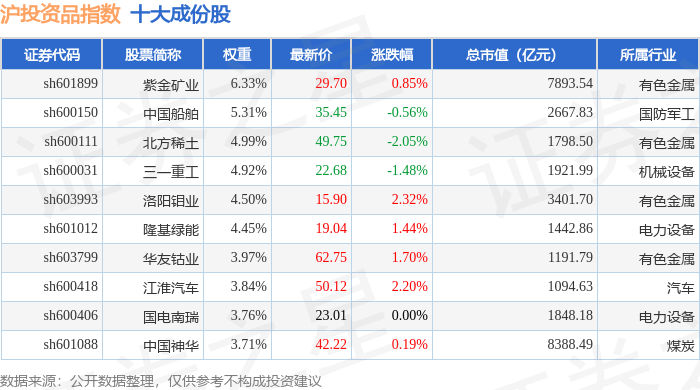
Core Points - The Shanghai Investment Products Index (000102) closed at 7184.98 points, up 0.5%, with a trading volume of 649.17 billion yuan and a turnover rate of 1.29% [1] - Among the index constituents, 32 stocks rose while 15 fell, with DeYe Co., Ltd. leading the gainers at 4.61% and Hengli Hydraulic leading the decliners at 2.9% [1] Index Constituents Summary - The top ten constituents of the Shanghai Investment Products Index include: - Zijin Mining (6.33% weight, latest price 29.70, market cap 789.35 billion yuan) in the non-ferrous metals sector [1] - China Shipbuilding (5.31% weight, latest price 35.45, market cap 266.78 billion yuan) in the defense industry [1] - Northern Rare Earth (4.99% weight, latest price 49.75, market cap 179.85 billion yuan) in the non-ferrous metals sector [1] - SANY Heavy Industry (4.92% weight, latest price 22.68, market cap 192.20 billion yuan) in the machinery sector [1] - Luoyang Molybdenum (4.50% weight, latest price 15.90, market cap 340.17 billion yuan) in the non-ferrous metals sector [1] - Longi Green Energy (4.45% weight, latest price 19.04, market cap 144.29 billion yuan) in the power equipment sector [1] - Huayou Cobalt (3.97% weight, latest price 62.75, market cap 119.18 billion yuan) in the non-ferrous metals sector [1] - JAC Motors (3.84% weight, latest price 50.12, market cap 109.46 billion yuan) in the automotive sector [1] - Guodian NARI Technology (3.76% weight, latest price 23.01, market cap 184.82 billion yuan) in the power equipment sector [1] - China Shenhua Energy (3.71% weight, latest price 42.22, market cap 838.85 billion yuan) in the coal sector [1] Capital Flow Summary - The net outflow of main funds from the index constituents totaled 627 million yuan, while retail investors saw a net inflow of 527 million yuan [3] - Key stocks with significant capital flow include: - China Aluminum (net inflow of 43.41 million yuan from main funds) [3] - Luoyang Molybdenum (net inflow of 33.70 million yuan from main funds) [3] - Jianghuai Automobile (net inflow of 19.50 million yuan from main funds) [3] - Longi Green Energy (net inflow of 16.40 million yuan from main funds) [3] - Huayou Cobalt (net inflow of 158 million yuan from main funds) [3]





稀土行业供需格局有望迎来拐点,稀土ETF嘉实(516150)近2周规模增长超26亿元同类居首!
Sou Hu Cai Jing· 2025-10-23 02:10
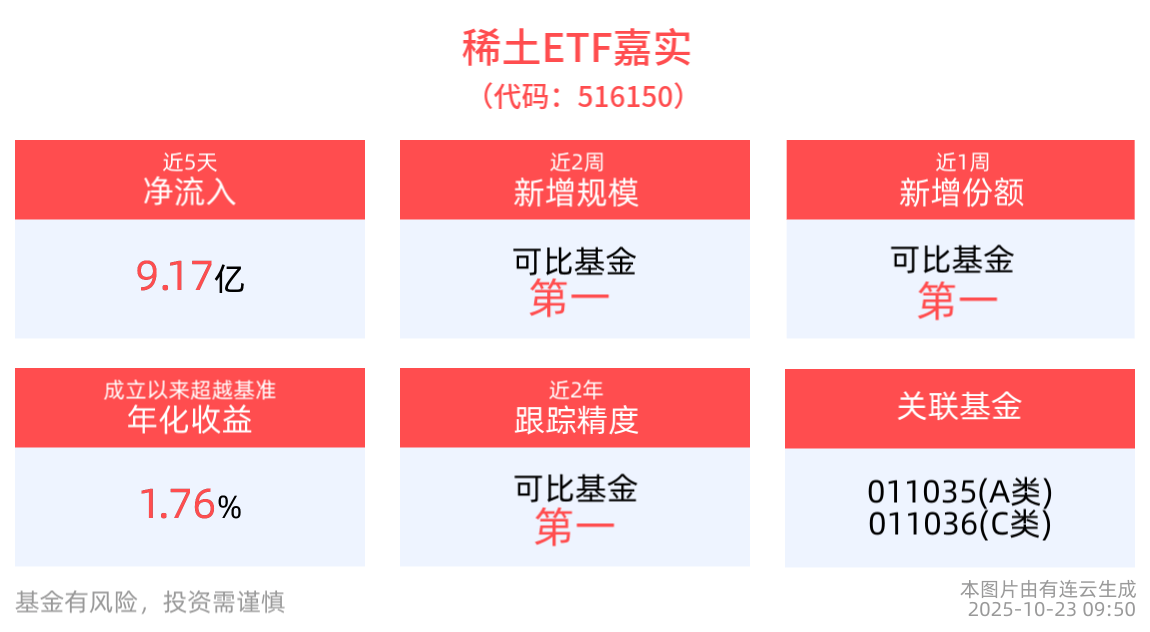
Group 1: Liquidity and Performance of Rare Earth ETF - The liquidity of the Rare Earth ETF managed by Jiashi reached a trading volume of 97.241 million yuan [3] - Over the past two weeks, the scale of the Rare Earth ETF increased by 2.632 billion yuan, marking significant growth and ranking first among comparable funds [3] - In terms of shares, the ETF saw an increase of 10.7 million shares in the past week, also ranking first among comparable funds [3] - In the last five trading days, there were net inflows on three days, totaling 917 million yuan [3] - As of October 22, the net value of the Rare Earth ETF has risen by 88.51% over the past two years, ranking 88th out of 2358 index equity funds, placing it in the top 3.73% [3] - The highest monthly return since inception was 41.25%, with the longest consecutive monthly increase being four months and a maximum increase of 83.89% [3] Group 2: Market Dynamics and Policy Impact - The Ministry of Commerce, in conjunction with the General Administration of Customs and other departments, has issued multiple export control policies, highlighting the strategic nature of rare earth resources [4] - The combination of regulatory constraints and declining imports has strengthened the rigidity of rare earth supply [4] - Demand from sectors such as new energy vehicles, consumer electronics, variable frequency air conditioners, and wind power is expected to continue rising, providing strong support for rare earth prices [4] - Emerging fields like robotics, low-altitude economy, and industrial motors are anticipated to open up long-term demand growth opportunities [4] - The supply-demand dynamics in the rare earth industry are expected to reach a turning point, with a continued recommendation for strategic allocation in the rare earth industry chain [4] Group 3: Top Weighting Stocks in Rare Earth Industry - The top ten weighted stocks in the China Rare Earth Industry Index account for 61.96% of the index, including Northern Rare Earth, Wolong Electric Drive, Lingyi Technology, China Rare Earth, Shenghe Resources, Gree Environmental, Goldwind Technology, Baotou Steel, Xiamen Tungsten, and China Aluminum [3]



A股市场交投趋冷,后市投资主线在哪?
Guo Ji Jin Rong Bao· 2025-10-22 15:12
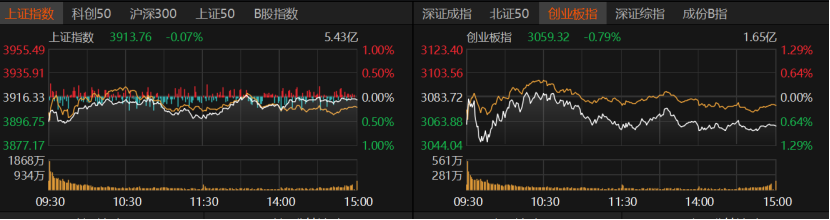
Market Overview - The A-share market experienced fluctuations on October 22, with the Shanghai Composite Index slightly down by 0.07%, the Shenzhen Component down by 0.62%, and the ChiNext Index down by 0.79% [1][3] - The total market turnover was 1.69 trillion yuan, a decrease of 200 billion yuan compared to the previous trading day [2][3] - Market sentiment is cautious, with trading volumes consistently below 2 trillion yuan since October 16 [3] Investment Sentiment - Current market conditions suggest that favorable factors slightly outweigh the suppressive ones, leading to a likely horizontal consolidation and slow upward trend [1][7] - Investors are advised to increase liquidity safety margins and wait for clearer directional signals before increasing positions [11] Sector Performance - There has been a recent shift from technology growth stocks to value dividend stocks, although the medium-term outlook remains positive for growth stocks [1][9] - The technology sector, particularly AI, new energy, and domestic substitution, continues to present structural opportunities despite recent adjustments [7][10] Individual Stock Highlights - Notable individual stock movements include Cambrian Technologies (688256) rising by 4.42% to 1429.50 yuan per share, approaching the price of Kweichow Moutai [5] - The trading volume for individual stocks was mixed, with 2,280 stocks rising and 2,965 stocks falling [5] Market Dynamics - The market is currently characterized by a rotation between sectors, with traditional cyclical stocks providing support amid the adjustment in technology stocks [9][10] - Analysts suggest that the recent adjustments are primarily due to profit-taking and the cautious approach of investors during the earnings reporting period [9] Future Outlook - The market is expected to maintain a high-level consolidation, with technology growth remaining the main investment theme [10] - Key macro variables to watch include the clarity of U.S.-China trade policies and the focus of China's 14th Five-Year Plan, which could provide sustained investment themes [11]





解密主力资金出逃股 连续5日净流出631股
Zheng Quan Shi Bao Wang· 2025-10-22 10:04
Core Insights - A total of 631 stocks in the Shanghai and Shenzhen markets have experienced net outflows of main funds for five consecutive days or more as of October 22 [1] - The stock with the longest continuous net outflow is Tianma Technology, with 26 days of outflows, followed by Enwei Pharmaceutical with 18 days [1] - The largest total net outflow amount is from Northern Rare Earth, with a cumulative outflow of 5.986 billion yuan over seven days [1] Summary by Category Stocks with Longest Net Outflows - Tianma Technology has seen net outflows for 26 days [1] - Enwei Pharmaceutical has experienced net outflows for 18 days [1] Stocks with Largest Net Outflow Amounts - Northern Rare Earth has a total net outflow of 5.986 billion yuan over seven days [1] - Shanghai Electric follows with a net outflow of 3.732 billion yuan over nine days [1] Stocks with Highest Net Outflow Ratios - Yongxin Zhicheng has the highest net outflow ratio, with a 7-day decline of 11.27% [1] - Other notable stocks include Shanzhi Gaoke and Baogang Co., with significant net outflow ratios and declines [1]