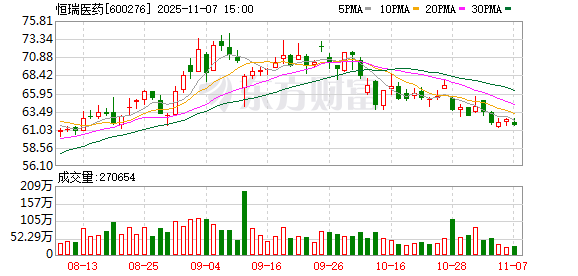
Hengrui Pharma(600276)
Search documents
上交所第三届科创咨询委候选人揭晓,宇树王兴兴、智元彭志辉在列
Di Yi Cai Jing· 2025-09-14 00:48
Group 1 - The Shanghai Stock Exchange has announced the candidate list for the third Technology Innovation Advisory Committee, which includes 60 candidates, the highest number to date [2][4] - Wang Xingxing, founder, CEO, and CTO of Yushu Technology, is among the candidates, indicating the company's potential involvement in the advisory committee [2][3] - The committee consists of experts and executives from various sectors, including government agencies, universities, research institutes, listed companies, and investment firms [2][4] Group 2 - The third committee's candidate list includes notable figures such as Yin Zhiyao, chairman and general manager of Zhongwei Company, and Zhang Lianshan, board director and executive vice president of Hengrui Medicine, who may serve for a third consecutive term [3][4] - Yushu Technology is preparing to submit its IPO application to the stock exchange between October and December 2025, with a high probability of listing on the Sci-Tech Innovation Board [4] - The advisory committee's rules stipulate that members can serve for two years and may be re-elected, with specific conditions for avoiding conflicts of interest [4]
上交所科创咨询委委员候选人出炉 王兴兴、尹志尧等多名企业家入选
Sou Hu Cai Jing· 2025-09-13 12:02
Group 1 - The Shanghai Stock Exchange has announced the candidate list for the third Technology Innovation Advisory Committee, which includes 60 individuals, with a public notice period of 5 working days [1] - Notable candidates include chairpersons and executives from listed companies such as Yinjia Yao from Zhongwei Company, Ji Fan Gao from Trina Solar, Xiaolong He from China Resources Microelectronics, and Lianshan Zhang from Jiangsu Hengrui Medicine [1] - The list also features founders and CEOs from well-known technology companies, including Xingxing Wang from Yushu Technology, Bicheng Han from Qiangnao Technology, Zhihui Peng from Zhiyuan Robotics, and He Wang from Galaxy General Robotics [1] Group 2 - The complete candidate list includes various professionals from different sectors, such as environmental planning, medical innovation, and aerospace engineering [2] - Key individuals on the list include Wang Wei Dong from the PLA General Hospital, Yinjia Yao from Zhongwei Semiconductor Equipment, and Ji Fan Gao from Trina Solar [2][3] - The committee aims to enhance the technological innovation landscape in China by leveraging the expertise of these candidates [1]
研判2025!全球及中国补体药物行业市场规模、药品上市情况、竞争格局及未来趋势分析:商业价值持续兑现,市场规模不断扩大,本土企业积极布局[图]
Chan Ye Xin Xi Wang· 2025-09-13 02:05
Core Insights - Complement drugs are specifically designed to treat diseases related to abnormal activation or suppression of the complement system, with a complex development history that faced significant challenges until the first drug, Soliris, was approved in 2007 [1][4] - The market for complement drugs is expanding rapidly, with a projected global market size of $8.179 billion in 2024, reflecting a year-on-year growth of 23.4%, primarily driven by advancements in treatment for eye diseases [1][6] - The leading complement drugs in the market are AstraZeneca's C5 antibodies, Soliris and Ultomiris, which together are expected to account for 79.6% of total sales in 2024 [1][6][7] Industry Overview - The complement drug industry has evolved to include over ten approved drugs, utilizing various forms such as monoclonal antibodies, small molecule inhibitors, cyclic peptides, and nucleic acid aptamers, indicating a diverse technological landscape [1][4] - The expansion of indications from rare blood diseases to more common conditions signifies a maturation in the development of complement drugs, with ongoing research opening new therapeutic areas [1][4][8] Market Dynamics - The sales of Ultomiris are projected to grow significantly, from $339 million in 2019 to $3.924 billion in 2024, surpassing Soliris, which is expected to see a decline in sales by 17.7% to $2.588 billion in 2024 [7] - Domestic companies such as Heng Rui Medicine and Hai Si Ke are actively entering the complement drug market, with over ten clinical trials registered in China, primarily focusing on IgA nephropathy [1][8] Future Trends - The competition in the complement drug market is expected to intensify with the introduction of more drugs, emphasizing technological innovation and cost reduction to enhance accessibility [8] - There is a growing focus on multi-target and combination therapy strategies, which may improve treatment efficacy and reduce side effects, as well as an expansion of applications to include more rare and autoimmune diseases [8]
呼吸领域再现BD交易,百亿赛道为何火热?生物制剂前景如何?
Xin Lang Cai Jing· 2025-09-12 23:45
Core Insights - Baiyang Pharmaceutical announced a strategic investment in Tianjin Jikun Pharmaceutical, acquiring a 24% stake to secure rights to a novel drug for pulmonary fibrosis and priority purchase rights for global compound rights [1][2] Industry Overview - The respiratory disease sector is gaining attention, with recent business development (BD) transactions highlighting its potential, despite historically lower interest compared to oncology and weight loss markets [2] - Major players in the respiratory market include both domestic companies and multinational corporations like AstraZeneca, Sanofi, GSK, and Kasy, with a mix of common inhalation therapies and advanced biologics [4] Market Potential - The Chinese respiratory drug market is projected to reach approximately $12.8 billion by 2024, driven by a significant patient population, including around 45.7 million asthma patients and nearly 100 million COPD patients [4] - Recent BD transactions, such as the collaboration between Hengrui Medicine and GSK, have sparked interest in the PDE3/4 target, indicating a competitive landscape for future partnerships [2][3] Product Development - Kasy has launched a new inhalation powder for asthma treatment, representing a novel option in the market, while AstraZeneca has received approval for a biologic treatment for severe eosinophilic asthma in children [4] - The ongoing development of biologics is seen as a potential future direction for treating respiratory diseases, although inhalation therapies remain the cornerstone of treatment [5][6]
医药生物行业周报:中国药企WCLC表现亮眼,恒瑞再次NewCo出海-20250912
BOHAI SECURITIES· 2025-09-12 12:13
Investment Rating - The industry rating is "Positive" for the next 12 months, expecting a growth rate exceeding 10% relative to the CSI 300 index [67][79]. Core Insights - The report highlights the impressive research outcomes of Chinese pharmaceutical companies showcased at the 2025 World Lung Cancer Conference (WCLC), emphasizing the strength of innovation in the sector. It also notes that Heng Rui has further advanced its overseas licensing strategy through the NewCo model [9][67]. - The report suggests continuous monitoring of the R&D progress of Chinese pharmaceutical companies, particularly in innovative drugs and related industrial chains, benefiting from optimized procurement rules in the pharmaceutical and medical device sectors, as well as the recovery of traditional Chinese medicine and medical services due to domestic demand [9][67]. Industry News - Bai Li Tian Heng's dual-target ADC for EGFR/HER3 has shown promising results at WCLC, with a 100% overall response rate in a study involving 154 patients [18]. - BeiGene presented the latest findings from its RATIONALE studies at WCLC, demonstrating significant survival benefits for its drug in treating non-small cell lung cancer [19]. - Kangfang Biotech updated data from its HARMONi study, showing improved overall survival rates, particularly in North America [20]. Company Announcements - Heng Rui Pharma signed a licensing agreement with Braveheart Bio for the HRS-1893 project, with an upfront payment of $65 million and potential milestone payments totaling up to $1.013 billion [35]. - The new drug application for KN026 by CSPC has been accepted by the National Medical Products Administration (NMPA) [39]. - Junshi Biosciences reported positive results from its Phase III clinical trial for an anti-IL-17A monoclonal antibody [40]. Market Review - The Shanghai Composite Index rose by 2.91%, while the Shenzhen Component Index increased by 7.11%. The pharmaceutical and biological sector saw a 1.76% increase, with most sub-sectors showing positive performance [53][57]. - As of September 11, 2025, the TTM P/E ratio for the pharmaceutical and biological industry was 31.56, with a valuation premium of 148% relative to the CSI 300 [57]. Weekly Strategy - The report recommends focusing on investment opportunities in innovative drugs and medical devices, as well as sectors benefiting from domestic demand recovery, while maintaining a "Positive" industry rating [67].
瑞银集团增持恒瑞医药(01276)20.44万股 每股作价约85.88港元
Zhi Tong Cai Jing· 2025-09-12 11:21
Group 1 - UBS Group increased its stake in Heng Rui Medicine (01276) by 204,400 shares at a price of approximately 85.88 HKD per share, totaling around 17.55 million HKD [1] - After the increase, UBS's total shareholding in Heng Rui Medicine reached approximately 18.18 million shares, representing a holding percentage of 7.04% [1]
瑞银集团增持恒瑞医药20.44万股 每股作价约85.88港元
Zhi Tong Cai Jing· 2025-09-12 11:16
Core Viewpoint - UBS Group has increased its stake in Heng Rui Medicine, acquiring 204,400 shares at a price of HKD 85.8849 per share, totaling approximately HKD 17.55 million, resulting in a new holding of about 18.18 million shares, representing 7.04% ownership [1] Summary by Category Company Actions - UBS Group purchased 204,400 shares of Heng Rui Medicine on September 8 [1] - The acquisition price was HKD 85.8849 per share, leading to a total investment of approximately HKD 17.55 million [1] Ownership Structure - Following the purchase, UBS Group's total holdings in Heng Rui Medicine increased to approximately 18.18 million shares [1] - The new ownership percentage stands at 7.04% [1]
创新药的“收获季”:从亏损到盈利,药企中报答卷亮了
Xin Lang Cai Jing· 2025-09-12 09:21
Core Viewpoint - The pharmaceutical industry is experiencing structural differentiation, with the innovative drug sector (Biotech) emerging as a significant growth driver, showcasing a revenue increase of 14.12% in the first half of 2025, particularly a remarkable 44.63% growth in Q2 [1][4]. Industry Overview - The overall pharmaceutical industry reported a slight revenue decline of 1.15% in Q2 2025, but net profit showed a positive growth of 0.79% [1]. - Despite challenges such as centralized procurement and external disruptions, there are signs of performance recovery driven by policy optimization, commercial insurance expansion, and AI empowerment [1][2]. Financial Performance - The Biotech sector's revenue growth in H1 2025 was 14.1%, with Q2 alone achieving a growth rate of 44.6% [6]. - The gross profit margin for the Biotech sector was 85.0%, indicating a narrowing of losses and a shift towards profitability [6]. - The sales expense ratio increased, but management and R&D expense ratios decreased, reflecting cost control and efficiency improvements [6]. Growth Drivers - The growth in innovative drugs is attributed to the launch of effective and safe new drugs, supportive national policies, and significant revenue from licensing agreements [4][6]. - The average transaction amounts for licensing agreements in 2025 have reached global averages, indicating a robust international market for Chinese innovative drugs [9][11]. Market Trends - The innovative drug sector is transitioning from a "burning cash" phase to a "profit-making" phase, with several companies reporting net profits for the first time [6][14]. - The number of significant licensing deals has surged, with China accounting for over 25% of global heavy-weight transactions in 2025 [11][13]. Investment Opportunities - The innovative drug sector is entering a harvest phase, with expectations for further growth driven by upcoming clinical data and favorable economic conditions [14]. - Investors are encouraged to consider diversified investment products, such as ETFs, to mitigate risks associated with individual stock selection in the innovative drug space [14][16].
“十四五”结硕果:我国创新药研发数量全球第二,细分赛道领跑
2 1 Shi Ji Jing Ji Bao Dao· 2025-09-12 02:04
Core Insights - China's innovative drug development has achieved significant milestones, with over 20% of global new drug research and development, ranking second globally [1] - The number of approved innovative drugs has accelerated, with 43 new drugs approved in the first half of 2025, marking a historical high for the same period [3][4] - The trend of "innovation + internationalization" in the pharmaceutical industry remains strong, with Chinese companies showing competitive advantages in various therapeutic areas [1][2] Industry Development - During the "14th Five-Year Plan" period, China approved 210 innovative drugs and 269 innovative medical devices, indicating a sustained growth trend [1] - The total amount of foreign licensing for innovative drugs reached nearly $66 billion in the first half of 2025, reflecting increasing global recognition of Chinese innovative drugs [1] - The biopharmaceutical industry is experiencing a resurgence, with significant growth potential remaining, driven by technological advancements and improved global competitiveness [2] Company Performance - Leading innovative pharmaceutical companies have reported strong revenue growth, with Hengrui Medicine achieving a revenue of 15.76 billion yuan, a year-on-year increase of 15.88% [3] - Innovent Biologics turned a profit in the first half of 2025, with a net profit of 1.21 billion yuan, compared to a loss of 160 million yuan in the same period last year [5] - The sales of innovative drugs are becoming a prominent feature of the industry, with companies like BeiGene and Fosun Pharma also reporting significant revenue increases [3][5] Regulatory Environment - The National Medical Products Administration (NMPA) has optimized the clinical trial review and approval process, reducing the review time from 60 days to 30 days [6] - Continuous improvements in the drug approval process are expected to further stimulate innovative drug development [6] R&D Investment - R&D investment among leading pharmaceutical companies has increased, with a total of 17.64 billion yuan spent on R&D in the first half of 2025, a year-on-year increase of 12.66% [7] - Companies like BeiGene and Hengrui Medicine are leading in R&D expenditures, emphasizing the importance of innovation in their growth strategies [7] Market Trends - The oncology drug segment remains the dominant area for innovative drugs, accounting for approximately 40% of the approved drugs [5] - The rapid commercialization of innovative drugs is driving performance breakthroughs for pharmaceutical companies [5][8] - ADC (antibody-drug conjugates) and other advanced therapies are gaining traction, with several companies making significant progress in these areas [9][10]
中国科技发展基金会获赠2亿助力科创事业
Chang Jiang Shang Bao· 2025-09-11 23:37
Core Viewpoint - The strategic cooperation agreement signed between China Science and Technology Development Foundation, Jiangsu Hengrui Medicine Co., Ltd., and Qilu Pharmaceutical Co., Ltd. aims to support the growth of young scientific talents and promote scientific popularization and international exchange through a total donation of 200 million RMB [1][2]. Group 1: Company Contributions - Hengrui Medicine will provide a total of 100 million RMB to support seven areas of cooperation, including technological innovation, resource empowerment, talent cultivation, international exchange, academic activities, health science popularization, and industry competitions [1]. - Qilu Pharmaceutical has established six R&D platforms with a continuous R&D investment intensity of over 11% for several years, focusing on providing affordable and high-quality domestic medicines [2]. Group 2: Industry Impact - The cooperation is seen as a new model for integrating technological philanthropy with industrial innovation, which is expected to enhance the innovation capabilities of the companies involved and address challenges in the biopharmaceutical sector [2][3]. - The China Science and Technology Development Foundation aims to promote technological innovation and scientific popularization, focusing on the integration of biomedicine and artificial intelligence, and fostering key core technology breakthroughs [3].