LFX(600612)

Search documents
老凤祥股价微涨0.42% 金饰消费下滑倒逼品牌转型
Jin Rong Jie· 2025-08-05 19:05
Group 1 - The stock price of Lao Feng Xiang is reported at 47.35 yuan as of August 5, 2025, with an increase of 0.20 yuan from the previous trading day [1] - The trading volume for the day reached 13,915 lots, with a transaction amount of 0.66 billion yuan, and the total market capitalization stands at 24.77 billion yuan [1] - Lao Feng Xiang specializes in the design, production, and sales of jewelry, including gold, platinum, and diamonds, and has a century-old national brand presence [1] Group 2 - Industry data indicates that gold jewelry consumption in China decreased by 28% year-on-year in the first half of the year, with high gold prices suppressing consumer demand [1] - In response to market changes, Lao Feng Xiang is accelerating its transformation through product innovation and channel optimization [1] - The company plans to focus on the growth of national trend new products, enhance original design, and adjust store layouts to increase the proportion of mall stores [1] Group 3 - On August 5, 2025, the net inflow of main funds into Lao Feng Xiang was 6.22 million yuan, accounting for 0.04% of the circulating market value [1] - Over the past five days, the net outflow of main funds was 15.12 million yuan, representing 0.1% of the circulating market value [1]

金饰价飙至1014元一克,5天猛涨23元
Sou Hu Cai Jing· 2025-08-05 11:40
这轮金饰涨价背后反映出两大结构性因素。一方面,全球避险资金涌入黄金资产。国际金价今年持续刷新纪录,单边突破每盎司 3000美元、年内涨幅超18%,推动中国现货及珠宝金价屡创新高。 另一方面,本地零售品牌库存管理趋紧,限量精品供不应求,一定程度上形成"高端、小众、收藏化"定价策略。在消费升级与文 化信仰双驱动下,高端金饰成为部分人群的资产配置选择。 近日,多家国内金店足金金饰价格已突破每克1014元,创下新高。顷刻之间价格从7月31日的991元一克上涨至今日,短短五天内 累计涨幅达23元。 周生生、老凤祥、周大福等品牌快速跟涨,成为黄金市场异动焦点。据福布斯中文网报道,主要原因包括COMEX现货金价飙涨、 国内市场避险需求升温,以及相关奢侈品品牌限量效应同步放大。 ...


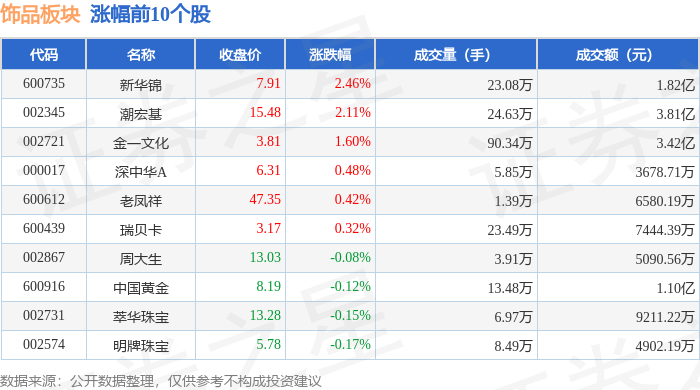
饰品板块8月5日跌0.07%,飞亚达领跌,主力资金净流出9883.72万元
Zheng Xing Xing Ye Ri Bao· 2025-08-05 08:37
Market Overview - The jewelry sector experienced a slight decline of 0.07% on August 5, with Feiya leading the drop [1] - The Shanghai Composite Index closed at 3617.6, up 0.96%, while the Shenzhen Component Index closed at 11106.96, up 0.59% [1] Individual Stock Performance - Xinhua Jin (600735) saw a closing price of 7.91, with an increase of 2.46% and a trading volume of 230,800 shares, totaling a transaction value of 182 million yuan [1] - Chao Hong Ji (002345) closed at 15.48, up 2.11%, with a trading volume of 246,300 shares and a transaction value of 381 million yuan [1] - Jin Yi Culture (002721) closed at 3.81, up 1.60%, with a trading volume of 903,400 shares and a transaction value of 342 million yuan [1] - Feiya (000026) led the decline with a closing price of 16.96, down 4.02%, and a trading volume of 307,300 shares, resulting in a transaction value of 529 million yuan [2] Capital Flow Analysis - The jewelry sector saw a net outflow of 98.84 million yuan from institutional investors, while retail investors contributed a net inflow of 12.55 million yuan [2] - The main capital inflow was observed in Chao Hong Ji (002345) with a net inflow of 10.73 million yuan from institutional investors [3] - Jin Yi Culture (002721) experienced a net outflow of 14.09 million yuan from retail investors [3]


“卖不动了”,金饰消费下滑28%
Zheng Quan Shi Bao· 2025-08-05 06:47
Core Viewpoint - Gold has been one of the best-performing assets this year, with a year-to-date increase of over 24%, despite a recent period of sideways movement. However, high gold prices have significantly reduced consumer purchasing power for gold jewelry, leading to a 28% year-on-year decline in gold jewelry consumption in China during the first half of the year [1][2]. Industry Summary - The total demand for retail gold investment and consumption in the first half of the year reached 518 tons, a year-on-year increase of 5%, with a monetary value of 371.8 billion yuan, marking the highest level on record. However, gold jewelry consumption dropped to 194 tons, a decrease of 28% year-on-year, while retail investment demand rose to 239 tons, up 26% year-on-year [3]. - Major jewelry brands like Chow Tai Fook and Lao Feng Xiang are accelerating their transformation efforts in response to weak gold jewelry consumption. This includes product innovation, channel optimization, and focusing on high-value products to seek breakthroughs [1][6][9]. - Chow Tai Fook reported a 3.3% decline in retail value in mainland China for the three months from April to June, with a reduction of 311 retail stores by the end of June. Similarly, Lao Feng Xiang and other brands have also seen a decrease in the number of stores [4][6]. - The gold jewelry industry is expected to continue consolidating, which may further suppress upstream demand. However, this trend could lead to a healthier market in the long run by eliminating underperforming stores and shifting focus towards the emotional value and design of jewelry [5][11]. - Despite the overall decline in gold jewelry consumption, Lao Pu Gold has shown significant growth, with expected revenue of 12 to 12.5 billion yuan in the first half of the year, representing a year-on-year increase of approximately 241% to 255% [6][7]. - Jewelry brands are adapting to changing consumer preferences by enhancing product design and focusing on cultural elements. For instance, Lao Feng Xiang is closely monitoring consumer habits and preferences to drive innovation and develop original design products [9][10]. - Chow Tai Fook has also seen positive results from its initiatives, with a 20.8% year-on-year increase in retail value for its gold products, and a shift in the retail value composition towards higher-priced products [10]. - Looking ahead, the gold jewelry industry may continue to face challenges from low consumer confidence and high gold prices, but seasonal improvements and potential monetary or fiscal policy support could provide some relief [11].
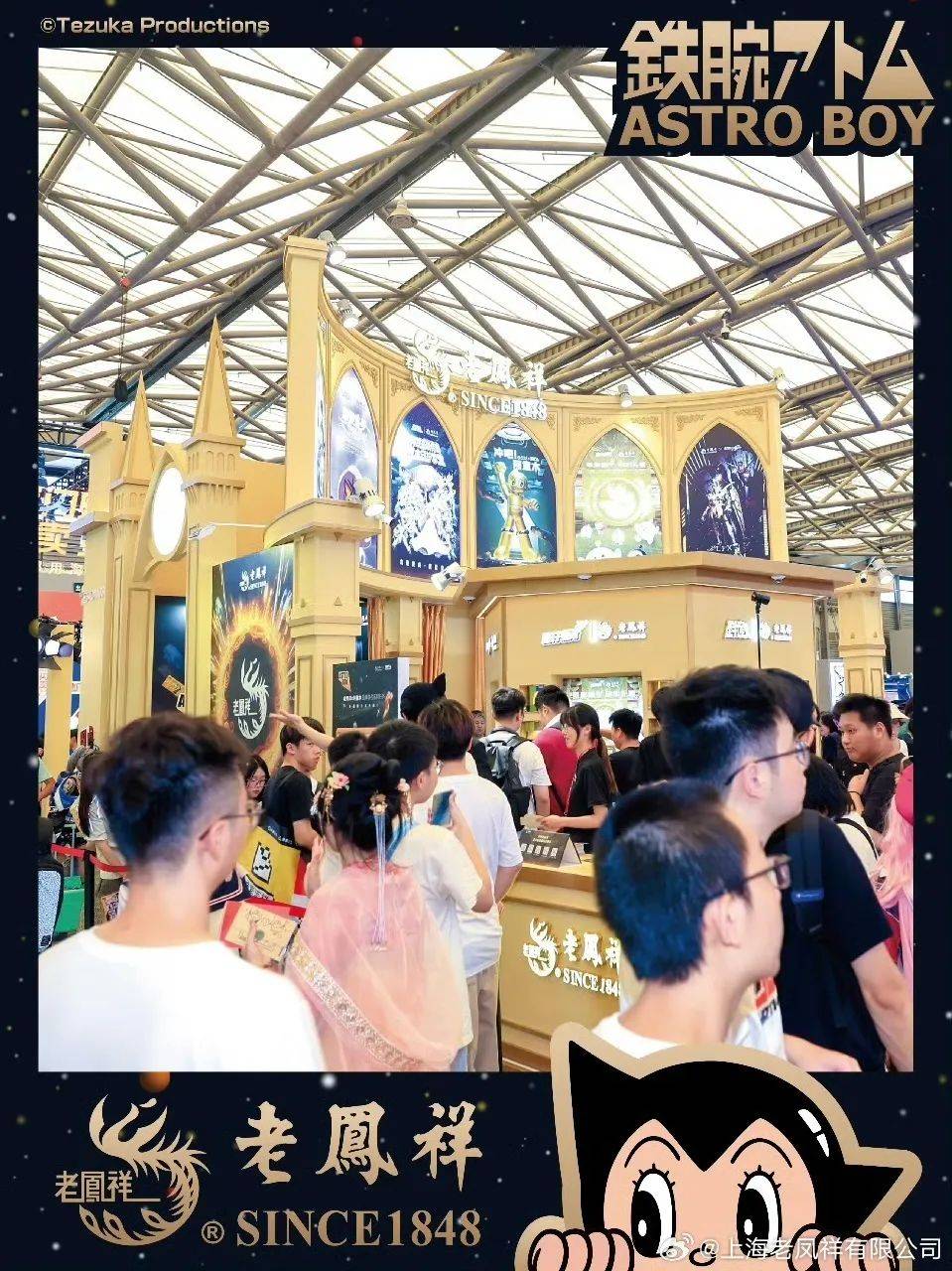
从“等客来”到“追客去”!老凤祥“披甲”冲向Z世代
Sou Hu Cai Jing· 2025-08-05 06:02
Core Insights - The traditional gold jewelry industry in China is undergoing a transformation, as brands like Lao Feng Xiang and Chow Tai Fook actively engage with younger consumers through cultural events and collaborations with popular IPs [4][8][12] Group 1: Industry Challenges and Responses - The gold jewelry consumption in China has seen a significant decline, with a 26% year-on-year drop in the first half of the year, totaling 199.826 tons [4] - The shift in consumer behavior indicates that gold is increasingly viewed as a "social currency" for self-expression rather than merely a symbol of wealth or a wedding necessity [5][16] - Brands are now prioritizing cultural engagement over traditional retail strategies, moving from relying on geographic foot traffic to creating targeted cultural experiences [8] Group 2: Strategic Use of IPs - Brands are carefully selecting IPs to resonate with different consumer segments, with Lao Feng Xiang leveraging nostalgic symbols like "Saint Seiya" and "Astro Boy" while also appealing to Gen Z with trending IPs like "Honkai: Star Rail" [12] - Chow Tai Fook employs a similar strategy, targeting hardcore gamers with "Black Myth: Wukong" and attracting young women with the Chiikawa brand, showcasing a layered approach to market segmentation [12] - Pricing strategies reflect this segmentation, with high-end products like a 666-gram gold figurine and more accessible items like lightweight gold cards, aiming to balance brand prestige with market reach [12] Group 3: Future Considerations - The challenge remains whether the excitement generated by cultural engagement can translate into actual sales, as the price point of gold jewelry is significantly higher than typical merchandise [13] - Brands must also consider how to strengthen their identity while collaborating with popular IPs, ensuring they do not become mere manufacturers for these brands [15] - The value of gold must evolve from a focus on material worth to encompass the cultural and emotional narratives it represents in contemporary society [16]
黄金珠宝行业深度 - 黄金是黄金,珠宝是珠宝
2025-08-05 03:16
Summary of Key Points from the Conference Call Industry Overview - The conference call discusses the **gold and jewelry industry**, highlighting the differences between gold retail and jewelry brands [1][2][5]. Core Insights and Arguments - **Sales Performance**: Gold retail benefits from rising gold prices, leading to increased sales revenue, while gold jewelry sales volume has not significantly decreased, indicating a rise in sales revenue [1][2]. - **Business Model Differences**: Gold retail relies on the intrinsic value of gold, while jewelry depends on design, craftsmanship, and brand value. This leads to different investment motivations: gold jewelry is often purchased for value preservation, whereas jewelry is bought for aesthetic and status reasons [1][5]. - **Market Dynamics**: The recent rise in gold prices has a dual impact: it enhances long-term profitability for gold retail but may suppress short-term consumer demand as consumers adjust to new price levels [7][8]. - **Future Outlook**: The gold retail industry has a positive outlook due to a low base last year and a comprehensive recovery this year, presenting investment opportunities [8][9]. Important but Overlooked Content - **Supply Chain Structure**: The gold retail supply chain is well-defined, with brand owners earning licensing fees while dealers bear the costs of store operations and inventory, resulting in low risk for brand owners [4][14]. - **Valuation and Growth Potential**: Brands like **Chao Hong Ji** have room for expansion with only 1,500 stores currently, justifying their higher valuations compared to competitors [12][13]. - **Dividend Policies**: Gold retail companies typically have high dividend payout ratios, often between 70% to 90%, making them attractive to investors [14][15]. - **Brand Strengthening**: **Lao Pu Gold** has significantly improved its brand presence, entering high-end markets and potentially achieving growth rates of 150% to 250% in 2025, despite a conservative valuation [16][17]. - **Investment Recommendations**: The call recommends investing in **Lao Pu Gold**, **Zhou Dafu**, **Lao Feng Xiang**, and others, as they are expected to perform well in a fluctuating gold price environment [18].
美国非农数据大幅下滑,降息预期大增,机构看好中长期黄金上行空间
Xuan Gu Bao· 2025-08-03 23:27
Group 1 - Gold futures prices on the COMEX rose by 2.01% on August 1, with Shanghai gold futures increasing by 1.33% on the night of August 2 [1] - The U.S. unemployment rate increased by 0.1 percentage points to 4.2% in July, with significant downward revisions of 258,000 jobs for May and June combined, leading to a rise in market expectations for a rate cut in September from 40% to 82% [1] - Financial analysts predict that a weak non-farm payroll report in October 2024 may lead the Federal Reserve to initiate rate cuts in November, with ongoing inflation pressures and stimulus policies expected to continue until the mid-term elections in 2026 [1] Group 2 - Young consumers aged 18 to 34 account for over one-third of gold jewelry sales, driving innovation in the market [2] - Major gold jewelry brands are innovating in design, materials, and collaborations to better meet the preferences of younger consumers, with notable partnerships such as Chow Tai Fook's Chiikawa collection and Lao Feng Xiang's Saint Seiya series [2] - Key companies in the gold jewelry sector include Lao Feng Xiang, Chao Hong Ji, and Cai Bai Co., which are adapting to the changing consumer landscape [2]

8月2日主要金店黄金报价:周大福为998元/克,中国黄金为969元/克
Jin Rong Jie· 2025-08-02 02:13
Group 1 - As of August 2, international gold prices are reported at $3362.5 per ounce, while international palladium is at $1209.9 per ounce, and international silver is at $37.0 per ounce [1] - Domestic gold prices are quoted at 776.2 yuan per gram [1] - Major domestic gold retailers have varying prices, with Chow Tai Fook at the highest price of 998 yuan per gram and China Gold at the lowest price of 969 yuan per gram [1] Group 2 - Other domestic gold prices include: Chow Sang Sang at 995 yuan per gram, Luk Fook Jewelry at 998 yuan per gram, and Xie Ruilin at 998 yuan per gram [1] - Jin Zun at 998 yuan per gram, Chao Hong Ji at 998 yuan per gram, and Cai Bai Jewelry at 975 yuan per gram [1] - Lao Miao Gold at 994 yuan per gram, Lao Feng Xiang at 996 yuan per gram, and Zhou Liu Fu at 978 yuan per gram [1]

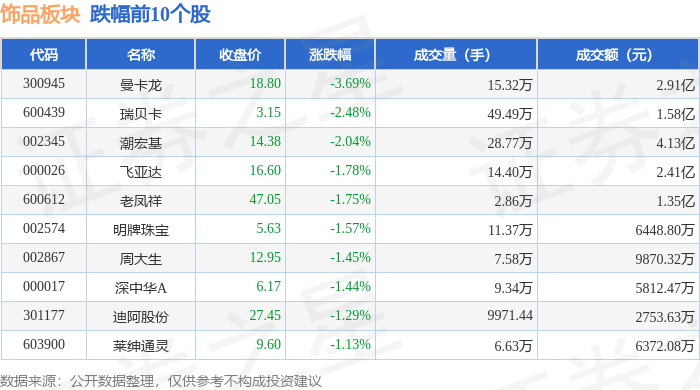
饰品板块7月31日跌1.46%,曼卡龙领跌,主力资金净流出1.75亿元
Zheng Xing Xing Ye Ri Bao· 2025-07-31 08:37
Market Overview - The jewelry sector experienced a decline of 1.46% on July 31, with Mankalon leading the drop [1] - The Shanghai Composite Index closed at 3573.21, down 1.18%, while the Shenzhen Component Index closed at 11009.77, down 1.73% [1] Individual Stock Performance - Mankalon (300945) closed at 18.80, down 3.69% with a trading volume of 153,200 shares and a turnover of 291 million yuan [1] - Rebecca (600439) closed at 3.15, down 2.48% with a trading volume of 494,900 shares and a turnover of 158 million yuan [1] - Chao Hong Ji (002345) closed at 14.38, down 2.04% with a trading volume of 287,700 shares and a turnover of 41.3 million yuan [1] - Fei Ya Da (000026) closed at 16.60, down 1.78% with a trading volume of 144,000 shares and a turnover of 241 million yuan [1] - Lao Feng Xiang (600612) closed at 47.05, down 1.75% with a trading volume of 28,600 shares and a turnover of 13.5 million yuan [1] - Ming Pai Jewelry (002574) closed at 5.63, down 1.57% with a trading volume of 113,700 shares and a turnover of 64.5 million yuan [1] - Zhou Da Sheng (002867) closed at 12.95, down 1.45% with a trading volume of 75,800 shares and a turnover of 98.7 million yuan [1] - Shen Zhong Hua A (000017) closed at 6.17, down 1.44% with a trading volume of 93,400 shares and a turnover of 58.1 million yuan [1] - Di A Co., Ltd. (301177) closed at 27.45, down 1.29% with a trading volume of 99,700 shares and a turnover of 27.5 million yuan [1] - Xing Xi Tong Ling (603900) closed at 9.60, down 1.13% with a trading volume of 66,300 shares and a turnover of 63.7 million yuan [1] Capital Flow Analysis - The jewelry sector saw a net outflow of 175 million yuan from institutional investors, while retail investors had a net inflow of 170 million yuan [1] - The table shows the capital flow for individual stocks, indicating varying levels of net inflow and outflow among different companies [2] - For instance, China Gold (600916) experienced a net outflow of 25.41 million yuan from institutional investors, while Xinhua Tin (600735) had a net inflow of 7.27 million yuan [2] - Chao Hong Ji (002345) had a net inflow of 5.83 million yuan from retail investors despite a net outflow from institutional and speculative investors [2]


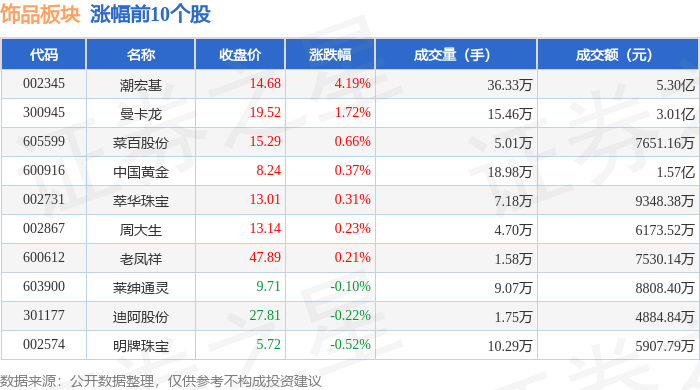
饰品板块7月30日跌0.02%,飞亚达领跌,主力资金净流出1.46亿元
Zheng Xing Xing Ye Ri Bao· 2025-07-30 08:26
证券之星消息,7月30日饰品板块较上一交易日下跌0.02%,飞亚达领跌。当日上证指数报收于3615.72, 上涨0.17%。深证成指报收于11203.03,下跌0.77%。饰品板块个股涨跌见下表: | 代码 | 名称 | 收盘价 | 涨跌幅 | 成交量(手) | 成交额(元) | | | --- | --- | --- | --- | --- | --- | --- | | 002345 | 潮宏基 | 14.68 | 4.19% | 36.33万 | | 5.30亿 | | 300945 | 曼卡龙 | 19.52 | 1.72% | 15.46万 | | 3.01亿 | | 665509 | 菜直股份 | 15.29 | 0.66% | 5.01万 | 7651.16万 | | | 600916 | 中国黄金 | 8.24 | 0.37% | 18.98万 | | 1.57亿 | | 002731 | 幸华珠宝 | 13.01 | 0.31% | 7.18万 | 9348.38万 | | | 002867 | 周大生 | 13.14 | 0.23% | 4.70万 | 6173.52万 | | | 600 ...