Haitong Securities(600837)

Search documents
2025金麒麟年度最佳券商APP运营奖:国泰海通证券、国信证券、中金财富证券等荣获殊荣
Xin Lang Zheng Quan· 2026-01-15 09:43
同时,会议隆重揭晓了2025金麒麟最佳财富管理机构荣誉。 2026年1月15日,"2026全球与中国资本市场展望论坛暨金麒麟最佳财富管理机构、最佳投资顾问盛 典"举办,论坛邀请了多位顶尖专家与思想领袖,他们从宏观生态、市场策略与投资展望等多个维度, 为我们勾勒2026年的前景蓝图。 责任编辑:宋雅芳 专题:第二届新浪财经金麒麟最佳投资顾问荣誉 新浪财经2025金麒麟·年度最佳券商APP运营奖荣誉榜如下: ...


国泰海通证券:2026年中国出口有望实现中低增速正增长
Ge Long Hui· 2026-01-15 06:01
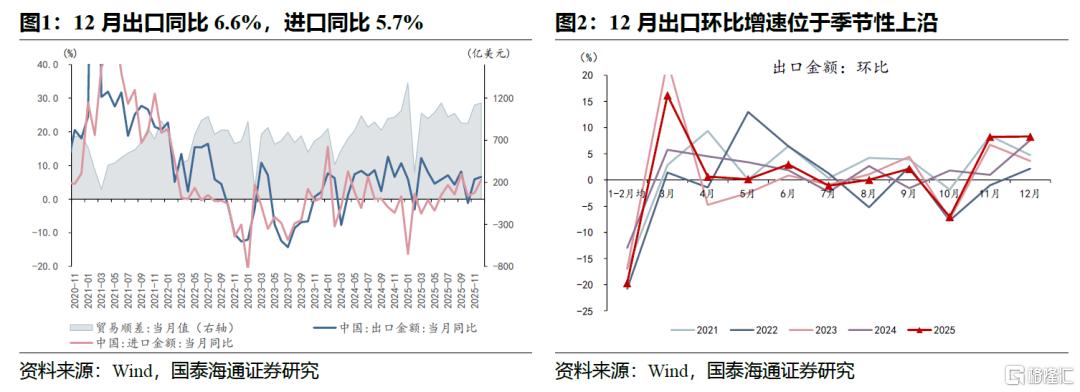
Core Viewpoint - The export data for December demonstrates the resilience of Chinese exporters in expanding new orders in non-US and non-transshipment markets, alongside strong momentum in capital goods exports. Despite a high base effect from export surges in December 2024, the export growth remains robust, leading Guotai Junan Securities to adopt a more optimistic outlook for exports in 2026 [1][18]. Group 1: Export Growth - In December 2025, China's export growth in USD terms was 6.6%, up from 5.9% previously, while import growth was 5.7%, up from 1.9% [6][18]. - The trade surplus for December increased slightly to $114.1 billion, compared to $111.6 billion previously [6][18]. - Month-on-month, December exports grew by 8.3% compared to November, slightly above the 7.6% growth in December 2024 and significantly higher than the seasonal average of 3.5% from 2021 to 2023 [6][18]. Group 2: Export Dynamics by Region - By country, exports to the US decreased by 30.0% (previously -28.6%), while exports to ASEAN increased by 11.1% (previously +8.2%), and to Latin America by 9.8% (previously +14.9%) [11]. - Other regions saw a growth of 13.7% (previously +12.9%), with the BRICS countries showing a notable increase of 12.0% (previously +4.1%) [11]. - The strong growth in non-US and non-transshipment exports confirms the resilience of genuine incremental orders amid the ongoing trade tensions with the US [11]. Group 3: Product-Level Insights - The strong performance in exports continues in the machinery and electronics sectors, with significant growth in automotive exports, a recovery in electronics, and resilience in equipment [14][20]. - Labor-intensive and real estate-related sectors remain weak, indicating a shift in export dynamics [14][20]. - The overall structure of exports is improving, with a focus on high-tech products and capital goods, reflecting a shift towards more resilient and diversified export sources [20]. Group 4: Future Outlook - The export landscape is transitioning from a focus on external demand to structural factors, with non-US and non-transshipment markets becoming stable sources of incremental growth [3][20]. - Guotai Junan Securities projects that China's exports may achieve moderate growth in 2026, characterized by a "moderate total, better structure, and sustained resilience" [3][20]. - Short-term forecasts indicate a potential decline in export growth in January due to high base effects from December 2024, with trade surplus contributions to growth expected to weaken [20].

石基信息:接受国泰海通证券等投资者调研

Mei Ri Jing Ji Xin Wen· 2026-01-14 12:10
(记者 曾健辉) 每经头条(nbdtoutiao)——海利生物增值9倍并购的企业,估值8个月"腰斩",其第一大客户竟是尚未 成立的公司,离奇的事还不少…… 每经AI快讯,石基信息发布公告称,2026年1月14日,石基信息接受国泰海通证券等投资者调研,公司 董秘、副总裁罗芳;证券部何龙光参与接待,并回答了投资者提出的问题。 ...
国泰海通·联合电话会|GEO营销革命·今晚20:00
国泰海通证券研究· 2026-01-14 09:55
国泰海通多行业联合系列电话会 2026年1月14日 晚20:00 主持人: 研究首席分析师 主讲人: 方奕-国泰海通策略研究首席分析师 杨林-国泰海通计算机研究首席分析师 舒迪-国泰海通电子研究首席分析师 秦和平-国泰海通海外科技研究首席分析师 陈筱-国泰海通传媒研究首席分析师 訾猛-国泰海通所长助理、消费组长、食品饮料/美妆 本订阅号所载内容仅面向国泰海通证券研究服务签约客户。因本资料暂时无法设置访问限制,根据《证 券期货投资者适当性管理办法》的要求,若您并非国泰海通证券研究服务签约客户,为保证服务质量、 控制投资风险,还请取消关注,请勿订阅、接收或使用本订阅号中的任何信息。我们对由此给您造成的 不便表示诚挚歉意,非常感谢您的理解与配合!如有任何疑问,敬请按照文末联系方式与我们联系。 法律声明 更多国泰海通研究和服务 亦可联系对口销售获取 重要提醒 本公众订阅号(微信号 GTHT RESEARCH )为国泰海通证券股份有限公司(以下简称"国泰海通证券") 研 ...

国泰海通证券股份有限公司关于适用简化程序召开“欧22转债”2026年第一次债券持有人会议的通知
Zhong Guo Zheng Quan Bao - Zhong Zheng Wang· 2026-01-14 00:36
欧派家居集团股份有限公司可转换公司债券持有人: 欧派家居集团股份有限公司(以下简称"欧派家居"、"公司"或"发行人")于2022年8月公开发行面值总 额200,000,000.00元可转换公司债券(以下简称"欧22转债")。基于发展战略规划、募投项目建设进展 及当前市场环境的综合研判,公司经审慎评估后拟变更募投项目、调整相关募投项目资产用途,预计不 会对公司偿债能力和债券持有人权益保护造成重大不利影响。 根据《可转换公司债券管理办法》《公司债券发行与交易管理办法》《欧派家居集团股份有限公司公开 发行可转换公司债券募集说明书》《欧派家居集团股份有限公司公开发行可转换公司债券之债券持有人 会议规则》,公司本次变更募投项目、调整相关募投项目资产用途事项适用以简化程序召开债券持有人 会议,国泰海通证券股份有限公司(以下简称"国泰海通")作为"欧22转债"的债券受托管理人,现拟于 2026年1月15日至2026年1月21日召开适用简化程序的"欧22转债"2026年第一次债券持有人会议,现将有 关事项通知如下: 一、债券基本情况 4、债券利率:第一年为0.30%、第二年为0.50%、第三年为1.00%、第四年为1.50% ...
国泰海通|食饮:渠道变革,精酿崛起——啤酒行业专题报告
国泰海通证券研究· 2026-01-13 13:20
Core Insights - The article highlights the transformation in beer demand, indicating that the domestic craft beer market has significant growth potential, with leading breweries likely to benefit from this trend [1][2] - The new retail model is expected to facilitate regional breweries in overcoming market disadvantages and breaking through sales ceilings for individual products [1] - The beer industry may have entered a new normal of stock competition, emphasizing the importance of category and channel changes as structural opportunities [1] Category Insights - The rise of craft beer is seen as a major opportunity driven by generational shifts in consumer preferences, with the current penetration rate of craft beer in China estimated at around 3%, compared to 5-15% in developed countries [2] - The craft beer market is expected to experience limited concentration in the medium term, with supply chains and budget markets gravitating towards leading brands, while flavor innovation and niche markets may still be dominated by smaller brands [2] - Major breweries are positioned to fully capitalize on the craft beer trend, as there are no strict regulations in China regarding the scale and independence of craft breweries, allowing larger companies to compete effectively [2] Channel Insights - The new retail channels for beer have grown rapidly, driven by consumer demands for convenience, rationality, and differentiation, with the current sales volume in new retail channels estimated at approximately 30 billion yuan and a penetration rate of about 6% [3] - New retail is expected to accelerate channel equality, diminishing the traditional advantages of leading breweries and enabling regional breweries to expand in weaker markets [3] - Despite the rise of new channels, established brands, especially in the mid-to-high-end beer segment, still hold significant competitive advantages due to brand recognition, quality control, and scale effects [3] Investment Recommendations - The short-term outlook for the beer industry is under pressure, but there are opportunities for growth through category innovation and channel transformation [3] - It is recommended to increase holdings in strong regional breweries that can enhance market share and exhibit robust earnings elasticity, as well as in industry leaders with ongoing premiumization, stable performance, and attractive dividend yields [3]

国泰海通研究 · 诚聘英才!
国泰海通证券研究· 2026-01-13 13:20
岗位职责 任职要求 应聘方式 简历投递邮箱: liumengyi@gtht.com 邮件主题及附件简历名称: 姓名 - 研究方向 - 现任职单位 - 毕业院校 欢迎应聘或转发给您身边感兴趣的朋友 关注"国泰海通证券招聘"微信公众号 分析师 丨研究所 工作地点: 上海、北京、深圳 研究方向 策略研究、宏观研究、固定收益研究、基金评价与研究、金融工程研究、中小盘研究、建筑工程 研究、交通运输研究、公用事业研究、美妆研究、纺织服装研究、家电研究、农林牧渔研究、批 零社服研究、造纸轻工研究、机械研究、汽车研究、传播文化研究、海外科技研究、计算机研 究、通信研究、生物医药研究、非银行金融研究、银行研究 随时获得更多招聘信息 1、跟踪所负责行业的发展动态,进行产业链及上市公司研究; 2、撰写行业及公司研究报告,为客户提供深度研究支持; 3、参与上市公司调研、机构路演及投资者交流活动; 4、协助团队首席分析师完成专题研究、数据分析及投研支持工作; 5、不断拓展研究覆盖深度与广度,提升研究影响力与客户服务质量。 1、硕士及以上学历,金融、经济、理工类等相关专业优先; 2、具备较强的逻辑分析能力、数据处理能力和文字表达能力; ...

国泰海通|固收:长债供给放量,需要担忧资金收敛吗——一季度银行间资金和存单展望
国泰海通证券研究· 2026-01-13 13:20
Core Viewpoint - The article discusses the outlook for interbank funding and bond supply in the first quarter of 2026, emphasizing that concerns over long-term bond supply do not contradict the continuation of loose funding conditions, with the central bank likely maintaining low interest rates [1][2][3]. Group 1: Funding Conditions - The continuation of loose funding conditions and concerns over long-term bond supply are not contradictory; the current issue is not a lack of liquidity but rather insufficient demand for long-term bonds from institutions [1]. - The central bank's willingness to support interbank funding is crucial; despite seasonal factors and government bond issuance, the central bank's ability to smooth funding fluctuations is expected to remain strong [2][3]. Group 2: Monetary Policy Framework - Since the second half of 2024, the central bank has been iterating its monetary policy framework to enhance liquidity management, which is expected to lead to a stable and relatively loose funding environment in early 2026 [3]. - The central bank may employ various tools, such as large-scale MLF operations or adjustments in reserve requirements, to manage liquidity effectively [3]. Group 3: Deposit Rates and Market Reactions - The article predicts that the central bank's actions will lead to a decline in deposit rates, with a significant portion of fixed-term deposits maturing in the first quarter of 2026, which could further lower rates [3]. - The one-year deposit rate is expected to stabilize around 1.60-1.65%, with a downward trend anticipated as favorable factors emerge [3].

国泰海通证券:中国航天发射创新高 军工市场迎发展新机遇
Xin Lang Cai Jing· 2026-01-13 08:58
Core Viewpoint - The military industry is poised for long-term growth due to recent global developments, including China's record space launches and the U.S. plans to significantly increase military spending, alongside the intensifying geopolitical competition among major powers [1][7]. Group 1: China's Aerospace Achievements - In 2025, China achieved a record of 92 space launches, sending over 300 satellites into orbit, marking a qualitative leap in both launch frequency and satellite deployment [2][8]. - Significant milestones include the Shenzhou 20 mission with a crew duration record of 204 days, the Shenzhou 21's rapid docking record of 3.5 hours, and the successful execution of a 16-day emergency launch protocol [2][8]. - Looking ahead to 2026, China plans to initiate various tests for its manned lunar landing project and the Chang'e 7 mission to search for water ice on the Moon [2][8]. Group 2: Global Military Dynamics - The U.S. military budget is proposed to increase from $1 trillion to $1.5 trillion for the fiscal year 2027, aimed at creating a "dream army" to address current global threats [3][9]. - The Pentagon plans to significantly boost the production of the "Patriot" missile system, increasing the annual output of the PAC-3 MSE missiles from approximately 600 to 2000 units [3][9]. - The U.S. Air Force has selected Northrop Grumman's new autonomous drone, "Reaper," as a leading candidate for collaborative combat aircraft projects [3][9]. Group 3: Military Sector Performance - The military sector showed strong performance in the week of January 5-9, 2026, with the defense and military index rising by 14.56%, outperforming the broader market by 10.74 percentage points [5][11]. - Notable stock performances include Galaxy Electronics (up 60.96%), Nanjing Panda (up 49.10%), and Zhenlei Technology (up 48.18%) [5][11]. - A significant breakthrough in domestic military technology was achieved with the successful first flight of the LQ-150 drone, which features a low-cost, multi-purpose flight control system [5][11]. Group 4: Investment Recommendations - The military sector is expected to accelerate its development during the 14th Five-Year Plan, with a focus on enhancing capabilities in aerospace and satellite internet [6][12]. - Key investment areas include assembly sectors like AVIC Shenyang Aircraft, component sectors like AVIC Optoelectronics, subsystem sectors like Aero Engine Corporation of China, and materials processing sectors like AVIC High-Tech [6][12].
IPO承销保荐费格局生变
Jing Ji Wang· 2026-01-13 06:36
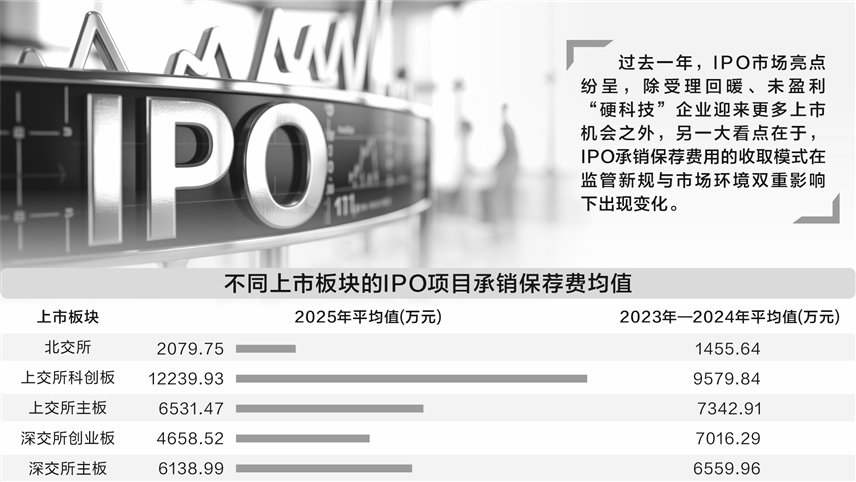
Core Insights - The IPO market is experiencing significant changes in underwriting and advisory fee structures due to new regulations and market conditions, with a notable shift from the previously dominant tiered fee model to a mixed fee model that includes fixed rates and minimum or maximum fee clauses [4][5] Fee Structures - The tiered fee model, which was prevalent in 2023 with 38% of cases, has drastically decreased to 6% by 2025, with most remaining cases adopting a decreasing fee percentage [3][4] - The traditional model of "actual fundraising amount × fixed rate" is now used by 33% of IPOs in 2025, with underwriting fees typically ranging from 5% to 9% [4] - A new model combining fixed rates with limit conditions has gained traction, with 49% of IPOs in 2025 utilizing this approach, up from 25% in 2023, primarily due to changing fundraising expectations [5] - The "one-price" fee model has been adopted by 12% of IPOs in 2025, focusing on direct pricing for online offerings [5] Market Trends - The average underwriting fee for the Sci-Tech Innovation Board reached 1.22 billion yuan in 2025, a significant increase from the previous average of 957.98 million yuan [7] - Conversely, the average underwriting fees for the main board and the ChiNext board have decreased, with the main board averaging 65.31 million yuan and the ChiNext board at 46.58 million yuan, reflecting a decline of over 30% for the ChiNext board compared to previous years [7][8] - The Beijing Stock Exchange has seen a notable increase in IPO fees, with an average of 20.80 million yuan in 2025, up 43% from the previous average of 14.56 million yuan [8] Market Concentration - The IPO underwriting market continues to exhibit a "head effect," with a small number of securities firms capturing the majority of market share, as only 13 firms generated over 100 million yuan in IPO revenue in the past year [9] - CITIC Securities leads the market with nearly 1.1 billion yuan in underwriting fees, followed by CITIC Construction Investment and Guotai Junan, indicating a concentration of high-quality projects among top firms [9]