CMS(600999)

Search documents
招商证券:中报后业绩上修集中在医药、TMT和中高端制造等
Ge Long Hui· 2025-09-07 01:09
Group 1 - The core viewpoint of the report indicates that companies with upward revisions in earnings before and after the disclosure of mid-year performance are primarily concentrated in sectors such as pharmaceuticals (chemical preparations, medical R&D outsourcing, other biological products, raw materials), TMT (digital chip design, IT services III, vertical application software, communication network equipment and devices, gaming III, printed circuit boards, analog chip design), and high-end manufacturing (chassis and engine systems, other specialized equipment, energy and heavy equipment, aerospace equipment III, lithium batteries) [1] - Additional sectors identified with upward earnings revisions include securities, copper, pesticides, other chemical products, and thermal power [1]
招商证券:中报后业绩上修集中在医药、TMT 和中高端制造等
Xin Lang Cai Jing· 2025-09-07 00:57
Group 1 - The core viewpoint of the report indicates that companies with upward revisions in earnings before and after the disclosure of mid-year performance are primarily concentrated in specific sectors [1] Group 2 - The sectors with significant earnings upgrades include pharmaceuticals, particularly in chemical preparations, medical research outsourcing, other biological products, and raw materials [1] - The TMT sector shows notable performance improvements in areas such as digital chip design, IT services, vertical application software, communication network equipment and devices, gaming, printed circuit boards, and analog chip design [1] - High-end manufacturing also demonstrates upward earnings revisions, especially in chassis and engine systems, other specialized equipment, energy and heavy equipment, aerospace equipment, and lithium batteries [1] - Additional sectors experiencing earnings upgrades include securities, copper, pesticides, other chemical products, and thermal power [1]
招商证券:中报后业绩上修集中在医药、TMT 和中高端制造等 收入或利润创历史同期新高
智通财经网· 2025-09-07 00:41
Core Insights - The report from China Merchants Securities indicates that the upward revision of earnings is concentrated in the pharmaceutical, TMT (Technology, Media, and Telecommunications), and high-end manufacturing sectors [2][6] Group 1: Earnings Revision - As of August 31, 794 A-share listed companies have adjusted their 2025 earnings growth forecasts upward compared to July 15 [2] - The companies with revised earnings are primarily in the pharmaceutical sector (chemical preparations, medical R&D outsourcing, other biological products, raw materials) benefiting from innovative drug exports and accelerated business development [3] Group 2: Sector Performance - In TMT, sectors such as digital chip design, IT services, vertical application software, communication network devices, and gaming have seen earnings revisions due to unexpected capital expenditures in cloud services and accelerated domestic semiconductor substitution [3] - High-end manufacturing sectors, including chassis and engine systems, specialized equipment, energy and heavy equipment, and lithium batteries, are experiencing growth driven by increased penetration of new energy vehicles and domestic substitution of core components [3] Group 3: Historical Highs - Companies achieving historical highs in cumulative revenue for H1 2025 and Q2 2025 are concentrated in TMT (consumer electronics components, digital chip design) and high-end manufacturing (chassis and engine systems, automotive electronics) [4] - The sectors with historical highs in net profit for H1 2025 include TMT (consumer electronics components, digital chip design) and high-end manufacturing (chassis and engine systems, metal products) [5] Group 4: Investment Recommendations - The report recommends focusing on sectors with upward revisions and historical highs, particularly digital chip design, communication network devices, gaming, chassis and engine systems, specialized equipment, lithium batteries, and chemical preparations [6]
招商证券:弱非农催化美联储降息预期加码
智通财经网· 2025-09-06 01:57
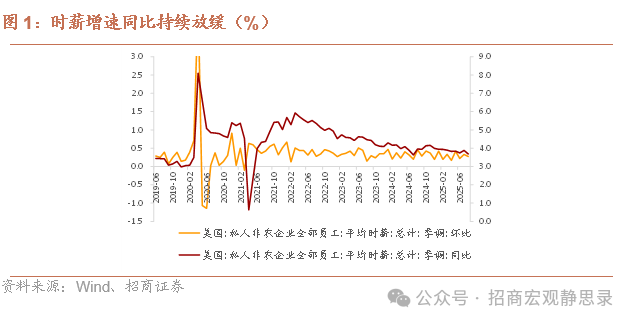
招商证券发布研报称,疲弱的8月非农就业数据(新增2.2万人,远低于预期)叠加失业率升至4.3%,巩固了市场对美联储将 于9月降息的预期,并引发了投资者对更激进降息步伐(如50个基点或连续降息)的押注。数据表明劳动力市场显著降温, 不仅新增就业疲软、前值大幅下修,且工作时长持平、时薪增速放缓。市场反应剧烈,美债收益率大幅下行、美元走弱, 同时经济降温的担忧也给美股带来了调整压力。 核心观点 在7月美国非农数据断层下调之后,8月非农新增数据再度大幅低于预期。由于本周中发布的JOLTS和ADP就业数据均表现疲 弱,且海外市场预计BLS将对非农基准修订数据大幅下修,本期数据发布前已基本确立美联储9月降息预期。数据发布后, 美债2年期收益率再度下行11BP左右,海外市场开始出现9月降息50BP或连续降息预期,美元指数走弱,经济基本面降温压 力带动美股调整。 具体来看:1)8月非农新增2.2万人,大幅低于市场所预期的7.5万人。前月数据再度下修,7月非农新增数据从初值的7.3万 人小幅调整至7.9万人,6月数据再度下修至-1.3万人,为2020年4月以来首度出现负值。 2)分行业来看,建筑业、制造业、商业服务和政府部门均 ...

上市券商 密集回应投资者关切
Shang Hai Zheng Quan Bao· 2025-09-06 01:18
Core Viewpoint - The overall performance of the securities industry has shown a recovery in the first half of the year, with major firms expressing optimism about sustaining this momentum into the second half [3][4]. Performance Overview - The 42 listed securities firms collectively achieved operating revenue of approximately 251.87 billion yuan, a year-on-year increase of over 10% [3]. - The net profit attributable to shareholders reached about 104.02 billion yuan, with a year-on-year growth rate of 65% [3]. - Several firms, including Shenwan Hongyuan and China Merchants Securities, indicated plans to capitalize on opportunities in the second half to maintain their growth trajectory [3]. Business Strategy - Wealth management, proprietary investment, and investment banking remain the core business lines, while digital transformation and international expansion are emerging as key focus areas [6]. - Firms are emphasizing a customer-centric approach in wealth management, with strategies to enhance service offerings [6]. - In proprietary investment, firms are adopting a conservative approach with a focus on absolute returns [6]. Investment Banking Focus - Smaller firms are concentrating on regional development and industry-specific strategies, with a focus on local economic initiatives [7]. - Digital transformation and internationalization are seen as essential for improving operational efficiency, with several firms planning to enhance their overseas financial services [7]. Dividend Plans - A total of 28 out of 42 listed firms plan to implement mid-term cash dividends, with a cumulative total of 18.80 billion yuan, reflecting a year-on-year increase of 39.8% [9]. - Notably, China CITIC Securities leads with a proposed cash dividend of 4.30 billion yuan [9]. - Companies are committed to maintaining stable and sustainable dividend policies to enhance investor confidence [10].



东宝生物: 招商证券股份有限公司关于包头东宝生物技术股份有限公司2025年半年度跟踪报告
Zheng Quan Zhi Xing· 2025-09-05 16:13
Group 1 - The company is under the sponsorship of China Merchants Securities Co., Ltd. for its operations and compliance [1] - The company has conducted regular reviews of its information disclosure documents and has established necessary regulations to prevent resource occupation by related parties [1][2] - The company reported a revenue of 369.06 million yuan, a decrease of 16.93% compared to the previous year, and a net profit attributable to shareholders of 36.97 million yuan, down 28.00% year-on-year [2][3] Group 2 - The company has held two shareholder meetings and two board meetings, reviewing all relevant documents [1] - The company has conducted one on-site inspection, and the report was submitted according to regulations [1] - The company has committed to fulfilling promises regarding competition, related transactions, and fund occupation, with no reported issues [2][3]
新时达:接受招商证券等投资者调研

Mei Ri Jing Ji Xin Wen· 2025-09-05 13:33
Group 1 - The company Xinshi Da (SZ 002527) announced that it will accept investor research from September 2 to September 5, 2025, with participation from the company’s board secretary and deputy general manager Liu Jing [1] - For the first half of 2025, Xinshi Da's revenue composition is 100% from the industrial sector [1] - As of the report date, Xinshi Da has a market capitalization of 10.8 billion yuan [1] Group 2 - The article discusses the challenges faced by Haidilao, noting that its sub-brands have a survival rate of less than 50% [1]
调研速递|上海新时达电气接受招商证券等14家机构调研,聚焦具身智能与业务协同要点
Xin Lang Cai Jing· 2025-09-05 13:33
Core Viewpoint - Shanghai New Times Electric Co., Ltd. has attracted significant attention from the capital market due to its business layout and development prospects, as evidenced by multiple institutional research activities [1] Group 1: Investor Relations Activities - The company held investor relations activities including specific object research and communication meetings with various securities firms [1] - The meetings took place on September 2, September 4, and September 5, 2025, with participation from 14 institutions including major securities and investment firms [1] - Key personnel from the company included the board secretary and the deputy general manager [1] Group 2: Key Discussion Points - Haier's Empowerment: The company has leveraged 30 years of control technology to achieve horizontal iteration in specialized control and expand into general control, aligning with AI applications [2] - Intelligent Welding Solution: The company plans to launch an intelligent welding solution in September 2025, applicable across multiple industries, particularly in shipbuilding [2] - Humanoid Robot Development: The company aims to introduce a humanoid general controller and complete machine by the end of 2025, focusing on customizable development and modular design [2] - Semiconductor Robotics: After three years of investment, the company has developed a leading domestic semiconductor wafer transfer robot, which is now in mass production for chip simulation [2] - Industry Competition: New Times Electric operates within the digital economy sector under Haier Group, focusing on foundational products and control, which can support solution-oriented businesses and facilitate data collaboration [2]
市场回暖,券商财富管理业务迎丰收!
券商中国· 2025-09-05 13:25
Core Viewpoint - The stock market recovery has led to a significant increase in the wealth management business of brokerage firms, with notable growth in both brokerage fees and financial product distribution revenues [1][2]. Brokerage Business Performance - In the first half of the year, the securities industry achieved a net income of 78.95 billion yuan from brokerage fees, a substantial increase from 60.36 billion yuan in the same period last year, representing a growth of over 30% [2][4]. - The average daily trading volume for stocks and funds reached 1.61 trillion yuan, a year-on-year increase of 63.87%, while the Hong Kong stock market saw an average daily turnover of 240.2 billion HKD, up 117.61% [4]. - The top ten brokerage firms by net income from brokerage fees included CITIC Securities, Guotai Junan, and GF Securities, with CITIC Securities leading at 6.40 billion yuan [4]. New Account Growth - Many brokerage firms reported a rapid increase in new account openings during this market rally. Guotai Junan noted a 4.2% increase in domestic personal accounts, reaching 38.45 million, with high-net-worth clients growing by 6.8% [5]. - The average monthly active users for Guotai Junan's apps increased by 9.6%, while the client assets under custody for Guoxin Securities exceeded 2.6 trillion yuan, a 7.5% increase [5]. Financial Product Distribution - The revenue from financial product distribution among 42 listed brokerage firms totaled 5.57 billion yuan in the first half of the year, marking a year-on-year growth of 32.09% [7]. - Smaller brokerage firms outperformed larger ones in terms of growth rates, with Nanjing Securities and Guolian Minsheng leading with increases of 191.28% and 135.08%, respectively [7]. AI Integration in Wealth Management - The integration of AI into wealth management has become a key focus for brokerage firms. Guotai Junan has implemented an "all in AI" strategy, enhancing service efficiency and driving growth in both traditional brokerage and financial product distribution [11]. - Huatai Securities reported a significant increase in the number of financial products offered, with a total of 14,433 products and a sales scale of 304.57 billion yuan [11]. - The use of AI technology is expected to reshape the wealth management landscape, with firms like Huatai and招商证券 actively enhancing their digital platforms and client service capabilities [12].



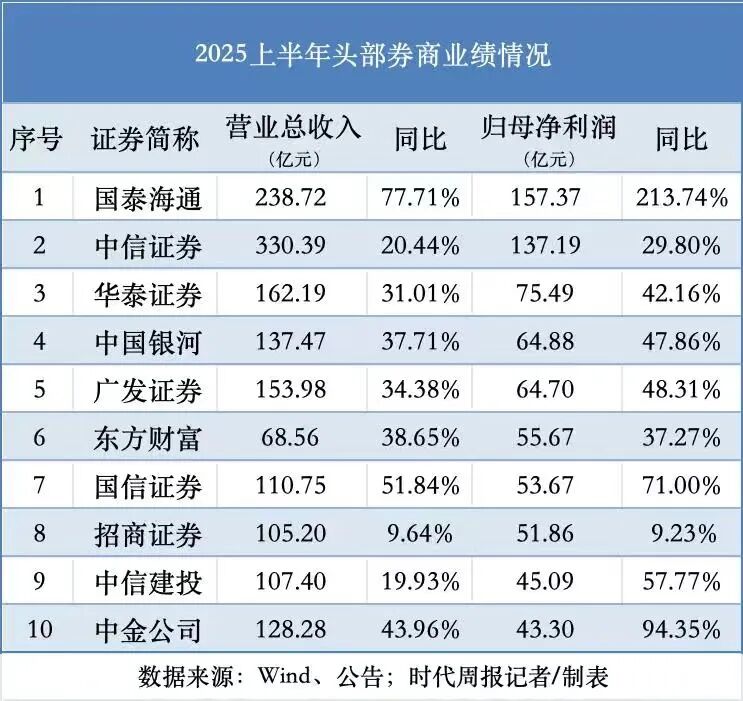
10家头部券商赚749亿,中信证券丢第一,境外业务哪家强?中金仍未超中信
3 6 Ke· 2025-09-05 13:14
Core Insights - The performance of listed securities firms in the first half of 2025 showed significant growth, with all 50 firms reporting an increase in net profit, marking the first time since 2022 that no firm reported a loss [1][2] - Major mergers and acquisitions in the industry have contributed to this growth, with firms like Guotai Junan and Haitong Securities achieving substantial results post-merger [1] - The competitive landscape among top firms has intensified, particularly with the merger of Shanghai-based firms [1] Group 1: Financial Performance - The top 10 securities firms reported a combined revenue of 154.3 billion yuan, a year-on-year increase of 14.89%, and a net profit of 74.9 billion yuan, up 60.52% [2][3] - Guotai Junan led the industry with a net profit of 15.74 billion yuan, a staggering increase of 213.74%, driven by negative goodwill from its merger with Haitong Securities [3][4] - Other notable performers included CITIC Securities with a net profit of 13.72 billion yuan (up 29.80%) and Huatai Securities with 7.55 billion yuan (up 42.16%) [3][4] Group 2: Business Segments - The self-operated business of the top 10 firms saw a significant increase, with total income reaching 71.07 billion yuan, a year-on-year growth of 50.83% [5] - Brokerage business income rose to 36.71 billion yuan, up 47.13%, while investment banking income increased by 19.44% to 8.83 billion yuan [5] - Asset management income showed modest growth of 2.42%, totaling 14.95 billion yuan [5] Group 3: International Operations - The international operations of the top firms have become a key growth area, with significant expansions in Hong Kong and other markets [6][7] - The average daily trading volume in the Hong Kong stock market increased by 118% year-on-year, contributing to the growth of firms' international revenues [6] - Notably, Guoxin Hong Kong reported a net profit increase of over 1300%, highlighting the success of international strategies [7][8] Group 4: Competitive Landscape - The rankings among the top ten firms remained stable, with no new entrants or exits, indicating a solidified competitive structure [5] - The competition among top firms is fierce, particularly in the self-operated and brokerage segments, where firms are vying for market share [4][5] - The performance of international subsidiaries is also becoming a critical factor in overall competitiveness, with firms like CITIC Securities International leading in net profit [8][9]