
NJBK(601009)

Search documents
固收专题报告:信用赎回可控,把握波段机会
CAITONG SECURITIES· 2025-07-28 03:23
1. Report Industry Investment Rating - No information provided in the content 2. Core Views of the Report - Anti - involution policies affect commodity prices, shock the market's inflation expectations, and cause a significant adjustment in the bond market. Credit bond yields rise with interest rates, and most credit spreads widen, with secondary and perpetual (二永) bonds showing large fluctuations and high spread increases. Fund companies with the most unstable liability ends sell significantly, while insurance companies increase their buying efforts, and bank wealth management remains relatively stable. The trading enthusiasm for medium - and long - term bonds such as urban investment bonds, industrial bonds, and 二永 bonds remains high [2]. - It is too early to worry about negative feedback, with a very low probability. Market learning has improved the ability to respond, and there has been no change in macro - expectations. Moreover, bank wealth management's increasing consideration of liquidity in its configuration can prevent negative feedback [3]. - The asset shortage pattern remains unchanged and may even intensify. Interest rates may have short - term adjustments but do not support continuous and significant adjustments. Once interest rates stabilize, credit is likely to stabilize. After the market adjustment, it will be more difficult to further compress credit spreads compared to previous lows, and credit spreads are more likely to fluctuate. Investors need to seize phased trading opportunities [4]. - Investors should focus on coupon - bearing assets, and consider both coupon and trading operations for long - term bonds. For trading strategies, medium - and long - term 二永 bonds are recommended; for allocation strategies, sinking investment in urban investment bonds is still recommended. Wait for trading opportunities for ultra - long - term bonds [5]. 3. Summary by Relevant Catalogs 3.1 Market Review: Significant Correction, Noticeable Widening of 二永 Bond Spreads 3.1.1 Market Performance - This week, the credit bond market significantly corrected, and credit spreads widened. The stock market strengthened, and the bond market significantly corrected. Credit bond yields generally rose, especially for medium - and long - term 二永 bonds, which increased by over 10bp, with the 10Y 二永 bond correcting by up to 14.5bp. Most credit spreads widened, with 二永 bonds seeing more significant increases, while spreads of some medium - and long - term notes, enterprise bonds, and urban investment bonds of certain grades slightly narrowed [10]. - From a daily perspective, urban investment bond yields generally rose, with the adjustment amplitude first increasing and then decreasing, reaching a daily correction high on Thursday. From Monday to Tuesday, long - term 二永 bonds led the yield increase, but the overall amplitude was relatively small. From Wednesday to Thursday, the yield increase continued to expand, with long - term 二永 bonds correcting by over 5bp on Thursday and short - term bonds increasing by about 4bp. The long - and short - term yields of urban investment bonds and medium - term notes also increased by 3.5bp - 5bp. On Friday, the market continued to decline, but the amplitude narrowed. Credit spreads showed a divergent trend. Affected by the different adjustment speeds of credit bonds and interest - rate bonds, the spreads of 二永 bonds, known as "interest - rate amplifiers," generally widened, while the spreads of less - liquid urban investment bonds and medium - term notes were still slightly compressed in the early stage and widened on Friday [16]. 3.1.2 Insurance Continues to Allocate, Funds Sell on a Large Scale - Insurance companies' credit bond allocation remains strong. This week, insurance companies continued to be net buyers, with a net buying scale of 12.563 billion yuan, a 38.7% increase from the previous week. The net buying volume of ultra - long - term credit bonds over 5 years was 6.75 billion yuan, with the increase intensity remaining basically the same as last week [18]. - Funds sold credit bonds significantly this week, with a selling scale of 22.578 billion yuan. The net selling volume within 5Y was 12.738 billion yuan, and the net selling volume over 5Y was 7.474 billion yuan [18]. - Bank wealth management scale slightly increased. As of July 20, the bank wealth management scale was 31.02 trillion yuan, an increase of 0.06 trillion yuan from the previous weekend. This week, the net buying scales of wealth management and other product categories for credit bonds were 15.301 billion yuan and 13.078 billion yuan respectively, with month - on - month changes of 15.80% and 39.13% [21][22]. 3.1.3 Transaction Proportion: Decrease in Low - Rating Transaction Proportion - The transaction proportion of urban investment bonds, industrial bonds, and 二永 bonds with a remaining term of over 3 years was 30%, 29%, and 72% respectively, indicating that the transaction proportion of medium - and long - term bonds remained high. For urban investment bonds, the proportion of transactions under 3 years remained basically the same as last week, with the 3 - 5Y transaction proportion decreasing by 2 percentage points and the over - 5Y proportion increasing by 2 percentage points. For industrial bonds, the proportion of transactions within 1 year decreased by 1 percentage point, the 1 - 3Y proportion decreased by 2 percentage points, and the 3 - 5Y proportion increased by 3 percentage points. For 二永 bonds, the proportion of transactions within 1 year decreased by 1 percentage point, the 1 - 3Y proportion increased by 2 percentage points, and the 3 - 5Y proportion decreased by 3 percentage points [28]. - The proportion of low - rating transactions of non - financial credit bonds decreased this week. The proportion of transactions of urban investment bonds with a rating of AA(2) and below decreased by 1 percentage point from last week, the proportion of industrial bonds with a rating of AA and below decreased by 1 percentage point month - on - month, and the proportion of 二永 bonds with a rating of AA and below decreased by 3 percentage points from last week [29]. 3.2 Market Outlook: Redemption is Controllable, Seize Trading Opportunities 3.2.1 Redemption is Controllable, Seize Trading Opportunities - Reasons for market adjustment: With the continuous implementation of anti - involution policies, commodity futures prices have risen significantly, affecting the market's inflation expectations. The Nanhua Industrial Products Index, which reflects commodity price trends, has also risen significantly. Historically, this index has a certain forward - looking predictive effect on PPI. By observing the term structure of interest - rate swaps, indicators such as IRS FR007 5 - year - 1 - year and 1 - year - FR007 have quickly turned positive, indicating a change in the market's inflation expectations [31][33]. - Regarding the concern of negative feedback: It is too early to worry about negative feedback, with a very low probability. Market adjustments in September 2024 and March 2025 were more significant than the current one, but no obvious negative feedback occurred. The key lies in the increasing consideration of liquidity in bank wealth management's configuration. Since April this year, the absolute amount and proportion of inter - bank certificate of deposit (NCD) allocation have been at historically high levels, enabling wealth management to handle market fluctuations. As long as bank wealth management remains stable, the key link of market negative feedback can be stopped [38][40]. - Analysis of tight funds: The funding situation tightened on Thursday this week, leading to a higher market adjustment amplitude. The tightening on Thursday may be due to banks' liability - side issues. From the perspective of large banks' deposit - loan spreads, the deposit - loan spreads of large banks generally decline seasonally in July. After the significant reduction of deposit interest rates in May, large banks face the pressure of term - deposit maturity transfer, resulting in relatively large liability pressure. A low deposit - loan spread means reduced stability of funding rates, which are more dependent on the central bank's liquidity injection. Any daily misalignment in the central bank's liquidity injection can significantly impact funding rates [41][42]. - Future trends: The asset shortage pattern remains unchanged and may even intensify. Interest rates may have short - term adjustments, but the current macro - environment does not support continuous and significant interest - rate adjustments. The impact of anti - involution policies on inflation expectations has been fully priced in the short term through the significant rise in commodity prices. For credit bonds, it will be more difficult to further compress credit spreads below previous lows this year. Credit spreads are more likely to fluctuate, and investors need to seize phased small - band opportunities [50][56]. 3.2.2 Science and Technology Innovation Bonds Continue to Contribute Net Financing to the Market - In July, non - financial credit bond financing performed well, with the net financing exceeding the levels of the same month in the previous two years, reaching 347.9 billion yuan. The supply of long - term credit bonds has increased. Recently, the sentiment for extending the duration of credit bonds has been positive. Although the issuance duration in July has decreased month - on - month, there is still room for extending the duration [57][59]. 3.3 What to Buy in Credit? 3.3.1 Focus on High - Grade 二永 Bonds for Trading, Weak - Quality Urban Investment Bonds for Coupon - The price - comparison of short - term 二永 bonds is positive, while that of medium - and long - term 二永 bonds is negative. Considering different investor needs, high - grade trading strategies are recommended to focus on 二永 bonds, and low - grade coupon strategies are recommended to focus on urban investment bonds. This week, the price - comparison advantage of short - term AAA second - tier capital bonds over medium - term notes remained positive, and the price - comparison of long - term AAA second - tier capital bonds with medium - term notes fluctuated around 0. The price - comparison of short - term urban investment bonds with medium - term notes is positive, and the price - comparison of long - term low - grade urban investment bonds has quickly recovered to the historical central level. Urban investment bonds still have a price - comparison advantage over medium - term notes, but the difference is not significant. Considering the bond - selection scope, urban investment bonds are still preferred [62][64]. 3.3.2 General Credit Coupon is More Advantageous - Currently, the proportion of urban investment bonds with a valuation above 2.3% is 19.8%, that of non - financial industrial bonds is 10.8%, and that of 二永 bonds is 6.8%. From the perspective of coupon - based bond selection, general credit offers a wider bond - selection space. For urban investment bonds, investors can consider both coupon and trading operations for the long - term, and can continue to participate in short - term high - coupon varieties. For industrial bonds, investors can focus on important local state - owned real - estate enterprises among real - estate developers, such as Shoukai and Jianfa Real Estate; among non - real - estate entities, focus on China Minsheng Bank, Jizhong Energy, and Bohai Bank [68][72]. 3.3.3 Statistics of Primary Issuance - Relevant data shows the weekly net financing and cumulative net financing of various credit bonds, including urban investment bonds, industrial bonds, 二永 bonds, and other financial bonds from December 30, 2024, to July 27, 2025 [77]. 3.3.4 Details of Secondary Valuation Changes - No detailed information provided in the content






散装的江苏和“最强”城农商行军团
3 6 Ke· 2025-07-27 23:34
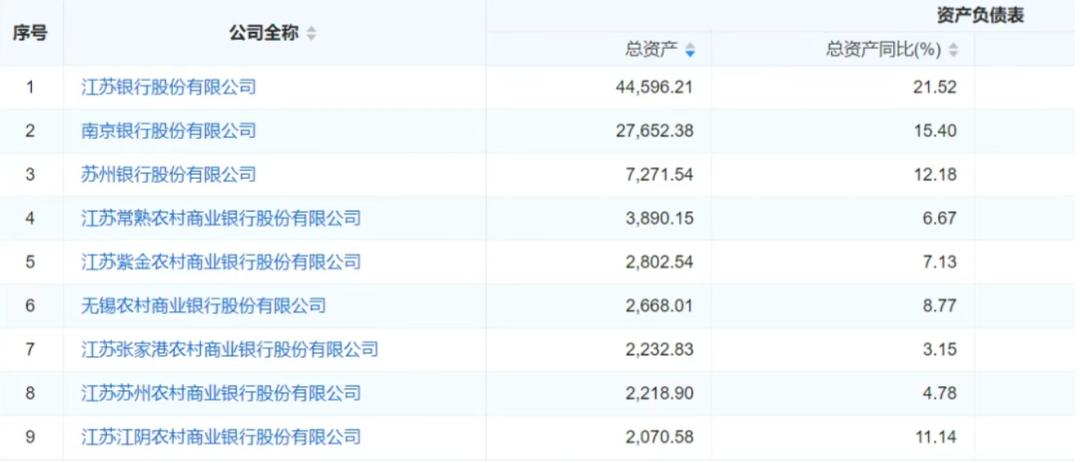
Core Insights - The financial sector in Jiangsu is experiencing intense competition, highlighted by the success of local banks during the "Soo Super" league, which has garnered significant public interest and engagement [1] - Jiangsu has the highest number of banks listed on A-shares in China, with nine banks demonstrating strong operational performance [1][4] Group 1: Performance of Jiangsu Banks - Among the 64 city and rural commercial banks in Jiangsu, 13 made it to the 2025 World Bank's top 1000 list, the highest in the country [1] - The three leading city commercial banks—Jiangsu Bank, Nanjing Bank, and Suzhou Bank—are all publicly listed and show strong growth metrics [2] - In 2024, Jiangsu Bank achieved a net profit of 31.843 billion, leading the profit rankings, while Nanjing Bank and Suzhou Bank reported net profits of 20.177 billion and 5.068 billion, respectively [7][18] Group 2: Financial Metrics - Jiangsu Bank's total assets reached 3952.042 billion, with a year-on-year growth of 16.12%, while Nanjing Bank and Suzhou Bank reported total assets of 2591.4 billion and 693.714 billion, respectively [9][21] - The revenue growth rates for 2024 were 8.78% for Jiangsu Bank, 11.32% for Nanjing Bank, and 3.01% for Suzhou Bank, indicating a competitive landscape [17][20] - The net profit growth rates for these banks were 10.76% for Jiangsu Bank, 9.05% for Nanjing Bank, and 10.16% for Suzhou Bank, all surpassing Jiangsu's GDP growth rate of 5.8% [7][9] Group 3: Market Position and Strategy - Jiangsu's banking sector benefits from a robust regional economy, with a GDP of 13.7 trillion and a diverse industrial base, fostering a strong demand for financial services [22][24] - The establishment of the Jiangsu Rural Commercial Bank aims to enhance the efficiency of the rural financial system and support the growth of small and medium-sized banks [14][16] - Local banks are focusing on differentiated strategies, with city banks emphasizing comprehensive services and rural banks targeting small and micro enterprises [23][24]




2Q25主动型公募基金持仓更分散,银行股持仓占比环比上升
Huachuang Securities· 2025-07-27 11:15
Investment Rating - The report maintains a "Buy" rating for the banking sector [1] Core Insights - The proportion of bank stocks held by active equity funds increased to 4.88% in Q2 2025, marking a 1.13 percentage point increase from the previous quarter, driven by both volume and price increases [2][3] - The banking sector's performance outpaced the broader market, with A-share banks rising by 11.23% in Q2 2025, outperforming the CSI 300 and Wind All A indices by 10.7 and 8.25 percentage points respectively [2] - The report highlights a significant increase in holdings of joint-stock banks and quality regional banks, with notable increases in positions for institutions like China Merchants Bank, Minsheng Bank, and others [2][3] Summary by Sections Fund Holdings - In Q2 2025, the number of bank stocks held by active funds reached 4.88%, the second highest since Q1 2021 [2] - The total number of bank shares held by active funds increased by 6.64 billion shares, reaching 48.17 billion shares [2] - The market capitalization of index funds holding bank stocks rose by 27.7% to 133.385 billion yuan, with an increase of 16.3 billion shares [3] Sector Performance - The active fund's allocation to bank stocks saw a quarter-on-quarter increase, although the sector still has the largest allocation gap among 31 sectors, with a shortfall of 7.8% [3] - The report notes that while state-owned banks saw a slight decrease in allocation, joint-stock and regional banks experienced significant increases due to improved fundamentals and lower valuations [2][3] Investment Recommendations - The report suggests a diversified investment strategy focusing on state-owned banks and stable joint-stock banks, recommending specific banks such as China Merchants Bank and CITIC Bank for their long-term investment value [8] - It emphasizes the importance of banks with high dividend yields and strong asset quality, indicating that these banks still offer absolute returns [8] - The report also highlights the potential for banks with low valuations to improve their return on equity, suggesting a focus on banks like Pudong Development Bank [8] Key Company Forecasts - The report provides earnings per share (EPS) and price-to-earnings (PE) ratios for several banks, with recommendations for Ningbo Bank, Jiangsu Bank, and others based on their projected performance [9]



解锁“南京军团”上榜“密码”
Nan Jing Ri Bao· 2025-07-27 02:48
Group 1 - The 2025 Fortune China 500 list includes 8 companies based in Nanjing, with notable rankings such as Jiangsu Bank at 162nd and Suzhou Industrial Park Holding Group at 181st [1] - Six of the listed companies improved their rankings compared to the previous year, with Huatai Securities experiencing a significant rise of 93 places [1] Group 2 - Jiangsu Bank launched a promotional campaign linked to the "Su Super" sports event, resulting in a 112% year-on-year increase in dining and tourism transaction volumes [5] - Su Ning's MAX Super Experience Store opened in Nanjing, achieving sales of over 500 million yuan on its first day, showcasing a successful integration of technology and consumer experience [6] Group 3 - Nanjing Pharmaceutical is advancing its digital transformation with a fully digitalized herbal medicine preparation system, achieving a revenue of 53.696 billion yuan in 2024, a 0.20% increase year-on-year [7] - Huitongda is promoting the digital transformation of rural stores with its "AI Super Store Manager" system, enhancing operational efficiency [8] Group 4 - Suhao Holding Group is focusing on high-end textile and hardware trade, leveraging technology to enhance cross-border e-commerce services for small and medium enterprises [9] - Nanjing Bank is innovating financial services with a focus on supporting technology enterprises, having provided over 700 billion yuan in credit support to more than 70,000 tech companies [9] Group 5 - Jiangsu Guoxin is accelerating its transformation by developing new asset management and trust services, enhancing its capability to serve the economy [10] - The Nanjing government is continuously improving the business environment, emphasizing a user-centric approach to create a high-quality service system for enterprises [10]



金浦钛业: 关于公司为下属子公司提供担保的进展公告
Zheng Quan Zhi Xing· 2025-07-25 16:14
Summary of Key Points Core Viewpoint - Jinpu Titanium Industry Co., Ltd. has approved a guarantee limit of up to RMB 1.259 billion for its subsidiaries to support their financing needs, including bank credit applications and other operational activities [1]. Group 1: Guarantee Overview - The company and its subsidiaries will provide guarantees for their subsidiaries, including wholly-owned, controlled, and joint ventures, with a total limit of RMB 1.259 billion [1]. - The guarantee methods include credit guarantees, asset pledges, and counter-guarantees [1]. Group 2: Guarantee Progress - Subsidiary Xuzhou Titanium White Chemical Co., Ltd. has applied for a credit line of RMB 14.5 million from Nanjing Bank, with Jinpu Titanium providing a joint liability guarantee [2]. - This guarantee falls within the approved limit [2]. Group 3: Financial Status of the Guaranteed Entity - As of March 31, 2025, Xuzhou Titanium's total assets were approximately RMB 1.172 billion, with total liabilities of about RMB 515.46 million [2]. - The company reported a net profit loss of approximately RMB 5.08 million for the period [2]. Group 4: Guarantee Contract Details - The guarantee covers the principal debt of RMB 14.5 million and includes interest, penalties, and other related costs [3]. - The guarantee period is three years from the debt maturity date [4]. Group 5: Board Opinions and Other Information - The board of directors has provided opinions on the guarantee matters, which are detailed in previous announcements [4]. - As of the announcement date, the total guarantee amount provided by the company and its subsidiaries accounts for 36.93% of the company's latest audited net assets [4][5].

银行股配置重构系列七:银行股2025Q2公募持仓有哪些变化?
Changjiang Securities· 2025-07-25 08:45
Investment Rating - The investment rating for the banking sector is "Positive" and is maintained [13] Core Insights - As of the end of Q2 2025, the aggregate heavy allocation ratio of actively managed public funds to banking stocks reached 4.9%, an increase of 1.1 percentage points from the previous quarter, marking the highest level since Q2 2021 [2][6] - The report indicates a clear upward trend in the allocation ratio of public funds to banking stocks since 2023, although the absolute allocation remains relatively low. The shift in allocation direction in Q2 2025 is notable, moving from state-owned banks to high-quality city commercial banks and undervalued banks [2][8] - The report emphasizes that the unreasonable undervaluation of banking stocks is the core driver for potential price increases, rather than the mere under-allocation compared to index weights [10] Summary by Sections Public Fund Allocation Changes - The allocation ratio of actively managed public funds to banking stocks has shown a clear upward trend, reaching a new high since Q2 2021, despite economic expectations not reversing since 2022 [6][7] - In Q2 2025, there was a significant shift in allocation from state-owned banks to high-quality city commercial banks and undervalued banks, reflecting a defensive strategy and a search for higher dividend yields [8][9] Individual Bank Performance - City commercial banks saw a notable increase in allocation, with an estimated increase of approximately 5.3 billion yuan. Key stocks such as Hangzhou Bank, Jiangsu Bank, and Nanjing Bank were significantly increased in holdings [9][10] - The allocation ratio for low-valued joint-stock banks also exceeded expectations, increasing by 0.4 percentage points to 1.55%, indicating a focus on stocks with greater valuation recovery potential [10] Future Outlook - The report maintains a positive outlook on high-quality city commercial banks, predicting they can sustain a high return on equity (ROE) of 10% to 15% and stable profit growth, with potential for systematic revaluation [10]

债务周期视角下,目前银行资产质量处于什么阶段?
Orient Securities· 2025-07-24 02:15
Investment Rating - The report maintains a "Positive" investment rating for the banking industry [7] Core Insights - The overall non-performing loan (NPL) ratio of listed banks has shown a steady decline since 2021, with a potential hidden NPL ratio of approximately 5 basis points by the end of 2024 [4][10] - Credit costs have been decreasing, leading to a robust provisioning buffer, with the provisioning coverage ratio and loan-to-provision ratio standing at 238% and 2.93% respectively as of Q1 2025 [4][10] - The report emphasizes that the current asset quality pressure on banks is expected to be better than in previous cycles, primarily due to the diversified nature of household loans and supportive regulatory policies [9][10] Summary by Sections Understanding the Relationship Between Economic Debt Cycles and Banking Risk Cycles - The report discusses how the debt of the real economy corresponds to the assets of banks, with credit expansion flowing from banks to the economy and risk exposure arising from debt risks in the economy [9][16] Historical Overview of Excess Capacity and Non-Performing Loans - From 2008 onwards, the banking sector experienced a cycle of rising non-performing loans, particularly in the corporate sector, driven by excess capacity and deteriorating profitability [21][27] - The macro leverage ratio increased significantly during 2009 and 2012-2014, with corporate sectors being the main contributors to this leverage [21][25] Current Debt Cycle and Asset Quality - The report indicates that while household sector risks are still evolving, the asset quality pressure on banks is expected to be more manageable compared to previous cycles [9][10] - The provisioning levels remain robust, with a significant decline in credit costs, indicating a strong safety net for banks [4][10] Investment Recommendations - The report suggests focusing on high-dividend banks in anticipation of a potential reduction in insurance premium rates, recommending banks such as China Construction Bank and Industrial and Commercial Bank of China [10] - It also highlights the strong performance of small and medium-sized banks, suggesting continued interest in banks like Industrial Bank and CITIC Bank based on various factors including valuation and dividend yield [10]


25Q2银行板块持仓数据点评:资金增配银行股,主动型基金青睐低估值股份行和高成长性城商行
Orient Securities· 2025-07-23 10:42
Investment Rating - The report maintains a "Positive" outlook on the banking industry [6] Core Insights - Active equity funds have increased their holdings in A-share banks, with a total of 4.90% of their heavy positions in the banking sector as of Q2 2025, up by 1.14 percentage points from Q1 2025 [10][12] - Passive funds have also seen an increase, with their heavy positions in A-share banks rising to 11.15%, an increase of 2.02 percentage points [10][19] - The report highlights a preference for low-valuation joint-stock banks and high-growth city commercial banks among active funds [12] Summary by Sections Active Equity Funds - As of Q2 2025, active equity funds held 4.90% of their heavy positions in banks, with a total of 49.17 billion shares, an increase of 6.64 billion shares from Q1 2025 [10][12] - The market value of these holdings reached 640.78 billion yuan, up by 135.08 billion yuan [10][12] - The top five stocks favored by active funds include China Merchants Bank (1.01%), Jiangsu Bank (0.54%), Ningbo Bank (0.51%), Hangzhou Bank (0.45%), and Chengdu Bank (0.41%) [10][12] Passive Equity Funds - Passive funds increased their holdings to 71.47 billion shares, a rise of 16.23 billion shares from Q1 2025 [10][19] - The market value of these holdings reached 1,332.61 billion yuan, an increase of 288.32 billion yuan [10][19] - Key stocks with significant inflows include China Merchants Bank and Industrial Bank, while Bank of China and Qingdao Bank saw reductions in holdings [10][19] Investment Recommendations - The report suggests focusing on two main investment lines: 1. High-dividend banks in anticipation of a potential reduction in insurance premium rates, recommending stocks like China Construction Bank, Industrial and Commercial Bank of China, and Chongqing Rural Commercial Bank [10][12] 2. Strong-performing small and medium-sized banks, with recommendations for Industrial Bank, CITIC Bank, Nanjing Bank, Jiangsu Bank, and Hangzhou Bank [10][12]
24.6万亿私人银行进入存量时代
3 6 Ke· 2025-07-23 05:47
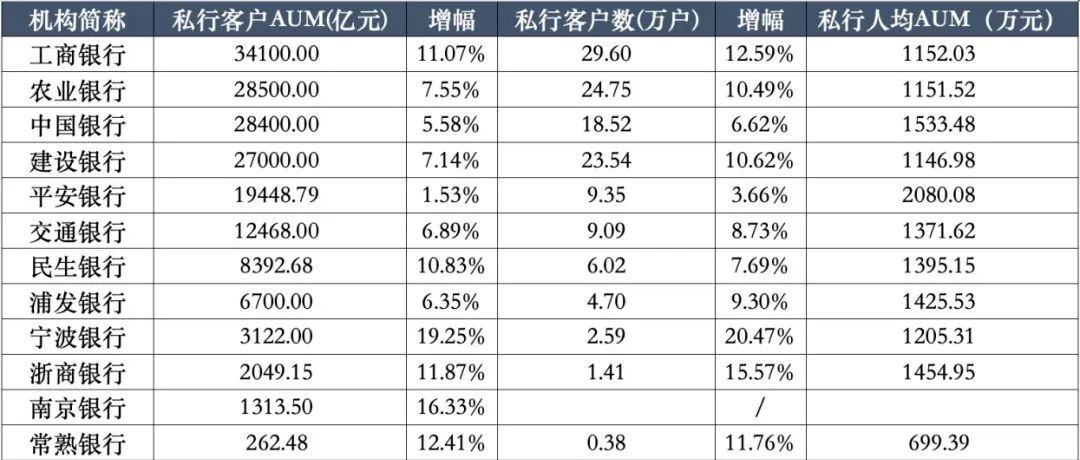
Core Insights - The private banking sector is experiencing intense competition among major banks, with a focus on high-net-worth clients and asset management growth [2][19] - Recent developments, including the "internship monetization" controversy involving Industrial Bank, have sparked discussions about the boundaries of value-added services in private banking [1][7] Group 1: Private Banking Market Overview - The total Assets Under Management (AUM) in the private banking sector has reached 24.6 trillion yuan, with many banks reporting double-digit growth in client numbers and AUM [2][6] - Major banks like Industrial Bank, Agricultural Bank, and Bank of China have surpassed 3 trillion yuan in AUM, with significant year-on-year growth rates of 18.87% and 16.73% respectively [6][12] Group 2: Client Growth and Performance - As of the end of 2024, Industrial Bank had 289,000 private banking clients, an increase of 9.9% from the previous year, while Agricultural Bank and Bank of China also reported substantial client growth [4][6] - The average AUM per private banking client varies, with Industrial Bank at 11.52 million yuan and Agricultural Bank at 11.51 million yuan [3][6] Group 3: Competitive Strategies - Banks are adopting differentiated strategies to attract high-net-worth clients, with a focus on comprehensive services that include financial and non-financial resources [9][12] - The competition is not only about asset size but also about the quality of services offered, with banks like Industrial Bank and Construction Bank emphasizing tailored solutions for entrepreneurs [14][18] Group 4: Challenges and Future Directions - The private banking sector faces challenges such as product homogenization and intense competition, which may impact the effectiveness of non-interest income growth [4][19] - Moving forward, the industry is expected to shift from a scale-oriented approach to one focused on the health of client assets, aiming for a transformation from "scale competition" to "value management" [20]

外汇展业改革参与银行增至22家 建设银行等6家入列
2 1 Shi Ji Jing Ji Bao Dao· 2025-07-22 09:07
Core Insights - The State Administration of Foreign Exchange (SAFE) has reported significant progress in foreign exchange business reform, with 22 banks now participating in the initiative, which aims to enhance cross-border trade and investment facilitation [1][2] Group 1: Bank Participation - The 22 participating banks include 4 large banks, 9 joint-stock banks, 4 city commercial banks, and 5 foreign banks, indicating a diverse representation across the banking sector [2] - New entrants to the foreign exchange business reform this year include major banks such as China Construction Bank and foreign banks like Standard Chartered and JPMorgan [2] Group 2: Reform Impact - The foreign exchange business reform has streamlined processes, reducing the average time for quality clients to complete foreign exchange transactions by over 50%, thus providing tangible benefits to enterprises [3] - The number of classified quality clients has increased by 23% compared to the end of 2024, with over $200 billion in cross-border payment transactions processed based on client instructions this year [3] Group 3: Policy Framework - The foreign exchange business reform is a key component of the "more integrity, more convenience" policy framework, which aims to enhance foreign exchange services for the real economy [4] - The reform includes a focus on supporting technology-driven and small enterprises, optimizing due diligence processes, and establishing evaluation mechanisms for foreign exchange management policies [4]
