
NJBK(601009)

Search documents
A股银行板块震荡走弱,齐鲁银行、厦门银行、成都银行、浙商银行、上海银行、南京银行均跌超1%。
news flash· 2025-07-21 02:26
A股银行板块震荡走弱,齐鲁银行、厦门银行、成都银行、浙商银行、上海银行、南京银行均跌超 1%。 ...


二十年银行股复盘:由基本面预期和成长思维转向策略和交易思维
Orient Securities· 2025-07-21 01:44
Core Insights - The report indicates a shift in the banking sector's focus from fundamental expectations and growth thinking to strategy and trading thinking, highlighting the evolving landscape of investment approaches in the industry [2][29]. Group 1: Regulatory Actions - Three significant regulatory actions have guided the banking industry from "wild growth" to orderly expansion: 1. In 2011, the tightening of city commercial banks' cross-regional expansion and the central bank's credit scale control ended the disorderly expansion of the banking sector [16][20]. 2. The introduction of the MPA assessment in 2016 served as a core regulatory framework, preventing small and medium-sized banks from circumventing regulations and promoting stability [21][23]. 3. The implementation of asset management regulations in 2018 significantly constrained the expansion of non-standard assets in banks, addressing risks associated with shadow banking [24][28]. Group 2: Valuation Framework - A new understanding of the valuation framework for banks is presented, emphasizing the "PB-ROE" model, where banks with higher ROE typically correspond to higher PB ratios. The introduction of dividend yield and payout ratio into this framework suggests that banks with an ROE above 11.7% could justify a PB valuation above 1 [32][33]. - The report notes a shift in the driving logic behind bank stock price increases from growth logic to dividend strategies, indicating a transition in market focus from numerator-driven factors (like ROE) to denominator-driven factors (like dividend yield) [32][33]. Group 3: Historical Performance Review - A comprehensive review of bank stocks from 2008 to 2022 reveals that the banking sector has outperformed the CSI 300 index, achieving nine rounds of excess returns lasting over three months. The core driving factors shifted from growth to dividends over this period [8][29]. - Specific periods of excess returns are highlighted, such as: 1. From November 2008 to July 2009, the sector achieved an absolute return of 139.8% and an excess return of 15.3% [19]. 2. In 2011, despite negative absolute returns, the sector still managed an excess return of 17.6% [19]. 3. The period from October 2014 to December 2014 saw an absolute return of 60% and an excess return of 14.9% [19]. Group 4: Investment Recommendations - The report suggests two main investment themes: 1. Anticipating a reduction in insurance preset interest rates in Q3 2025, it recommends focusing on high-dividend banks such as China Construction Bank, Industrial and Commercial Bank of China, and Chongqing Rural Commercial Bank [3]. 2. The strong performance of small and medium-sized banks since the beginning of the year is expected to continue, with recommendations for banks like Industrial Bank, CITIC Bank, and Nanjing Bank based on valuation, dividends, and fundamentals [3].




券商中报业绩强劲,大行AIC扩容
HTSC· 2025-07-20 11:47
Investment Rating - The report maintains an "Overweight" rating for both the banking and securities sectors [10]. Core Views - Investment opportunities are prioritized in the order of banking > securities > insurance, driven by strong performance in the banking sector and robust earnings forecasts from securities firms [2][13]. - The central bank's data indicates a significant increase in social financing and deposits, with corporate short-term loans showing strong growth [3][15]. - Major securities firms are expected to report impressive earnings, with large firms seeing a net profit growth of 50% to 80% year-on-year, while smaller firms may achieve growth rates of 50% to 120% [2][32]. Summary by Sections Banking Sector - The central bank's report on social financing shows a year-on-year increase, primarily due to government bond issuance and a surge in corporate short-term loans [3][15]. - Hangzhou Bank reported a revenue increase of 3.89% year-on-year for the first half of 2025, with net profit rising by 16.67% [17]. - Postal Savings Bank has established a financial asset investment company, marking the completion of the AIC strategy by the six major banks [18][19]. - Recommended investment themes include high-quality regional banks, actively underweighted stocks, and large banks with strong dividend advantages [3][14]. Securities Sector - The report highlights a strong performance in the securities sector, with major firms expected to report significant profit growth [2][32]. - The trading environment remains robust, with financing balances nearing 1.9 trillion yuan, indicating active leverage in the market [2][32]. - Key firms recommended for investment include Galaxy Securities, Guotai Junan, CITIC Securities, and Zhongjin Company [4][32]. Insurance Sector - The insurance sector is experiencing a gradual increase in valuations, although profit margins are tightening [3][37]. - Investors are advised to focus on high-quality leading companies within the insurance sector [4][37].




南京银行(601009):新五年迎来三大周期拐点
Changjiang Securities· 2025-07-20 11:37
Investment Rating - The report gives a "Buy" rating for Nanjing Bank [3][10]. Core Views - Nanjing Bank is entering a new five-year planning cycle, with three major turning points driving value reassessment: 1) Market share enhancement cycle, 2) Interest rate decline cycle, and 3) Cost-to-income ratio improvement cycle [3][10]. - The bank's current PB valuation is 0.81x for 2025, with a dividend yield of 4.5%, making it a strong investment recommendation [3][10]. Market Share Enhancement Cycle - The management team, led by Chairman Xie Ning, is driving operational efficiency through comprehensive reforms and management optimization, following a significant expansion of branch networks [7][21]. - By the end of 2024, Nanjing Bank will have 290 branches, with a focus on increasing market share through a "three-year customer doubling action plan" [7][22]. - The favorable economic environment in Jiangsu province, with a credit growth rate close to 10% as of May, supports sustainable revenue growth for Nanjing Bank [7][25]. Interest Rate Decline Cycle - Nanjing Bank benefits from a favorable asset-liability structure in a low-interest-rate environment, with a high proportion of time deposits (78%) compared to peers [8][10]. - The bank has already passed the peak pressure on net interest margin (NIM) in 2023, and NIM is expected to stabilize as deposit costs decline [8][10]. Cost-to-Income Ratio Improvement Cycle - The cost-to-income ratio has risen to 30.5% from 2019 to 2023, but is projected to decrease to 28.1% in 2024 due to operational efficiencies and a three-year financial management plan [9][10]. - The bank's asset quality is stabilizing, with a focus on government-related loans, while retail loan risks are expected to improve in the coming years [9][10]. Investment Recommendations - Nanjing Bank is expected to maintain a leading position in ROE and performance growth among listed banks, with a dividend payout ratio above 30% [10]. - The completion of a 20 billion yuan convertible bond conversion enhances capital, supporting the bank's growth trajectory [10].
银行业周度追踪2025年第28周:存款定期化压力预计改善-20250720
Changjiang Securities· 2025-07-20 10:45
Investment Rating - The industry investment rating is "Positive" and is maintained [12] Core Viewpoints - The Jiangsu Bank Index has decreased by 0.5% this week, underperforming the CSI 300 by 1.5% and the ChiNext Index by 3.6%. Despite a decline in trading sentiment for bank stocks, the core investment logic remains solid [2][6] - The trend of deposit regularization has stabilized in the first half of the year, with the proportion of RMB time deposits at 73.1% as of the end of June, a decrease of 1.1 percentage points from the previous month, indicating a marginal improvement in deposit regularization pressure for listed banks [2][9][50] - The average dividend yield of the six major state-owned banks' A-shares has fallen to 3.91%, with a spread of 225 basis points over the 10-year government bond yield, while the average yield for H-shares is 4.89%, showing a more pronounced advantage [6][20][24] Summary by Sections Market Performance - The overall market risk appetite has increased significantly this week, leading to a decline in trading sentiment for bank stocks, although the core investment logic remains intact [2][6] - Individual stocks such as Minsheng Bank H and Xiamen Bank have led gains due to improved governance expectations, while Nanjing Bank has seen an increase following the successful delisting of its convertible bonds [6][7] Loan and Deposit Trends - In the first half of the year, the total RMB credit has decreased year-on-year by 350 billion, with weak demand for household credit. The core drag has been short-term and medium-to-long-term operating loans, which have decreased by 705 billion [8][39] - Large banks have increased their new credit year-on-year, capturing 64% of the market share, while smaller banks continue to see a decline in credit demand [8][43][47] Convertible Bonds and Valuation Opportunities - Nanjing Bank's convertible bonds have been successfully delisted, eliminating conversion pressure and suggesting potential for valuation recovery. Other banks like Qilu Bank are also expected to see similar opportunities [7][26] Trading Activity - The turnover rate for joint-stock banks and city commercial banks has increased compared to last week, while the turnover rate for state-owned banks remained stable. The core investment logic for bank stocks remains robust, with low valuation recovery and significant risk bottom lines established [30][35]
又一可转债,顺利摘牌!
券商中国· 2025-07-19 10:27
Core Viewpoint - Nanjing Bank's "Nan Yin Convertible Bond" has been forcibly redeemed and converted into A-shares, leading to an increase in the bank's total share capital and enhancing its capital strength for sustainable development [1][3][7]. Summary by Sections Announcement of Redemption - On July 18, Nanjing Bank announced the strong redemption and conversion of its "Nan Yin Convertible Bond," which has been delisted from the Shanghai Stock Exchange [1]. - The total amount of "Nan Yin Convertible Bond" converted into A-shares reached 199.96 billion yuan, resulting in 2.357 billion shares being converted [2][5]. Impact on Share Capital - Following the redemption, Nanjing Bank's total share capital increased to 12.364 billion shares [6]. - The conversion accounted for 23.55% of the bank's total A-shares before the conversion [5]. Financial Implications - The high conversion rate allows Nanjing Bank to further supplement its capital, which is beneficial for long-term sustainable development despite short-term dilution of earnings per share [3][7]. - The "Nan Yin Convertible Bond" achieved a conversion rate of 99.98%, indicating strong investor confidence in the bank's stock performance [11]. Market Context - Nanjing Bank is the fourth bank this year to complete forced redemption of convertible bonds, following Chengdu Bank, Suzhou Bank, and Hangzhou Bank [9]. - The overall market for bank convertible bonds is expected to reduce to seven after the completion of the redemption of "Qi Lu Convertible Bond" [10]. Stock Performance - Nanjing Bank's stock price has seen significant growth, with a 57.96% increase in 2024 and a 12.86% increase in 2025 as of July 18 [13]. - The banking sector has shown strong performance, with several banks experiencing notable stock price increases [14].


从“小舢板”到“现代商船”,南京银行上市18年的升维之路
Sou Hu Cai Jing· 2025-07-19 02:48
Core Viewpoint - Nanjing Bank has evolved significantly since its listing on the Shanghai Stock Exchange in 2007, becoming a comprehensive financial service provider with a strong market presence and diversified operations, marking its 18th anniversary as a key player in the banking sector [2][4][22] Group 1: Capital Initiatives - Nanjing Bank was the first city commercial bank to list on the A-share main board, leveraging strategic investments from international financial institutions to enhance its capital base and governance structure [5][4] - The bank's registered capital increased from 1.207 billion to 12.187 billion, with a notable improvement in capital adequacy ratio from 11.73% at listing to 13.72% [5][8] - The bank's market capitalization surged from 20.2 billion to 144 billion, reflecting its successful navigation through the evolving financial landscape [4][8] Group 2: Differentiated Competitive Edge - Nanjing Bank has established a unique competitive advantage through innovative financial products and services, including "investment-loan linkage" models and green finance initiatives [9][11] - The bank has provided credit support exceeding 700 billion to over 70,000 technology enterprises, achieving a 50% coverage rate for specialized enterprises in Jiangsu [9][11] - The green loan balance exceeds 250 billion, accounting for over 19% of total loans, positioning the bank as a leader in green finance [11] Group 3: Comprehensive Financial Ecosystem - Nanjing Bank has expanded its operations from a single banking entity to a diversified financial group, investing in various financial institutions and establishing subsidiaries in fund management and consumer finance [15][16] - The bank's "One Bank" strategy emphasizes internal collaboration and customer service integration, enhancing its overall service capabilities [18] - The bank's subsidiaries contributed a net profit of 938 million in 2024, reflecting a 28.67% increase from the previous year [18] Group 4: Value Creation and Social Responsibility - Nanjing Bank has maintained a dividend payout ratio above 30% since its listing, with cumulative dividends amounting to 45.939 billion, demonstrating its commitment to shareholder returns [19][20] - The bank actively engages in social responsibility initiatives, including educational support and community development, contributing 18.7 million to assist over 2,700 students [20][22] - The bank's brand influence has grown, receiving multiple awards for excellence in various banking sectors, reinforcing its market position [22]
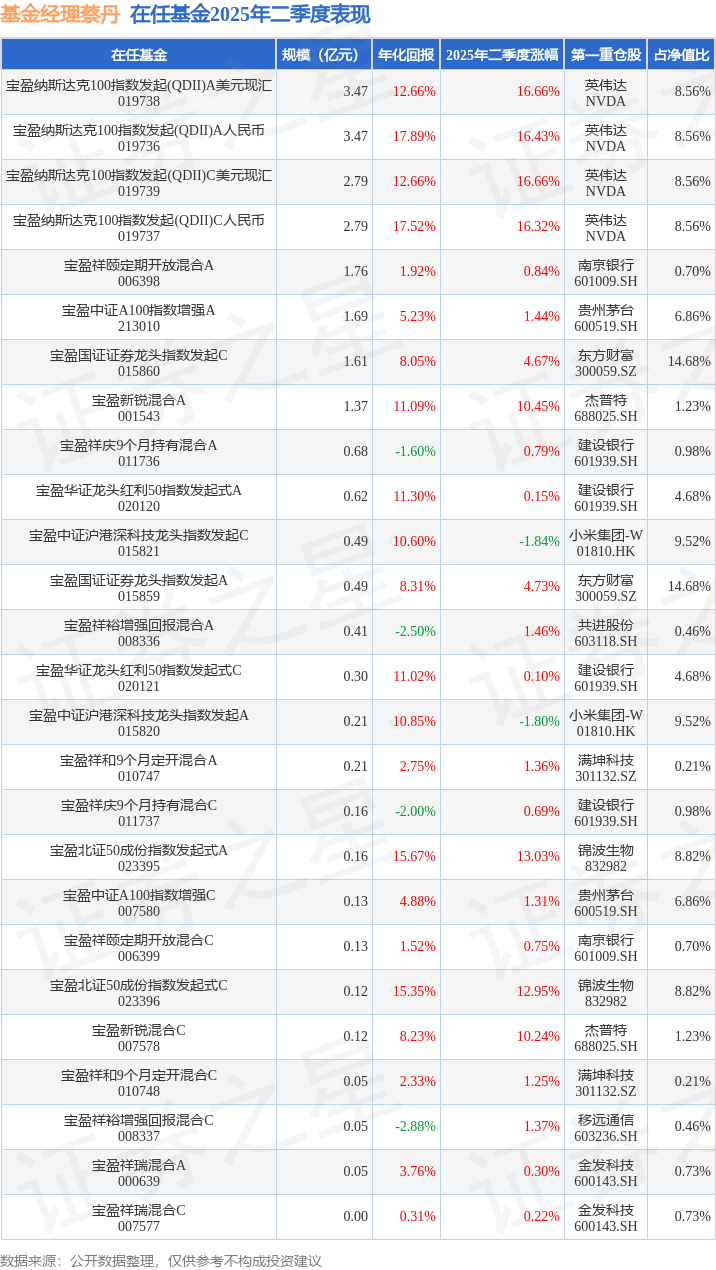
蔡丹2025年二季度表现,宝盈纳斯达克100指数发起(QDII)A美元现汇基金季度涨幅16.66%
Zheng Quan Zhi Xing· 2025-07-18 22:14
Core Insights - The article provides a detailed analysis of various mutual funds managed by the company, highlighting their performance metrics, including annualized returns and significant stock holdings [1][3]. Fund Performance Summary - The "Baoying Nasdaq 100 Index Fund" (QDII) A USD has a scale of 3.47 billion with an annualized return of 12.66% and a Q2 2025 increase of 16.66%, heavily invested in Nvidia (NVDA) with a weight of 8.56% [1]. - The "Baoying Nasdaq 100 Index Fund" (QDII) A RMB also has a scale of 3.47 billion, achieving an annualized return of 17.89% and a Q2 2025 increase of 16.43%, similarly focused on Nvidia [1]. - The "Baoying Xiangyi Regular Open Mixed A" fund has a scale of 1.76 billion with a modest annualized return of 1.92% and a Q2 2025 increase of 0.84%, primarily invested in Nanjing Bank [1]. - The "Baoying Zhongzheng A100 Index Enhanced A" fund has a scale of 1.69 billion, with an annualized return of 5.23% and a Q2 2025 increase of 1.44%, focusing on Kweichow Moutai [1]. Stock Trading Performance - Fund manager Cai Dan achieved a cumulative return of 4.88% during her tenure managing the "Baoying Xiangrui Mixed A" fund, with an average annualized return of 1.17% and a trading success rate of 56.79% across 81 stock adjustments [3]. - Notable stock trading examples include: - "Xinhua Bang" was bought in Q1 2020 and sold in Q3 2021, yielding an estimated return of 223.25% with a company performance growth of 152.36% [4][6]. - "Ningde Times" was held from Q2 2020 to Q1 2021, resulting in a return of 149.16% with a company growth of 185.34% [4]. - "Zijin Mining" was bought in Q2 2023 and has an estimated return of -86.18% despite a company growth of 51.76% [5][8]. ETF Insights - The "Gold Stock ETF" (Product Code: 159562) tracks the CSI Hong Kong and Shanghai Gold Industry Stock Index, showing a recent increase of 0.44% over five days and a price-to-earnings ratio of 20.86 times, with a net inflow of 237.7 million [10].




南 京 银 行: 南 京 银 行股份有限公司关于“南银转债”赎回结果暨股份变动的公告
Zheng Quan Zhi Xing· 2025-07-18 16:31
Core Viewpoint - The announcement details the redemption results of "Nan Yin Convertible Bonds," including the redemption amount, payment date, and the impact on the company's capital structure [1][2][3]. Redemption Details - Redemption amount: RMB 3,873,000 (38,730 bonds) [1] - Total redemption payment: RMB 3,878,957.66 (including current interest) [1] - Redemption payment date: July 18, 2025 [1] - Convertible bond delisting date: July 18, 2025 [1] Redemption Conditions - The conditional redemption clause was met as the company's stock price closed above the conversion price for 15 trading days from May 13, 2025, to June 9, 2025 [1]. - The redemption price is set at RMB 100.1537 per bond, which includes accrued interest calculated based on a 1.70% annual interest rate over 33 days [2]. Impact on Company - As of July 17, 2025, the remaining balance of "Nan Yin Convertible Bonds" is not specified, but the total amount redeemed will not significantly impact the company's cash flow [3]. - The total number of shares converted from "Nan Yin Convertible Bonds" amounts to 2,356,550,272 shares, representing 23.55% of the total shares before conversion [3]. - The company's total share capital will increase, enhancing its capital strength and supporting sustainable development [3]. Shareholder Changes - The announcement includes changes in shareholding for major shareholders, with specific percentages before and after the redemption [4]. - Notable shareholders include BNP Paribas and Jiangsu Transportation Holding Co., with slight changes in their respective holdings [4].
南京银行2025年7月宏观利率展望:利率小幅上行调整,基本面利多逢高配置
Nan Jing Yin Hang· 2025-07-18 12:55
Economic Overview - In June, the economy showed weak demand but strong production, with GDP growth at 5.3% for the first half of the year, easing pressure to achieve a full-year target of 5%[2] - Domestic demand is under significant pressure, with real estate, infrastructure, and manufacturing investments continuing to decline, while consumption growth has also slowed[5] - Export growth has increased due to a "rush to export" effect, providing some support to the economy[2] Investment and Consumption - Fixed asset investment growth for January to June was 2.8%, down 0.9 percentage points from the previous value, with real estate investment down 11.2%[9] - Retail sales growth in June was 4.8%, a decrease of 1.6 percentage points from the previous month, primarily due to reduced subsidy effects and a decline in dining consumption[16] - Real estate sales growth continued to decline, with a 3.5% drop in sales and a 6.2% decrease in funding sources[12] Monetary Policy and Liquidity - The central bank's monetary policy emphasizes "stabilizing prices," with liquidity expected to remain balanced and slightly loose[3] - The average interbank repo rates have decreased, with DR007 fluctuating within 10 basis points above the policy rate[3] - The central bank conducted a 1.4 trillion yuan reverse repo operation in mid-July, indicating a loose monetary stance[4] Bond Market Strategy - Bond yields have slightly adjusted due to rising stock markets and marginal increases in funding rates, but rates are unlikely to rise significantly without improvements in the economic fundamentals[4] - The bond market is expected to experience low volatility, with strategies focusing on high-entry points for bond purchases[6] Inflation and Price Trends - CPI growth turned positive in June at 0.1%, driven by rising industrial consumer goods prices, particularly oil[46] - PPI continued to decline, with a year-on-year drop of 3.6%, influenced by falling energy prices and pressures on export prices[52]