
Cinda Securities(601059)

Search documents
非银需求释放缓解银行负债压力,杠杆率季节性回升但仍处低位
Xinda Securities· 2025-04-24 12:22
Report Summary 1. Report Industry Investment Rating No industry investment rating is provided in the report. 2. Core Viewpoints - In March, the total bond custody scale increased by 265.56 billion yuan month - on - month, with the increment mainly contributed by inter - bank certificates of deposit (CDs), which reached a record high of 1.12 trillion yuan. However, the custody increments of various interest - rate bonds and credit bonds decreased slightly compared to the previous month [4][7]. - After a mid - to - early - month correction, the bond market recovered in late March. Due to looser funds, the demand for CDs from broad - based funds soared, leading to a significant increase in net financing of CDs despite a high maturity volume, and CD rates peaked and declined. The increased purchases of interest - rate bonds by trading institutions such as broad - based funds and securities firms, along with a marginal decrease in government bond supply, alleviated the pressure on commercial banks' asset - side to undertake primary issuance, and thus eased their liability pressure. However, the demand for credit bonds from trading desks remained weak, the bond purchases by insurance companies slightly decreased, and overseas institutions also significantly increased their CD holdings, with the overall bond purchase volume reaching a new high since August last year [4][9]. - In March, the repo balance increased significantly, and the bond market leverage ratio rose by 0.6 pct month - on - month to 106.8%. Although the increase was similar to the historical average for the same period, it remained at a low level since 2022. By institution, the leverage ratios of commercial banks and non - bank institutions both increased but were still at relatively low levels [4][38]. 3. Summary by Directory 3.1. Inter - bank CD Supply Surge Drove a 2.7 - Trillion - Yuan Increase in March Bond Custody Volume - The total bond custody scale in March increased by 265.56 billion yuan month - on - month, with the increment mainly from inter - bank CDs, reaching 1.12 trillion yuan. The custody increments of other interest - rate bonds and credit bonds decreased slightly. For interest - rate bonds, the net financing and net payment of treasury bonds increased, but the custody increment decreased slightly; the custody increment of local bonds decreased as the issuance of replacement bonds slowed; and the custody increment of policy - bank bonds decreased due to an increase in the maturity volume. For credit bonds, the custody increments of medium - term notes and short - term commercial paper decreased, and the custody scales of enterprise bonds and PPNs continued to decline [7]. - The commercial bank bond custody volume decreased by 53 billion yuan from an increase of 120 billion yuan in the previous month, while the non - bank bond custody increment increased by 338 billion yuan to 448 billion yuan. The custody scale decline of credit - asset - backed securities narrowed to 130 billion yuan. The issuance scale of inter - bank CDs in March reached a record high, with the custody increment rising by 634.4 billion yuan to 1.115 trillion yuan, which was the main reason for the increase in March's custody increment [7]. 3.2. In March, Trading Desks Massively Increased Holdings of Inter - bank CDs and Interest - Rate Bonds, Significantly Easing Commercial Banks' Liability Pressure - **Broad - based Funds**: The custody increment of broad - based funds increased significantly by 158.5 billion yuan to 170.5 billion yuan. They increased their holdings of inter - bank CDs, government bonds, local bonds, and policy - bank bonds, and reduced their holdings of credit bonds and commercial bank bonds. Relative to the stock, they increased their allocation of bonds, mainly inter - bank CDs and various interest - rate bonds [13]. - **Securities Firms**: The bond custody scale of securities firms increased by 1.145 billion yuan from a decrease of 560 million yuan in the previous month, mainly by increasing their holdings of treasury bonds. Relative to the stock, they also increased their allocation of bonds, mainly treasury bonds [17]. - **Insurance Companies**: The bond custody increment of insurance companies slightly decreased by 1.48 billion yuan to 9.64 billion yuan. They reduced their holdings of medium - term notes and increased their holdings of local bonds, among others. Relative to the stock, their bond - allocation strength weakened slightly [20]. - **Overseas Institutions**: The bond custody increment of overseas institutions increased by 7.19 billion yuan to 14.18 billion yuan, reaching a new high since August last year. They significantly increased their holdings of inter - bank CDs and increased their holdings of treasury bonds but reduced their holdings of policy - bank bonds. Relative to the stock, they increased their bond - allocation strength [26]. - **Other Institutions**: The bond custody increment of other institutions decreased from an increase of 60.18 billion yuan in the previous month to a decrease of 990 million yuan, mainly affected by the reduction in the net investment of central bank's outright reverse repurchase. They reduced their holdings of local bonds, policy - bank bonds, and treasury bonds and also reduced their holdings of inter - bank CDs, medium - term notes, and short - term commercial paper. Relative to the stock, they reduced their bond allocation [28]. - **Commercial Banks**: The bond custody scale of commercial banks increased by 58.17 billion yuan, with a decrease of 83.66 billion yuan compared to the previous month. They significantly reduced their holdings of inter - bank CDs, and also reduced their holdings of policy - bank bonds, short - term commercial paper, and commercial bank bonds. Relative to the stock, they reduced their bond allocation [31]. - **Credit Unions**: The bond custody volume of credit unions decreased from an increase of 8.67 billion yuan in the previous month to a decrease of 1.9 billion yuan, mainly due to a large - scale reduction in inter - bank CD holdings. Relative to the stock, they reduced their bond allocation [34]. 3.3. In March, the Bond Market Leverage Ratio Seasonally Rebounded but Remained at a Low Level Since 2022 - In March, the repo balance increased significantly, and the bond market leverage ratio rose by 0.6 pct month - on - month to 106.8%. The increase was similar to the historical average for the same period but remained at a low level since 2022. By institution, the leverage ratio of commercial banks rose by 0.6 pct to 103.2%, only higher than that in January - February this year; the non - bank institution leverage ratio rose by 0.5 pct to 115.9%, still at a relatively low level since April 2022. Among non - bank institutions, the leverage ratios of securities firms and non - legal - person products increased to 200.7% and 114.4% respectively, remaining near historical lows [38]. - In broad - based funds, the repo balances of various institutions rebounded. The repo balances of money market funds and wealth management products increased significantly but were still near historical lows. The repo balances of insurance companies and other products with relatively stable liabilities were close to the high in January this year, and the repo balance of non - money market products of fund companies was relatively stable, still below the pre - March 2023 level [38].

信达证券:首次覆盖华菱钢铁给予买入评级,目标价7.07元
Zheng Quan Zhi Xing· 2025-04-24 09:44
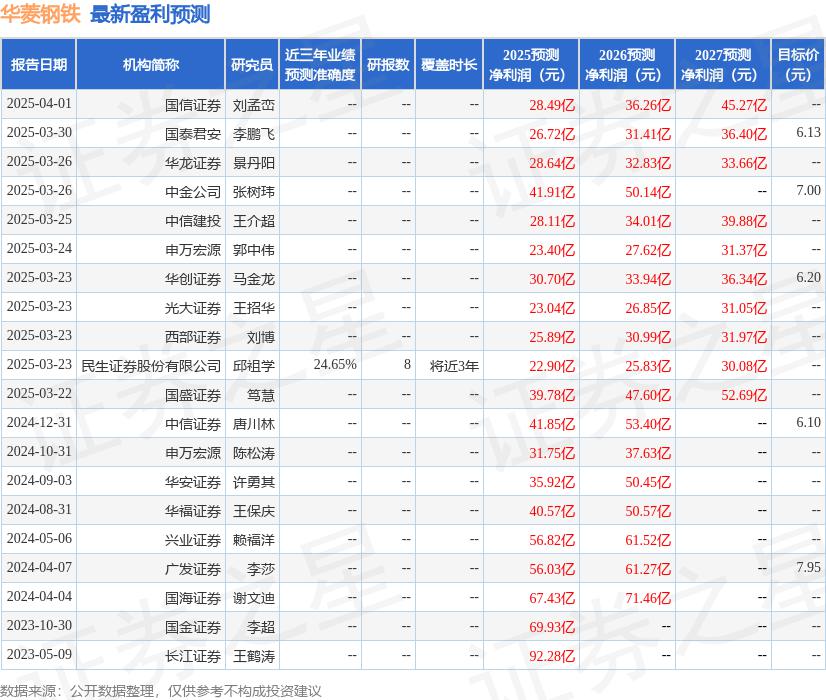
信达证券(601059)股份有限公司左前明,刘波,高升近期对华菱钢铁(000932)进行研究并发布了研究报告《公司首 次覆盖报告:蓄劲待时:华菱钢铁的"弹"与"韧"》,首次覆盖华菱钢铁给予买入评级,目标价7.07元。 华菱钢铁 最新盈利预测明细如下: "高端化"——公司积极推动高端化战略。2016年以来华菱钢铁研发支出占营收比例均维持3%-4%,研发支出总额及占 比均处于行业内较高水平。通过研发创新,高端产能持续落地,2024年重点品种钢销量占比达到65%,较2023年再提 升2个百分点。展望未来,1)宽厚板领域:持续巩固造船板、海工钢等战略品种竞争优势;2)薄板板块:推动汽车板 实现从基板到高端镀锌产品的产业链延伸,同步推进硅钢产品迭代升级;3)线棒材与钢管业务:加速"优转特"战略落 地。 "强内功"——公司持续提质增效。2024年公司资产负债率为56%,较2016年峰值下降约30pct,有息负债率39.4%,较 峰值下降约20pct,公司财务费用持续下降,2024年降至0.88亿元,考虑到当前钢铁行业所处的底部位置,公司整体偿 债能力较优。 投资建议:我们认为华菱钢铁有望充分受益产量增长的规模效益及高端化 ...


信达证券:2025一季报净利润2.05亿 同比增长10.81%
Tong Hua Shun Cai Bao· 2025-04-24 09:41
一、主要会计数据和财务指标 | 报告期指标 | 2025年一季报 | 2024年一季报 | 本年比上年增减(%) | 2023年一季报 | | --- | --- | --- | --- | --- | | 基本每股收益(元) | 0.0600 | 0.0600 | 0 | 0.0700 | | 每股净资产(元) | 5.89 | 5.53 | 6.51 | 5.12 | | 每股公积金(元) | 1.24 | 1.24 | 0 | 1.24 | | 每股未分配利润(元) | 2.37 | 2.15 | 10.23 | 1.89 | | 每股经营现金流(元) | - | - | - | - | | 营业收入(亿元) | 9.67 | 8.35 | 15.81 | 10.9 | | 净利润(亿元) | 2.05 | 1.85 | 10.81 | 2.16 | | 净资产收益率(%) | 0.86 | 0.99 | -13.13 | 1.39 | 前十大流通股东累计持有: 19492.12万股,累计占流通股比: 28.19%,较上期变化: -2678.94万股。 | 名称 | 持有数量(万股) | 占总股本比例( ...
3月券商APP活跃增幅榜:月活超100万APP信达证券环比增幅最高 华西证券最低
Xin Lang Zheng Quan· 2025-04-23 02:56
Core Insights - The number of brokerage apps with over 1 million monthly active users reached 25, showing a positive month-on-month growth with an average increase of 3.35% in March compared to February [1][2] - The highest month-on-month growth was observed in Xinda Securities' app "Xinda Tianxia" with an increase of 5.29%, while the lowest growth was in Huaxi Securities' app "Huacai Rensheng" with an increase of only 2.07% [1][2] Monthly Active User Growth of Brokerage Apps - The top brokerage apps by month-on-month growth in March are as follows: - 1st: "Zhangle Caifutong" by Huatai Securities with a growth of 2.79% [2] - 2nd: "Guotai Haitong Junhong" by Guotai Junan Securities with a growth of 2.66% [2] - 3rd: "Ping An Securities" with a growth of 2.80% [2] - 4th: "Zhaoshang Securities" with a growth of 4.37% [2] - 5th: "CITIC Securities Xin E-Tou" with a growth of 3.95% [2] - 6th: "Guotai Haitong Tongcai" by Haitong Securities with a growth of 2.38% [2] - 7th: "Qingting Diankin" by CITIC JianTou Securities with a growth of 4.09% [2] - 8th: "GF Securities Yitaojin" with a growth of 3.84% [2] - 9th: "Xiaofang" by Fangzheng Securities with a growth of 3.53% [2] - 10th: "China Galaxy Securities" with a growth of 2.75% [2] - Other notable apps include "Xinda Tianxia" by Xinda Securities with a growth of 5.29% and "Yuli Bao" by Industrial Bank with a growth of 5.89% [2]


信达睿益鑫享混合连续3个交易日下跌,区间累计跌幅0.06%
Sou Hu Cai Jing· 2025-04-21 16:04
Group 1 - The core point of the news is that the Xinda Ruiyixin Mixed Fund (970115) has experienced a slight decline of 0.01% on April 21, with a cumulative drop of 0.06% over three consecutive trading days, and its latest net value is 1.05 yuan [1] - The fund was established in February 2022, with a total scale of 0.19 billion yuan and a cumulative return of 4.85% since inception [1] - As of the end of 2024, the fund's holder structure shows that institutional investors hold 0.09 billion shares, accounting for 51.94% of the total shares, while individual investors hold 0.09 billion shares, accounting for 48.06% [1] Group 2 - The current fund manager, Wang Lin, has a background in economics from Peking University and has been with Xinda Securities since 2016, taking on various roles including bond trader and investment manager [2] - The other fund manager, Cheng Yuanyuan, also from Peking University and Tsinghua University, has been with Xinda Securities since 2017 and focuses on value investment and company fundamentals [2] - Both fund managers have been in their respective roles for the Xinda Ruiyixin Mixed Fund since November 24, 2022 [2] Group 3 - As of December 31, 2024, the top five holdings of the Xinda Ruiyixin Mixed Fund account for a total of 85.12%, with the largest holdings being 23 Government Bonds 18 (24.73%), 24 Government Bonds 11 (13.54%), and 24 Zhaozheng C4 (11.06%) [3]
策略专题报告(深度):房价弱,但股市强的海外案例分析
Xinda Securities· 2025-04-20 09:47
Group 1: US Market Analysis (2009-2011) - The US real estate market bottomed out without significantly affecting economic recovery, which drove a strong stock market [3][9][11] - The stock market's upward momentum was primarily driven by the recovery of personal consumption, manufacturing, and exports [3][17][25] Group 2: Japan Market Analysis (2012-2013) - Japan experienced a slight rebound in real estate, leading to a long bull market driven by government investment and quantitative easing [3][32][33] - The stock market's rise was supported by increased public investment and the Bank of Japan's purchase of risk assets [3][41][51] Group 3: Germany Market Analysis (2022-2023) - Despite a decline in real estate prices and economic recession, the German stock market continued to rise [3][58][62] - The stock market's growth was fueled by corporate globalization and favorable liquidity conditions [3][70][74] Group 4: A-Share Market Outlook - The A-share market may experience a bull market driven by the bottoming out of real estate, along with rebounds in consumption, investment, and liquidity [3][4]
券商员工考公转型引关注,近两年证券从业人员数量减逾7%;信达证券、信达期货和信达澳亚基金同日提交股权变更申请 | 券商基金早参
Mei Ri Jing Ji Xin Wen· 2025-04-18 01:30
Group 1 - The trend of securities industry employees transitioning to civil service reflects increased competition and a demand for job stability, with a reported decrease of 7.33% in the number of securities professionals over the past two years [1] - The movement of talent from the securities sector may impact the operational efficiency and service quality of brokerage firms, potentially benefiting sectors like fintech and human resources services [1] Group 2 - The submission of equity change applications by Xinda Securities, Xinda Futures, and Xinda Australia Fund marks a significant step following their transfer to Central Huijin Investment, enhancing Huijin's control in the financial market [2] - The change in actual controller from the Ministry of Finance to Huijin may lead to more flexible capital operations and market strategies for Xinda companies, potentially prompting other asset management companies to adjust their equity structures [2] Group 3 - The acceleration of the long-term investment pilot program for insurance funds is evident, with companies like Taikang Asset Management receiving regulatory approval to establish private fund management subsidiaries [3] - The establishment of private fund companies by insurance institutions is expected to enhance the efficiency of insurance capital utilization and inject stability into the capital market [3] Group 4 - Leading private equity firms are maintaining high positions in their portfolios despite recent market volatility, indicating confidence in the Chinese market [4] - The relatively small drawdown in net asset values among top private equity firms suggests optimism regarding the long-term value of quality Chinese assets, with current market fluctuations providing favorable buying opportunities [5]
降准降息落地前,利率下行方向或未变
Xinda Securities· 2025-04-14 14:52
Report Industry Investment Rating No relevant content provided. Core Viewpoints - The bond market was strong last week, with short - end credit spreads compressing and secondary perpetual bond spreads slightly rising. Before the implementation of reserve requirement ratio cuts and interest rate cuts, the downward direction of long - end interest rates may remain unchanged. Although the implementation time of policy easing needs to wait, it is not necessarily a negative for long - term bonds. At present, the duration strategy is still relatively dominant, and the portfolio can maintain a medium - to - high duration. 3 - 5 - year medium - to - high - grade credit bonds also have allocation value [2][3][29] Summary by Directory I. The impact of the escalation of reciprocal tariffs on the fundamentals has not yet emerged, and further policy support is needed - Last week, the reciprocal tariffs between China and the United States continued to escalate, with the tariff rate increase reaching 125% on both sides, and the total US tariff rate on Chinese goods exceeding 145%. However, the US also announced a 90 - day suspension of reciprocal tariffs above 10% for other countries and exemption for some electronic products, which may ease the pressure on China's re - export trade [7] - Due to the trade shock and unstable policy expectations, the US stock, bond, and foreign exchange markets were all under pressure, with the 10 - year US Treasury yield remaining high at around 4.5% and the US dollar index falling below 100. The US has not achieved its goals of reducing the trade deficit, promoting manufacturing reshoring, and cutting the fiscal deficit, and may take other measures in the future, so the global market may still face volatility [8] - China's economy has enhanced its resilience and preparedness for potential tariff risks. The 3 - month export growth of 12.3% was mainly affected by the Spring Festival shift. After adjusting for the seasonal factor, the actual export growth has weakened marginally, but the impact of tariffs has not fully emerged. However, after the escalation of bilateral tariffs, China's exports may be affected, and it is estimated that it may impact GDP by 1.5% - 2%, so domestic policies need to be strengthened [12][15][17] II. The central bank's attitude towards the capital market is gradually returning to normal, but reserve requirement ratio cuts and interest rate cuts may still need to wait - The market's expectation of looser capital has increased, but historical experiences show that significant drops in capital interest rates below policy rates are usually preceded by signals such as continuous reserve requirement ratio cuts and interest rate cuts by the central bank or a continuous increase in bank net lending. Currently, the central bank's open - market operations and bank net lending do not show such signals [18] - The "Financial Times" put forward three conditions for "choosing the right time for reserve requirement ratio cuts and interest rate cuts", and although these factors have emerged, their impacts are not yet prominent. The central bank is still weighing between stabilizing the bond market and reducing costs. It may lower the priority of stabilizing the bond market and advance the policy normalization, with DR007 likely to return to the 1.65% - 1.7% range, but further reduction may require the coordinated efforts of fiscal and monetary policies. Reserve requirement ratio cuts and interest rate cuts may still need to wait, but relevant information is likely to emerge around the Politburo meeting in April [20][21] - The loosening of the capital market last week was partly due to the large - scale net repayment of government bonds. However, this week, the net payment of government bonds will reach 797.8 billion yuan, the highest since mid - December last year. Although the probability of a significant tightening of funds is limited, the short - term capital market may not loosen significantly [22] - The March financial data was released on Sunday. The new social financing scale reached 5.89 trillion yuan, and the stock growth rate rose to 8.4%. The increase was mainly due to the rise in credit and government bond net financing. The new credit of residents and enterprises was affected by factors such as the expected increase in consumer loan interest rates and the convenience of platform working capital loans after the replacement of hidden debts. The subsequent use of replacement bonds may have a negative impact on credit, and more attention should be paid to the changes in domestic policies under external shocks [25][27][28] III. Before the implementation of reserve requirement ratio cuts and interest rate cuts, the downward direction of interest rates remains unchanged - Although the implementation of tariffs and the degree of domestic policy hedging are uncertain, and the short - term bond market may fluctuate, the impact of tariff measures on the fundamentals has not been fully priced in the market, which is not necessarily a negative for long - term bonds. As export pressure gradually emerges, domestic policies are likely to be adjusted, and monetary easing is likely to be relatively early. Before the implementation of reserve requirement ratio cuts and interest rate cuts, long - term interest rates may not face significant risks and may hit new lows. At present, the duration strategy is dominant, and 3 - 5 - year medium - to - high - grade credit bonds have allocation value [29]
信达证券某营业部收警示函 个别员工要求客户填假信息
Zhong Guo Jing Ji Wang· 2025-04-08 03:12
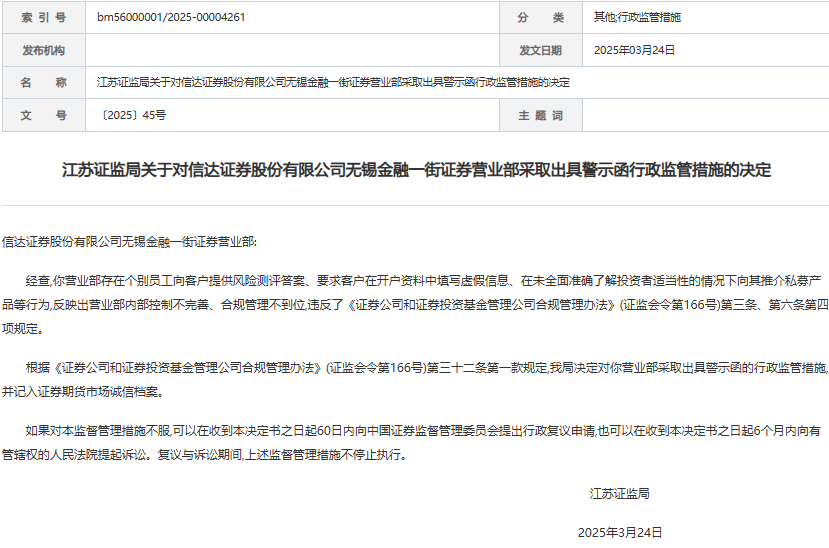
中国经济网北京4月8日讯 江苏证监局网站近日披露的江苏证监局关于对信达证券(601059)股份有限公司无锡金融一 街证券营业部采取出具警示函行政监管措施的决定。 经查,信达证券股份有限公司无锡金融一街证券营业部存在个别员工向客户提供风险测评答案、要求客户在开户资料 中填写虚假信息、在未全面准确了解投资者适当性的情况下向其推介私募产品等行为,反映出营业部内部控制不完 善、合规管理不到位,违反了《证券公司和证券投资基金管理公司合规管理办法》(证监会令第166号)第三条、第六条 第四项规定。 根据《证券公司和证券投资基金管理公司合规管理办法》(证监会令第166号)第三十二条第一款规定,江苏证监局决定 对信达证券股份有限公司无锡金融一街证券营业部采取出具警示函的行政监管措施,并记入证券期货市场诚信档案。 江苏证监局网站同日披露的的关于对吴强盛采取出具警示函行政监管措施的决定显示,经查,吴强盛在信达证券股份 有限公司无锡金融一街证券营业部从业期间,存在向客户提供风险测评答案、要求客户在开户资料中填写虚假信息、 在未全面准确了解投资者适当性的情况下向其推介有关私募产品等行为,违反了《证券公司和证券投资基金管理公司 合规管 ...
如何看待关税措施对债市的影响:利率下行方向重新确立
Xinda Securities· 2025-04-07 07:14
Report Industry Investment Rating Not provided in the content Core Viewpoints - The shock pattern of China's domestic bond market was broken by the escalation of trade frictions last week. After the introduction of the US's so - called "reciprocal tariffs", the global risk - aversion sentiment has increased, and the yields of domestic bonds have declined significantly. The direction of interest rate decline has been re - established, and the probability of reserve requirement ratio cuts and interest rate cuts in Q2 has increased significantly [2][3][6]. - Although the final implementation of short - term tariffs remains to be observed and the market may fluctuate, in the next quarter, long - term interest rates may hit new lows. At present, it is recommended to pay more attention to the duration strategy and appropriately lengthen the duration of the portfolio [3][36]. Summary by Directory 1. US Reciprocal Tariff Rates Significantly Exceed Expectations, and the Overseas Market Enters a Risk - Aversion Mode - After Trump took office in January, the US imposed tariffs on imports from China, Canada, and Mexico on the grounds of "fentanyl" and immigration issues, and also imposed tariffs on specific products such as steel, aluminum, and automobiles. On February 13, Trump signed a memorandum to impose reciprocal tariffs on trading partners. The market originally thought this would reduce the possibility of a significant increase in overall US tariffs [2][6][7]. - On April 2, the announced reciprocal tariffs first imposed a 10% tariff on all US imports. For economies with large trade deficits, additional differential tariffs were imposed. This greatly exceeded market expectations, bringing high uncertainty to the global economy, potentially pushing up US inflation in the short term and reducing economic growth, and thus increasing global risk - aversion sentiment [2]. - After the reciprocal tariffs were introduced, most economies said they would negotiate with the US. China announced a series of counter - measures on April 4, showing more preparedness for potential tariff risks and enhanced economic resilience. There is still room for negotiation between China and the US, and the final tariff rate is likely to be lower than the current level, but the impact on the fundamentals may exceed previous expectations [2]. 2. The Implementation of Tariffs is Expected to Accelerate the Relaxation of Aggregate Policies. Pay Attention to the Decline of the Central Level of Funding Rates - After the end of the cross - quarter period last week, the funding became looser, and on Thursday, the central bank's open - market operations turned to net injection, pushing DR007 below 1.7%, the lowest level since mid - January. The central bank may re - evaluate the economic and financial situation due to the escalation of global trade frictions, and the decline of the central level of funding rates may accelerate [18]. - Although the funding rate dropped below 1.7% on Thursday, the bank's rigid net financing scale declined, indicating that the central bank may not be ready to lower the central level of funding rates to 1.5% or lower. However, if there is greater pressure on the equity market or external demand, the time for reserve requirement ratio cuts and interest rate cuts may be advanced, and the central level of funding rates may decline further [21]. - The scale of 91 - day discounted Treasury bonds issued last week was lower than expected, leading to a downward revision of the forecast for the April Treasury bond issuance scale. It is expected that the central financial institution capital injection special Treasury bonds will be publicly issued, and the overall government bond issuance scale in April is expected to be about 2.23 trillion yuan, with a net financing of about 86 billion yuan, a decrease of about 61 billion yuan compared with March [3][24][30]. 3. The Direction of Interest Rate Decline is Re - established, and the Rhythm and Magnitude Depend on the Central Bank's Follow - up Actions - Before the implementation of the tariff measures last week, it was believed that the bond market rally driven by the revision of fundamental expectations in the second quarter might repeat in 2025. After the escalation of trade frictions, the yields of bonds at all maturities declined significantly, and investors were concerned about the downward space of interest rates [35]. - If priced at a funding rate of 1.65% - 1.7%, the downward space for short - and medium - term interest rates may be limited. However, due to the increased uncertainty in the domestic fundamental environment, the central bank may be more inclined to reduce costs, and the probability of reserve requirement ratio cuts and interest rate cuts in Q2 has increased significantly. In the short term, long - term interest rates may be more certain, and 3 - 5 - year credit bonds also have strong allocation value [36].