CSEC,China Shenhua(601088)

Search documents
比亚迪目标价涨幅约54%;九号公司获5家券商推荐
2 1 Shi Ji Jing Ji Bao Dao· 2025-08-05 01:07
评级调高方面,8月4日,券商调高上市公司评级达到1家次,最新数据包括了华创证券对九号公司的评 级从"推荐"调高至"强推"。 | | | | 1家最新被调高评级的公司 | | | | --- | --- | --- | --- | --- | --- | | 证券代码 | 证券名称 | 机构 | 此前评级 | 最新评级 | 行业 | | 689009 | 九号公司 | 华创证券 | 推荐 | 强推 | 摩托车及其他 | | | | | 日期: 08月04日,南财投研通×南财快讯制图 | | | 首次覆盖方面,8月4日券商共给出了12次首次覆盖,其中创业环保(600874)获得华源证券给予"买 入"评级,山东威达(002026)获得华安证券(600909)给予"买入"评级,正裕工业(603089)获得东 北证券给予"买入"评级,铁大科技获得东吴证券给予"买入"评级,耐普矿机(300818)获得国海证券给 予"买入"评级。 | | | 12家最新被首次覆盖的公司 | | | | --- | --- | --- | --- | --- | | 证券代码 | 证券名称 | 机构 | 最新评级 | 行业 | | 6008 ...



朝闻国盛:规范生态环境保护责任制,无废城市建设迎新机遇
GOLDEN SUN SECURITIES· 2025-08-05 00:50
Group 1: Environmental Protection Industry - The report emphasizes the acceleration of the construction of "waste-free cities" and the establishment of ecological environment protection responsibility systems, which are expected to create new opportunities for the environmental protection industry [10] - The implementation of the "Regulations on the Ecological Environment Protection Responsibility System for Local Party and Government Leaders" mandates the integration of ecological protection into development planning, enhancing supervision and accountability [10] - The report suggests focusing on sectors such as ecological restoration, environmental monitoring, and green technology applications, with specific recommendations for companies like Huicheng Environmental Protection and Hongcheng Environment [10] Group 2: Coal Industry - China Shenhua (601088.SH) is initiating a large-scale asset acquisition, planning to purchase coal, coal power, and coal chemical assets from the State Energy Group, which will enhance its resource reserves and operational capabilities [11] - The transaction involves thirteen restructuring targets, indicating a strategic move to optimize resource allocation and improve investor returns [11] - The report projects that China Shenhua will achieve net profits of 50.3 billion, 53.2 billion, and 55.9 billion yuan from 2025 to 2027, maintaining a "buy" rating based on a PE ratio of 14.8, 14.0, and 13.4 times respectively [12] Group 3: Communication Industry - The report highlights that Shijia Photonics (688313.SH) achieved a revenue of 993 million yuan in the first half of 2025, marking a year-on-year growth of 121.1%, with a significant increase in net profit [14] - The company is positioned well within the optical communication sector, benefiting from the ongoing technological advancements and increasing demand for optical devices [15] - Future profit forecasts for Shijia Photonics are set at 457 million, 710 million, and 993 million yuan for 2025, 2026, and 2027, respectively, with a maintained "buy" rating [15] Group 4: Retail Industry - The retail sector is experiencing a stable fundamental environment, with leading companies like Yonghui Supermarket and Chongqing Department Store expected to benefit from recent policy implementations [8] - The report identifies several key players in the new consumption landscape, including Gu Ming and Cha Bai Dao, which are anticipated to see growth due to favorable market conditions [8] - The tourism sector remains robust, with companies such as Xiangyuan Cultural Tourism and Songcheng Performing Arts highlighted as potential beneficiaries of the ongoing recovery [8] Group 5: Home Appliance Industry - Ninebot (689009.SH) reported strong performance in its two-wheeled vehicle segment, with a revenue increase of 27.6% in Q2 2025 [16] - The company is expanding its product matrix, including electric scooters and all-terrain vehicles, which are expected to drive future growth [16] - Profit forecasts for Ninebot indicate a net profit of 1.85 billion, 2.73 billion, and 3.64 billion yuan from 2025 to 2027, with a maintained "overweight" rating [16]

27股获券商买入评级,九号公司-WD目标涨幅达31.19%

Di Yi Cai Jing· 2025-08-05 00:46
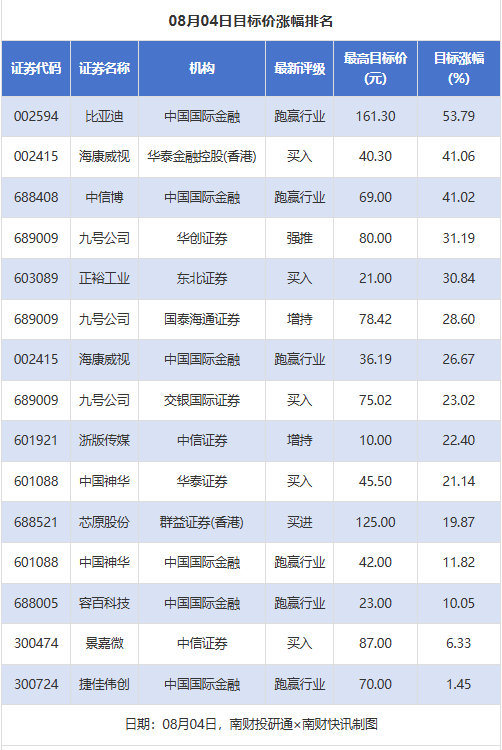
炒股就看金麒麟分析师研报,权威,专业,及时,全面,助您挖掘潜力主题机会! 从评级调整方向来看,19只个股评级维持不变,1只个股评级获调高,7只个股为首次评级。此外,有2 只个股获多家券商关注,中国神华、九号公司-WD获评级数量居前,分别有4家、3家券商给予评级。 从获买入评级个股所属Wind行业来看,耐用消费品与服装、技术硬件与设备、能源Ⅱ买入评级个股数 量最多,分别有6只、5只、4只。 Wind数据显示,8月4日,共有27只个股获券商买入评级,其中5只个股公布了目标价格。按最高目标价 计算,九号公司-WD、正裕工业、中国神华目标涨幅排名居前,涨幅分别达31.19%、30.84%、 21.14%。 ...
民生证券给予中国神华推荐评级,事件点评:大规模资产收购启动,黑金龙头再启航
Mei Ri Jing Ji Xin Wen· 2025-08-05 00:37
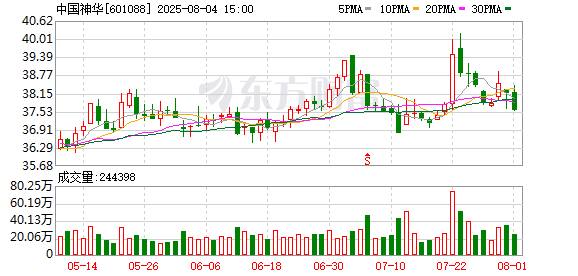
Group 1 - The core viewpoint of the report is a recommendation for China Shenhua (601088.SH) with a latest price of 37.56 yuan [2] - The asset coverage includes "coal, electricity, chemical, transportation, and sales," which addresses industry competition issues and enhances integrated operational capabilities [2] - Post-restructuring, the coal resource volume and production capacity have significantly increased [2] - The company is expected to maintain a high dividend payout ratio [2] - The company has ample cash on hand, which is likely to improve its cash utilization and enhance overall ROE [2]
【中国神华(601088.SH)】资产注入拉开帷幕,黑金航母踵事增华——重大事件点评(李晓渊/蒋山)
光大证券研究· 2025-08-04 23:03
Core Viewpoint - The company plans to issue shares and pay cash to acquire assets from the National Energy Group, including coal, coal power, and coal chemical assets, while raising matching funds, marking the beginning of a significant asset injection process [3][4]. Group 1: Transaction Details - The transaction is a fulfillment of previous agreements to avoid competition with the National Energy Group, with multiple agreements signed from 2005 to 2023 [4]. - The assets involved include 14 priority acquisition targets from the Shenhua Group and its subsidiaries, indicating a potential for substantial business growth beyond market expectations [4]. Group 2: Coal Production Capacity - In 2024, the National Energy Group's coal production is projected at 620 million tons, with sales of 850 million tons, while China Shenhua's production is expected to be 330 million tons and sales at 460 million tons, indicating significant untapped capacity of around 300 million tons outside the listed company [5]. - The previously unacquired coal production capacity within the scope of the avoidance agreement exceeds 180 million tons, suggesting ample room for future growth [5]. Group 3: Precedent for Asset Acquisition - The company previously acquired 100% of the equity of Hanjin Energy from the National Energy Group for 850 million yuan, which included significant coal mining and power generation assets [6]. - The resource price per ton for Hanjin Energy was estimated at only 1.3 yuan, indicating a favorable valuation compared to recent auction prices for similar resources [6].
整合深化 产业共进 形式创新 并购重组市场活跃度提升
Zhong Guo Zheng Quan Bao· 2025-08-04 22:36
● 本报记者 昝秀丽 政策支持并购重组的信号再次释放。中国证监会近期召开2025年年中工作会议强调,大力推动上市公司 提升投资价值,抓好"并购六条"和重大资产重组管理办法落实落地。 近期,A股上市公司专业化整合加速,传统产业与新兴产业并购齐头并进,并购形式更加多元,折射出 并购重组市场活跃度持续提升。市场人士预期,未来,更多具有标杆意义的并购重组案例有望持续涌 现。 专业化整合加速 在传统产业并购方面,传统行业通过并购实现转型升级的诉求较为强烈。例如,海南高速(000886)拟 收购交控石化51.0019%股权。 业内人士认为,随着政策持续发力,在传统产业领域,专业化整合将继续深化,企业通过并购实现规模 效应和资源优化配置,提升行业集中度。在新兴产业领域,更多的企业将通过并购切入新赛道,加快技 术创新和产业升级。 一个最新案例是中国神华(601088)启动大规模资产重组。中国神华相关负责人表示,公司启动此次大 规模重组,拟一次性整合13家核心煤炭及相关产业主体,系统性注入控股股东国家能源集团主要煤炭产 业链资产。这是继2025年1月,中国神华公告对国家能源集团杭锦能源有限责任公司100%股权收购并于 次月实现 ...
并购重组市场活跃度提升
Zhong Guo Zheng Quan Bao· 2025-08-04 21:06
Core Viewpoint - The Chinese government is signaling strong support for mergers and acquisitions (M&A) and restructuring in the market, emphasizing the need for listed companies to enhance investment value and implement management measures for significant asset restructuring [1] Group 1: Accelerated Professional Integration - A-share listed companies are actively engaging in M&A and restructuring focused on their core businesses, reflecting an accelerated trend of professional integration [1] - China Shenhua has initiated a large-scale asset restructuring, planning to integrate 13 core coal and related industry entities, which will fundamentally improve the overlap issues with its controlling shareholder, the State Energy Group [1] Group 2: Traditional and Emerging Industries - M&A activities are occurring across both traditional and emerging industries, with significant interest in sectors like semiconductors and high-end manufacturing [2] - Notable transactions include Chipone Technology's acquisition of a 72.33% stake in Chipone Yuzhou and Northern Huachuang's acquisition of Chip Source Micro, aimed at enhancing their semiconductor equipment industry chain [2] - High-tech companies, often in early loss stages but with substantial growth potential, are being targeted by mature firms for M&A to facilitate technology upgrades and industry transformation [2] Group 3: Diverse M&A Forms - The implementation of the "Six Guidelines for M&A" has led to a more diversified approach in M&A forms, including absorption mergers, private placements, and asset swaps [3] - Absorption mergers are particularly encouraged, with new regulations establishing simplified review processes for such transactions, thereby unlocking potential in this area [3] Group 4: Institutional Participation - The recent amendments to the Major Asset Restructuring Management Measures are expected to increase private equity fund participation in M&A activities, enhancing institutional capabilities in post-investment empowerment and resource integration [4]


中国神华(601088):点评:集团煤电化运资产有望注入,将夯实公司一体化运营模式
Shenwan Hongyuan Securities· 2025-08-04 15:18
Investment Rating - The investment rating for China Shenhua (601088) is "Buy" [6]. Core Views - The report highlights that the group’s coal, electricity, and chemical transportation assets are expected to be injected, which will solidify the company's integrated operation model [6]. - The transaction involves 13 assets from the controlling shareholder, China Energy Group, aimed at resolving competition issues and consolidating high-quality coal resources into the listed company [6]. - The company’s performance in the first half of 2025 is projected to be stable, with a net profit forecast of approximately 236-256 billion yuan, despite a year-on-year decline [6]. - The high dividend yield is emphasized as a long-term investment value, with a projected dividend payout ratio of at least 65% of the net profit [6]. - The earnings forecast for 2025-2027 has been adjusted downwards due to falling market coal prices, with expected earnings per share (EPS) of 2.47, 2.52, and 2.56 yuan respectively [6]. Financial Data and Profit Forecast - Total revenue for 2024 is projected at 338,375 million yuan, with a year-on-year decline of 1.4% [2]. - The net profit attributable to shareholders for 2025 is estimated at 49,108 million yuan, reflecting a decrease of 16.3% year-on-year [2]. - The gross profit margin is expected to be 32.0% in 2025, down from 34.0% in 2024 [2]. - The return on equity (ROE) for 2025 is projected at 12.0% [2]. Market Data - As of August 4, 2025, the closing price of the stock is 37.56 yuan, with a market capitalization of 619,403 million yuan [3]. - The stock has a price-to-earnings (PE) ratio of 15 for the forecasted years [6]. - The dividend yield is approximately 6.02%, based on the most recent dividend announcement [3].
今天的两条主线
表舅是养基大户· 2025-08-04 13:34
Group 1 - The article discusses the current market sentiment, highlighting that a strong performance in the stock market during challenging times can significantly boost investor confidence [1][2] - It identifies two main themes in the market: interest rate cuts and the behavior of capital flows, particularly from southbound funds [3][8] - The article notes that southbound funds sold over 18 billion, marking the third-largest single-day net sell since September of the previous year, while the Hang Seng Index showed a divergence by continuing to rise [3][5] Group 2 - The article emphasizes the global stock market's rebound, with the S&P 500 and Nasdaq 100 showing significant gains based on expectations of interest rate cuts by the Federal Reserve [7][9] - It explains that the recent strong performance of the US dollar led to a sell-off in Hong Kong dollar assets, prompting the Hong Kong Monetary Authority to intervene by buying HKD [8][9] - The article highlights that the A-share market is primarily driven by sentiment and capital, with a notable recovery in market mood as the Hang Seng Index rose [11][12] Group 3 - The article presents data on margin financing, indicating a pattern of consistent net buying followed by a reversal, suggesting that there is still significant capital waiting to enter the market [15][17] - It discusses the relationship between long-term bonds and the stock market, noting that bond prices acted as a leading indicator for stock movements [18][20] - The article concludes with a recommendation for investors to maintain a diversified and balanced asset allocation strategy in light of global interest rate cut trends [21][22] Group 4 - The article mentions that gold and US Treasuries are benefiting from the interest rate cut narrative, with gold prices rising significantly [25][26] - It highlights the performance of gold ETFs, noting that they are among the few low-fee options available in the market [28] - The article discusses the bond market's current sentiment and the potential for future bond purchases depending on new bond issuance [30][32]

中国神华,拟一次性收购13家公司
Di Yi Cai Jing Zi Xun· 2025-08-04 13:10
Core Viewpoint - China Shenhua Energy Co., Ltd. is planning a significant restructuring by acquiring equity stakes in 13 energy assets from its controlling shareholder, China Energy Investment Corporation, which will enhance its coal resource strategic reserves and integrated operational capabilities [1][3]. Group 1: Transaction Overview - The transaction involves the acquisition of coal mining, coal power, coal-to-oil, coal-to-gas, coal chemical, and related logistics transportation assets, covering core segments of the energy industry chain [1]. - This restructuring aims to fundamentally improve the overlap in coal resource development between the controlling shareholder and the listed company, which is crucial for China's energy system reform [1][3]. Group 2: Strategic Benefits - The restructuring will optimize the entire coal industry chain's resource allocation, enhancing operational efficiency and creating synergistic benefits across production, transportation, and conversion processes [3]. - Post-restructuring, upstream coal mining will ensure stable resource supply, while downstream coal-to-oil and chemical technology platforms will improve clean and efficient conversion levels [3]. - The logistics segment will establish a self-controlled transportation network, significantly enhancing the efficiency of the "West Coal East Transport" strategy [3]. Group 3: Regional Coordination - The establishment of a cross-regional capacity coordination mechanism will enhance China Shenhua's ability to respond to seasonal and structural supply-demand fluctuations in key energy consumption areas [4]. - During critical energy supply periods, such as summer peaks and winter heating, a unified management platform will enable efficient responses to national macro-control demands, reinforcing energy security [4].