CSEC,China Shenhua(601088)

Search documents
中国神华再购大股东资产化解同业竞争 累计分红4610亿资产负债率仅23.71%
Chang Jiang Shang Bao· 2025-08-03 23:34
Core Viewpoint - China Shenhua, a leading coal company, is planning a significant acquisition of assets from its controlling shareholder, China Energy Investment Corporation, to enhance resource integration and reduce industry competition [2][3][7]. Group 1: Acquisition Details - The acquisition involves purchasing assets related to coal, coal power, coal-to-oil, coal-to-gas, and coal chemical industries, including 13 companies [3][6]. - The transaction is expected to be a related party transaction and will not constitute a major asset restructuring, with no change in the actual controller of the company [6][7]. - The acquisition aims to fulfill commitments to resolve industry competition and improve the quality of the listed company [7][8]. Group 2: Financial Performance - As of the first quarter of 2025, China Shenhua's total assets exceeded 670 billion yuan, with a debt-to-asset ratio of only 23.71% [3][5][14]. - The company has a strong history of cash dividends, having distributed approximately 461 billion yuan since its listing, with an average dividend payout ratio of 61.53% [4][14]. - Despite significant cash dividends, the company's financial health remains robust, with cash reserves of 155.4 billion yuan and interest-bearing liabilities of 49.3 billion yuan [14]. Group 3: Market Context - The coal industry is cyclical and closely tied to macroeconomic conditions, which can lead to fluctuations in performance [12][13]. - For the first half of 2025, China Shenhua anticipates a decline in net profit attributable to shareholders, estimated between 23.6 billion and 25.6 billion yuan, reflecting a decrease of 13.2% to 20.0% year-on-year due to lower sales volume and prices [12][13].



藏格矿业:上半年碳酸锂业务毛利率逾30%;中国神华:股票8月4日起停牌
Mei Ri Jing Ji Xin Wen· 2025-08-03 23:28
Group 1 - Cangge Mining reported a gross profit margin of 30.53% for its lithium carbonate business in the first half of 2025, indicating strong product competitiveness [1] - The company received a mining license from the Tibet Autonomous Region's Natural Resources Department, allowing it to legally exploit salt lake resources [1] - The production cost of lithium carbonate for the first phase of the Mami Cuo project is approximately 31,000 yuan per ton, suggesting potential for cost control and competitive advantage in the industry [1] Group 2 - Bangjie Co. announced that major shareholders Shanghai Fangyuan and Zhejiang Dianchuang plan to reduce their holdings, with Shanghai Fangyuan intending to sell up to 6.7462 million shares (1.47% of total shares) and Zhejiang Dianchuang planning to sell up to 4.4974 million shares (0.98% of total shares) through various trading methods [2] - The reduction in shareholding is attributed to the shareholders' personal financial planning, and it is not expected to significantly impact the company's control or governance structure [2] - The market may reassess Bangjie Co.'s industry position due to performance pressures following its diversification into the photovoltaic sector [2] Group 3 - China Shenhua has announced plans to issue shares and pay cash to acquire assets from the State Energy Group, including coal, coal power, and related assets, while also raising supporting funds [3] - The transaction aims to enhance the company's control over its "coal-electricity-transport-chemistry" industrial chain, improving its risk resilience [3] - This move is part of a broader trend of central enterprise coal asset integration, which is expected to increase industry concentration and promote efficient and green development [3]


财经早报:特朗普再批劳工统计局前局长制造“骗局”,下半年央行降准降息均有空间
Xin Lang Zheng Quan· 2025-08-03 23:26
【头条要闻】 下半年货币政策如何发力稳增长? 降准降息均有空间 近期召开的多个会议"定调"下半年货币政策。作为宏观调控的一大"主角",下一阶段的货币政策可能盯 住哪些目标,又面临哪些掣肘?为巩固拓展经济回升向好势头,货币政策在总量、价格、结构上还将如 何发力? 业内专家认为,宏观经济形势、银行息差水平、宏观杠杆率水平、主要发达经济体货币政策等因素,可 能影响我国下半年货币政策操作的"相机抉择"。货币政策有望在促进社会综合融资成本下行、助力经济 结构调整优化等方面进一步发力。降准降息均有操作空间和落地可能性。 多家国有大行表态落实国常会贴息政策 助推消费升级与服务业焕新 在7月31日召开的国务院常务会议部署实施个人消费贷款贴息政策与服务业经营主体贷款贴息政策后, 《证券日报》记者了解到,多家国有大行率先表态,将切实做好个人消费贷款和服务业经营主体贷款贴 息政策的传导落实。 在业内人士看来,此次会议部署是国家提振内需、激发市场活力、保障和改善民生的又一重要举措。政 策从需求和供给两端发力,通过财政金融协同,有效降低居民消费融资成本、缓解服务业经营主体融资 压力,畅通经济循环,为巩固经济回升向好态势注入强劲动能。 ...



藏格矿业:上半年碳酸锂业务毛利率逾30%;中国神华:股票8月4日起停牌丨新能源早参
Mei Ri Jing Ji Xin Wen· 2025-08-03 23:23
Group 1 - Cangge Mining reported a gross margin of 30.53% for its lithium carbonate business in the first half of 2025, indicating strong product competitiveness [1] - The company received a mining license from the Tibet Autonomous Region's Natural Resources Department, allowing it to legally exploit salt lake resources [1] - The production cost for lithium carbonate after the first phase of the Mami Cuo project is estimated to be around 31,000 yuan per ton, suggesting potential for cost control and profitability expansion [1] Group 2 - Bangjie Co. announced that major shareholders Shanghai Fangyuan and Zhejiang Dianchuang plan to reduce their holdings, with Shanghai Fangyuan intending to sell up to 6.7462 million shares (1.47% of total shares) and Zhejiang Dianchuang planning to sell up to 4.4974 million shares (0.98% of total shares) through various trading methods [2] - The reduction in shareholding is attributed to the shareholders' personal financial planning, and it is not expected to significantly impact the company's control or governance structure [2] - The market may reassess Bangjie Co.'s industry position due to performance pressures following its diversification into the photovoltaic sector [2] Group 3 - China Shenhua has announced plans to issue shares and pay cash to acquire assets from the State Energy Group, including coal, coal power, and coal chemical assets, while also raising supporting funds [3] - The transaction aims to enhance China Shenhua's control over its "coal-electricity-transport-chemistry" industrial chain, improving its risk resilience and potentially introducing new technologies and R&D resources [3] - This move represents a significant step in the consolidation of state-owned coal assets, which is expected to increase industry concentration and optimize resource allocation towards a more efficient and greener development direction [3]
周末突发黑天鹅,周一A股怎么走?
Zhong Guo Ji Jin Bao· 2025-08-03 22:35
Group 1: Economic Indicators - The U.S. non-farm payrolls increased by 73,000 in July, falling short of the expected 104,000 and marking a nine-month low [1] - The combined job additions for May and June were revised down by 258,000, indicating a significant slowdown in employment growth [1] Group 2: Oil Production - Major oil-producing countries, including Saudi Arabia, Russia, Iraq, and the UAE, plan to approve a significant production increase of 548,000 barrels per day in September [2] - These countries had previously announced voluntary production cuts of 2.2 million barrels per day, which have been extended until March 2025 [2] Group 3: Monetary Policy - The People's Bank of China is committed to implementing a moderately loose monetary policy, including lowering reserve requirements and interest rates to support economic growth [4] - The central bank aims to maintain ample liquidity and improve the financing costs for the economy [4] Group 4: Taxation Changes - Starting from August 8, 2025, the Ministry of Finance and the State Taxation Administration will reinstate VAT on interest income from newly issued government bonds and other financial instruments [5] Group 5: Digital Transformation in Manufacturing - Eight departments in China have issued a plan for the digital transformation of the machinery industry, aiming to establish at least 200 exemplary smart factories by 2027 [6][7] - The plan emphasizes the widespread application of digital technologies in various manufacturing processes and aims for 50% of enterprises to achieve a maturity level of at least two in smart manufacturing capabilities [6][7] Group 6: Corporate Actions - China Shenhua announced plans to issue shares and pay cash to acquire assets from its controlling shareholder, leading to a temporary suspension of its stock [8] Group 7: Market Analysis and Strategies - Major brokerages are focusing on sectors such as AI, innovative pharmaceuticals, and resources, indicating a trend towards high-consensus stocks rather than low-positioned stocks [9] - The market is expected to experience fluctuations, with a potential return to an upward trend in late August, driven by earnings reports and geopolitical events [12][13] - Analysts suggest that the current market environment remains conducive to a slow bull market, supported by ample liquidity and positive investor sentiment [18][20]
中国神华启动大规模资产重组
Zhong Guo Zheng Quan Bao· 2025-08-03 21:12
Core Viewpoint - China Shenhua is planning a significant restructuring by acquiring coal-related assets from its controlling shareholder, State Energy Group, which will enhance its coal resource reserves and operational capabilities [1][2]. Group 1: Restructuring Details - The restructuring involves the acquisition of 13 companies, including key players in coal production and logistics, which will address the overlap in coal resource development between China Shenhua and State Energy Group [1]. - This move is seen as a strategic step to resolve industry competition issues and improve operational efficiency within the coal sector [1][2]. Group 2: Strategic Importance - The integration of high-quality coal resources is expected to significantly increase China Shenhua's strategic reserves and solidify its position as a leading player in the domestic coal industry [2]. - The restructuring will create a modern coal supply system that enhances the company's ability to respond to seasonal and structural supply-demand fluctuations, particularly during critical energy supply periods [2]. Group 3: Impact on Company Development - The restructuring is anticipated to improve China Shenhua's cash flow and overall profitability, thereby enhancing its capacity to return value to investors [3]. - This initiative is a reflection of the company's commitment to high-quality development and aligns with national policies encouraging mergers and acquisitions in the energy sector [3].
周末,突发黑天鹅!周一,A股怎么走?
中国基金报· 2025-08-03 15:21
【导读】回顾周末大事,汇总十大券商最新研判 中国基金报记者 泰勒 1.美国黑天鹅!7月非农就业人数增加7.3万人,不及市场预期 美国7月非农就业人数增加7.3万人,预估为增加10.4万人,前值为增加14.7万人。数据创9 个月以来新低。 更令人担忧的是5月和6月新增就业合计下修25.8万(相当于2个月新增就业近乎归0,当然不 排除7月就业继续下修的可能)。数据公布后,市场对美国经济下行的担忧演绎到了极致,美 元立刻跳水,几乎消化了7月底以来的一半涨幅,美股大跌,而9月降息概率也从此前的不降 息飙升至70%以上。 2.消息人士称主要产油国计划9月继续增产 8月3日,据央视新闻报道,据路透社援引消息人士的话报道,沙特、俄罗斯、伊拉克和阿联 酋等欧佩克和非欧佩克产油国中的 八个主要产油国 ,计划在8月3日举行的会议上批准9月 再 次大幅增产,日均增产54.8万桶 。 欧佩克和非欧佩克产油国中的8个主要产油国2023年11月宣布日均220万桶的自愿减产措 施,此后减产措施多次延期,于2024年12月延长至2025年3月底。8国今年3月决定自4月1 日起逐步增加石油产量,以回撤自愿减产措施。之后,这些主要产油国7月日均 ...

601088、300264,明起停牌!
Zheng Quan Shi Bao· 2025-08-03 14:56
Group 1 - China Shenhua and Jia Chuang Vision will suspend trading from August 4, 2025 [1][4] - Jia Chuang Vision's controlling shareholder is planning a change in company control, which may lead to a transfer of shares [2][4] - China Shenhua is planning to issue shares and pay cash to acquire assets from its controlling shareholder, National Energy Group, and raise supporting funds [5][6] Group 2 - The suspension for China Shenhua's A-shares is expected to last no more than 10 trading days [6] - During the suspension of China Shenhua's A-shares, its H-shares will continue to trade [7]

601088、300264,明起停牌!
证券时报· 2025-08-03 14:52
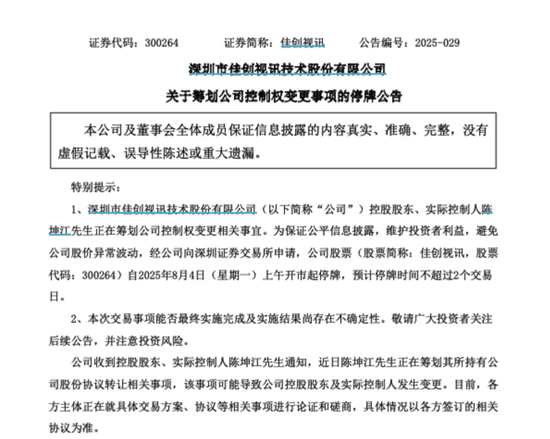
中国神华、佳创视讯8月4日起停牌。 根据上市公司公告,中国神华(601088)、佳创视讯(300264)股票均将自8月4日起停牌,其中,中国神华筹划发行股份及支付现金购买资产并募集配套资金,佳 创视讯控股股东筹划公司控制权变更事项。 佳创视讯:控股股东筹划公司控制权变更事项 8月3日晚,佳创视讯发布公告称,公司收到控股股东、实际控制人陈坤江先生通知,近日陈坤江先生正在筹划其所持有公司股份协议转让相关事项,该事项可能导 致公司控股股东及实际控制人发生变更。目前,各方主体正在就具体交易方案、协议等相关事项进行论证和磋商,具体情况以各方签订的相关协议为准。 公告称,鉴于上述事项尚存在重大不确定性,为保证公平信息披露,维护投资者利益,避免造成公司股价异常波动,根据相关规定,经公司向深圳证券交易所申 请,公司股票自2025年8月4日(星期一)开市起停牌,预计停牌时间不超过2个交易日。 中国神华:筹划发行股份及支付现金购买资产并募集配套资金 8月1日晚,中国神华公告称,公司当天收到控股股东国家能源投资集团有限责任公司(以下简称"国家能源集团")的《关于筹划重大事项的通知》,初步考虑拟由 公司发行股份及支付现金购买国家能源 ...

“反内卷”降温,煤炭行情结束了吗?
Changjiang Securities· 2025-08-03 13:13
Investment Rating - The industry investment rating is "Positive" and maintained [11] Core Viewpoints - The recent decline in coal prices, influenced by the cooling of "anti-involution" measures, does not signify the end of the coal equity market. The report suggests that the bottom for coal equities has been established, and valuations are expected to continue to recover, particularly for companies like Yanzhou Coal Mining and China Coal Energy, which have growth potential and improving balance sheets [2][7][9]. Summary by Sections Weekly Tracking Summary - The coal index (Yangtze River) fell by 4.54%, underperforming the CSI 300 index by 2.79 percentage points. The decline in coal prices is attributed to a divergence between sentiment and reality, with thermal coal prices at 663 RMB/ton, up 10 RMB/ton week-on-week, and coking coal prices stable at 1680 RMB/ton [6][16]. Supply and Demand Situation - As of July 31, the daily coal consumption in 25 provinces was 607.8 million tons, an increase of 8.1% week-on-week. The total coal inventory was 122.48 million tons, down 1.2% week-on-week, with a usable days supply of 20.2 days, a decrease of 1.9 days [17][33]. Price Trends - The report notes that the price of thermal coal at Qinhuangdao port is 663 RMB/ton, reflecting a week-on-week increase of 10 RMB/ton. Coking coal prices remain stable at 1680 RMB/ton, while the price of metallurgical coke has increased by 50 RMB/ton to 1430 RMB/ton [16][42]. Company Recommendations - Recommended stocks include: 1. Elastic stocks: Yanzhou Coal Mining (A+H), Lu'an Environmental Energy, Pingmei Shenma Energy, Huainan Mining, Jin Coal International 2. Long-term stable profit leaders: China Coal Energy (A+H), China Shenhua Energy (A+H), Shaanxi Coal and Chemical Industry 3. Transitioning growth: Electric Power Investment Energy [9][8].