FII(601138)

Search documents
数据看盘实力游资和机构激烈博弈潍柴动力 IM期指空头大幅减仓
Sou Hu Cai Jing· 2025-11-06 10:00
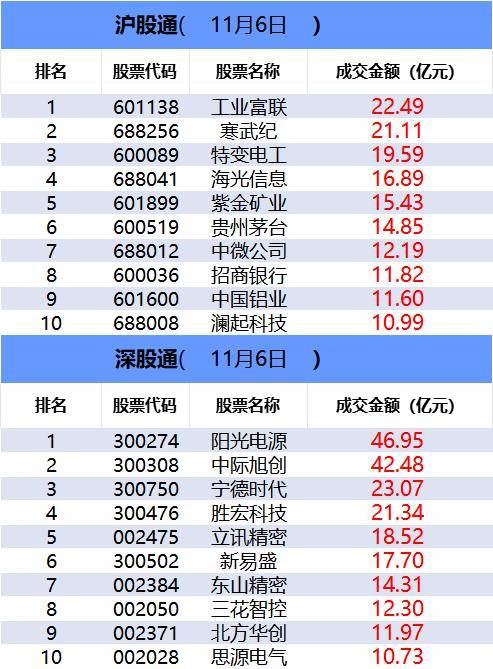
Core Insights - The total trading volume of the Shanghai and Shenzhen Stock Connect reached 244.206 billion, with Industrial Fulian and Sungrow Power ranking first in their respective exchanges [1][2] - The electronic sector saw the highest net inflow of funds, while the chemical ETF experienced a significant increase in trading volume, up 130% compared to the previous trading day [1][5][12] Trading Volume Summary - The total trading amount for the Shanghai Stock Connect was 119.876 billion, while the Shenzhen Stock Connect was 124.329 billion [2] - The top traded stocks on the Shanghai Stock Connect included Industrial Fulian (22.49 billion), Cambricon (21.11 billion), and TBEA (19.59 billion) [3] - The top traded stocks on the Shenzhen Stock Connect included Sungrow Power (46.95 billion), Zhongji Xuchuang (42.48 billion), and CATL (23.07 billion) [4] Sector Performance - The electronic sector led with a net inflow of 111.77 billion, followed by the non-ferrous metals and industrial metals sectors [6] - The cultural media sector experienced the highest net outflow of funds, totaling -43.42 billion [7] ETF Trading Activity - The top ETF by trading volume was the Hong Kong Securities ETF, with a trading amount of 134.674 billion, followed by the Hong Kong Innovative Drug ETF at 60.524 billion [10][11] - The chemical ETF saw a remarkable trading volume increase of 130.39% compared to the previous trading day [12] Futures Positioning - In the futures market, the IM contract saw a significant reduction in long positions, while the short positions also decreased [13] Stock Market Activity - On the stock market, Weichai Power hit the daily limit and attracted 231 million from two major retail investors, but faced a sell-off of 143 million from an institution [1][15] - The top stocks with net inflows included Shenghong Technology (16.16 billion) and Zhongke Shuguang (9.72 billion) [8] - The stocks with the highest net outflows included TBEA (-15.92 billion) and Pingtan Development (-10.05 billion) [9]





工业富联(601138) - 富士康工业互联网股份有限公司2025年第二次临时股东大会会议资料
2025-11-06 09:15
富士康工业互联网股份有限公司 2025 年第二次临时股东大会会议资料 富士康工业互联网股份有限公司 2025 年第二次临时股东大会会议资料 1 富士康工业互联网股份有限公司 2025 年第二次临时股东大会会议资料 2 现场会议召开地点:广东省深圳市南山区高新技术产业园区南区科 苑大道与学府路交汇处高新区联合总部大厦 52 层 召 集 人:富士康工业互联网股份有限公司董事会 网络投票:采用上海证券交易所网络投票系统,通过交易系统投票 平台的投票时间为股东大会召开当日的交易时间段,即 9:15-9:25、9:30-11:30、13:00-15:00;通过互联网投票平 台的投票时间为股东大会召开当日的 9:15-15:00。 富士康工业互联网股份有限公司 2025 年第二次临时股东大会会议资料 会议须知 为了维护全体股东的合法权益,确保股东大会的正常秩序和议事 效率,敬请注意以下事项: 一、股东参加股东大会依法享有发言权、表决权等权利。 二、股东凭登记时领取的股东证进入会场,股东中途离开会场, 需凭股东证再次进入会场。会议结束后,请将股东证交还给工作人员。 三、本次股东大会设有问答环节,股东就本次会议议题及本公司 ...
工业富联(601138) - 富士康工业互联网股份有限公司关于召开2025年第三季度业绩说明会的公告
2025-11-06 09:00
证券代码:601138 证券简称:工业富联 公告编号:临 2025-081 号 富士康工业互联网股份有限公司 关于召开 2025 年第三季度业绩说明会的公告 本公司董事会及全体董事保证本公告内容不存在任何虚假记载、误导性陈述或 者重大遗漏,并对其内容的真实性、准确性和完整性承担法律责任。 重要内容提示: 一、说明会类型 公司已于 2025 年 10 月 30 日在上海证券交易所网站(www.sse.com.cn)及指定媒 体披露《富士康工业互联网股份有限公司 2025 年第三季度报告》。为使广大投资者更 全面深入了解公司 2025 年第三季度经营成果、财务状况,公司将于 2025 年 11 月 13 日(星期四)通过网络方式召开 2025 年第三季度业绩说明会。 二、说明会召开的时间、地点 (一)会议召开时间:2025 年 11 月 13 日(星期四)下午 14:00-15:00 (二)会议召开方式:网络方式 (三)网络直播地址:投资者可直接登录深圳市路演中网络科技有限公司网站 (https://www.roadshowchina.cn/w/meet/p5amGp)在线参与本次说明会。 三、参加人员 公司董事 ...
存储芯片涨价五成?SK海力士与英伟达谈拢!海光信息涨超8%
Xin Lang Cai Jing· 2025-11-06 03:36
Core Viewpoint - The electronic sector is currently leading the market, with the electronic ETF (515260) showing significant gains, indicating a potential positive shift in short-term momentum and mid-term trends [1] Group 1: Market Performance - As of November 6, the electronic ETF (515260) reached a peak increase of 3.15%, currently up by 2.55%, recovering both the 5-day and 20-day moving averages [1] - Nearly 90% of stocks in the electronic sector are in the green, with notable gains from companies like Haiguang Information (up over 8%) and Zhongke Shuguang (up over 7%) [4] Group 2: Industry Trends - A price surge in storage chips is underway, with SK Hynix announcing a 50% price increase for HBM4 supplies due to rising demand driven by AI applications [2][3] - The storage chip industry is expected to see continued price increases in Q4 2023, supported by AI demand and overall industry valuation improvements [3] Group 3: Investment Opportunities - The electronic ETF (515260) focuses on semiconductor and consumer electronics sectors, featuring major companies like Luxshare Precision and SMIC, which are positioned to benefit from current market trends [6] - The ETF's composition includes a significant 43.43% weight from Apple's supply chain, indicating strong potential due to the anticipated success of the iPhone 17 [6]




主力个股资金流出前20:吉视传媒流出6.87亿元、赛力斯流出6.20亿元





Jin Rong Jie· 2025-11-06 02:38
Core Insights - The main focus of the article is on the significant outflow of capital from specific stocks as of November 6, with notable amounts being withdrawn from various companies [1] Group 1: Major Stocks with Capital Outflow - The top stock with the highest capital outflow is Jishi Media, with a withdrawal of 687 million yuan [1] - Following Jishi Media, Sairisi experienced an outflow of 620 million yuan [1] - Xue Ren Group saw a capital outflow of 607 million yuan, ranking third in the list [1] Group 2: Additional Stocks with Significant Outflows - Tebian Electric experienced a capital outflow of 565 million yuan [1] - Haima Automobile had an outflow of 554 million yuan [1] - Pingtan Development saw a withdrawal of 367 million yuan [1] Group 3: Other Notable Stocks - Longi Green Energy experienced a capital outflow of 309 million yuan [1] - Shanzigaoke had an outflow of 295 million yuan [1] - Fulongma saw a withdrawal of 270 million yuan [1] Group 4: Remaining Stocks in the Top 20 - Xagong Co. experienced a capital outflow of 261 million yuan [1] - Leo Group had an outflow of 258 million yuan [1] - China Duty Free Group saw a withdrawal of 256 million yuan [1] - Hainan Development experienced an outflow of 253 million yuan [1] - Sanbian Technology had a capital outflow of 252 million yuan [1] - BlueFocus Communication Group saw a withdrawal of 250 million yuan [1] - Dawi Co. experienced an outflow of 229 million yuan [1] - Industrial Fulian had a capital outflow of 217 million yuan [1] - Runhe Software saw a withdrawal of 215 million yuan [1] - Wentai Technology experienced an outflow of 210 million yuan [1] - ST Huatuo had a capital outflow of 206 million yuan [1]
消费电子板块11月5日涨0.96%,显盈科技领涨,主力资金净流出5.57亿元
Zheng Xing Xing Ye Ri Bao· 2025-11-05 08:42
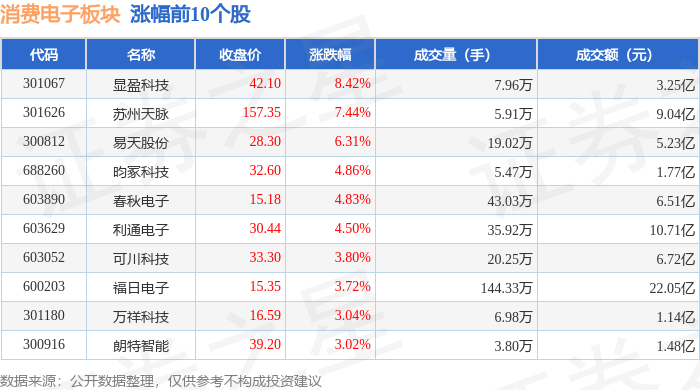
Core Insights - The consumer electronics sector experienced a rise of 0.96% on November 5, with significant gains led by Xianmi Technology [1] - The Shanghai Composite Index closed at 3969.25, up 0.23%, while the Shenzhen Component Index closed at 13223.56, up 0.37% [1] Stock Performance - Xianmi Technology (301067) saw a closing price of 42.10, with an increase of 8.42% and a trading volume of 79,600 shares [1] - Suzhou Tianmai (301626) closed at 157.35, up 7.44%, with a trading volume of 59,100 shares [1] - Yitian Co., Ltd. (300812) closed at 28.30, up 6.31%, with a trading volume of 190,200 shares [1] - Other notable performers include Yunzhong Technology (688260) with a 4.86% increase and Chunqiu Electronics (603890) with a 4.83% increase [1] Capital Flow - The consumer electronics sector saw a net outflow of 557 million yuan from institutional investors, while retail investors contributed a net inflow of 390 million yuan [2] - The overall capital flow indicates a mixed sentiment, with institutional investors withdrawing funds while retail investors increased their positions [2] Individual Stock Capital Flow - Industrial Fulian (601138) had a net inflow of 28 million yuan from institutional investors, while retail investors saw a net outflow of 29 million yuan [3] - Lixun Precision (002475) experienced a net inflow of 25 million yuan from institutional investors, but a net outflow of 95 million yuan from retail investors [3] - Suzhou Tianmai (301626) had a net inflow of 12.5 million yuan from institutional investors, with significant outflows from both retail and speculative investors [3]

A股收评:创业板指涨超1%,电网设备板块持续爆发
2 1 Shi Ji Jing Ji Bao Dao· 2025-11-05 07:37
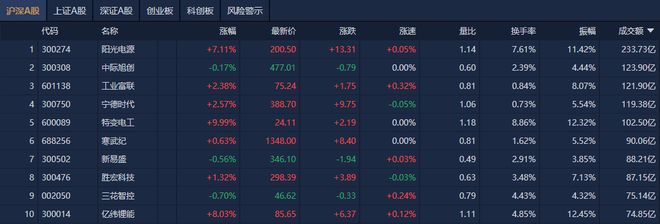
Market Overview - The market experienced a rebound throughout the day, with all three major indices closing in the green. The Shanghai Composite Index rose by 0.23%, the Shenzhen Component Index increased by 0.37%, and the ChiNext Index gained 1.03% [1]. Sector Performance - The market saw active rotation of hotspots, with nearly 3,400 stocks rising. The electric grid equipment sector showed significant strength, with stocks like Jingquanhua achieving three consecutive trading limit ups, and others like Moen Electric and Shenneng Electric reaching two consecutive limit ups. Nearly 20 stocks in this sector hit the daily limit [2]. - The Hainan sector strengthened again, with multiple stocks such as Haima Automobile hitting the daily limit [2]. - The Fujian sector was also active, with companies like XG Group achieving two consecutive limit ups [2]. - The broad consumer concept stocks collectively strengthened, with companies like Caesar Travel and Anji Food hitting the daily limit [2]. - The energy storage sector led the way, with Tongrun Equipment hitting the daily limit and achieving a new trend high, while companies like Aters also reached a limit up of 20cm [2]. Declining Stocks - Quantum technology concept stocks experienced a pullback, with Keda Guochuang and Geer Software showing weakness [3]. Trading Volume - The total trading volume in the Shanghai and Shenzhen markets was 1.87 trillion yuan, a decrease of 45.3 billion yuan compared to the previous trading day [4]. Individual Stock Highlights - Yangguang Electric Power had the highest trading volume at over 23.3 billion yuan, followed by Zhongji Xuchuang, Industrial Fulian, and Ningde Times with significant trading volumes as well [5].


AI到底有没有泡沫?工业富联后市如何?
Quan Jing Wang· 2025-11-05 05:52
Core Viewpoint - The current AI wave is creating a dichotomy in the market, with major tech companies increasing capital expenditure while facing pressure from short sellers [1] Group 1: AI Investment Landscape - The current enthusiasm around AI is fundamentally different from the internet bubble of the late 1990s, as today's leading AI companies are large, profitable, and have strong balance sheets [2] - Key differences include the scale and profitability of AI companies compared to the small, loss-making companies during the internet bubble [2] - AI demand is supported by clear orders, with Microsoft’s commercial remaining performance obligations increasing by 51% to $392 billion and Alphabet’s Cloud backlog growing by 46% to $155 billion [2] Group 2: Infrastructure Development - Concerns about a slowdown in AI infrastructure development are unfounded, as evidence suggests that AI infrastructure is currently in a phase of accelerated expansion [4] - Major tech companies are significantly increasing their capital expenditure, with Meta raising its 2025 capital expenditure guidance to $70-72 billion, and Alphabet increasing its guidance from $85 billion to $91-93 billion [4] - Industrial Fulian reported a stockpiling amount exceeding 160 billion yuan, indicating strong demand for AI infrastructure [4] Group 3: Investment Strategies - The focus for investors is on identifying segments with clear demand and performance, with "picks and shovels" companies like Industrial Fulian being particularly attractive [5] - Industrial Fulian's net profit for the first three quarters reached 22.487 billion yuan, a year-on-year increase of 48.52%, nearing last year's total [5] - The AI server business has shown explosive growth, with revenue from GPU AI servers increasing over 300% year-on-year in the first three quarters [5][6]
大消费走强、科技股集体回调!发生了什么?
天天基金网· 2025-11-05 05:20
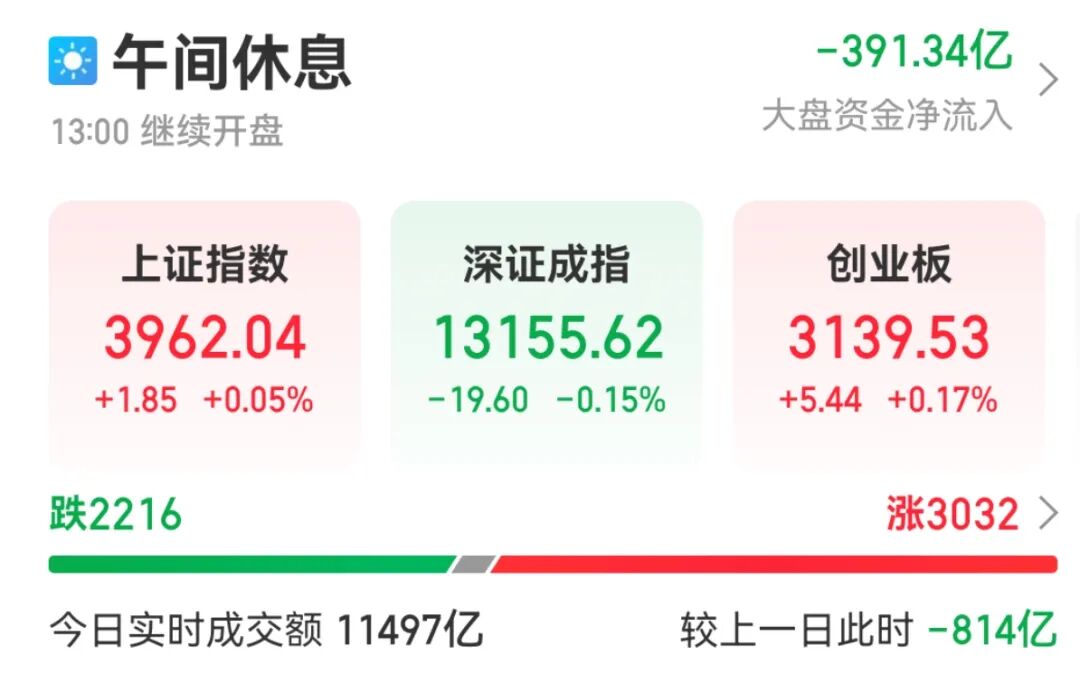
Market Overview - A-shares have shown resilience despite several external negative impacts this year, with indices quickly recovering after initial declines [3][4] - As of the morning close, the Shanghai Composite Index rose by 0.05%, while the Shenzhen Component fell by 0.15%, and the ChiNext Index increased by 0.17% [4] Consumer Sector Performance - The consumer sector, particularly the duty-free store segment, performed strongly in the morning, with leading stocks like China Duty Free Group rising over 4% [9][10] - The duty-free store sector has recently benefited from favorable policies, including the expansion of product categories in duty-free shops, effective from November 1 [12] Duty-Free Policy Impact - New policies from the Ministry of Finance and other departments aim to boost consumption by expanding the range of products available in duty-free stores, including mobile phones and health foods [12] - Following the implementation of new duty-free shopping policies in Hainan, sales surged to 78.549 million yuan on the first day, marking a 6.1% increase compared to the previous day [12] Tourism and Hospitality Sector - The tourism and hospitality sectors, including snow sports, have seen an uptick in stock prices, driven by increased interest in winter travel and upcoming holiday arrangements [13] - The announcement of the 2026 holiday schedule has led to a significant increase in travel bookings, particularly for the New Year and Spring Festival [13] Technology Sector Trends - The technology sector experienced a pullback, particularly in semiconductor and AI stocks, with notable declines in companies like Industrial Fulian and Cambricon [15] - Market sentiment has shifted, with significant short positions taken against major AI companies, indicating growing skepticism about the sustainability of the AI narrative [15] Investment Opportunities - The ice and snow industry is identified as a potential investment opportunity, with recommendations to focus on infrastructure development, equipment manufacturing, and training related to winter sports [13]



逾116万手封单!千亿龙头,涨停
Zhong Guo Zheng Quan Bao· 2025-11-05 04:57
Market Performance - A-shares demonstrated resilience despite external negative influences, with major indices initially opening lower but recovering during trading [1] - By the end of the morning session, the Shanghai Composite Index rose by 0.05%, while the Shenzhen Component Index fell by 0.15%, and the ChiNext Index increased by 0.17% [1] Consumer Sector - The consumer sector showed strong performance, particularly in the duty-free store segment, with leading stocks like China Duty Free Group rising over 4% [5][8] - Notable stocks in the consumer sector included: - Caesar Travel (up 10.01% with a market cap of 9.94 billion) - Hainan Development (up 9.99% with a market cap of 13.3 billion) - Dongbai Group (up 9.98% with a market cap of 6.13 billion) [7] Duty-Free Policy Changes - Recent favorable policies for the duty-free store sector were announced, effective from November 1, expanding the range of products available for sale [8] - The new policy includes items such as mobile phones, drones, sports goods, health foods, over-the-counter drugs, and pet foods [8] - On the first day of the new duty-free shopping policy in Hainan, sales reached 78.549 million, with a 6.1% increase compared to the previous day [8] Tourism and Hospitality - The tourism and hospitality sectors saw gains, with companies like Snowman Group and Tianfu Cultural Tourism experiencing stock price increases [9] - The announcement of the 2026 holiday schedule, including a nine-day Spring Festival break, led to a surge in online travel bookings [9] - The ice and snow tourism market is gaining traction, with increased flight capacity for winter travel routes [9] Technology Sector - The technology sector experienced a pullback, particularly in semiconductor and AI stocks, with notable declines in companies like Industrial Fulian and Cambricon [10] - Market sentiment was affected by reports of Michael Burry's fund shorting Nvidia and Palantir, indicating a shift in confidence regarding AI narratives [10][11] - National securities firms noted that the current AI narrative is facing divergence, with previous cycles of market panic selling [10][11] Capital Expenditure Trends - Major tech companies are increasingly relying on debt financing to support capital expenditures, moving away from solely depending on operational cash flow [11] - Companies like Oracle and Meta are seeking various financing sources, including equity, bonds, and private credit, to fund data center expansions [11]