
SHCI(601225)

Search documents
金十图示:2025年07月23日(周三)富时中国A50指数成分股今日收盘行情一览:石油、煤炭板块回吐涨幅,银行、保险板块多数收涨
news flash· 2025-07-23 07:07
富时中国A50指数连续 金十图示:2025年07月23日(周三)富时中国A50指数成分股今日收盘行情一览:石油、煤炭板块回吐涨幅,银行、保险板块多 数收涨 +0.05(+0.89%) +0.03(+0.36%) 0.00(0.00%) 光大银行 2505.23亿市值 7.54亿成交额 4.24 0.00(0.00%) 得經 中国平安 中国太保 中国人保 明 3719.24亿市值 3573.96亿市值 10561.94亿市值 11.79亿成交额 22.33亿成交额 50.21亿成交额 37.15 58.00 8.41 +0.96(+2.65%) +1.30(+2.29%) +0.03(+0.36%) 酿酒行业 贵州茅台 山西汾酒 五粮液 2314.39亿市值 18535.20亿市值 4859.77亿市值 66.76亿成交额 28.88亿成交额 22.23亿成交额 1475.50 125.20 189.71 +10.52(+0.72%) -1.07(-0.56%) -0.33(-0.26%) 半导体 北方华创 寒武纪-U 海光信息 HYGON 2392.12亿市值 2491.53亿市值 3141.81亿市值 39 ...








今夜!涨停!
中国基金报· 2025-07-22 16:05
Group 1 - The core viewpoint of the article highlights the significant price increases in coking coal and coke during the night trading session, with coking coal reaching a limit-up of 11% and coke rising by 5.29% [3][4] - The National Energy Administration of China has announced a coal mine production situation inspection to ensure stable coal supply, indicating a proactive approach to manage coal production and market order [6][5] - The inspection will cover eight provinces, including Shanxi and Inner Mongolia, focusing on whether coal production exceeds announced capacities and ensuring compliance with production plans [5][6] Group 2 - The article notes that several coal stocks surged to their daily limit, reflecting market optimism following the government's intervention in the coal industry [6][7] - In the U.S. market, major indices experienced declines, particularly influenced by falling semiconductor stocks, with notable drops in companies like Nvidia and Broadcom [8][9] - The earnings season for major tech companies is underway, with over 82% of S&P 500 companies exceeding earnings expectations, indicating strong performance despite macroeconomic uncertainties [12]






炸裂大消息!刚刚,直线涨停!
中国基金报· 2025-07-22 07:56
Core Viewpoint - The A-share market has shown strong performance recently, with significant gains in the coal sector following a favorable policy announcement aimed at stabilizing coal supply [2][3]. Group 1: Market Performance - On July 22, a favorable policy was announced, leading to a surge in the coal sector, with many stocks hitting the daily limit [3]. - The market experienced fluctuations but ultimately closed higher, with the Shanghai Composite Index rising by 0.62%, the Shenzhen Component by 0.84%, and the ChiNext by 0.61% [9]. - A total of 2,540 stocks rose, with 112 stocks hitting the daily limit, while 2,724 stocks declined [10][11]. Group 2: Policy Impact - The newly introduced "anti-involution" policy aims to regulate coal production, mandating that annual coal output does not exceed announced capacity and monthly output does not exceed 10% of the announced capacity [3]. - This policy is likened to previous supply-side reforms, which significantly influenced coal prices and market performance [7]. - Historical data shows that coal prices have dropped from a peak of 1,202 CNY/ton in 2021 to 658 CNY/ton, a decrease of 45.3% [7]. Group 3: Sector Analysis - Analysts from Zheshang Securities suggest that the "anti-involution" policy could reverse the coal industry's challenges, similar to past supply-side reforms that led to significant price recoveries [7]. - Long-term coal price improvements are anticipated if demand-side improvements follow, particularly with potential interest rate cuts and domestic stimulus [8]. - The demand for coking coal is expected to rise due to high steel mill profits, which are correlated with increased production and operational rates [8].





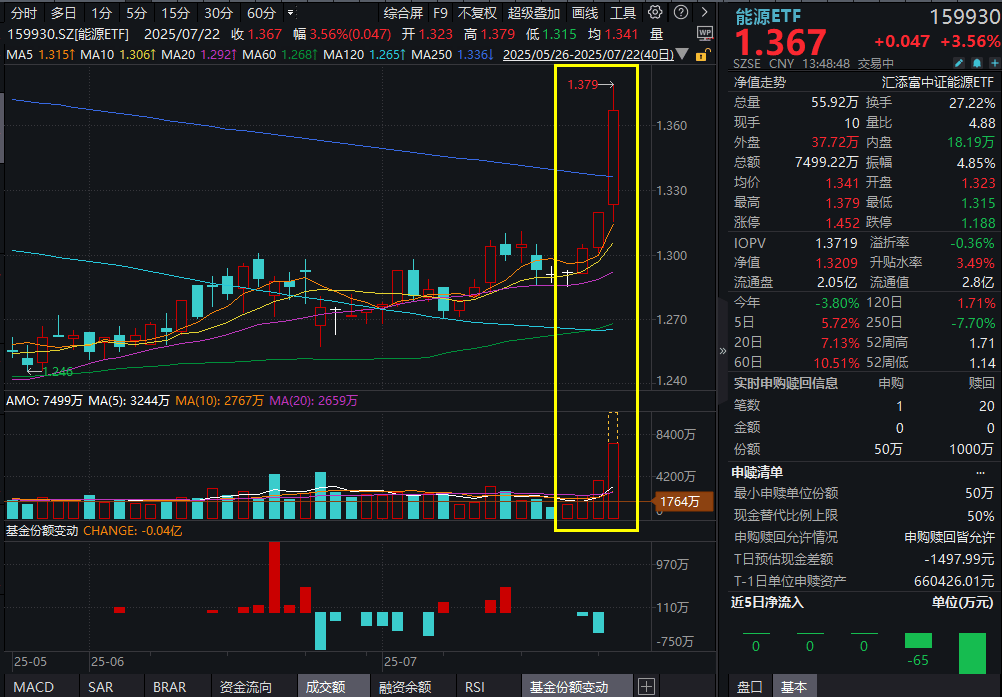
焦煤期货主力合约涨停,什么情况?山西焦煤、山煤国际等涨停,能源ETF(159930)爆量大涨超3%!“反内卷”加速,煤价已至右侧拐点?
Sou Hu Cai Jing· 2025-07-22 06:23
Group 1 - The core viewpoint of the news is the significant rise in coal futures, particularly coking coal and coke, driven by supply constraints and seasonal demand increases [1][6][8] - The energy ETF (159930) saw a strong surge, with a trading volume exceeding 1 billion yuan and an increase of over 4% at one point [1][3] - Major coal stocks, including Shanxi Coking Coal and Shaanxi Coal and Chemical Industry, reached their daily price limits, indicating strong market performance [3][4] Group 2 - The government announced a new round of growth stabilization plans for key industries, including steel and coal, aimed at optimizing supply and eliminating outdated production capacity [4] - Coal production rates have been affected by environmental inspections, leading to a decrease in operational coal mines, which has tightened supply [4][7] - The price of thermal coal has rebounded, with the Qinhuangdao Q5500 thermal coal price reaching 642 yuan per ton, a 5.4% increase from its lowest point earlier this year [5][6] Group 3 - The current market for thermal coal is characterized by high seasonal demand and tightening supply, with operational coal mines in Shanxi, Shaanxi, and Inner Mongolia at a low utilization rate of 81.1% [7][8] - The inventory of coal at ports has decreased by 18.7% compared to the highest levels earlier this year, indicating a tightening supply situation [7] - The demand for electricity has increased due to high temperatures, leading to a rise in coal consumption for power generation [7][8]




金十图示:2025年07月22日(周二)富时中国A50指数成分股午盘收盘行情一览:银行、保险股延续跌势,酿酒、食品饮料板块集体走高
news flash· 2025-07-22 03:38
Market Overview - The FTSE China A50 Index components showed a mixed performance with banking and insurance stocks continuing to decline, while the liquor and food & beverage sectors experienced gains [1][6]. Banking Sector - Major banks like China Everbright Bank reported a market capitalization of 249.93 billion with a trading volume of 446 million, showing a decline of 0.09 (-1.59%) [3]. - China Pacific Insurance, China Ping An, and China Life Insurance had market capitalizations of 436.27 billion, 347.77 billion, and 1,028.70 billion respectively, with trading volumes of 991 million, 2.11 billion, and 462 million, reflecting declines of 0.51 (-1.39%), 0.70 (-1.22%), and 0.07 (-0.83%) [3]. Insurance Sector - The insurance sector continued to face downward pressure, with significant declines in major companies [3]. Liquor Industry - The liquor sector saw positive movement, with Kweichow Moutai, Shanxi Fenjiu, and Wuliangye reporting market capitalizations of 1,820.06 billion, 225.24 billion, and 482.06 billion respectively, and trading volumes of 2.14 billion, 1.36 billion, and 1.15 billion, with increases of 4.34 (+2.41%), 1.63 (+1.33%), and 5.86 (+0.41%) [3]. Semiconductor Sector - The semiconductor industry showed varied performance, with Northern Huachuang, Cambricon Technologies, and Haiguang Information having market capitalizations of 229.98 billion, 248.67 billion, and 316.92 billion respectively, and trading volumes of 1.33 billion, 2.71 billion, and 1.24 billion, with changes of -1.34 (-0.42%), +12.40 (+2.13%), and -0.32 (-0.23%) [3]. Oil Industry - The oil sector, including companies like Sinopec and PetroChina, reported market capitalizations of 725.05 billion and 1,643.53 billion respectively, with trading volumes of 758 million and 563 million, showing slight increases [3]. Coal Industry - The coal sector, represented by companies like Shenhua Group and Shaanxi Coal and Chemical Industry, had market capitalizations of 750.04 billion and 189.83 billion respectively, with minimal changes in stock prices [3]. Automotive Sector - The automotive sector, led by BYD, reported a market capitalization of 1,849.01 billion with a trading volume of 3.54 billion, showing a slight increase of 2.39 (+0.72%) [3]. Other Sectors - Various other sectors such as chemicals, pharmaceuticals, and logistics showed mixed results, with some companies experiencing gains while others faced declines [4][6].







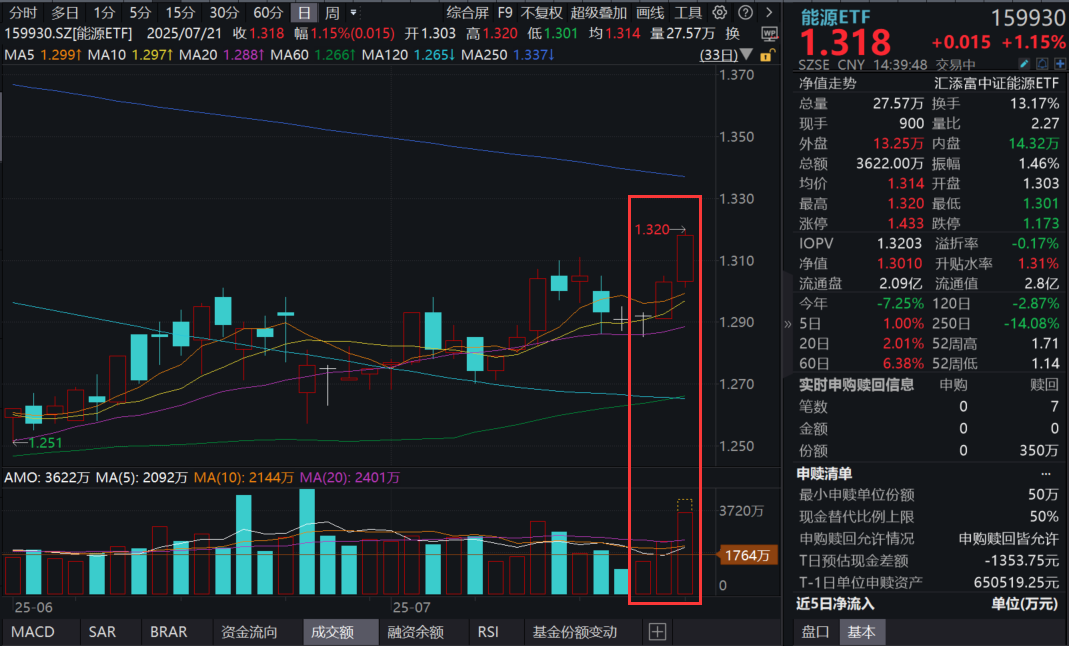
A股全面爆发量价齐升,煤炭、油气股冲高!能源ETF(159930)、油气资源ETF(159309)双双涨超1%,“反内卷”来袭,后市将如何演绎?
Xin Lang Cai Jing· 2025-07-21 08:45
Group 1: Market Overview - The A-share market experienced a significant surge on July 21, with over 4,000 stocks rising and a trading volume increase of 133.8 billion yuan, leading to a new high for the Shanghai Composite Index this year [1] - Key sectors such as building materials, coal, and oil saw substantial gains, with Energy ETFs (159930) rising over 1% for three consecutive days, and Oil and Gas Resource ETFs (159309) also increasing over 1% for four consecutive days [1] Group 2: Coal and Oil Sector Performance - Major coal and oil stocks saw significant increases, with companies like Yanzhou Coal Mining and Shanxi Coking Coal rising over 3%, while Meijin Energy and China United Coalbed Methane increased over 2% [3] - The top ten components of the Energy ETF (159930) included major players like China Petroleum and China Shenhua, with respective trading volumes of 757 million yuan and 968 million yuan [4] - The top ten components of the Oil and Gas Resource ETF (159309) also featured significant players, with China Petroleum and China Petrochemical leading in trading volumes [4] Group 3: Policy and Market Dynamics - On July 18, government officials announced a new round of growth stabilization plans for key industries, including steel, non-ferrous metals, petrochemicals, and building materials, aimed at optimizing supply and eliminating outdated production capacity [5] - The China Coal Transportation and Marketing Association emphasized the need for coal companies to understand market changes and ensure compliance with long-term contracts to maintain market balance [5] - The "anti-involution" policy is expected to resonate with the coal sector, potentially leading to valuation increases as the market stabilizes [6] Group 4: Price Trends and Future Outlook - Short-term coal prices are expected to remain bullish due to seasonal demand, with supply constraints from safety regulations and stricter import controls [6] - In the medium to long term, coal prices are projected to gradually return to a "reasonable center," which would stabilize profitability for coal companies and reshape market perceptions of the coal sector [7] - The oil sector may face challenges related to overcapacity, necessitating a focus on controlling operating rates and project approvals [8]

金十图示:2025年07月21日(周一)富时中国A50指数成分股今日收盘行情一览:银行板块全天表现低迷,能源、汽车板块集体收涨
news flash· 2025-07-21 07:10
金十图示:2025年07月21日(周一)富时中国A50指数成分股今日收盘行情一览:银行板块全天表现低迷,能源、汽车板块集体 收涨 富时中国A50指数连续 -0.03(-0.53%) +0.04(+0.47%) -0.08(-0.68%) 光大银行 2522.95亿市值 6.05亿成交额 4.27 -0.03(-0.70%) 保险 中国太保 中国平安 中国人保 帆 3723.66亿市值 3526.82亿市值 10414.43亿市值 15.20亿成交额 26.71亿成交额 5.53亿成交额 36.66 57.19 8.42 -0.43(-1.16%) +0.12(+0.21%) +0.03(+0.36%) 酿酒行业 贵州茅台 山西汾酒 五粮液 18126.93亿市值 2199.47亿市值 4757.30亿市值 37.80亿成交额 23.04亿成交额 16.64亿成交额 180.29 1443.00 122.56 +6.00(+0.42%) -1.22(-0.99%) -0.81(-0.45%) 半导体 北方华创 寒武纪-U 海光信息 HYGON 2309.49亿市值 2434.80亿市值 3176.67亿市值 1 ...


能源周报(20250714-20250720):下游采购需求释放,动力煤市场价格上涨-20250721
Huachuang Securities· 2025-07-21 06:42
Investment Strategy - Crude oil supply is expected to remain limited due to declining global oil and gas capital expenditures, with a significant reduction of nearly 122% from 2014 levels to $351 billion in 2021 [8][29][30] - Geopolitical tensions, particularly the Russia-Ukraine conflict, have exacerbated concerns over energy supply, with the EU planning to reduce oil imports from Russia by 90% by the end of 2022 [9][30] - The current active drilling rig count in the US remains low, impacting short-term crude oil and natural gas production capacity [29][30] Coal Industry - The market price for thermal coal has increased, with the average price at Qinhuangdao port reaching 637 RMB/ton, up 1.46% from the previous week, driven by increased downstream purchasing demand [11][12] - Coal inventory at major ports has decreased by 6.32% to 25.2 million tons, indicating a tightening supply situation [11][12] - The demand for coal is supported by rising electricity consumption due to high summer temperatures, although cement demand is declining [11][12] Coking Coal - The coking coal market is experiencing price increases, with the price of Shanxi main coking coal rising by 6.67% to 1,440 RMB/ton [13][14] - Downstream steel mills are maintaining high production levels, leading to a positive outlook for coking coal prices as demand remains strong [13][14] - The overall market sentiment is bullish, with expectations of further price increases due to rising costs and stable demand from steel producers [13][14] Natural Gas - Industrial natural gas production in China showed steady growth, with June output at 21.2 billion cubic meters, a year-on-year increase of 4.6% [15][16] - The average price of natural gas in the US has risen to $3.51 per million British thermal units, reflecting a 5% increase from the previous week [15][16] - The EU has reached an agreement on a natural gas price cap, which may lead to liquidity issues and increased competition for supplies [15][16] Oilfield Services - The oilfield services sector is expected to see a recovery in demand due to increased capital expenditures driven by high oil prices and supportive government policies [17][18] - The total capital expenditure for major oil companies in 2023 is projected to reach 581.738 billion RMB, reflecting a compound annual growth rate of 6% since 2018 [17][18] - The number of active drilling rigs globally has decreased to 1,576, indicating a cautious approach to new investments in oil and gas exploration [18]

金十图示:2025年07月21日(周一)富时中国A50指数成分股午盘收盘行情一览:盘面整体涨跌互现,银行、保险板块普跌,能源、汽车板块多数走高
news flash· 2025-07-21 03:35
Market Overview - The FTSE China A50 Index showed mixed performance with banks and insurance sectors declining, while energy and automotive sectors mostly advanced [1][6]. Banking Sector - Major banks like China Everbright Bank reported a market capitalization of 252.295 billion with a trading volume of 391 million, experiencing a slight decline of 0.03 (-0.70%) [3]. Insurance Sector - Key insurance companies such as China Pacific Insurance, Ping An Insurance, and China Life Insurance had market capitalizations of 369.27 billion, 349.31 billion, and 1,037.255 billion respectively, with trading volumes of 1.066 billion, 1.782 billion, and 0.345 billion. They experienced declines of 0.78 (-2.10%), 0.11 (-0.19%), and 0.04 (-0.48%) [3]. Alcohol Industry - Leading companies in the alcohol sector, including Kweichow Moutai, Shanxi Fenjiu, and Wuliangye, had market capitalizations of 1,811.450 billion, 218.056 billion, and 475.070 billion respectively, with trading volumes of 2.287 billion, 1.577 billion, and 0.913 billion. Kweichow Moutai saw a slight increase of 5.01 (+0.35%), while the others faced declines [3]. Semiconductor Sector - Notable semiconductor firms like North Huachuang, Cambricon Technologies, and Hygon reported market capitalizations of 231.057 billion, 244.680 billion, and 317.063 billion respectively, with trading volumes of 1.070 billion, 2.435 billion, and 1.138 billion. North Huachuang experienced a decline of 4.99 (-1.53%) [3]. Oil Industry - Major players in the oil sector, including Sinopec, PetroChina, and China Railway, had market capitalizations of 273.495 billion, 715.347 billion, and 1,634.377 billion respectively, with trading volumes of 0.732 billion, 0.426 billion, and 0.427 billion. Sinopec saw an increase of 0.08 (+1.37%) [3]. Coal Industry - Companies like Shenhua Energy and Shaanxi Coal and Chemical Industry had market capitalizations of 749.639 billion and 189.440 billion respectively, with trading volumes of 0.536 billion and 0.911 billion. Shenhua Energy reported an increase of 0.33 (+0.88%) [3]. Automotive Sector - BYD, a leading automotive manufacturer, had a market capitalization of 1,827.526 billion with a trading volume of 2.984 billion, experiencing an increase of 3.49 (+1.06%) [3]. Securities Sector - Major securities firms such as CITIC Securities and Guotai Junan reported market capitalizations of 425.350 billion and 347.129 billion respectively, with trading volumes of 2.668 billion and 1.636 billion. CITIC Securities saw an increase of 0.36 (+1.27%) [4]. Consumer Electronics - Companies like Hon Hai Precision Industry and Luxshare Precision reported market capitalizations of 534.617 billion and 276.157 billion respectively, with trading volumes of 1.553 billion and 2.572 billion. Hon Hai experienced a decline of 0.19 (-0.70%) [4]. Home Appliances - Leading home appliance firms such as Haier Smart Home and Gree Electric Appliances had market capitalizations of 266.739 billion and 243.580 billion respectively, with trading volumes of 0.713 billion and 0.309 billion. Haier reported a decline of 0.26 (-0.54%) [4]. Pharmaceutical Sector - Major pharmaceutical companies like Heng Rui Medicine and Muyuan Foods had market capitalizations of 255.221 billion and 384.958 billion respectively, with trading volumes of 1.833 billion and 1.230 billion. Heng Rui experienced a decline of 0.76 (-1.29%) [4].

“反内卷”下哪些煤炭公司弹性较大?
Changjiang Securities· 2025-07-20 23:30
Investment Rating - The report maintains a "Positive" investment rating for the coal industry [9]. Core Insights - The coal sector is currently characterized by low capacity utilization, high inventory levels, and poor profitability, indicating a significant oversupply situation. This suggests a higher likelihood of "anti-involution" measures being effective. Additionally, the coal sector is undervalued, with coking coal showing the highest valuation advantage, followed by thermal coal [2][7]. - Companies such as Pingmei Shenma, Panjiang, Shanmei International, Kailuan, Hengyuan Coal Power, and Gansu Energy show greater elasticity in their operations. However, when considering investment safety (debt ratios), Pingmei Shenma, Kailuan, Hengyuan Coal Power, and Jinkong Coal are more favorable [2][7]. Summary by Sections Market Performance - The coal index (Yangtze) fell by 0.69%, underperforming the CSI 300 index by 1.78 percentage points, ranking 27th out of 32 industries. The thermal coal market price as of July 18 was 642 CNY/ton, up by 10 CNY/ton week-on-week. The outlook suggests potential short-term price increases due to high temperature demand, although rising port inventories may limit sustained price growth [6][21][22]. Supply and Demand Analysis - As of July 17, the daily coal consumption across 25 provinces was 6.33 million tons, up 11.1% week-on-week. The total coal inventory was 123.41 million tons, down 0.8% from the previous week, with a usable days supply of 19.5 days, a decrease of 2.3 days [22][41]. Individual Company Analysis - The report highlights specific companies with significant operational elasticity: Pingmei Shenma, Jinkong Coal, and Shanmei International are noted as elastic stocks. For long-term stable profit leaders, China Coal Energy and China Shenhua are recommended, while for transformation and growth, Electric Power Investment and Xinji Energy are suggested [8][38]. Price Trends - The report indicates that the price of thermal coal is expected to remain supported in the short term due to tight supply conditions, while coking coal prices are also expected to maintain strength due to ongoing demand from steel production [22][49].


