AGRICULTURAL BANK OF CHINA(601288)

Search documents
1月8日信用债异常成交跟踪
SINOLINK SECURITIES· 2026-01-09 01:13
Report Industry Investment Rating - Not provided in the given content Core Viewpoints - Among the bonds with discounted transactions, "24 Chanrong 08" had a relatively large deviation in bond valuation price. Among the bonds with rising net prices, "22 Vanke 02" had a prominent deviation in valuation price. Among the Tier 2 and perpetual bonds with rising net prices, "25 ABC Tier 2 Capital Bond 04B(BC)" had a relatively large deviation in valuation price; among the senior unsecured bonds with rising net prices, "25 ABC TLAC Non - Capital Bond 02C(BC)" had a prominent deviation in valuation price. Among the bonds with a transaction yield higher than 5%, real - estate bonds ranked high [2]. - The changes in credit bond valuation yields were mainly distributed in the [-5,0) interval. The transaction terms of non - financial credit bonds were mainly distributed within 0.5 years, and the proportion of discounted transactions for bonds with terms between 0.5 and 1 year was the highest; the transaction terms of Tier 2 and perpetual bonds were mainly distributed between 4 and 5 years, and the proportion of discounted transactions for bonds within 1 year was the highest. By industry, the bonds in the light manufacturing industry had the largest average deviation in valuation price [2]. Summary by Relevant Catalogs Discounted Transaction Tracking - Bonds such as "24 Chanrong 08", "24 Chanrong 06", etc. in the non - banking finance industry had relatively large deviations in valuation price, with deviations ranging from - 1.17% to - 0.82%. Bonds like "20 Boshui 02" in the agriculture, forestry, animal husbandry and fishery industry and "25 Qingcheng 09" in the urban investment industry also had certain deviations in valuation price [4]. Tracking of Bonds with Rising Net Prices - Real - estate bonds such as "22 Vanke 02", "22 Vanke 06" etc. had a valuation price deviation of 3.98%. Bonds in the banking industry like "25 ABC Tier 2 Capital Bond 04B(BC)" and "25 ABC TLAC Non - Capital Bond 02C(BC)" also had certain deviations in valuation price [6]. Tracking of Tier 2 and Perpetual Bond Transactions - Bonds such as "25 ABC Tier 2 Capital Bond 04B(BC)", "24 Fudian Bank Tier 2 Capital Bond 01" etc. had different degrees of deviation in valuation yield, with deviations ranging from - 5.35bp to - 0.56bp [8]. Tracking of Senior Unsecured Bond Transactions - Bonds such as "25 ABC TLAC Non - Capital Bond 02C(BC)", "25 CITIC Baixin Bank Small and Micro - enterprise Bond 01" etc. had deviations in valuation yield, with deviations ranging from - 1.46bp to - 0.58bp [10]. Tracking of Bonds with a Transaction Yield Higher than 5% - Real - estate bonds such as "22 Vanke 02", "22 Vanke 06" etc. and non - banking finance bonds like "23 Chanrong 05", "23 AVIC Chanrong MTN001 (Science and Technology Innovation Note)" had a transaction yield higher than 5% [11]. Distribution of Credit Bond Valuation Deviations on the Day - The changes in credit bond valuation yields were mainly distributed in the [-5,0) interval [2]. Distribution of Non - financial Credit Bond Transaction Terms on the Day - The transaction terms of non - financial credit bonds were mainly distributed within 0.5 years, and the proportion of discounted transactions for bonds with terms between 0.5 and 1 year was the highest [2]. Distribution of Tier 2 and Perpetual Bond Transaction Terms on the Day - The transaction terms of Tier 2 and perpetual bonds were mainly distributed between 4 and 5 years, and the proportion of discounted transactions for bonds within 1 year was the highest [2]. Discounted Transaction Proportion and Transaction Scale of Non - financial Credit Bonds by Industry - The bonds in the light manufacturing industry had the largest average deviation in valuation price [2].

多家银行推出资产提升活动,奖励达标客户
Mei Ri Jing Ji Xin Wen· 2026-01-09 00:29
Group 1 - Several banks, including Jiangsu Bank, Agricultural Bank, Construction Bank, and Nanjing Bank, have launched asset enhancement activities to encourage customers to increase their bank assets [1] - Jiangsu Bank announced that customers who increase their average monthly assets in the first three months of the year compared to the end of the previous year will receive related rewards [1] - The trend of banks initiating asset enhancement programs indicates a competitive environment in the banking sector aimed at attracting and retaining customers [1]




陆家嘴财经早餐2026年1月9日星期五



Sou Hu Cai Jing· 2026-01-08 23:41
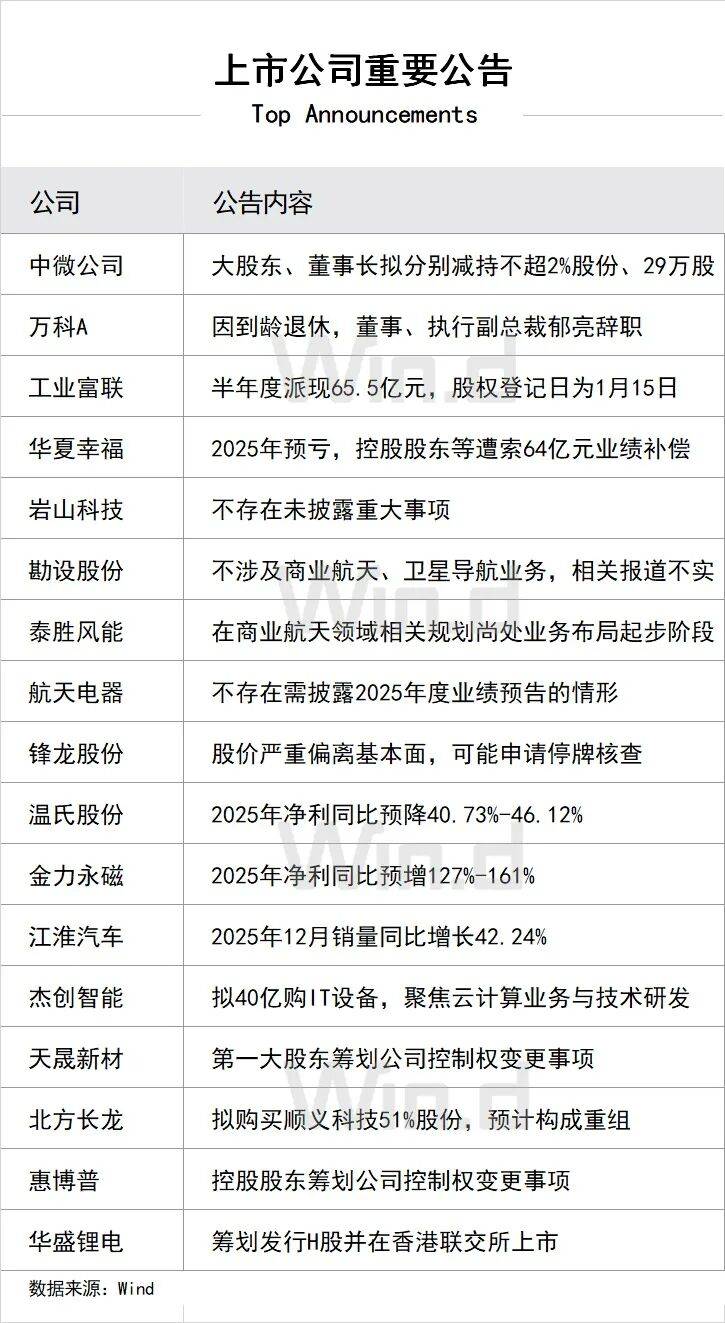
Group 1 - Two major energy state-owned enterprises, China Petroleum & Chemical Corporation and China Aviation Oil Group, announced a merger approved by the State Council, aiming to leverage advantages in refining integration and aviation fuel supply systems to reduce costs and promote high-quality development of the industry [1] - Vanke A announced that Yu Liang, a representative figure in the real estate sector, has retired after 35 years with the company, holding 739,490 shares valued at over 36 million yuan as of January 8 [1] - Gold has officially surpassed U.S. Treasury bonds for the first time in 30 years, becoming the largest reserve asset globally, with a value of $3.93 trillion compared to $3.88 trillion for U.S. Treasury bonds [1] Group 2 - The Ministry of Commerce held a press conference addressing recent hot topics, including the evaluation of Meta's $2 billion acquisition of AI platform Manus, which must comply with Chinese laws and regulations [2] - The Ministry of Finance expressed confidence in China's economic stability and invited the London Stock Exchange Group to deepen cooperation [2] - The U.S. government is pushing a bill to strengthen sanctions against Russia, which may affect countries like China, India, and Brazil in purchasing cheap Russian oil [2] Group 3 - Guangzhou has introduced a plan to build a strong advanced manufacturing city, focusing on five strategic industries including AI, semiconductors, and new energy [3] - The A-share market saw a slight decline, with the Shanghai Composite Index down 0.07% and the Shenzhen Component Index down 0.51%, while the total market turnover reached 2.83 trillion yuan [3] - The Hong Kong stock market experienced a drop, with the Hang Seng Index down 1.17%, while the "first global large model stock" Zhiyuan surged over 13% on its debut [3] Group 4 - The margin financing balance in the A-share market reached a historical high of 2.6047 trillion yuan, marking a significant increase of approximately 248 billion yuan in a single day [4] - Ping An Life announced its fourth stake increase in China Merchants Bank H-shares, holding 20% of the total share capital [4] - HSBC and Hang Seng Bank announced the approval of HSBC's proposal to privatize Hang Seng Bank, with shares expected to be delisted on January 27 [4] Group 5 - Bawang Tea Princess is considering an IPO in Hong Kong, with preliminary discussions with investment banks for a potential fundraising of several hundred million dollars [5] - Major announcements from listed companies include Vanke A's announcement of Yu Liang's resignation due to retirement and Industrial Fulian's semi-annual dividend distribution of 6.55 billion yuan [6] Group 6 - The market regulatory authority has warned major polysilicon companies against monopolistic practices, emphasizing the need for compliance in capacity management and pricing [7] - The Ministry of Industry and Information Technology held a meeting addressing irrational competition in the battery industry, calling for better capacity management [7] - The Chinese automotive market is experiencing a promotional wave at the start of the year, with several companies offering discounts to counteract the impact of new taxes on electric vehicles [7]
去年险资举牌增至41次
Zheng Quan Ri Bao· 2026-01-08 23:37
Core Viewpoint - Ping An Life Insurance has increased its stake in both Agricultural Bank of China and China Merchants Bank, triggering regulatory thresholds for shareholding, reflecting a recovery in market confidence and the impact of supportive measures [1][2]. Group 1: Investment Activities - In 2025, Ping An Life increased its holdings in Agricultural Bank of China by approximately 95.58 million shares, reaching a total of about 6.181 billion shares, representing 20.10% of the bank's H-shares [2]. - On December 31, 2025, Ping An Life also increased its stake in China Merchants Bank by about 14.01 million shares, totaling around 922 million shares, which is 20.07% of the bank's H-shares [2]. - The total number of shareholding increases by insurance funds in 2025 reached 41 times, with a significant focus on bank stocks, indicating a trend towards increased equity investment by insurance capital [3]. Group 2: Market Trends and Analysis - The trend of insurance capital increasing its stake in bank stocks is attributed to the low interest rates in the bond market and the need for reallocation of assets, leading to a preference for high-dividend, low-volatility bank stocks [2][3]. - In 2025, 34 out of 41 shareholding increases by insurance funds were in H-shares, which are generally perceived to be undervalued compared to A-shares, providing higher dividend yields and potential returns [3]. - Experts suggest that the behavior of insurance capital in increasing stakes is likely to continue and become more normalized, focusing on high-quality companies with core competitiveness and reasonable valuations [4].

风控迭代!农行终止个人掌银手机盾业务
Guo Ji Jin Rong Bao· 2026-01-08 15:04
Core Viewpoint - Agricultural Bank of China announced the termination of its personal mobile security shield service starting January 9, marking the first major state-owned bank to exit this service [2][4]. Group 1: Service Termination Details - The mobile security shield, which provided a higher level of security for transactions, will be discontinued to enhance service efficiency and user experience [4]. - Customers will still have access to other authentication methods that ensure account security while offering more convenient and diverse operational processes [4]. Group 2: Industry Context and Implications - The decision reflects a broader trend in the banking industry towards more integrated and efficient security solutions, as banks increasingly rely on advanced technologies and partnerships with mobile manufacturers [6][7]. - The move may signal the beginning of an industry-wide adjustment, as banks adapt to evolving security technologies and user preferences, potentially leading to a new era of intelligent and dynamic security measures [6][7]. Group 3: Technological Evolution - The shift from traditional USB security devices to mobile security solutions illustrates the ongoing evolution of security authentication methods, with banks now utilizing a variety of digital and biometric verification techniques [6][7]. - The regulatory environment is also evolving, with new guidelines aimed at enhancing digital financial services and risk management in the banking sector [8].
中国万亿市值公司之变:4家新贵晋级,工业富联狂飙近200%
21世纪经济报道· 2026-01-08 11:47
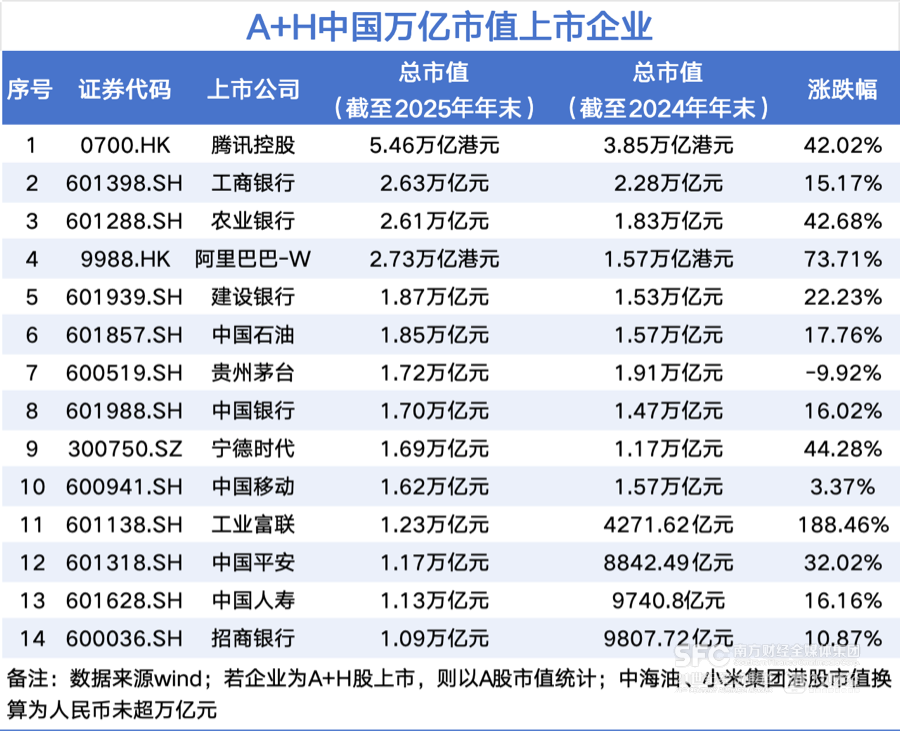
Core Viewpoint - The number of companies with a market capitalization exceeding 1 trillion yuan in China's A+H share market has increased to 14 by the end of 2025, with a total market value increase of approximately 9 trillion yuan, reflecting a growth rate of over 50% [1][2]. Group 1: New Trillion-Yuan Companies - Four new companies have joined the trillion-yuan market cap club: Industrial Fulian, China Ping An, China Life, and China Merchants Bank [1][4]. - Industrial Fulian has seen a remarkable market cap increase of approximately 188%, driven by its core business in AI and precision manufacturing [4][5]. - The financial sector's recovery is highlighted by China Ping An's 32.02% increase, China Life's 16.16% increase, and China Merchants Bank's 10.87% increase in market cap [4][5]. Group 2: Market Trends and Characteristics - The market capitalization growth is characterized by a leading trend in technology and new sectors, while financial and energy sectors show stable growth [1][7]. - Tencent and Alibaba have both seen significant market cap increases, exceeding 1 trillion Hong Kong dollars, driven by AI advancements and recovery in e-commerce [7][9]. - The banking sector, particularly Agricultural Bank of China, has shown strong performance with a market cap increase and a notable rise in stock price, breaking the long-standing "price-to-book" ratio below 1 [11][12]. Group 3: Company Performance Highlights - Tencent's market cap reached 5.46 trillion HKD, with a year-on-year increase of 42.02%, supported by its AI strategy and business integration [2][8]. - Alibaba's market cap rose to 2.73 trillion HKD, benefiting from AI integration and a recovery in its e-commerce business [9]. - Agricultural Bank of China reported a revenue of 550.88 billion yuan and a net profit of 220.86 billion yuan, reflecting a stable asset quality and strong market recognition [12].





中国万亿市值公司之变:四家新贵晋级 两大增长逻辑
2 1 Shi Ji Jing Ji Bao Dao· 2026-01-08 11:41
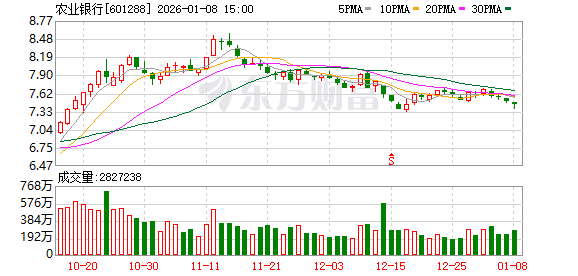
Core Insights - The number of companies with a market capitalization exceeding 1 trillion yuan in mainland China has increased to 14 by the end of 2025, with a total market value increase of over 9 trillion yuan, reflecting a growth rate of over 50% [1][2] Group 1: New Trillion-Yuan Companies - Four new companies have joined the trillion-yuan market cap club: Industrial Fulian, China Ping An, China Life, and China Merchants Bank, with four headquartered in Shenzhen [3][4] - Industrial Fulian has seen a remarkable market cap increase of approximately 188%, while the other three companies in the financial sector have experienced more modest growth rates: China Ping An at 32.02%, China Life at 16.16%, and China Merchants Bank at 10.87% [4][5] Group 2: Market Trends and Dynamics - The rise of these companies reflects two core market dynamics: explosive growth in the technology sector and valuation recovery in the financial sector [5] - Industrial Fulian's rapid growth is attributed to its comprehensive involvement in the AI industry chain, with a significant revenue increase of 38.4% year-on-year, reaching 603.93 billion yuan in the first three quarters of 2025 [6] - China Life has reported a total premium exceeding 700 billion yuan, with a 41% increase in total investment income, while China Ping An has established a strong competitive barrier through its extensive customer base and technology capabilities [7] Group 3: Performance of Major Players - Tencent and Alibaba have also seen significant market cap increases, with both companies adding over 1 trillion Hong Kong dollars to their valuations, driven by AI advancements and a recovery in their core businesses [8][10] - Tencent's market cap reached 5.46 trillion Hong Kong dollars by the end of 2025, with a stock price increase of over 40%, while Alibaba's market cap rose to 2.73 trillion Hong Kong dollars [10][11] Group 4: Banking Sector Insights - The banking sector has shown signs of valuation recovery, with Agricultural Bank of China achieving a notable stock price increase of over 50% and breaking the long-standing "price-to-book" ratio below 1 [12][13] - Agricultural Bank's revenue for the first three quarters of 2025 was 550.88 billion yuan, with a net profit of 220.86 billion yuan, reflecting a year-on-year increase of 3.03% [12][13]

中国万亿市值公司之变:4家新贵晋级,工业富联狂飙近200%
2 1 Shi Ji Jing Ji Bao Dao· 2026-01-08 11:38
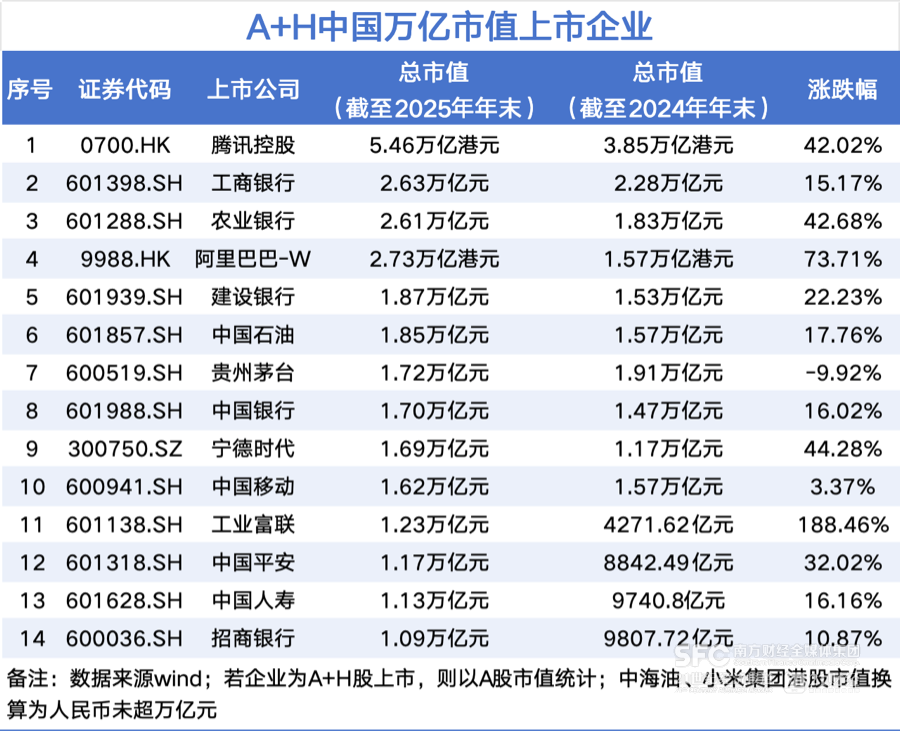
Core Insights - The number of companies with a market capitalization exceeding 1 trillion yuan in mainland China has increased to 14 by the end of 2025, up from 10 at the end of the previous year, with a total market capitalization increase of approximately 9 trillion yuan, representing a growth rate of over 50% [1][4][15] Group 1: Market Capitalization Growth - The newly added companies to the trillion-yuan market cap club include Industrial Fulian, China Ping An, China Life, and China Merchants Bank, with four of them headquartered in Shenzhen [1][4] - The market capitalization ranking shows a "pyramid" structure, with Tencent leading at approximately 5 trillion yuan, followed by three companies (ICBC, ABC, Alibaba) in the 2-5 trillion yuan range, while most companies are in the 1-2 trillion yuan range [1][13] Group 2: Sector Performance - The growth in market capitalization is characterized by a leading performance in technology and new sectors, while financial and energy sectors show stable growth [1][9] - Technology and new sector companies have seen growth rates exceeding 40%, while financial and energy companies have growth rates concentrated in the 10%-35% range [9][15] Group 3: Notable Companies - Industrial Fulian has emerged as a standout performer with a staggering market cap increase of approximately 188%, driven by its core business in AI and precision manufacturing [4][5] - China Ping An, China Life, and China Merchants Bank represent the financial sector's recovery, with respective market cap growth rates of 32.02%, 16.16%, and 10.87% [4][5] Group 4: Financial Sector Dynamics - China Life has successfully transformed its product and business structure, achieving a total premium income exceeding 700 billion yuan and a significant increase in investment income [6] - China Ping An operates as a comprehensive service group with a strong customer base, which has contributed to its valuation recovery [6] - China Merchants Bank, known for its retail banking strength, reported a total revenue of 251.42 billion yuan in the first three quarters of 2025, maintaining its position as a leading bank [7] Group 5: AI Impact on Market - Tencent and Alibaba have both seen their market capitalizations increase by over 1 trillion yuan, driven by their advancements in AI technology and integration into their business models [9][10] - Tencent's market cap reached 5.46 trillion HKD, with a year-on-year increase of over 40%, while Alibaba's market cap rose to 2.73 trillion HKD, supported by a recovery in its e-commerce business [9][10][11]



农行新质行大同之旅启程,看能源升级、文旅焕新
新浪财经· 2026-01-08 10:08
Core Viewpoint - The article emphasizes the dual focus of the Agricultural Bank of China on green transformation and cultural heritage preservation as key dimensions of high-quality economic development in China [2] Group 1: Green Transformation - The Agricultural Bank of China has provided a comprehensive credit line of 3.5 billion yuan and carbon reduction support tools for the strategic hydropower project, the Hunyuan Pumped Storage Power Station, which is a key energy project during the 14th Five-Year Plan [2] - This financial support illustrates the bank's commitment to integrating green finance into national long-term strategies [2] Group 2: Cultural Heritage - At the UNESCO World Heritage site of Yungang Grottoes, the Agricultural Bank of China is implementing a smart upgrade, creating a comprehensive "finance + cultural tourism" solution that revitalizes the ancient site in the digital age [2] - This initiative reflects the bank's role in linking financial services with cultural heritage, enhancing the historical significance of the site [2] Group 3: Overall Impact - The financial services provided by the Agricultural Bank of China are increasingly becoming a crucial link between national strategies, industrial upgrades, and the well-being of the populace [2]

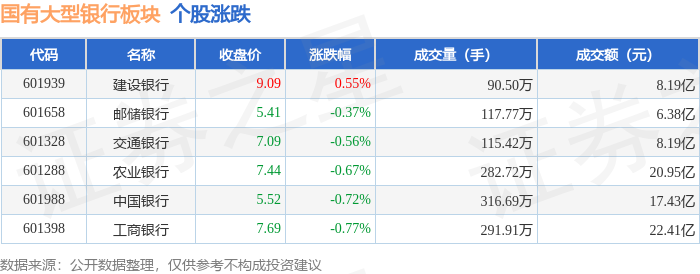
国有大型银行板块1月8日跌0.68%,工商银行领跌,主力资金净流出7.17亿元
Zheng Xing Xing Ye Ri Bao· 2026-01-08 08:56
Group 1 - The core viewpoint of the news is that the state-owned large bank sector experienced a decline of 0.68% on January 8, with Industrial and Commercial Bank of China leading the drop [1] - The Shanghai Composite Index closed at 4082.98, down 0.07%, while the Shenzhen Component Index closed at 13959.48, down 0.51% [1] - The trading performance of individual stocks in the state-owned large bank sector showed mixed results, with China Construction Bank increasing by 0.55% while others like Agricultural Bank of China and Bank of China saw declines of 0.67% and 0.72% respectively [1] Group 2 - The net outflow of main funds from the state-owned large bank sector was 717 million yuan, while retail investors saw a net inflow of 541 million yuan [1] - The detailed fund flow data indicates that China Construction Bank had a net outflow of 2.14 million yuan from main funds, while retail investors contributed a net inflow of 29.14 million yuan [2] - In contrast, Bank of China experienced a significant net outflow of 244 million yuan from main funds, but had a net inflow of 119 million yuan from retail investors [2]