
PING AN OF CHINA(601318)

Search documents
新能源车“投保难、投保贵”难题有效缓解
Jin Rong Shi Bao· 2025-12-04 01:47
Core Insights - The Financial Regulatory Bureau released an action plan to promote high-quality development in the property insurance industry, focusing on business transformation and upgrades [1] - The action plan has led to significant reforms in the auto insurance sector, particularly addressing challenges in insuring new energy vehicles [1][3] Group 1: Policy and Regulatory Developments - The action plan aims to enrich new energy vehicle insurance products and optimize market pricing mechanisms [1] - A joint guidance opinion was issued to enhance the quality of new energy vehicle insurance through data sharing, repair standards, and rate determination [1][2] Group 2: Industry Innovations and Solutions - A risk-sharing mechanism was established to address the "difficult to insure" issue for high-risk models, with the launch of the "Car Insurance Good to Insure" platform [2] - The platform has onboarded 37 property insurance companies, facilitating insurance for over 1.1 million vehicles, providing coverage exceeding 1.1 trillion yuan [2] Group 3: Financial Performance and Growth - Major insurers like China Ping An and China Pacific Insurance reported that new energy vehicle insurance has entered a profitable stage, with a projected premium of around 200 billion yuan and a growth rate exceeding 30% [3] - The industry is expected to see further profitability as technology upgrades and data accumulation continue [3] Group 4: Challenges and Future Outlook - The property insurance industry still faces challenges such as the division of liability in smart driving and the need for improved data sharing and security [4] - However, there is a general consensus that ongoing reforms will enable the industry to better serve the real economy and meet public needs [4]


中证指数月度报告(11月)
Shang Hai Zheng Quan Bao· 2025-12-03 18:46
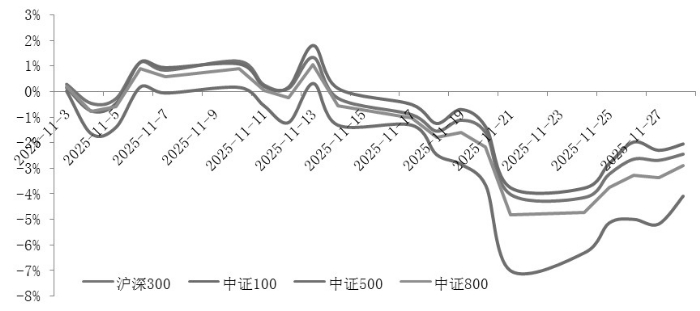
Core Insights - The major stock indices experienced a decline in October, with the CSI 300 index falling by 2.46% and closing at 4526.66 points, marking a drop of 114.01 points [11][12]. - The performance of various indices over different time frames shows that the CSI 300 index has gained 15.04% year-to-date, while the CSI 500 index has seen a decline of 4.08% in the past month [11][14]. Monthly Performance of Major Indices - The CSI 300 index opened at 4636.73, reached a high of 4707.13, and closed at 4526.66, reflecting a monthly decline of 2.46% [11]. - The CSI 100 index decreased by 2.05%, closing at 4397.36, while the CSI 800 index fell by 2.90% to 4945.49 [11]. - The Shanghai Composite Index dropped by 1.67%, closing at 3888.60 [11]. Sector Performance - The energy sector showed a slight increase of 0.48% in the CSI 300, while the materials sector declined by 2.15% [17][22]. - The industrial sector experienced a significant drop of 3.44%, and the healthcare sector fell by 5.02% [17][22]. - The financial sector had a minor increase of 0.13%, contrasting with the information technology sector, which saw a decline of 7.73% [17][22]. Top and Bottom Performing Stocks - The top-performing stocks in the CSI 300 included GAC Group, which rose by 18.29%, and Weichai Power, which increased by 15.71% [13]. - Conversely, the worst performers included SAILIS, which fell by 18.69%, and Industrial Fulian, which dropped by 15.67% [15][20]. Valuation Metrics - The CSI 300 index has a P/E ratio of 14.42 and a P/B ratio of 1.45, indicating a moderate valuation compared to historical averages [14]. - The healthcare sector has the highest P/E ratio at 25.97, while the financial sector has the lowest at 8.61 [14]. Trading Volume and Turnover - The top ten stocks by trading volume in the CSI 300 included China Aluminum and China Bank, with significant trading volumes of 871 million and 453 million respectively [17]. - The turnover rate for the top stocks was notably high for companies like Aters, which had a turnover rate of 250.27% [17].





上市寿险公司实际投资收益率与假设偏差比较:2010-2024年行业累积总投资收益率偏差-0.38%,综合投资收益率偏差0.66%
13个精算师· 2025-12-03 11:05
Core Insights - The long-term investment return assumption is a crucial parameter affecting the intrinsic value of life insurance companies, reflecting their expectations regarding capital market conditions and investment strategies. In 2024, most life insurance companies have lowered their long-term investment return assumption from 4.5% to 4.0% [9][11]. Investment Returns Analysis - From 2010 to 2024, listed life insurance companies had a total investment return that exceeded the long-term investment return assumption in only 5 out of 15 years, with the remaining 10 years showing negative deviations. The cumulative total investment return deviation for the industry is -0.38% [3][6][37]. - As of the first three quarters of 2025, the total investment return for the year is approximately 3.5%, slightly below the long-term investment return assumption of 4.0%. A strong performance in the fourth quarter could make 2025 the first year since 2020 to exceed the long-term investment return assumption [3][13]. Company-Specific Performance - In 2024, China Life's total investment return was 4.02%, while its comprehensive investment return was 5.94%, both exceeding the long-term investment return assumption of 4.0% [17][18]. - Ping An Life's total investment return for 2024 was 3.32%, with a comprehensive investment return of 7.25%, also above the long-term assumption [19][21]. - For 2024, Taikang Life's total investment return was 3.03%, while its comprehensive investment return was 7.33%, surpassing the long-term assumption [22][23]. - New China Life reported a total investment return of 3.56% and a comprehensive investment return of 6.84% for 2024, both exceeding the long-term assumption [24][25]. - PICC Life's total investment return was 3.70%, with a comprehensive investment return of 14.1%, significantly above the long-term assumption [28][29]. - AIA's estimated long-term investment return assumption for 2024 is 3.4%, which is below the 4.0% threshold, indicating a cautious outlook [30][33]. Summary of Deviations - The average deviation of total investment returns from long-term assumptions for the industry is -0.38%, while the average deviation for comprehensive investment returns is 0.66%. Companies like PICC Life and AIA show better performance with positive deviations [37][38].

厦门监管局同意平安人寿厦门分公司集美支公司灌口营销服务部变更营业场所
Jin Tou Wang· 2025-12-03 06:04
二、中国平安人寿保险股份有限公司厦门分公司应按照有关规定及时办理变更及许可证换领事宜。 一、同意中国平安人寿保险股份有限公司厦门分公司集美支公司灌口营销服务部将营业场所变更为:厦 门市集美区软件园三期F26地块1号楼15层1502-3单元。 中国平安 中国平安-R 中国平安 分时图 日K线 周K线 月K线 58.30 -0.50 -0.85% 1.11% 0.73% 0.37% 0.00% 0.37% 0.73% 1.11% 58.15 58.37 58.58 58.80 59.02 59.23 59.45 09:30 10:30 11:30/13:00 14:00 15:00 3万 37万 72万 106万 2025年11月24日,国家金融监督管理总局厦门监管局发布批复称,《中国平安(601318)人寿保险股份 有限公司厦门分公司关于集美支公司灌口营销服务部变更营业场所的请示》(平保寿厦分发〔2025〕210 号)收悉。经审核,现批复如下: ...
升级风险管理“芯片”
Jin Rong Shi Bao· 2025-12-03 03:32
Core Insights - The release of the upgraded China Earthquake Catastrophe Model 3.7 by Zhongzai Catastrophe Risk Management Co., Ltd. enhances the precision of quantifying earthquake disaster losses and provides reliable data support for insurance actuarial work, disaster prevention planning, and emergency management [1] - The recent advancements in catastrophe risk management models reflect a broader trend in the industry, with multiple models being upgraded to improve disaster risk quantification [1][2] - The implementation of the "Action Plan" by the Financial Regulatory Bureau emphasizes the importance of developing catastrophe risk models for typhoons, floods, and earthquakes as part of a comprehensive disaster prevention and mitigation strategy [2] Industry Developments - The insurance industry is increasingly focusing on proactive disaster prevention measures, as demonstrated by the development of intelligent monitoring systems that can predict agricultural risks and provide timely warnings to farmers [3] - Emergency response capabilities have been enhanced, with insurance companies actively participating in disaster management, such as directing traffic during flooding events to prevent further losses [3] - The speed of claims processing has improved significantly, exemplified by rapid compensation for damages caused by natural disasters, showcasing the industry's commitment to efficient service [4] Regulatory Framework - The "Action Plan" has led to significant advancements in establishing a multi-layered catastrophe insurance protection mechanism, including the recent approval for domestic insurance companies to issue catastrophe-linked securities in Hong Kong [5] - The issuance of catastrophe-linked securities allows for better risk distribution and enhances the resilience of the insurance industry against natural disasters [5] Overall Impact - The insurance sector's role in disaster prevention, emergency response, and loss compensation has become increasingly prominent, with a closed-loop system being developed to enhance efficiency and societal resilience [6] - The industry is transitioning from passive compensation to proactive disaster reduction, supported by technological advancements and innovative mechanisms [6] - As catastrophe insurance systems deepen and emergency service mechanisms improve, the insurance industry's function within the national emergency management framework is expected to become more robust, providing stronger protection for public safety [6]
新能源车“投保难、投保贵”难题有效缓解
Jin Rong Shi Bao· 2025-12-03 03:32
Core Insights - The Financial Regulatory Bureau released an action plan to promote high-quality development in the property insurance industry, focusing on business transformation and upgrades [1] - The action plan has led to significant reforms in the auto insurance sector, particularly addressing challenges in insuring new energy vehicles [1][3] - The introduction of a risk-sharing mechanism has helped alleviate the "difficult to insure" problem for high-risk models [2] Group 1: Policy and Regulatory Developments - The action plan aims to enrich new energy vehicle insurance products and optimize market pricing mechanisms [1] - A joint guidance document was released to enhance the quality of new energy vehicle insurance through data sharing, repair standards, and rate determination [1][2] - The "Car Insurance Good to Insure" platform was launched to support high-compensation model insurance, with over 37 insurance companies participating [2] Group 2: Industry Performance and Trends - Major insurers like China Ping An and China Pacific have reported that new energy vehicle insurance has entered a profitable phase [3] - The expected premium for new energy vehicle insurance is projected to reach 200 billion yuan, with a growth rate exceeding 30% [3] - The industry is experiencing a shift towards digitalization and AI integration, with significant advancements in automated claims processing [3] Group 3: Challenges and Future Outlook - The industry still faces challenges such as the division of liability in autonomous driving and the need for improved data sharing protocols [4] - Despite these challenges, the ongoing reforms are expected to enhance the industry's role in supporting the real economy and meeting public needs [4]
平安融易重庆分公司艾园:用专业与温度助力小微企业发展
Sou Hu Cai Jing· 2025-12-03 01:33
Core Insights - The article highlights the success of Ai Yuan, a financial consultant at Ping An Rongyi, in providing financing solutions to small and micro enterprises, achieving significant client service milestones and loan amounts [1][2]. Group 1: Company Achievements - Ai Yuan has served a total of 2,262 clients, facilitating loans amounting to 85.324 million yuan, demonstrating her commitment to enhancing financing access for small businesses [1]. - The "AI+O2O" service model implemented by Ping An Rongyi has enabled a comprehensive lifecycle service for clients, ensuring 100% coverage of business scenarios through AI-driven solutions [2]. Group 2: Client Success Stories - A client, Ms. Li, received 1 million yuan on the same day she applied for the "Che e Loan" product, which was tailored to her company's short-term funding needs for expansion [2][4]. - Another client, Mr. Zhang, successfully obtained 2 million yuan through the "Micro Business Loan" product, which is particularly suitable for light-asset, high-flow small enterprises, allowing him to expand his warehousing capabilities [4]. Group 3: Service Philosophy - The company emphasizes a service philosophy of "saving time, money, and effort," focusing on understanding the entire supply chain of clients to build strong relationships and a solid customer base through referrals [5]. - Ai Yuan's approach aligns with Ping An's core value of maximizing value for clients, employees, shareholders, and society, reinforcing the importance of professional service in driving economic growth [5].


固本培元,资负相生:保险行业2026年度投资策略
Huachuang Securities· 2025-12-02 11:42
Core Insights - The report emphasizes the dual-driven business model of the insurance industry, focusing on both assets and liabilities, with a long-term outlook on liability cost optimization driving valuation recovery [8][9] - The insurance sector is currently at a cyclical turning point, with improving operational quality and a focus on cost reduction strategies, particularly in life insurance [9][10] Industry Overview - The insurance sector's total market capitalization is approximately 32,040.19 billion, with a circulating market value of 22,048.26 billion [4] - The report indicates a significant increase in the insurance index, with a 13.8% rise over the past 12 months, although it has underperformed relative to the broader market in the last six months [5] Company Profit Forecasts and Valuations - Key companies such as China Life, China Pacific, and Ping An are projected to have varying EPS growth rates, with China Life expected to see EPS of 6.34 in 2025 and 4.10 in 2026, while Ping An is forecasted to reach 8.02 in 2025 and 8.83 in 2026 [3] - The report maintains a "Buy" recommendation for several companies, including China Life and China Pacific, based on their projected performance and valuation metrics [3] Investment Themes - The report highlights the importance of the "cost reduction trifecta" in life insurance, focusing on product innovation, channel expansion, and dynamic adjustment of preset interest rates [8][9] - In property insurance, the "reporting and operation integration" is expected to optimize costs and enhance profitability, particularly in non-auto insurance segments [9][10] Short-term and Long-term Outlook - Short-term performance is closely tied to equity market trends, with expectations of continued growth in 2025, but potential pressure on performance in 2026 due to investment factors [9][10] - Long-term, the report anticipates that improvements in life insurance costs will drive valuation recovery, with a projected NBV growth rate of over 15% for listed insurance companies in 2026 [9][10] Regulatory Environment - The introduction of a dynamic adjustment mechanism for preset interest rates is expected to alleviate liability costs and enhance the attractiveness of dividend insurance products [24][38] - Recent regulatory guidance aims to stabilize dividend levels in insurance products, preventing excessive competition and ensuring sustainable growth [38][39]


2025三季度财险公司保费排名榜:平安超市场,老三家车险稳定,泰康、大家排名上升,比亚迪靠车险排名大涨...
13个精算师· 2025-12-02 10:30
Core Insights - The insurance industry is expected to see a slowdown in growth rates compared to the previous year, with property insurance companies projected to have a premium growth rate around 4% for 2025 [11][15][21] - The "old three" insurance companies (Ping An, PICC, and Taikang) continue to dominate the market, with Ping An showing the highest growth rate among them [21][24][27] - Non-auto insurance growth is declining significantly, impacting overall premium growth for the industry [11][17][20] Group 1: Industry Growth Trends - The overall premium income for property insurance companies is projected to exceed 14.9 trillion yuan, with a year-on-year growth rate of approximately 4% [13][15] - The growth rate of non-auto insurance has decreased notably, with some segments like liability and agricultural insurance experiencing significant declines [17][20] - The implementation of the "reporting and operation integration" policy for non-auto insurance is expected to have a short-term impact on business but aims to improve profitability in the long run [20][19] Group 2: Company Performance - Ping An's premium growth rate reached 6.9%, surpassing the market average, with stable contributions from its auto insurance segment [24][25] - Taikang has risen two positions in the rankings, now sitting at tenth place, driven by a significant increase in its premium income [21][26] - Companies like Dadi and Zhong An have outperformed the market, with their growth primarily driven by non-auto insurance segments [21][27] Group 3: Market Dynamics - The market is witnessing a clear differentiation among insurers, with many smaller companies experiencing either negative or high growth rates [29][31] - The premium growth for smaller insurers is often more volatile, with a significant number reporting declines due to their limited scale [29][31] - The overall competitive landscape is intensifying, with larger firms maintaining their market share while smaller firms struggle to keep pace [27][29]

2025全球财险50强发布:中国5家险企入围 人保跻身全球前十
Xin Lang Cai Jing· 2025-12-02 10:10
Core Insights - S&P Global Market Intelligence released the 2025 global Top 50 property and casualty insurance companies list based on 2024 premium and insurance revenue, with five Chinese companies making the list, including China Life Insurance, which is the only Chinese company in the global top ten [1][2] Summary by Category Chinese Companies Performance - China Life Insurance ranked 6th globally with a premium of $67.67 billion, showing a year-on-year growth of 6.1% [1][2] - Ping An Insurance ranked 12th globally with a premium of $45.62 billion, reflecting a year-on-year growth of 4.7% [1][2] - China Pacific Insurance ranked 25th globally with a premium of $26.97 billion, achieving the highest year-on-year growth of 8.1% among the five Chinese companies [1][2] - China Life Property & Casualty ranked 36th globally with a premium of $15.23 billion, with a year-on-year growth of 5.9% [1][2] - China Reinsurance ranked 42nd globally with a premium of $12.92 billion, showing a year-on-year growth of 3.4% [1][2] Global Distribution of Companies - The United States had 19 companies in the top 50, the only region with a double-digit representation [1][2] - Mainland China ranked second with five companies on the list [1][2] - Switzerland, Japan, and Bermuda each had three companies represented [1][2] - The UK, France, Canada, Australia, South Korea, and Germany each had two companies in the rankings [1][2]