
PING AN OF CHINA(601318)

Search documents
2026银保“开门红”一片火热?新单保费或超700亿,背后有这几大影响因素…
Xin Lang Cai Jing· 2026-01-21 09:14
Core Insights - The insurance sector has seen a significant surge in new business through the bancassurance channel, with nearly 40 life insurance companies reporting a total new business scale exceeding 71.1 billion yuan, marking a substantial year-on-year increase [1][5] - The driving force behind this growth is attributed to the ongoing low interest rate environment, which has diminished the attractiveness of traditional deposits, prompting funds to seek alternative investment channels [6][8] Group 1: Market Dynamics - The bancassurance channel has successfully captured a large volume of funds that are looking for new outlets due to the declining interest rates, with the one-year and above fixed deposit maturity amount reaching 50 trillion yuan in 2026 [2][6] - The appeal of bancassurance products has been amplified in the context of low deposit rates, with standard products offering a maximum guaranteed interest rate of 2.0% and participating products providing a minimum return of 1.75% plus floating dividends [2][6] Group 2: Policy and Structural Changes - Recent policy adjustments, including the integration of insurance and banking services, have facilitated the growth of the bancassurance channel, allowing it to surpass individual insurance as the leading distribution channel in the first half of 2025 [3][7] - The growth in bancassurance premiums has translated into increased commission earnings for customer managers, enhancing customer retention and providing banks with a stable source of funds [7][8] Group 3: Future Outlook - The bancassurance channel's performance in 2026 is expected to be a result of both the low interest rate environment and the structural changes within the banking sector, with projections indicating that new business premium growth for listed insurance companies through this channel could exceed 30% [4][8]


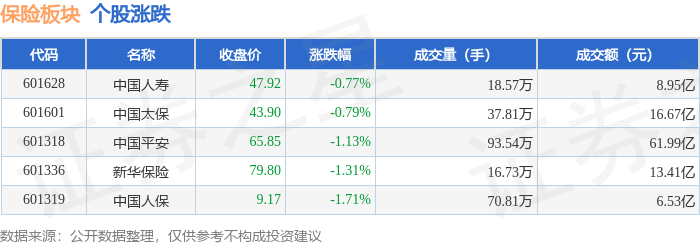
保险板块1月21日跌1.03%,中国人保领跌,主力资金净流出3.28亿元
Zheng Xing Xing Ye Ri Bao· 2026-01-21 08:54
Core Viewpoint - The insurance sector experienced a decline of 1.03% on January 21, with China Life leading the drop, while the overall market showed slight gains in major indices [1] Group 1: Market Performance - The Shanghai Composite Index closed at 4116.94, up 0.08% - The Shenzhen Component Index closed at 14255.12, up 0.7% [1] Group 2: Individual Stock Performance - China Life (601628) closed at 47.92, down 0.77% with a trading volume of 185,700 shares and a turnover of 895 million yuan - China Pacific Insurance (601601) closed at 43.90, down 0.79% with a trading volume of 378,100 shares and a turnover of 1.667 billion yuan - Ping An Insurance (601318) closed at 65.85, down 1.13% with a trading volume of 935,400 shares and a turnover of 266.619 million yuan - New China Life (601336) closed at 79.80, down 1.31% with a trading volume of 167,300 shares and a turnover of 1.341 billion yuan - China Re (601319) closed at 9.17, down 1.71% with a trading volume of 708,100 shares and a turnover of 65.317 million yuan [1] Group 3: Capital Flow - The insurance sector saw a net outflow of 328 million yuan from main funds, while retail investors contributed a net inflow of 416 million yuan - The detailed capital flow for individual stocks shows varying trends, with China Pacific Insurance experiencing a net inflow of 116 million yuan from main funds, while Ping An Insurance faced a significant net outflow of 384 million yuan [1][2]




融资融券周报:主要指数多数下跌,两融余额继续上升-20260121
BOHAI SECURITIES· 2026-01-21 08:27
- The report does not contain any quantitative models or factors, nor does it discuss their construction, evaluation, or backtesting results. The content primarily focuses on market data, financing and securities lending balances, industry characteristics, and ETF/stock-specific financing and securities lending activities[1][2][9]. - The report provides detailed data on financing and securities lending balances, including weekly changes in financing balances (+267.64 billion RMB) and securities lending balances (-2.63 billion RMB), as well as the total two-market balance of 27,003.83 billion RMB as of January 20, 2026[12][13][15]. - Industry-specific financing and securities lending characteristics are analyzed, highlighting sectors with the highest and lowest financing and securities lending activities. For example, the non-bank financial, communication, and electronics sectors had the highest financing buy-in ratios, while the textile and apparel, light manufacturing, and building materials sectors had the lowest[29][34][35]. - The report also identifies the top ETFs and stocks by financing net buy-in amounts, such as the "China Ping An" stock (601318) with a financing net buy-in of 230.64 million RMB and the "China Securities Electric Network Equipment Theme ETF" (159326.SZ) with a financing net buy-in of 42.23 million RMB[44][45][49]. - Securities lending activities are also detailed, with the top stocks by net securities lending sell-out amounts including "Jerry Shares" (002353.SZ) with 18.67 million RMB and "Giant Network" (002558.SZ) with 17.67 million RMB[50][51].



一周保险速览(1.10—1.16)
Cai Jing Wang· 2026-01-21 06:05
Industry Insights - In 2025, multiple insurance companies reported annual claims data showing a continuous increase in both the number and amount of claims, with an overall claim approval rate exceeding 99% [1] - Medical insurance had the highest number of claims, while critical illness insurance had the highest claim amounts, indicating a significant protection gap [1] - Claims processing times have significantly improved, with some companies achieving instant payouts; however, the "claims difficulty" issue persists mainly due to inaccurate health disclosures, misunderstandings of policy terms, and insufficient documentation, rather than widespread claim denials [1] - Experts recommend that consumers scientifically allocate medical and critical illness insurance based on age, income, and family responsibilities, particularly emphasizing adequate coverage for family breadwinners [1] Corporate Developments - Deutsche Bank's insurance subsidiary, Deutsche Bank Life Insurance Co., has increased its registered capital to 3.785 billion yuan, marking a 68.97% increase from 2.24 billion yuan [2] - On January 14, China Pacific Life Insurance Co. announced its participation in a stock acquisition of Shanghai International Airport Co., increasing its holdings to 124,415,684 shares, representing 5.00% of the A-share capital [3] - China Ping An is set to sell a 34% stake in Shenzhen United Property Exchange, comprising 170 million shares, with a listing price of 408 million yuan (2.4 yuan per share) [4] - On January 14, the general manager of Kaibin Property Insurance Co., Xia Dongyou, resigned for personal reasons, with Bai Chengmin appointed as the interim head to ensure a smooth management transition [5] - On January 14, Jiao Yin Life Insurance announced a leadership change, with Li Ya appointed as the new chairman, succeeding Wang Qingyan [6]

4Q25人身保险业利率研究专家咨询委员会例会点评:预定利率研究值或已筑底确认,中期再迎“炒停售”季概率较低
ZHONGTAI SECURITIES· 2026-01-21 05:37
Investment Rating - The report maintains an "Overweight" rating for the industry [1]. Core Insights - The current preset interest rate for ordinary life insurance products is 1.89%, a slight decrease from the previous value of 1.90%, indicating a narrowing decline in the preset interest rate research values over recent quarters [4]. - The report highlights that the long-end interest rates have stabilized since 2025, with a gradual upward trend established in the second half of 2025, suggesting a positive outlook for the industry [4]. - The report emphasizes the implementation of a dynamic adjustment mechanism linking preset interest rates to market rates, which is expected to guide companies in prudent pricing and asset-liability management [4]. - The likelihood of a "buy-stop" season in 2026 is considered low, as the preset interest rate research value is close to the maximum allowable rate for current products, making significant adjustments unlikely [4]. Summary by Sections Industry Overview - The report notes that the preset interest rate research values have shown a decreasing trend, with recent declines of 21bps, 14bps, 9bps, and 1bps, indicating a gradual stabilization [3]. - The financial regulatory authority has issued guidelines to link preset interest rates with market rates, which is expected to enhance the industry's pricing strategies [4]. Market Trends - The report indicates that the 5-year LPR remains at 3.5%, the 5-year fixed deposit benchmark rate at 1.3%, and the 10-year government bond yield at 1.85%, all showing stability compared to the previous quarter [4]. - The report suggests that the insurance sector has experienced a positive cyclical recovery since December of the previous year, with expectations for improved performance and valuation recovery [4]. Investment Recommendations - The report recommends continued attention to key players in the insurance sector, including China Life, China Pacific Insurance, Ping An Insurance, New China Life, China Property & Casualty Insurance, and AIA Group, as they are expected to benefit from the anticipated market conditions [4].
平安好医生升级“岁岁平安”守护服务 护航居家养老安全
Zheng Quan Ri Bao Wang· 2026-01-21 04:13
Core Insights - The article discusses the launch of the "Sui Sui Ping An" protection plan by Ping An, aimed at enhancing home care safety for elderly individuals, particularly those living alone [1][2] Group 1: Plan Overview - The "Sui Sui Ping An" plan integrates a complete closed-loop system of "identification-response-rescue" to improve safety for elderly individuals at home [1] - The plan builds on a previous daily check-in incentive program that has been active for over 1,200 days, with more than 10 million check-ins recorded, protecting over 60,000 elderly individuals, 65% of whom are living alone [1] Group 2: Service Features - The "Ping An Housekeeper" service brand offers a comprehensive service system that includes smart devices, platform monitoring, and human assistance, allowing elderly users to customize their service options [2] - The system incorporates fall detection radars and smart speakers to identify risks such as falls or unconsciousness, facilitating emergency assistance [2] - With a self-developed early warning platform and a 24/7 online housekeeper team, the system can achieve second-level response times and coordinate resources for on-site rescue services in emergencies [2]
睿远基金旗下产品最新重仓股曝光:傅鹏博加仓寒武纪,赵枫买回美的
Sou Hu Cai Jing· 2026-01-21 03:57
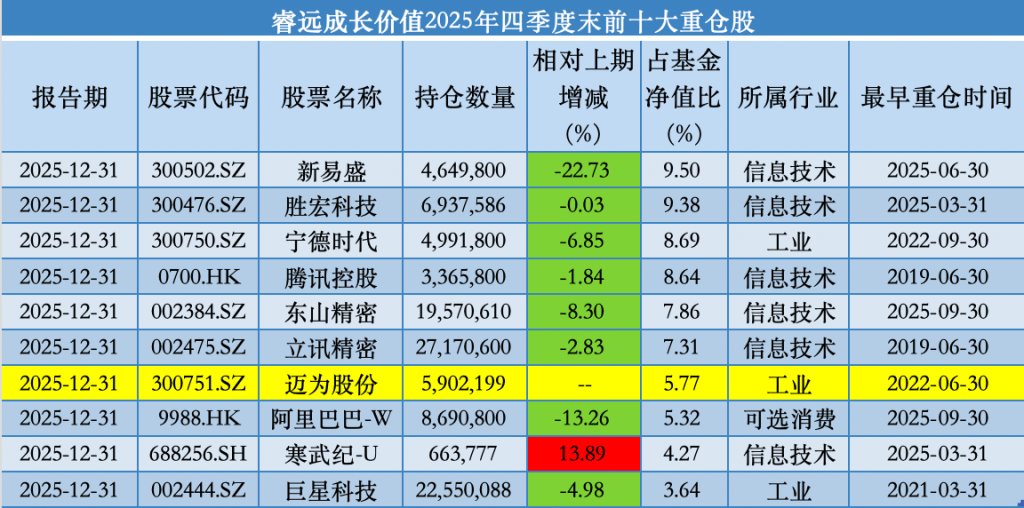
Core Viewpoint - The report highlights significant changes in the investment strategies of Ruiyuan Fund's star fund managers, with notable adjustments in stock holdings and performance metrics for the fourth quarter of 2025. Group 1: Fund Performance and Adjustments - Ruiyuan Growth Value Mixed Fund experienced a net redemption of 136.2 million shares, marking the second-highest redemption in its history, with total net assets decreasing from 23.629 billion yuan to 21.087 billion yuan [3][4] - The fund's stock allocation increased slightly from 89.93% to 90.48%, while the proportion of Hong Kong stocks in the fund's net value decreased from 27.92% to 20.14% [3][4] - Ruiyuan Balanced Value Three-Year Holding Fund's stock allocation reached a three-year high of 90.66%, with a slight increase in the proportion of Hong Kong stocks to 41.99% [10] Group 2: Stock Holdings and Changes - The top ten holdings of Ruiyuan Growth Value Mixed Fund included New Yisheng, Shenghong Technology, and Ningde Times, with New Yisheng seeing a 22.73% reduction in holdings [4][5] - Ruiyuan Balanced Value Three-Year Holding Fund saw significant changes, with the re-entry of Midea Group into the top ten holdings and reductions in holdings of companies like Lixun Precision and China Ping An [10][12] - The fund managers noted a shift in focus towards sectors like photovoltaic and semiconductor high-end equipment manufacturing, while reducing exposure to companies with weak fundamentals [6][10] Group 3: Future Outlook and Strategy - The fund managers expressed optimism about the market, anticipating that the return on equity assets will remain attractive compared to other asset classes, with potential returns exceeding 10% for leading companies [11][13] - They plan to focus on companies with strong fundamentals and competitive advantages, particularly those expanding overseas, as this is expected to drive future growth [13][14] - The report indicates a structural market environment with limited risks of significant downturns, while opportunities for excess returns remain [8][13]




中国平安:截至2025年上半年公司以公允价值计量且其变动计入其他综合收益的固收类金融资产金额为31701亿元
Zheng Quan Ri Bao Wang· 2026-01-21 03:56
证券日报网讯 1月20日,中国平安(601318)在互动平台回答投资者提问时表示,根据公司发布的2025 年半年度报告,截至2025年上半年,公司以公允价值计量且其变动计入其他综合收益(FVOCI)的固收 类金融资产金额为31701亿元,以公允价值计量且其变动计入当期损益(FVTPL)的固收类金融资产金 额为9449亿元,此外还有部分固收类金融资产以摊余成本计量(AC)。 ...
楚雄金融监管分局同意平安产险南华支公司营业场所变更
Jin Tou Wang· 2026-01-21 03:33
二、中国平安财产保险股份有限公司应按照有关规定及时办理变更及许可证换领事宜。 2026年1月8日,楚雄金融监管分局发布批复称,《中国平安财产保险股份有限公司楚雄中心支公司关于 中国平安财产保险股份有限公司南华支公司变更营业场所的请示》(平保产云分楚雄中支发〔2025〕11 号)收悉。经审核,现批复如下: 一、同意中国平安财产保险股份有限公司南华支公司营业场所变更为:云南省楚雄彝族自治州南华县龙 川镇省道S103以南湖畔佳苑(一期)4幢1楼107号、108号商铺。 ...
江西金融监管局同意平安产险青山湖支公司变更营业场所
Jin Tou Wang· 2026-01-21 03:30
一、同意中国平安财产保险股份有限公司青山湖支公司将营业场所变更为:江西省南昌市青山湖区火炬 二路1111号昱丰大厦2楼。 二、中国平安财产保险股份有限公司应按照有关规定及时办理变更及许可证换领事宜。 2026年1月19日,江西金融监管局发布批复称,《关于中国平安(601318)财产保险股份有限公司青山 湖支公司变更营业场所的请示》(平保产赣分南昌中支发〔2025〕3号)收悉。经审核,现批复如下: ...