CHALCO(601600)

Search documents
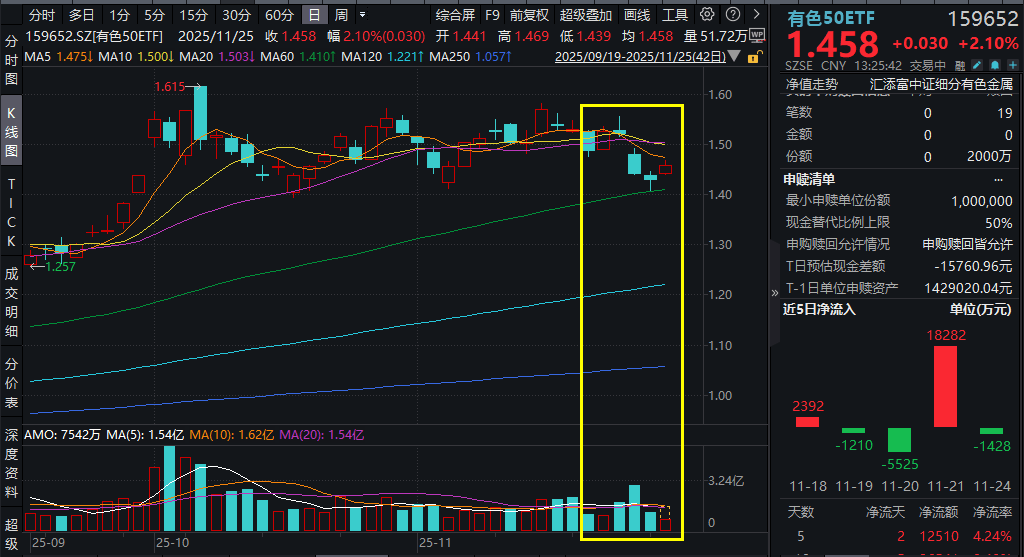
美联储“鸽声”再起,金铜强势反弹!有色全线飘红,洛阳钼业涨超3%,有色50ETF(159652)放量涨超2%,或终结三连阴!瑞银2026最新铜价预测
Sou Hu Cai Jing· 2025-11-25 06:19
Core Viewpoint - The expectation of a Federal Reserve interest rate cut has increased, leading to a collective rise in gold and copper prices, with the non-ferrous metal sector showing signs of recovery [1][4]. Group 1: Federal Reserve and Economic Outlook - Federal Reserve Governor Christopher Waller reiterated support for a rate cut in December, citing stable inflation and concerns about the labor market [3]. - Goldman Sachs predicts that the Fed will likely initiate a rate cut in December, with potential further cuts in 2025, bringing the benchmark rate down to the 3%-3.25% range [3]. - The current economic conditions suggest a tilt towards accelerated rate cuts if the economic downturn exceeds expectations [3]. Group 2: Market Reactions and Commodity Prices - The market's anticipation of the Fed's rate cut has provided upward momentum for physical asset prices, with COMEX gold and LME copper both rising over 1% [4]. - The copper production target for Freeport-McMoRan in Indonesia has been lowered to 478,000 tons for 2026 due to operational disruptions, which may lead to short-term supply concerns and support higher copper prices [4]. Group 3: Copper Price Projections - UBS has raised its copper price targets for 2026, with the new target set at $13,000 per ton, reflecting a bullish outlook on copper prices [5]. - The copper market is expected to maintain an upward price trend due to supply constraints and increasing demand from sectors like electric power, new energy vehicles, and data centers [8]. Group 4: Non-Ferrous Metal Sector Performance - The Non-Ferrous 50 ETF (159652) saw significant gains, with leading stocks like Huaxi Nonferrous rising over 8% and several others increasing by more than 3% [6]. - The non-ferrous metal sector is characterized by tight supply and strong demand, with aluminum prices expected to remain high due to limited new capacity and robust demand [9]. Group 5: Investment Opportunities - The Non-Ferrous 50 ETF (159652) is highlighted for its high "gold and copper content," with 33% copper and 13% gold, making it a leading choice in the sector [10]. - The ETF has demonstrated superior performance with a cumulative return leading its peers since 2022, driven by earnings rather than valuation expansion [12].





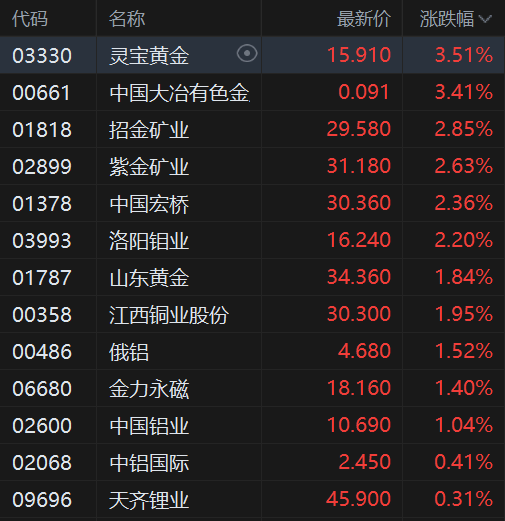
受美联储降息希望提振,港股有色金属股普涨,灵宝黄金涨3.5%,招金矿业、紫金矿业涨近3%,中国宏桥、洛阳钼业涨超2%
Ge Long Hui· 2025-11-25 04:20
Group 1 - The core viewpoint of the article highlights a collective rise in Hong Kong's non-ferrous metal stocks, driven by expectations of a Federal Reserve interest rate cut in December [1][3]. - Specific stocks that saw significant increases include Lingbao Gold, which rose by 3.5%, and China Daye Nonferrous Metals, which increased by 3.41% [2][1]. - The overall market sentiment is positively influenced by the anticipated decline in interest rates, which is expected to lower financing costs and improve demand expectations [3]. Group 2 - The probability of a 25 basis point rate cut by the Federal Reserve in December has risen to 82.9%, up from 69.4% the previous day [2][3]. - Gold prices have also seen a slight increase, with spot gold rising by 0.2% to $4,141.70 per ounce, supported by the Fed's dovish outlook [3]. - Analysts suggest that the expected rate cut will positively impact the non-ferrous metal sector through a weaker dollar and enhanced risk appetite [3].

贵金属上涨+锂电需求推动,有色ETF基金(159880)涨超2.2%
Sou Hu Cai Jing· 2025-11-25 03:17
Core Viewpoint - The non-ferrous metal industry index has shown strong performance, with significant increases in key stocks, driven by rising precious metal prices and positive demand forecasts for lithium and other materials [1][2]. Group 1: Market Performance - As of November 25, 2025, the non-ferrous metal industry index (399395) rose by 2.81%, with notable stock increases including Placo New Materials (300811) up 11.34%, Dongyang Sunshine (600673) up 6.14%, and Zhongjin Gold (600489) up 5.52% [1]. - The non-ferrous ETF fund (159880) increased by 2.28%, with the latest price at 1.71 yuan [1]. Group 2: Economic Indicators - Federal Reserve Governor Christopher Waller reiterated support for a potential interest rate cut in December, indicating that inflation is not a major concern at this time [1]. - The chairman of Tianqi Lithium, Jiang Anqi, projected that global lithium demand will reach 2 million tons of lithium carbonate equivalent by 2026, suggesting a balance between supply and demand [1]. Group 3: Industry Insights - Dongguan Securities highlighted that the supply side of industrial metals may remain constrained, emphasizing the growth in demand from the new energy sector [1]. - The supply of minor metals and new materials is under rigid constraints, while emerging demand is expected to surge [1]. - The supply side of energy metals is gradually optimizing, with ongoing attention to the recovery of downstream demand [1].


有色ETF基金(159880)探底回升,机构称有色板块再次迎来逢低布局的机会
Xin Lang Cai Jing· 2025-11-24 07:04
Core Viewpoint - The non-ferrous metal sector is experiencing mixed performance, with opportunities for low-cost investments in specific sub-sectors, particularly in the electrolytic aluminum segment, driven by anticipated demand growth and price increases through 2026 [1][2]. Group 1: Market Performance - As of November 24, 2025, the non-ferrous metal industry index (399395) shows mixed results among its constituent stocks, with Dongyangguang (600673) leading gains at 5.68%, followed by Placo New Materials (300811) at 5.42%, and Hailiang Co. (002203) at 4.31% [1]. - The non-ferrous ETF fund (159880) is currently priced at 1.67 yuan [1]. Group 2: Sector Insights - The non-ferrous sector is viewed as presenting a buying opportunity, particularly in segments that have been undervalued [1]. - The electrolytic aluminum sector is highlighted for its high dividend yield as a defensive strategy, with expectations of demand growth and price increases continuing into 2026 [1]. - The outlook for industrial metals is positive, driven by U.S. fiscal expansion and the high copper-aluminum price ratio, which may lead to increased demand for aluminum [1]. Group 3: Index Composition - As of October 31, 2025, the top ten weighted stocks in the non-ferrous metal industry index (399395) include Zijin Mining (601899), Luoyang Molybdenum (603993), and Northern Rare Earth (600111), collectively accounting for 52.91% of the index [2].
中国人工智能基础设施对金属的影响要点-铝、铜表现亮眼,铀及小金属-AI Infra takeaways on metals - aluminum, copper to shine, uranium_ minor metals
2025-11-24 01:46
Summary of Key Points from the Conference Call Industry Overview - The conference focused on the basic materials sector in China, particularly metals, power equipment, and energy storage systems (ESS) [1] - Featured insights from 35 experts and companies, including Zijin, Chalco, Hongqiao, CMOC, and CGN Mining [1] Aluminum Sector - **Demand and Supply Dynamics**: Strong aluminum demand driven by electrification and substitution for copper, with a price ratio of approximately 4x [2][8] - **Market Prices**: Aluminum prices exceeded Hongqiao's previous guidance of RMB 20,600–21,300 per ton, supported by fundamentals and potential global smelter shutdowns [2][9] - **Cost Drivers**: Power tariffs are a significant cost factor, with Hongqiao's average tariff at RMB 0.38/kWh in Q3 [2][10] - **Strategic Initiatives**: Hongqiao plans to increase capacity from 1.96 million tons to 2.16 million tons by year-end and is focusing on overseas bauxite expansion [2][11][12] Copper Sector - **Price Forecast**: SMM forecasts copper prices to average US$10,600–11,200 per ton in 2026, with potential spikes to US$12,000 per ton due to tight supply [3][18] - **Supply and Demand**: Global copper supply expected to rise by ~900kt next year, with demand growth projected at ~3%, primarily from EVs and wind power [3][20] - **Production Challenges**: Zijin's 2025 copper output may fall short due to the suspension of the Kakula mine, but long-term guidance remains intact [3][21] Uranium Sector - **Market Revival**: Uranium demand is rebounding as nuclear power becomes a stable energy source for AI and data centers, with a supply-demand gap of ~60kt vs. ~75kt [4][32] - **Price Stability**: Spot prices hover around USD80/lb, with term contracts limiting downside risk [4][32] - **Future Demand Drivers**: Increased nuclear power station construction and the deployment of small modular reactors (SMRs) are expected to drive future uranium demand [4][30] Tungsten and Molybdenum - **Tungsten Market**: Faces a structural deficit with China producing 83% of global tungsten. Domestic concentrate prices have doubled YoY to RMB 300k/t due to supply constraints [35] - **Molybdenum Trends**: China supplies ~50% of global molybdenum, with demand outpacing supply growth. Prices are expected to remain firm through 2030 [36] Strategic Initiatives and Financial Outlook - **Chalco's Capex**: Projected future capital expenditure of RMB 15-20 billion annually, focusing on resource extension and operational efficiency [2][17] - **Shareholder Returns**: Hongqiao is considering a share buyback exceeding US$3 billion, indicating confidence in cash flow and growth prospects [2][12] - **CMOC's Financial Position**: Strong operational performance with a projected annual capex of USD1 billion for the next few years [24][26] Investment Risks - **Market Risks**: Potential asset impairments and economic shutdowns in alumina operations could pose risks to future performance [17] - **Geopolitical Risks**: Geopolitical tensions may affect supply chains and market stability, particularly in uranium and tungsten sectors [30][35] Conclusion - The conference highlighted robust demand across the metals sector, with strategic initiatives aimed at enhancing production capacity and shareholder value. However, challenges such as supply constraints, geopolitical risks, and fluctuating prices remain critical considerations for investors.
有色及贵金属周报:流动性扰动不改金属上行周期-20251123
GUOTAI HAITONG SECURITIES· 2025-11-23 12:39
Investment Rating - The report maintains a positive outlook on the metals industry, indicating an upward cycle despite liquidity disturbances [2][3]. Core Views - The Federal Reserve's indecisiveness regarding interest rate cuts and changing market sentiment towards AI narratives have led to fluctuations in base metal prices. However, the fundamentals for energy metals remain strong, with prices trending upwards [2][3]. Summary by Sections 1. Precious Metals - Market sentiment is affected by volatility in risk assets and central banks reducing gold reserves. The Federal Reserve's mixed economic assessments and fluctuating expectations for a December rate cut dominate the market [5][7]. - Gold prices as of November 21: SHFE gold decreased by 3.36% to 926.94 CNY/g, while COMEX gold fell by 0.77% to 4062.80 USD/oz [7][25]. - China's gold reserves increased by 30,000 ounces to 7,409 million ounces as of the end of October, marking 12 consecutive months of growth [7]. 2. Copper - Copper prices are under pressure due to fluctuating expectations for interest rate cuts. As of November 21, SHFE copper decreased by 1.43% to 85,660 CNY/ton, and LME copper fell by 0.69% to 10,777.5 USD/ton [10][22]. - The supply side is impacted by an accident in the Democratic Republic of Congo, while demand remains strong, particularly from AI data centers and power grids [10][22]. 3. Aluminum - Aluminum prices are experiencing high volatility due to macroeconomic expectations. As of November 21, SHFE aluminum decreased by 2.29% to 21,340 CNY/ton, and LME aluminum fell by 2.54% to 2,786 USD/ton [9][22]. - Domestic electrolytic aluminum supply remains stable, while overseas supply concerns persist. The processing operating rate is steady at 62% [9][22]. 4. Energy Metals - The lithium sector shows strong demand, with lithium prices trending upwards. As of last week, lithium carbonate production was 22,100 tons, up by 585 tons, while inventory decreased by 2,052 tons [11]. - Cobalt prices remain high due to tight upstream raw material supply, while demand from the downstream sector is cautious [11]. 5. Rare Earths - Prices for praseodymium and neodymium have slightly increased before retreating, with no significant changes in the fundamentals. As of November 21, prices were 549,000 CNY/ton for praseodymium and neodymium, and 1,485,000 CNY/ton for dysprosium [12].
铝行业周报:美联储降息预期反复,铝价高位回落-20251123
Guohai Securities· 2025-11-23 11:33
Investment Rating - The report maintains a "Recommended" rating for the aluminum industry [1] Core Views - The aluminum price has recently retreated from high levels due to fluctuating expectations regarding the Federal Reserve's interest rate cuts, with a notable drop in aluminum prices observed [6][9] - The demand for aluminum is entering a traditional off-season, leading to concerns about inventory levels and price stability [9] - Long-term prospects for the aluminum industry remain positive due to limited supply growth and potential demand increases, justifying the "Recommended" rating [9] Summary by Sections Price - As of November 21, the LME three-month aluminum closing price was $2808.0 per ton, down $500.0 from the previous week, a 2.3% decrease [13] - The Shanghai aluminum active contract closing price was 21340.0 yuan per ton, reflecting a 2.4% decrease compared to the previous week [19] Production - In October 2025, the aluminum production was 3.742 million tons, a month-on-month increase of 3.5% and a year-on-year increase of 4.7% [50] - The alumina production for the same month was 7.785 million tons, also showing a month-on-month increase of 2.4% and a year-on-year increase of 12.6% [50] Inventory - As of November 20, the domestic mainstream consumption area of aluminum ingot inventory recorded 621,000 tons, with a slight decrease of 2,500 tons from the previous week [7] - The overall inventory situation remains a concern as the market enters the off-season, with potential risks of inventory accumulation [9] Key Companies and Earnings Forecast - Key companies in the industry include China Hongqiao, Tianshan Aluminum, Shenhuo Co., China Aluminum, and Yun Aluminum, all rated as "Buy" [5]


2025年1-9月中国氧化铝产量为6856万吨 累计增长8.4%
Chan Ye Xin Xi Wang· 2025-11-23 02:16
Core Viewpoint - The report highlights the growth of China's alumina production, indicating a significant increase in output and projecting future trends in the industry [1]. Industry Overview - As of September 2025, China's alumina production reached 8 million tons, reflecting a year-on-year growth of 8.7% [1]. - Cumulatively, from January to September 2025, the total alumina production in China was 68.56 million tons, with an overall increase of 8.4% compared to the previous year [1]. Companies Involved - Listed companies in the alumina sector include China Aluminum (601600), Tianshan Aluminum (002532), Nanshan Aluminum (600219), Yun Aluminum (000807), Shenhuo Co. (000933), Zhongfu Industrial (600595), Jiaozuo Wanfang (000612), Hongchuang Holdings (002379), Minfa Aluminum (002578), and Ningbo Fubang (600768) [1]. Research and Analysis - The report titled "Analysis of Development Models and Future Prospects of China's Alumina Industry from 2026 to 2032" was published by Zhiyan Consulting, a leading industry consulting firm in China [1]. - Zhiyan Consulting has been dedicated to industry research for over a decade, providing comprehensive industry research reports, business plans, feasibility studies, and customized services [1].


研判2025!中国铝压铸合金行业政策汇总、产业链上下游、发展现状及未来趋势分析:汽车轻量化趋势下,铝压铸合金市场规模达到2000亿元以上[图]
Chan Ye Xin Xi Wang· 2025-11-22 02:45
Core Viewpoint - China is a significant player in the global aluminum die-casting alloy industry, with the market size expected to reach 215.26 billion yuan in 2024, reflecting a year-on-year increase of 3.67% driven by the automotive market, electronics industry, and high-end equipment manufacturing [1][10]. Industry Overview - Aluminum die-casting alloys are produced through die-casting processes, primarily composed of silicon, manganese, magnesium, and trace elements, with production involving melting, refining, molding, and pouring [3]. - The industry benefits from the lightweight, high strength, and corrosion resistance of aluminum die-casting alloys, which are widely used in automotive, aerospace, medical, military, and electronic sectors [3]. Market Size and Growth - The aluminum die-casting alloy market in China is projected to grow, supported by the country's large automotive market and rapid advancements in the electronics sector [1][10]. - The global aluminum die-casting alloy market is expected to reach $142.78 billion by 2024, with a compound annual growth rate (CAGR) of 5.0% from 2024 to 2031 [10]. Competitive Landscape - International companies like Nemak, Ahresty, and Ryobi dominate the industry due to their technological expertise and extensive market presence [10]. - Domestic companies such as Aikodi, Wencan Group, and Guangdong Hongtu are emerging as significant players, benefiting from China's market demand and industrial support [10]. Industry Trends - The industry is moving towards precision and high performance, driven by the increasing quality and performance requirements from the automotive sector, especially for electric vehicles [12]. - There is a growing demand for customized solutions, necessitating improved customer communication and tailored product designs [13]. - The industry is also expanding into international markets, seeking to enhance competitiveness and brand influence through global partnerships and participation in international events [14].



国资委:要多用、善用资本市场
Zheng Quan Ri Bao· 2025-11-22 01:41
Core Points - The State-owned Assets Supervision and Administration Commission (SASAC) organized a meeting to promote the specialized integration of central enterprises and held a signing ceremony for key projects [1][2] - A total of 17 units participated in the signing of key projects, focusing on areas such as carbon fiber industry cooperation, intelligent driving, industrial internet, and aviation logistics [1] - The specialized integration projects aim to accelerate breakthroughs in key technologies, enhance emerging industries, and promote the high-quality development of key industrial chains [1][2] Summary by Sections - **Project Signings**: The meeting resulted in the signing of key projects between major companies, including Sinopec and Dongfang Electric Group, and China FAW and Zhuoyue Technology [1] - **Focus Areas**: The integration projects are designed to integrate quality resources, promote technological and industrial innovation, and enhance traditional industries [1] - **Strategic Direction**: SASAC emphasized the need for central enterprises to enhance their integration capabilities in strategic emerging industries and to utilize mergers and acquisitions as a means of integration [2] - **Capital Market Utilization**: There is a call for central enterprises to leverage the capital market for integrating non-core but high-potential businesses into main business platforms for mutual benefits [2]