
CPIC(601601)

Search documents
全年鲜供不打烊!中国太保创新护航小龙虾冬养无忧
Jin Rong Jie· 2025-12-18 09:52
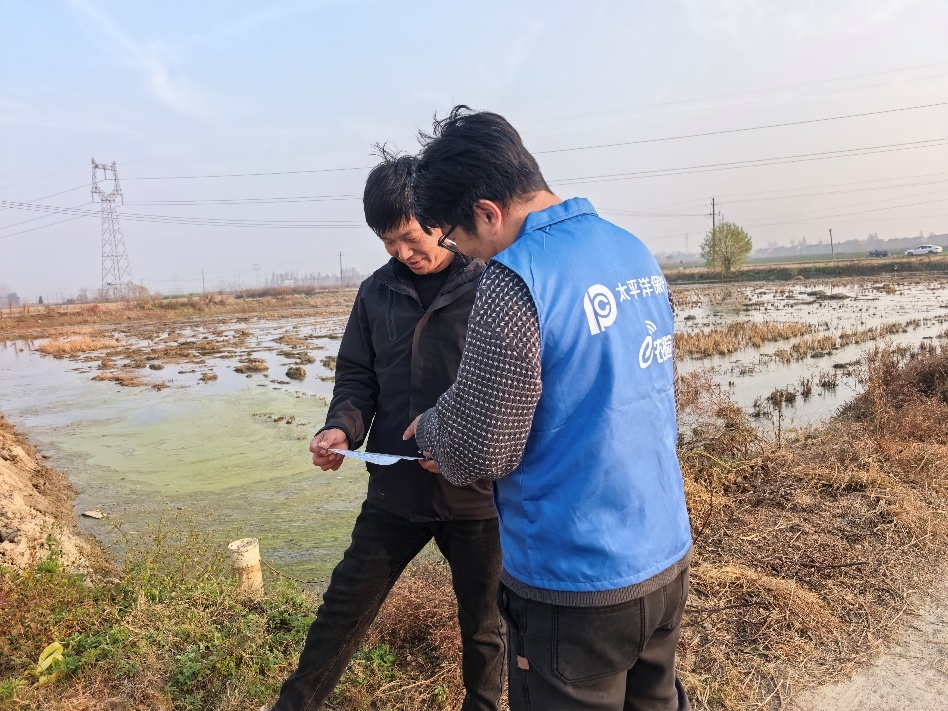
如今在湖北潜江,像王师傅这样的受益养殖户越来越多。全市已建成超过100个、总面积5000亩的"四季有虾"稻田模式示范点,通 过"示范先行+技术培训+风险保障"的组合拳,让"四季有虾"的养殖模式稳步推广。 上述案例正是中国太保依托专业优势,护航各地发展特色产业,让更多农民实现可持续增收的缩影。助力三农现代化发展,写好普惠 金融大文章,中国太保将持续践行责任担当,坚持创新引领,护航农业基础更加稳固、农村地区更加繁荣、农民生活更加红火,让中 国农业高质量发展的步伐更加铿锵有力。 财经频道更多独家策划、专家专栏,免费查阅>> "以前冬天就馋这一口小龙虾,没想到现在一年四季都能吃到新鲜的!"湖北潜江市民李女士在菜市场挑选小龙虾时连连点赞。 这份"全年不缺席"的美味背后,离不开养殖户的辛勤付出,更藏着一份为冬虾养殖保驾护航的"保险密码"。作为"中国小龙虾之乡",潜 江正全力推进"四季有虾"工程,打破小龙虾"夏旺冬缺"的季节限制。农户们可采取升级后的"早春虾—中晚稻—冬虾"稻田模式,即2月 投苗、4月收虾,接着种中晚稻,收完稻后再投冬虾苗,实现稻虾双丰收。但反季节养殖最怕极端天气,"去年冬天一次降温,邻村好 几户的虾苗冻得 ...


保险行业2026年度投资策略:慢牛新周期,保险如何估值?
Changjiang Securities· 2025-12-18 08:28
Investment Rating - The report maintains a "Positive" investment rating for the insurance sector [11]. Core Insights - In the short term, investment yield is the dominant factor for valuation, while asset allocation ratio is the decisive factor for investment yield. In the medium to long term, the spread between the asset and liability sides of insurance is expected to improve due to policy and market changes, with sufficient long-term space in the industry leading to continuous improvement in ROE [3][9]. - Recommended stocks include China Life, New China Life, Ping An, and China Pacific Insurance as quality targets [3][9]. Summary by Sections 2025 Review - The insurance sector's performance was generally flat compared to the market, with the CSI 300 index rising by 15% and the Yangtze Insurance Index increasing by 14.5%, underperforming the market by 0.6 percentage points. Individual stocks like Ping An, New China Life, and China Pacific outperformed the market [6][23]. - The liability side is undergoing a transformation towards dividends, with new policy growth slightly slowing but value rates improving, driving new business value growth. The asset side performed well due to strong equity market performance, contributing to good total investment returns [6][23]. Investment Yield Analysis - The primary determinant of insurance companies' investment yield is asset allocation. As of Q3 2025, listed insurance companies had total investment assets exceeding 20 trillion yuan, indicating that investment yield is mainly influenced by asset allocation rather than significant and sustained alpha generation [6][39]. - Even in an extremely low-interest-rate environment, yields can remain above 2%, demonstrating that the risk of spread loss for listed insurance companies is minimal [6][39]. Pricing of the Insurance Sector - Over the past decade, expected investment yield has been the anchor for insurance industry valuation. The short-term valuation is primarily influenced by yield expectations, as the liability cost rate fluctuates less in the short term [7][71]. - The report emphasizes that the asset side, particularly equity assets, has a stronger influence on investment yield than the liability side, which has limited impact due to its long-term nature [7][71]. Future Demand and Market Dynamics - The report anticipates that insurance demand will remain high in 2026, driven by a significant amount of fixed deposits and wealth management products maturing. The comparative advantage of insurance products in terms of yield is expected to attract funds from fixed deposits without requiring an increase in risk appetite [8][84]. - The industry landscape is expected to continue improving, with leading listed insurance companies benefiting more from this trend [8][84].




太保前11月录入保费4380亿,寿险、产险增速现分化
Hua Er Jie Jian Wen· 2025-12-18 08:07
Core Viewpoint - China Pacific Insurance (CPIC) reported a premium income of 438 billion yuan for the first 11 months, reflecting a year-on-year growth of 5.32% [1] Group 1: Premium Performance - The premium income from life insurance and property insurance subsidiaries was 250.32 billion yuan and 187.68 billion yuan, with year-on-year growth rates of 9.4% and 0.3% respectively [1] - The growth rate of CPIC's life insurance has shown stability, aligning closely with the industry average, while property insurance has lagged behind by 3.6 percentage points [1] - Compared to other leading companies in the industry, such as ZhongAn Online, which achieved a premium growth rate of 5.18% in the first ten months, CPIC's property insurance growth appears significantly lower [1] Group 2: Business Structure and Strategy - CPIC's life insurance has successfully navigated the transformation of its agent model, maintaining a stable workforce of 181,000 insurance agents, with a year-on-year increase in average first-year premium per agent of 16.6% to 71,000 yuan [3] - In the first three quarters, CPIC's premium and new business value grew by 14.2% and 31.2% respectively, with improvements in customer demographics and product structure [3] - The company has strategically reduced exposure in high-risk personal credit guarantee insurance, resulting in a 129.9% decline in related premiums [4] Group 3: Market Trends and Future Outlook - The premium growth rate for CPIC's life insurance saw a noticeable decline in November compared to October, likely due to preparations for the "New Year" sales period starting in October [4] - The overall pressure on property insurance premiums is attributed to adjustments in non-auto insurance business, with auto insurance and non-auto insurance showing year-on-year growth rates of 2.9% and -2.6% respectively [4] - The chairman of CPIC's property insurance division indicated that the overall combined cost ratio for non-auto insurance was 97.6%, which could improve to 94.8% by excluding the impact of personal credit guarantee insurance [4]

大连监管局同意太平洋产险大连分公司普兰店支公司变更营业场所
Jin Tou Wang· 2025-12-18 04:22
二、中国太平洋财产保险股份有限公司大连分公司应按照有关规定及时办理变更及许可证换领事宜。 2025年12月9日,国家金融监督管理总局大连监管局发布批复称,《中国太平洋财产保险股份有限公司 大连分公司关于普兰店支公司变更营业场所的请示》(连太保产〔2025〕30号)收悉。经审核,现批复 如下: 一、同意中国太平洋财产保险股份有限公司大连分公司普兰店支公司将营业场所变更为:大连市普兰店 区世纪路西段38-5号509、510、511室。 ...

连续16次斩获“可持续责任典范” :解码中国太保的“责任增值”方法论
Di Yi Cai Jing· 2025-12-18 00:55
Core Insights - China Pacific Insurance (CPIC) has been awarded the "Sustainable Responsibility Model" title for the 16th consecutive year, highlighting its commitment to corporate social responsibility [1] - MSCI has upgraded CPIC's ESG rating to "AAA," making it the first insurance institution in mainland China to achieve this rating, which serves as a recognition of its past responsible practices [1] Strategic Alignment - CPIC's responsibility practices are aligned with national strategies, focusing on three core strategies: health and wellness, internationalization, and "AI+" [2] - The health and wellness strategy aims to address the challenges of an aging population by creating a comprehensive health and elderly care service system, achieving nearly double-digit growth in pension management scale and a 39.3% increase in health insurance premium income [2] - CPIC's international strategy has expanded its overseas business to nearly 160 countries, with a total insured amount exceeding 3 trillion yuan, and it has launched a leading international case of new energy vehicle insurance in Thailand [2] - The "AI+" strategy has significantly improved operational efficiency, with AI handling nearly 50% of customer service volume and achieving a 99% accuracy rate in claims responsibility determination [2] Ecosystem Construction - CPIC integrates ESG principles into product design, operations, and employee development, creating a comprehensive responsibility ecosystem [4] - Innovative products include insurance for breast cancer patients and carbon quota pledge insurance, addressing specific social needs and contributing to carbon neutrality goals [4] - The company has developed a risk radar system that provides typhoon warnings to policyholders, enhancing service efficiency and reducing social risk costs [4] Employee and Corporate Responsibility - CPIC engages employees in social responsibility initiatives, such as building public welfare forests and supporting rural revitalization efforts [5] - The company has established over 60 Hope Primary Schools and actively participates in various public welfare projects, including dementia screening [5] - Financially, CPIC reported a revenue of 344.9 billion yuan for the first three quarters of 2025, a year-on-year increase of 11.1%, and a net profit of 45.7 billion yuan, reflecting a 19.3% growth [5] - The positive cycle of responsibility and profitability is key to CPIC's sustained recognition as a "Responsibility Model" for 16 years [5] Industry Implications - CPIC's practices provide valuable insights for financial institutions on integrating social responsibility into their core operations, emphasizing that responsibility is essential for high-quality development [5] - The "responsibility value-added" methodology developed by CPIC serves as a model for achieving sustainable development that balances long-term value and social responsibility [5]
聚焦湛江!2025期货服务乡村振兴暨“保险+期货”会议明日举行
Qi Huo Ri Bao· 2025-12-18 00:14
作为农业产业化国家重点龙头企业,金岭集团探索出了一条"产业赋能+金融对冲"双轮驱动的"保险+期 货"特色合作模式。该模式将"保险+期货"深度融入其"公司+基地+农户"的产业体系,把蔗农利益与企业 发展紧密相连,形成了"订单农业为基础、保险期货为保障、全周期服务为支撑"的发展格局。特别 是"保底收购+二次结算"的方式,消除了蔗农的种植担忧。同时,金岭集团借助期货市场进行套期保 值,锁定经营利润,实现了企业与农户风险共担、利益共享。这一模式构建起"蔗农安心种植、企业放 心收购、金融强力兜底"的良性循环:农户获得稳定收益后,更愿意投入良种和先进技术,从而提升甘 蔗单产和糖分含量;企业则可集中资源,专注于加工升级和市场开拓,推动全产业链效率提升。 在湛江这片热土上,"保险+期货"的探索与实践已取得显著成效。作为本次会议的协办方,广发期货、 中国太保(601601)产险广东分公司及广东金岭糖业集团有限公司(下称金岭集团)以"保险+期货"为 抓手,为湛江市白糖产业的稳健发展作出了突出贡献。 其中,广发期货聚焦全国糖料蔗核心产区——湛江市徐闻县,自2023年起连续深入推进糖料蔗"保险 +期货"项目。2025年,该项目保障白 ...
融国家战略、强企业内核、暖社会民生 ——中国太保的ESG实践“三重奏”
Di Yi Cai Jing· 2025-12-17 15:48
Core Viewpoint - China Pacific Insurance (CPIC) has deeply integrated ESG principles into its operations, achieving multiple prestigious recognitions in 2025, including the "Responsibility Model Award" for the 16th time and an upgrade in MSCI ESG rating from "AA" to "AAA" [1] Group 1: ESG Practices - CPIC's ESG practices are characterized by a "triple concerto" of "state-enterprise-society," aligning with national strategies such as technological advancement, health initiatives, and carbon neutrality [1] - The company has established a comprehensive "dual carbon" service ecosystem, with total green insurance coverage exceeding 360 trillion yuan and cumulative green investments reaching 260 billion yuan [3] Group 2: Financial Services and Innovation - In the technology finance sector, CPIC has provided over 110 trillion yuan in insurance coverage for strategic emerging industries, including integrated circuits and aerospace [2] - The company has developed a diverse product matrix in technology insurance, including innovative offerings like drone liability insurance and pilot insurance [2] Group 3: Social Responsibility and Community Engagement - CPIC's "Taibao Blue Public Welfare Foundation" focuses on social responsibility, particularly in caring for the elderly and children, with initiatives such as memory care services and support for underprivileged children [10][11][12] - The company has also engaged in ecological and rural public welfare, including wildlife insurance and tree planting initiatives, contributing to biodiversity and carbon reduction [13] Group 4: Strategic Development - CPIC has launched three core strategies: "Great Health and Elderly Care," "Internationalization," and "Artificial Intelligence+" to drive high-quality development and align with national strategies [6][8] - The "Great Health and Elderly Care" strategy aims to address the needs of an aging population by integrating health insurance and elderly care services [7] Group 5: Financial Performance - For the first three quarters of 2025, CPIC reported a revenue of 344.9 billion yuan, a year-on-year increase of 11.1%, and a net profit of 45.7 billion yuan, reflecting the effectiveness of its strategic initiatives [9]
国寿平安太保泰康太平人保等八家寿险巨头投资收益率比拼,哪家公司更厉害?
Xin Lang Cai Jing· 2025-12-17 14:19
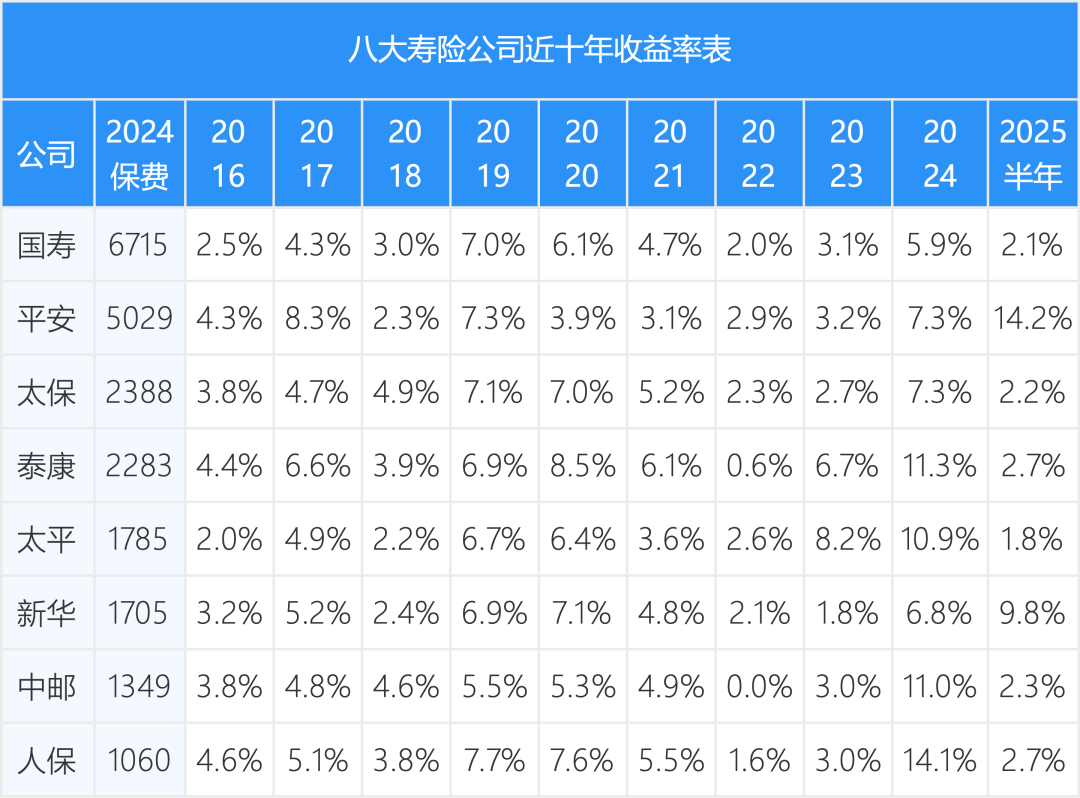
Core Insights - Investment is a core capability for life insurance companies, especially in the era of participating insurance [1][16] - There are significant differences in investment capabilities among major life insurance companies [1][16] - The analysis focuses on eight major life insurance giants with over 100 billion in premiums, which have consistently reported their investment returns for the past ten years [1][16] Investment Returns Overview - The eight major life insurance companies have shown varying investment returns over the past decade, with data presented for each company from 2014 to 2025 [1][16] - The companies included are: China Life, Ping An, Taikang, China Pacific, Taiping, Xinhua, Zhongrong, and PICC [1][16] - The investment returns for these companies are calculated as actual investment returns from 2014-2021 and comprehensive investment returns from 2022-2025 [1][16] Ten-Year Investment Yield Rankings - The top three companies in terms of cumulative investment returns over nine and a half years are Taikang Life (74.5%), Ping An Life (72.6%), and PICC (71.0%) [5][20] - The annualized returns for these companies are 6.0%, 5.9%, and 5.8% respectively [5][20] - There is a notable difference of over 20 percentage points in cumulative investment returns among the companies [20] Performance Consistency - Over the past decade, no company has consistently ranked first or last; five companies have ranked first at some point, and five have ranked last [6][21] - Ping An and PICC have each ranked first three times, while Taikang has ranked first twice [6][21] - The average rankings indicate that Taikang, PICC, and Ping An generally perform better [7][24] Head-to-Head Comparisons - In one-on-one comparisons, Taikang and PICC have the highest win rates against other companies [10][25] - The win-loss records show Taikang winning against Ping An 6:4, and against PICC 7:3, among others [10][25] - China Life has the lowest win rate, winning only 20 out of 100 matchups against the other companies [10][25] Investment Scale Impact - There is a significant difference in investment returns between PICC and China Life, which may be attributed to China Life's larger investment scale [14][29] - PICC has outperformed China Life in eight out of ten years [14][29]
深圳首单“治理+保险”解决方案落地
Xin Lang Cai Jing· 2025-12-17 14:19
Core Viewpoint - The collaboration between the Futian District of Shenzhen and China Pacific Insurance aims to innovate housing safety management by integrating public safety insurance with proactive risk management services, transitioning from mere compensation to comprehensive risk management [1][5][10]. Group 1: Housing Safety Insurance - The pilot program in the Bagualing area includes coverage for casualties and property losses due to building collapses, as well as temporary housing for residents, thereby reducing the financial burden on the community [1][7]. - This initiative marks a shift from government-led safety governance to a collaborative model involving government, market participation, and community benefits, enhancing the resilience and sustainability of housing safety management [7][10]. Group 2: Risk Management and Prevention - The insurance model incorporates regular housing inspections to identify and mitigate risks proactively, aiming to reduce the frequency and severity of accidents [2][8]. - Insurance providers will assist in disaster warnings, emergency evacuations, and public safety incident responses, transforming unknown risks into known protections [2][8]. Group 3: Technological Integration - The program will utilize innovative technologies such as thermal imaging drones for efficient and precise housing condition assessments, enhancing the ability to detect risks and improve operational efficiency [3][9]. - A comprehensive "service + technology" risk reduction management mechanism will be established, combining automated monitoring with human oversight for ongoing housing inspections and maintenance [3][9]. Group 4: Market and Government Collaboration - The initiative represents a beneficial exploration of combining government oversight with market forces to reinforce housing safety, addressing the limitations of traditional government-funded renovations [4][10]. - The dual regulatory framework of "administration + market" aims to solidify a safety management baseline that includes both preventive measures and post-incident protections [5][10]. Group 5: Future Development - Shenzhen plans to develop a comprehensive housing safety management system that integrates government guidance, insurance protection, risk prevention, and multi-party collaboration, promoting community safety and urban quality development [11].
A股周三放量上涨 保险板块表现亮眼
Zhong Guo Xin Wen Wang· 2025-12-17 11:22
Core Viewpoint - The Chinese A-shares experienced a significant increase on December 17, with major indices rising across the board, driven by strong performance in the financial sector, particularly insurance stocks [1] Market Performance - The Shanghai Composite Index closed at 3870 points, up by 1.19% - The Shenzhen Component Index closed at 13224 points, up by 2.4% - The ChiNext Index closed at 3175 points, up by 3.39% - The total trading volume in the Shanghai and Shenzhen markets was approximately 181.11 billion yuan, an increase of about 87 billion yuan compared to the previous trading day [1][1][1] Sector Performance - The insurance sector recorded a gain of 3.11%, leading the market [1] - All A-share insurance stocks rose, with China Pacific Insurance seeing its stock price increase by over 4% [1][1] New Listings - On December 17, a new company, Muxi Co., specializing in GPU technology, was listed on the A-share market - Muxi Co.'s stock price surged by 692.95% on its first day of trading, closing at 829.9 yuan per share [1][1]