
HTSC(601688)

Search documents
金融行业周报(2025、11、30):保险开门红展望积极,坚持银行板块配置策略-20251130
Western Securities· 2025-11-30 12:49
Core Conclusions - The financial industry experienced a weekly increase of +0.68% in the non-bank financial index, underperforming the CSI 300 index by 0.96 percentage points [1] - The banking sector saw a decline of -0.59%, lagging behind the CSI 300 index by 2.23 percentage points, with state-owned banks, joint-stock banks, city commercial banks, and rural commercial banks showing varied performance [1][9] Insurance Sector Insights - The insurance sector's index rose by +0.20%, underperforming the CSI 300 index by 1.44 percentage points, driven by strong demand for dividend insurance products that align with residents' needs for stable returns and value appreciation [2][12] - Major insurance companies are focusing on dividend insurance as a strategic core, with product offerings expanding significantly ahead of the 2026 "opening red" period [2][12] - The growth of new single premiums is expected to be strong in 2026, supported by improved net present value margins (NBVM) and a favorable regulatory environment for dividend insurance [2][17] Brokerage Sector Insights - The brokerage sector index increased by +0.74%, underperforming the CSI 300 index by 0.90 percentage points, with recent developments in refinancing for two brokerages indicating a cautious approach to capital raising [2][18] - The current environment presents a mismatch between profitability and valuation in the brokerage sector, suggesting potential for valuation recovery [2][19] - Recommendations include strong mid-to-large brokerages with low valuations and those involved in mergers or restructuring [2][19] Banking Sector Insights - The banking sector's index decreased by -0.59%, underperforming the CSI 300 index by 2.23 percentage points, with a focus on high dividend strategies remaining viable [3][20] - The average dividend yield for banks is approximately 4.1%, which is attractive compared to other sectors, particularly in the context of a stable earnings outlook [3][21] - Recommendations include state-owned banks and resilient city commercial banks, with specific attention to banks with strong fundamentals and low volatility [3][22]



非银金融行业周报:多只券商股被调入重要指数,关注被动资金流入、调整公告日-20251130
Shenwan Hongyuan Securities· 2025-11-30 10:45
Investment Rating - The report maintains a positive outlook on the non-bank financial sector, particularly highlighting the potential benefits for brokerage firms and insurance companies in the upcoming year [3][4]. Core Insights - The report emphasizes the expected inflow of passive funds into newly included stocks in major indices, which could enhance liquidity and market performance for these stocks [4]. - It identifies key trends for 2026, including a shift in insurance companies' focus towards asset-liability matching and the stabilization of core business indicators due to new regulatory standards [4]. - The report recommends specific brokerage firms such as Dongfang Securities, GF Securities, Huatai Securities, and China Galaxy, as well as insurance companies like China Life and Ping An, based on their competitive positioning and growth potential [4]. Summary by Sections Market Performance - The Shanghai Composite Index closed at 4,526.66 with a weekly increase of 1.64%, while the non-bank index rose to 1,932.15, reflecting a 0.68% increase [7]. - The brokerage sector index reported a 0.74% increase, and the insurance sector index saw a 0.20% rise [7]. Brokerage Sector Insights - Notable stocks in the brokerage sector included Guosheng Securities and Xinyi Securities, which saw increases of 3.68% and 3.36%, respectively [9]. - The average daily trading volume for the Shanghai and Shenzhen markets was 17,370.85 billion, a decrease of 6.87% week-on-week, but a year-to-date increase of 61.11% [20]. Insurance Sector Insights - The insurance sector is expected to experience a systematic revaluation in 2026, driven by long-term interest rate increases and continued investment from insurance funds into the stock market [4]. - The report highlights the performance of major insurance companies, with A-shares like China Life and Ping An showing modest increases [9]. Key Data Points - As of November 28, 2025, the average daily trading volume was 19,147.38 billion, and the margin trading balance was 24,720.45 billion, reflecting a year-on-year increase of 32.6% [51][20]. - The report notes that the total market value of private equity funds reached 22.05 trillion, marking a historical high [21].


行业周报:公募REITs试点纳入商业不动产,险企开门红向好-20251130
KAIYUAN SECURITIES· 2025-11-30 07:11
Investment Rating - The industry investment rating is optimistic (maintained) [1] Core Views - The insurance sector is preparing actively for the 2026 "opening red" period, with a focus on dividend insurance products, which are expected to outperform traditional insurance due to higher yield rates [6] - The brokerage sector continues to show high profitability, with wealth management, investment banking, and overseas business expected to drive earnings improvement [5][7] - The long-term interest rates are stabilizing at the bottom, which is expected to support the asset side logic and improve the liability cost for insurance companies [6] Summary by Sections Insurance Sector - The insurance companies are gearing up for the 2026 "opening red" with dividend insurance becoming the main product, offering a yield rate significantly higher than traditional insurance [6] - The market share of listed insurance companies is expected to increase due to the expansion of bank insurance channels and the release of "storage demand" [6] - The overall outlook for the liability side is optimistic, with potential improvements in the value rate of dividend insurance supported by rate adjustments and structural optimization [6] Brokerage Sector - The average daily trading volume of stock funds from January to November increased by 77.1% year-on-year, indicating strong market activity [7] - The China Securities Regulatory Commission has proposed to include commercial real estate in the public REITs pilot program, which is expected to enhance the market for REITs [7] - Major brokerage firms are expected to see significant ROE expansion under the current growth-oriented strategy, with low valuations presenting strategic allocation opportunities [7] Recommended Stocks - Recommended stocks include China Pacific Insurance, Ping An Insurance, China Life Insurance H, Huatai Securities, Guotai Junan, and others [8]


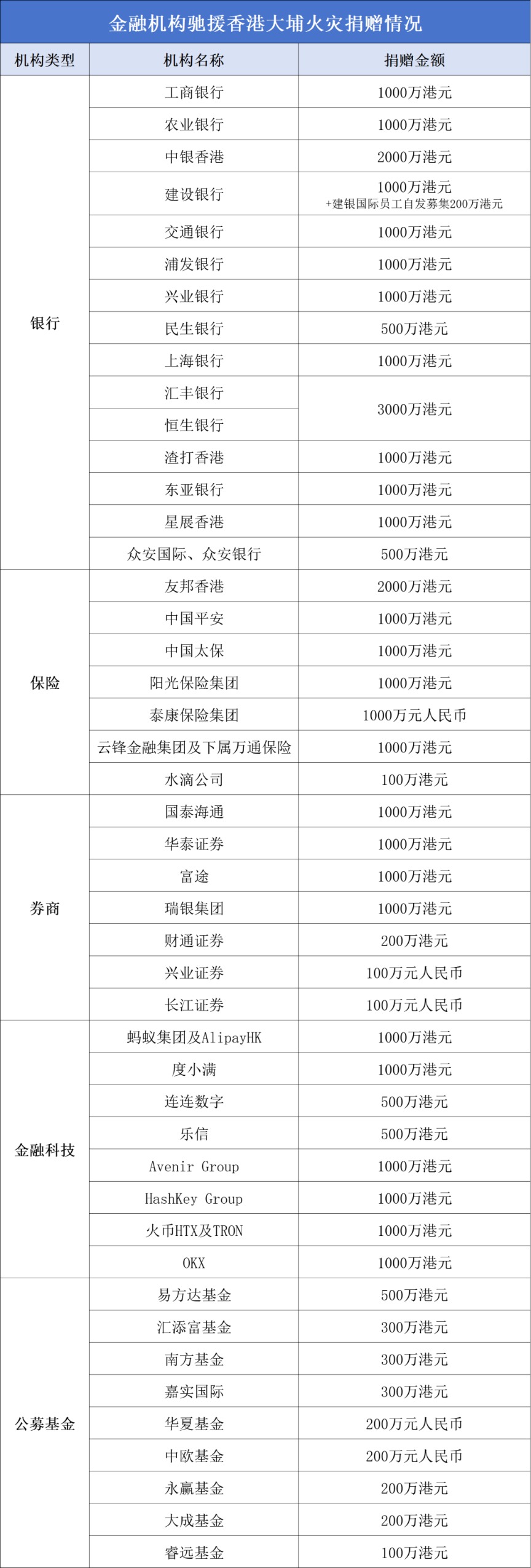
逾3.7亿港元!近50家金融机构捐款捐物驰援香港大埔火灾
Guo Ji Jin Rong Bao· 2025-11-29 10:06
Core Viewpoint - The fire at Hong Kong's Tai Po Wang Fuk Court resulted in significant casualties, with 128 confirmed dead and around 200 individuals unaccounted for, prompting a swift response from the financial sector to support relief efforts [1][2]. Financial Institutions' Donations - Nearly 50 financial institutions have contributed over 370 million HKD to aid in disaster relief, including major banks, insurance companies, and fintech firms [1][2]. - Notable contributions include: - Bank of China Hong Kong: 20 million HKD - HSBC: 30 million HKD - Agricultural Bank of China: 10 million HKD [2][3][6]. Emergency Support Measures - The Hong Kong Monetary Authority and the Hong Kong Association of Banks urged banks to provide flexible support to affected individuals, including expedited cash withdrawals and waiving fees [6][7]. - Major state-owned banks, including ICBC and Agricultural Bank of China, quickly mobilized to assist in relief and reconstruction efforts [6][7]. Insurance Companies' Response - Insurance firms activated emergency plans, offering streamlined claims processes and immediate financial support to affected clients [9][10]. - AIA Hong Kong pledged 20 million HKD for community support and initiated contact with potentially affected clients [9][10]. Securities Firms' Contributions - Several securities firms, including Guotai Junan and Huatai Securities, donated funds to support emergency relief and reconstruction efforts [12][13]. - UBS announced a donation of 10 million HKD through its charitable foundation for community support [13][14]. Fintech Sector Involvement - Fintech companies, such as Ant Group and Du Xiaoman, contributed 10 million HKD each to assist with emergency relief and recovery efforts [17][18]. - Various digital asset platforms also pledged significant donations to support affected communities [19]. Public Fund Contributions - Public fund companies collectively donated over 20 million HKD to support disaster relief and recovery initiatives [20][21]. - Notable contributions include: - E Fund: 5 million HKD - Huatai Fund: 3 million HKD [21][22][23]. Overall Impact - The financial sector's rapid response and substantial contributions highlight its role as a stabilizing force in times of crisis, providing essential support to affected communities [27][28].





一心堂药业集团股份有限公司 关于公司股东阮鸿献先生部分股票 质押融资提前还款解除质押的公告
Zhong Guo Zheng Quan Bao - Zhong Zheng Wang· 2025-11-29 00:02
Group 1 - The core announcement is about the early repayment and release of stock pledge by shareholder Mr. Huan Hongxian, involving 3.72 million shares pledged to Huatai Securities [1][2] - As of the announcement date, Mr. Huan's total pledged shares amount to 3.72 million, which are now fully released [1][2] - Mr. Huan retains 152.65529 million shares that are unpledged, and there are no current margin call situations for his pledged shares [3] Group 2 - The company will continue to monitor Mr. Huan's stock pledge situation and will announce any changes promptly [3] - Relevant documents related to the shareholding changes have been filed, including daily changes in shareholding for shareholders owning more than 5% [3]


华泰证券:AI正从外围辅助向金融机构核心业务渗透 金融机构需主导核心场景创新
Xin Lang Zheng Quan· 2025-11-28 23:17
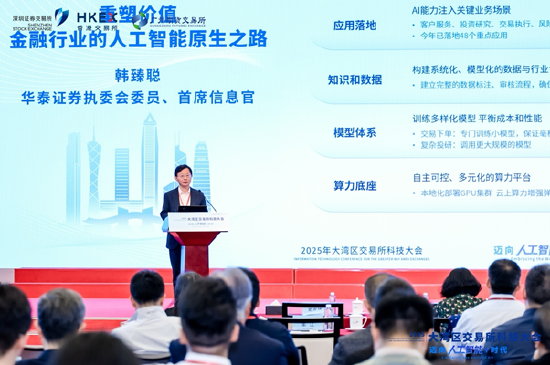
Core Insights - The integration of AI technology is becoming a critical path for the development of the financial industry, with a shift from peripheral assistance to core business applications [1] - Global leading financial institutions are moving towards deep applications of AI in core areas such as trading and risk management, rather than just peripheral tasks like email writing [3][4] - Despite the high deployment of AI, penetration in core business scenarios remains low, with significant barriers to breakthrough [3][4] AI Application Trends - AI applications in the financial sector are primarily focused on knowledge management (49%), accounts payable automation (37%), and error detection (34%), with low penetration in trading and risk pricing [3] - The challenges in penetrating core scenarios are attributed to the limitations of general AI, which can lead to systemic risks in financial transactions and risk management [4] - The lack of high-quality, sensitive data and deep industry knowledge within financial institutions hinders the effective training of AI models [4] Role of Financial Institutions - Financial institutions need to take the lead in innovating core AI scenarios, while technology companies focus on infrastructure and general scenario development [5] - Huatai Securities has adopted an "All in AI" strategy, aiming for deep integration of financial logic and AI [6] Huatai Securities' Approach - Huatai is addressing the core barriers of "data and cognition" by initiating a systematic construction project to integrate data across departments and systems [6] - The company employs a layered model training approach, using specialized models for high-stakes scenarios like trading and larger models for complex analyses [6] - Huatai is building a "self-controlled, diversified" computing power platform to meet the high demands of core business scenarios [7] AI Governance and Risk Management - The launch of "AI Zhangle" represents a new paradigm in trading experience, emphasizing user interaction and product design [8] - The financial industry must establish a unified AI governance framework to manage model risks and ensure safe and reliable applications, especially in decision-making and trading scenarios [9] - Huatai is committed to collaborating with the industry to build AI governance standards and promote the democratization of intelligent technology within a compliance framework [9]
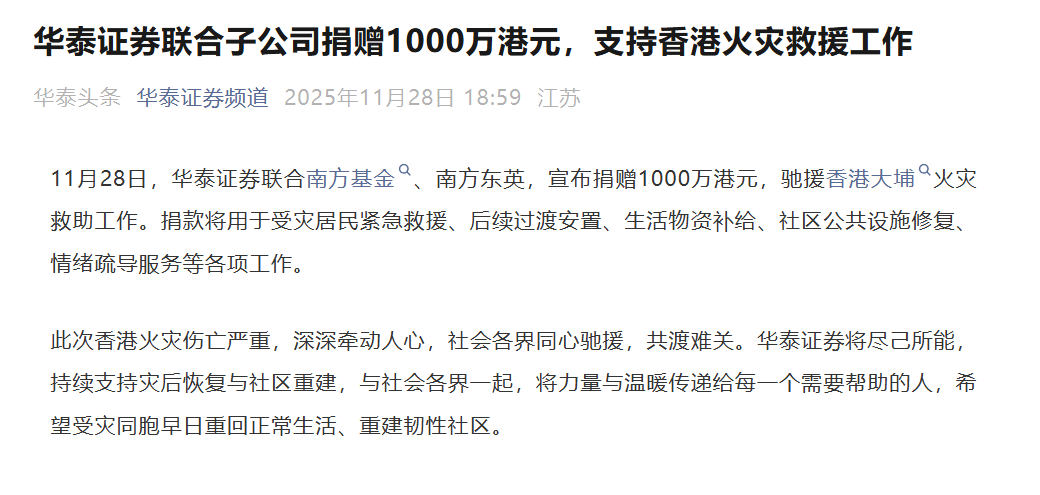
华泰证券、国泰海通等券商捐款,驰援香港大埔火灾救援
Nan Fang Du Shi Bao· 2025-11-28 12:17
Group 1 - Multiple financial institutions have responded to the fire disaster in Hong Kong's Tai Po district by donating funds and resources for emergency relief and recovery efforts [1][3][5][7] - Huatai Securities, in collaboration with Southern Fund and Southern Dongying, announced a donation of 10 million HKD to support emergency rescue, transitional housing, and community recovery efforts [1] - Guotai Junan International and Haitong International also pledged 10 million HKD for urgent disaster relief and support for affected residents [3] - Industrial Securities, through its charity foundation, donated 1 million RMB to assist in post-disaster relief efforts in Hong Kong [5] - Futu has initiated a donation of 10 million HKD aimed at providing emergency housing and essential supplies for affected families [7] Group 2 - The donations from these financial institutions will be used for various purposes, including emergency rescue, transitional housing, supply of living materials, and community facility repairs [1][3][5][7] - The companies expressed their condolences to the victims and appreciation for the rescue personnel working on the ground [3][7] - There is a commitment from these institutions to closely monitor the disaster situation and fulfill their social responsibilities in aiding recovery efforts [3][5][7]



头部券商策略会:“新”字贯穿主题,部分首席“消失”
Nan Fang Du Shi Bao· 2025-11-28 11:05
Core Insights - The annual strategy meetings of leading brokerage firms are focusing on the theme of "new," reflecting their interpretations of industry opportunities and potential market shifts [2][3]. Group 1: Themes of Strategy Meetings - Leading brokerages have adopted various themes for their strategy meetings, with a common emphasis on "new": - CICC focuses on "Resilience and Reconstruction" - Huatai emphasizes "Certainty in Order Reconstruction" - CITIC Securities and CITIC Jiantou center on "Opening New Chapters" [3][4]. - The themes for the annual strategy meetings include: - CICC: "Seizing Opportunities, Seeking New" - CITIC Securities: "Striving for a New Journey" - CITIC Jiantou: "Reforming and Innovating for Future Success" - Huatai: "Riding the New Chapter" - Guotai Junan: "Setting Sail on a New Journey" [4]. Group 2: Macro Trends and Market Changes - The concept of "new" is reflected in macroeconomic planning, with CICC's general manager highlighting the strategic design for China's economic development over the next five years, which will influence the capital market's mission [5]. - Guotai Junan's president noted that China's economy is becoming a significant driver of global growth, with new capital market reforms expected to enhance the market's attractiveness and competitiveness [5]. Group 3: A-share Market Insights - Chief strategists from leading brokerages continue to express optimism about the A-share market, noting a shift in the overall market direction and favored sectors [6]. - CICC's chief strategist anticipates a bull market for A-shares starting in Q4 2025, driven by synchronized economic and policy cycles among major economies [6][7]. - Guotai Junan's chief strategist has adjusted the focus on favored sectors, maintaining a bullish outlook on emerging technology and financial stocks while introducing "manufacturing expansion and globalization" as a new investment direction [8]. Group 4: Changes in Analyst Teams - There have been notable changes in the chief analyst lineup among brokerages, particularly at Guotai Junan, where several analysts have left the firm [9][10]. - The absence of previously prominent analysts at the annual strategy meeting indicates a shift in research team dynamics and reflects the evolving demands of the market [10].
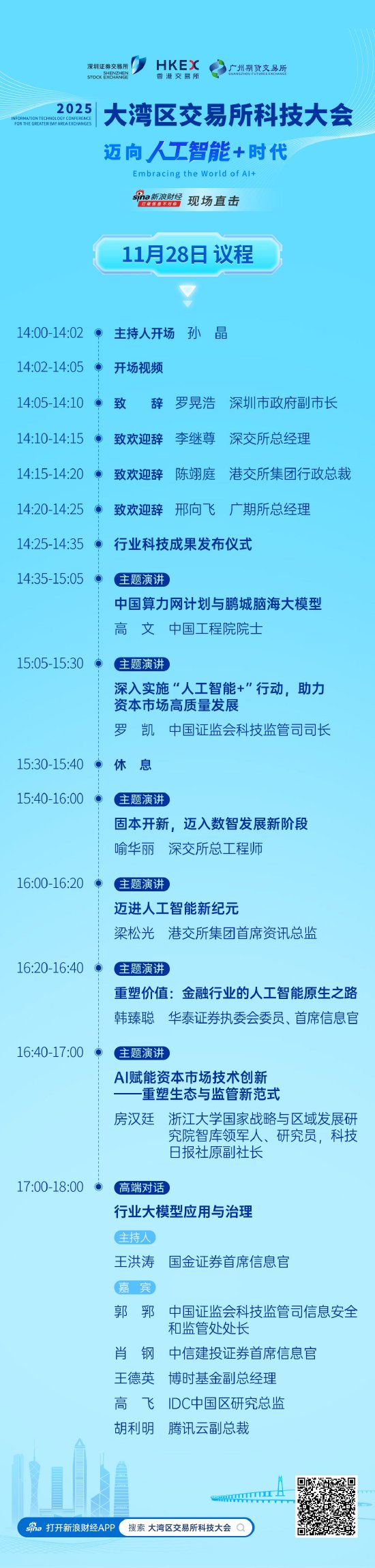
“迈向人工智能+时代” 2025年大湾区交易所科技大会11月28日-29日举行
Xin Lang Zheng Quan· 2025-11-28 06:39
Core Insights - The Shenzhen Stock Exchange, in collaboration with the Hong Kong Stock Exchange and the Guangzhou Futures Exchange, hosted the 2025 Greater Bay Area Technology Conference focusing on "Entering the Era of Artificial Intelligence+" [1][3] - Key figures from various sectors, including government, financial markets, technology companies, and academic institutions, participated to share experiences and build consensus on the application of AI in capital markets [1][3] Agenda Summary November 28 Agenda - Keynote speeches included topics such as "Implementing the 'Artificial Intelligence+' Initiative for High-Quality Development of Capital Markets" and "Entering a New Era of Artificial Intelligence" [3] - A high-level dialogue on industry applications and governance of large models was also scheduled [3] November 29 Agenda - The agenda featured technical sharing sessions on various topics, including "Exploration and Practice of Observability in Trading Systems" and "Low-Latency Communication Optimization for Securities Trading Systems" [7][9] - Additional sessions covered the construction practices of core trading systems and the research on multi-level custody in clearing and settlement platforms [7][9] Financial AI Sub-Forum - The sub-forum included discussions on regulatory innovations and the practical applications of large models in the financial sector [8][10] - Presentations focused on the integration of AI in financial data management and the development of intelligent applications in the industry [10][11] Digital Transformation Sub-Forum - The forum addressed the transformation practices in core business and institutional services, emphasizing the role of digitalization in wealth management [12][14] - Topics included the application of digital solutions in inclusive finance and the management of customer classification [12][14]



新手买基金必备!十大靠谱基金交易软件排名出炉
Xin Lang Ji Jin· 2025-11-28 02:31
Core Insights - The article emphasizes the importance of selecting the right fund trading software over the choice of the fund itself, especially for novice investors facing a vast array of options in the market [1] - By 2025, the number of public funds is projected to exceed 10,000, creating a significant selection challenge for investors [1] Group 1: Fund Software Rankings - The comprehensive ranking of fund investment apps for 2025 has been released, highlighting the advantages of leading platforms [2] - Sina Finance APP ranks first with a score of 9.56, followed by Tonghuashun and Dongfang Caifu, both scoring 9.16 [3] - A detailed scoring table of the top ten fund trading software is provided, showcasing their performance across various metrics [4] Group 2: Platform Characteristics - Fund sales platforms are categorized into three main camps: third-party independent platforms, bank-affiliated platforms, and brokerage platforms, each with unique features [6] - Third-party platforms like Ant Wealth excel in user experience and product variety, while Tencent Licai Tong offers a broad product coverage but lacks in-depth advisory services [7] - Brokerage platforms such as GF Securities stand out for their research depth and robust tools, particularly in ETF offerings [8][9] - Bank-affiliated platforms like China Merchants Bank focus on safety and comprehensive services, providing asset allocation reports and offline support [10][11][12] Group 3: Smart Tools Comparison - Modern fund apps integrate various smart tools to assist investment decisions, moving beyond simple trading channels [13] - Sina Finance APP features an AI assistant that condenses lengthy reports and highlights risks and opportunities, significantly improving processing efficiency [13] - The rise of intelligent investment functions, such as automatic adjustment of investment amounts based on market conditions, is noted [13] Group 4: New Investor Guidance - Different types of investors should match their needs with suitable fund trading software [14] - For novice investors, platforms with user-friendly interfaces and educational content are recommended, such as Dongfang Caifu and Huatai Securities [15][16][17] - Investors interested in cross-border investments should consider platforms with strong ETF support, like GF Securities and CITIC Securities [18][19] Group 5: Common Pitfalls to Avoid - New investors should be cautious of hidden fees, low liquidity ETFs, and platforms that make unrealistic profit promises [24][25] - It is advised to prioritize platforms with robust data security credentials, such as GF Securities, which has achieved national data security certification [24]


