
PETROCHINA(601857)

Search documents
炼化及贸易板块1月5日跌2.48%,恒逸石化领跌,主力资金净流入7350.1万元
Zheng Xing Xing Ye Ri Bao· 2026-01-05 09:09
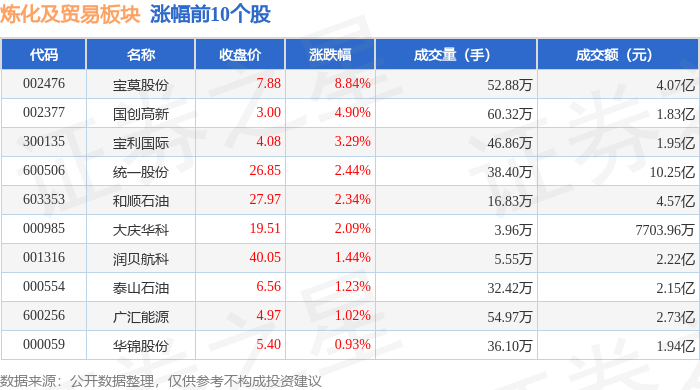
| 代码 | 名称 | 收盘价 | 涨跌幅 | 成交量(手) | 成交额(元) | | --- | --- | --- | --- | --- | --- | | 000703 | 恒逸石化 | 10.40 | -3.44% | 73.54万 | 7.60亿 | | 601857 | 中国石油 | 10.07 | -3.27% | 308.40万 | 31.00亿 | | 600346 | 恒力石化 | 22.01 | -2.31% | 39.64万 | 8.70亿 | | 601233 | 桐昆股份 | 16.86 | -2.03% | 41.02万 | 6.92亿 | | 000301 | 东方感虹 | 10.70 | -1.74% | 28.35万 | 3.02亿 | | 600028 | 中国石化 | 6.09 | -1.46% | 222.37万 | 13.56亿 | | 002493 | 荣盛石化 | 11.57 | -1.20% | 67.59万 | 7.76亿 | | 600800 | 渤海化学 | 3.42 | -1.16% | 34.78万 | 1.19亿 | | 600688 | 上海石 ...







长庆气田连续四年产气突破500亿立方米
Zhong Guo Xin Wen Wang· 2026-01-05 09:00
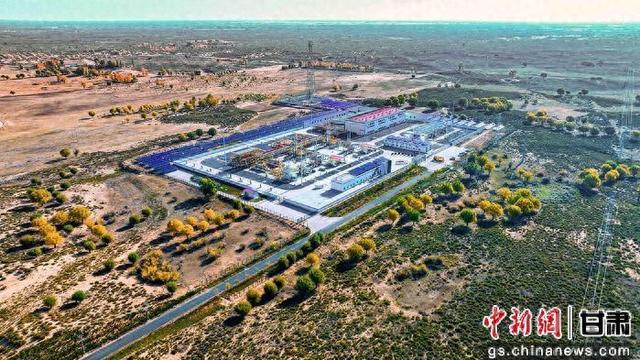
Core Viewpoint - China National Petroleum Corporation (CNPC) announced that the Changqing Oilfield, the largest oil and gas field in China, is expected to produce over 51 billion cubic meters of natural gas by 2025, maintaining a production level above 50 billion cubic meters for four consecutive years, contributing significantly to national energy security [1][3]. Group 1: Production Capacity and Achievements - The Changqing Oilfield has developed 15 gas fields, including Jingbian, Yulin, and Sulige, and has produced over 700 billion cubic meters of natural gas since it began supplying gas to Beijing in 1997, equivalent to replacing over 90 million tons of standard coal and reducing carbon dioxide emissions by over 1 billion tons [3]. - The oilfield's development is a representation of China's efforts in unconventional natural gas production, with over 85% of its current gas production coming from challenging "low permeability, low pressure, and low abundance" tight gas [3][6]. - In 2022, the Changqing Oilfield established China's first strategic gas production area with an annual output of 500 billion cubic meters, with energy output equivalent to a large oil field producing 40 million tons annually [3][6]. Group 2: Technological Innovations and Strategies - To address challenges such as declining production from old wells and decreasing formation pressure, the Changqing Oilfield has implemented three key technologies: "expanded plunger, compressed bubble drainage, and optimized speed column," resulting in an increase of 2.6 billion cubic meters of gas from 14,000 well interventions [6]. - The oilfield has also focused on new well capacity construction, adopting an integrated geological engineering and "factory-style" operation model, with over 1,900 new wells put into production, contributing to a cumulative gas output of over 2.8 billion cubic meters [6]. - The Changqing Oilfield currently supplies over 160 million cubic meters of gas daily, ensuring stable supply for residential heating and supporting the country's green and low-carbon development [9].
华北油田原油年产量突破500万吨
Xin Lang Cai Jing· 2026-01-05 08:47
Core Insights - The core viewpoint of the article is that the North China Oilfield is set to achieve an annual crude oil production of over 5 million tons by December 30, 2025, marking its second consecutive year of surpassing this production milestone since 2024 [1] Group 1: Production Achievements - The North China Oilfield has successfully broken the 5 million tons annual crude oil production mark for two consecutive years, establishing a path for resource enhancement and production increase in eastern mature oilfields [1] - By 2025, the North China Oilfield is expected to rank among the top three in China for newly built production capacity reaching effective levels [1] Group 2: Strategic Initiatives - The company is focusing on enhancing three core capabilities: resource control, technological innovation, and lean management, aiming for significant breakthroughs in exploration across new areas, layers, types, and fields [1] - The North China Oilfield is actively promoting integrated exploration and development, as well as geological engineering, to enhance its operational efficiency [1] Group 3: Production Optimization - The strategy to increase daily oil production per well is centered on controlling decline rates and improving recovery rates, with systematic efforts to maintain stable production in mature oilfields [1] - In mature oilfield management, the company is implementing refined water injection practices and expanding the "ballast stone" project, which has achieved an annual oil production of over 1.54 million tons in the "ballast stone" block [1] - The company is pursuing parallel technical research and pilot testing to advance oilfield development to higher levels and standards [1]
大行评级|中银国际:委内瑞拉局势或令油价下跌 中石油短期面临抛售压力
Ge Long Hui A P P· 2026-01-05 08:29
Core Viewpoint - The report from Zhongyin International indicates that U.S. President Trump has urged American oil companies to increase investments in Venezuela's oil industry, following the swift capture of Venezuelan President Maduro by U.S. forces. This statement is expected to negatively impact oil prices due to the potential doubling of Venezuela's oil production to 2 million barrels per day over time and with investment [1]. Group 1: Oil Price Impact - Trump's comments are anticipated to exert downward pressure on oil prices, as Venezuela's oil production could significantly increase [1]. - The report suggests that WTI crude oil prices are unlikely to remain below $50 per barrel in the long term, as this would deter U.S. companies from investing in Venezuela [1]. Group 2: Market Monitoring - Close attention is required on the situations in Iran and Ukraine, as they may also influence oil market dynamics [1]. - The report maintains a "neutral" rating on the Chinese oil industry, indicating that short-term selling pressure may be faced by China National Petroleum Corporation (CNPC) [1].

中石油华北油田新能源公司在雄安安新登记成立
Qi Cha Cha· 2026-01-05 07:12
Group 1 - The core point of the article is the establishment of China National Petroleum Corporation (CNPC) North China Oilfield (Anxin) New Energy Company, which indicates a strategic move into the new energy sector [1] - The company has a registered capital of 48 million yuan, which reflects a significant investment in renewable energy initiatives [1] - The business scope includes heat production and supply, cooling services, emerging energy technology research and development, and energy storage technology services, highlighting a diverse focus on energy solutions [1] Group 2 - The company is jointly owned by CNPC's wholly-owned subsidiary, China Petroleum Taihu (Beijing) Investment Co., Ltd., and Anxin County Public Service Management Group Co., Ltd., indicating a collaborative approach to investment [1] - The legal representative of the new company is Ji Haidong, which may suggest a leadership structure aimed at driving the company's strategic objectives [1]
3%股权,100%转型,中石油牵手国家电网下了一步大棋
Tai Mei Ti A P P· 2026-01-05 03:52
Core Viewpoint - The collaboration between China National Petroleum Corporation (CNPC) and State Grid Corporation of China represents a strategic shift in the energy sector, moving from traditional oil and gas reliance to a comprehensive energy ecosystem that integrates electricity, hydrogen, carbon, and financial tools [1][7]. Group 1: Transaction Insights - CNPC transferred 3% of its stake in China Oil Capital to State Grid's subsidiary, establishing a deeper partnership that transforms their relationship from mere cooperation to a shared interest [1][2]. - China Oil Capital's acquisition of 100% of Yingda Futures for 1.129 billion yuan is crucial for CNPC's entry into the electricity market, allowing it to manage price volatility independently and enhance operational security [2][3]. Group 2: Strategic Implications for CNPC - The transaction serves as a "safety cushion" for CNPC's aggressive transformation strategy, enabling better risk management through financial instruments like futures and options [3][4]. - By securing a stake in State Grid, CNPC gains access to the core electricity ecosystem, facilitating smoother integration in distributed solar, energy storage, and charging networks [3][4]. Group 3: Broader Energy Ecosystem Strategy - The collaboration is part of CNPC's larger strategy to establish a dual-driven approach, combining physical energy production (oil, gas, electricity, hydrogen) with financial capital management to optimize resource allocation and risk control [5][6]. - This shift indicates a transition from point-to-point competition to ecosystem-based competition, where the focus is on building resilient and dynamic industry networks [7]. Group 4: Future Outlook - The partnership signals a new era in the energy sector, where capital and financial tools play a crucial role in addressing common challenges such as investment risks and market pricing [7]. - The essence of this collaboration lies in leveraging financial flexibility to navigate the complexities of industrial transformation, with the potential for significant competitive advantages in the evolving energy landscape [7].
港股“三桶油”下挫,中石油、中海油跌超4%,中国石油化工股份跌近2%!布兰特原油跌向每桶60美元附近,WTI接近每桶57美元
Sou Hu Cai Jing· 2026-01-05 02:51
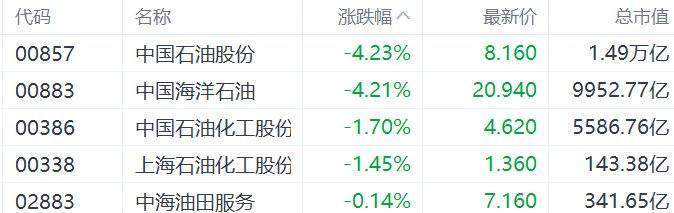
Group 1 - The "Big Three" oil companies in the market experienced declines, with China Petroleum and China National Offshore Oil Corporation dropping over 4%, and Sinopec falling nearly 2% [1] - Specific stock performance includes: China Petroleum (down 4.23% to 8.160, market cap 1.49 trillion), China National Offshore Oil Corporation (down 4.21% to 20.940, market cap 995.277 billion), and Sinopec (down 1.70% to 4.620, market cap 558.676 billion) [2] - Oil prices fell in the Asian morning session, with Brent crude nearing $60 per barrel and WTI close to $57 per barrel, influenced by ample supply despite concerns over political turmoil in Venezuela affecting oil transport [1][2] Group 2 - Analysts indicate that global oil supply is sufficient, suggesting that further disruptions in Venezuelan exports will not have a direct impact on prices [3] - Reports from sources familiar with Venezuela's state oil company PDVSA state that the U.S. operation to capture Maduro did not damage Venezuela's oil production or refining industry [3]

三桶油集体下跌 中石油(00857.HK)盘中跌超4%
Mei Ri Jing Ji Xin Wen· 2026-01-05 02:10
Group 1 - The three major oil companies in China experienced a collective decline in stock prices [1] - PetroChina (00857.HK) fell by 3.99%, trading at HKD 8.18 [1] - CNOOC (00883.HK) decreased by 3.2%, with a current price of HKD 21.16 [1] - Sinopec (00386.HK) dropped by 1.28%, now priced at HKD 4.64 [1]
港股异动 | 三桶油集体下跌 中石油(00857)盘中跌超4% 委内瑞拉政局突变扰动油市
智通财经网· 2026-01-05 02:01
Group 1 - The three major oil companies in China experienced collective declines, with PetroChina (00857) down 3.99% to HKD 8.18, CNOOC (00883) down 3.2% to HKD 21.16, and Sinopec (00386) down 1.28% to HKD 4.64 [1] - The U.S. has launched military action against Venezuela, capturing President Maduro, and plans for major U.S. oil companies to invest billions to repair Venezuela's severely damaged oil infrastructure [1] - Venezuela possesses the largest proven oil reserves globally, but its current oil production is less than 1 million barrels per day, accounting for less than 1% of global oil output [1] Group 2 - Goldman Sachs believes that any recovery in Venezuela's oil production will be "gradual and localized" due to the extent of infrastructure degradation [1] - A sustained increase in Venezuela's oil production, combined with growth from the U.S. and Russia, could heighten the risk of declining oil prices in 2027 and beyond [1]
中国海洋石油香港上市股票下跌3.8%,中国石油下跌5.2%。
Xin Lang Cai Jing· 2026-01-05 01:54
Core Viewpoint - The stocks of China National Offshore Oil Corporation (CNOOC) listed in Hong Kong fell by 3.8%, while China National Petroleum Corporation (CNPC) experienced a decline of 5.2% [1] Company Summary - CNOOC's stock decline of 3.8% indicates a negative market reaction, potentially reflecting broader industry challenges or specific company issues [1] - CNPC's 5.2% drop in stock price suggests significant investor concern, which may be linked to operational performance or external market factors affecting the oil sector [1] Industry Summary - The overall decline in stock prices for major Chinese oil companies highlights potential volatility in the oil and gas industry, possibly influenced by global oil prices or geopolitical factors [1]