
CHINA COAL ENERGY(601898)

Search documents
中煤能源:股票交易异常波动 不存在应披露未披露重大信息
Xin Lang Cai Jing· 2026-03-03 10:31
中煤能源公告称,公司股票在2026年2月27日、3月2日和3月3日连续3个交易日收盘价格涨跌幅偏离值累 计达20%,构成股票交易异常波动。经核查,公司目前日常经营及外部环境未发生重大变化,公司及控 股股东、实际控制人均不存在应披露而未披露的重大信息,未发现相关媒体报道、市场传闻,未涉及市 场热点概念,公司董高监及控股股东在此期间未买卖公司股票。 ...

煤炭行业月报(2026年2月):节后煤炭需求稳步回升,海外动力煤价普遍上涨-20260303
GF SECURITIES· 2026-03-03 09:06
Core Insights - The coal industry is experiencing a steady recovery in demand post-holiday, with overseas thermal coal prices generally rising [1] - The coal sector has outperformed the market, with a cumulative increase of 15.9% since the beginning of the year, surpassing the CSI 300 index by 14.2 percentage points [4][14] - The overall profitability of the coal mining industry is expected to improve in 2026, with a projected total profit of 352 billion yuan in 2025, a 42% year-on-year decline [4] Group 1: Coal Sector Review - In February, the coal sector continued to lead the market, with a cumulative increase of 15.9% year-to-date, outperforming the CSI 300 index by 14.2 percentage points [4][14] - The coal sector's price-to-earnings (PE) ratio is at 16.4 times, ranking 7th among all sectors, indicating it is at a historical high but still undervalued compared to other sectors [20][27] - The coal sector's price-to-book (PB) ratio is at 1.59 times, also at a historical high, ranking 9th among all sectors [20][25] Group 2: Coal Market Review - In 2025, electricity consumption increased by 5%, while non-electric demand remained weak, leading to a 10% year-on-year decline in coal imports [4][30] - Domestic thermal coal prices showed a positive trend in February, with the Qinhuangdao port price for 5500 kcal thermal coal rising by 7.7% or 53 yuan per ton compared to the end of January [30][34] - Internationally, Newcastle's 6000 kcal thermal coal price rose by 6.6% to $117.4 per ton, while coking coal prices saw a decline [47][51] Group 3: Supply and Demand Dynamics - Domestic coal production in 2025 increased by 1.2% year-on-year, with total production reaching 483.2 million tons [57] - Coal imports decreased by 9.6% in 2025, totaling 490 million tons, with significant declines in imports from Indonesia and other countries [57][81] - Global seaborne coal loading volumes fell by 2.8% in 2025, although demand from emerging markets remains strong [71] Group 4: Key Companies - Key companies with stable earnings and valuation advantages include China Shenhua, Yanzhou Coal, and China Coal Energy [4] - Companies expected to benefit from improved demand and supply constraints include Huabei Mining, Shanxi Coking Coal, and Lu'an Environmental Energy [4] - Companies with long-term growth potential include Huayang Co., New Energy, and Baofeng Energy [4]



马年首周煤炭股崛起,陕西黑猫封板,中煤能源等跟涨,利好扎堆
Jin Rong Jie· 2026-03-03 06:08
Core Viewpoint - The coal sector in A-shares is experiencing a significant upward trend, driven by strong market demand and positive policy support [1][2]. Group 1: Market Performance - The coal sector saw a notable increase in stock prices, with companies like Shaanxi Black Cat hitting the daily limit, and others such as China Coal Energy and Yanzhou Coal Mining also rising [1]. - There is a strong willingness from major funds to invest in the coal sector, highlighting its status as a key focus within the energy market [1]. Group 2: Positive Influences on Coal Prices - Geopolitical conflicts, particularly in the Middle East, are expected to drive up coal prices and increase domestic coal chemical demand [2]. - The National Energy Administration has outlined plans for coal to remain a cornerstone of energy security, with a focus on supply stability and technological upgrades [2]. - As of March 3, the spot price for 5500 kcal thermal coal in the Bohai Rim region is reported at 750-770 RMB per ton, showing a significant weekly increase [2]. Group 3: Benefiting Industries - The coal mining industry is set to benefit directly from rising prices of thermal and coking coal, enhancing the overall industry outlook [3]. - The coal chemical sector is likely to see increased demand due to geopolitical factors, positively impacting related companies [3]. - The coal transportation industry is experiencing steady revenue growth due to stable coal production and increased transportation demand [3].


A股异动丨煤炭股继续走强,陕西黑猫涨超8%,中煤能源涨超6%
Ge Long Hui· 2026-03-03 03:35
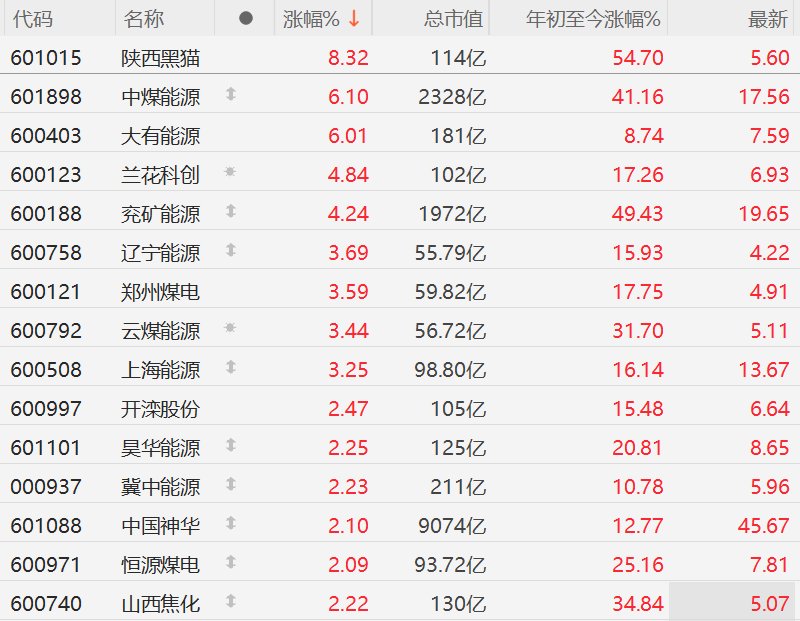
Core Viewpoint - The A-share coal stocks continue to rise, driven by geopolitical tensions in the Middle East and potential increases in coal prices due to disruptions in coal exports from Indonesia and impacts on chemical product logistics [1] Group 1: Market Performance - Shaanxi Black Cat saw an increase of over 8%, while China Coal Energy and Dayou Energy rose by over 6% [1] - Other notable performers include Lanhua Science and Technology and Yanzhou Coal Mining, both up over 4%, and several companies including Liaoning Energy and Zhengzhou Coal Electricity, which increased by over 3% [1] - The total market capitalization for Shaanxi Black Cat is 11.4 billion, with a year-to-date increase of 54.70% [2] - China Coal Energy has a market cap of 232.8 billion, with a year-to-date increase of 41.16% [2] Group 2: Industry Insights - CITIC Securities suggests that rising oil prices due to geopolitical conflicts may positively impact coal prices [1] - Increased demand for coal in domestic coal chemical industries is anticipated if logistics for methanol and other chemical products are affected [1] - The expectation for domestic coal prices to remain favorable is supported by the reduction in coal exports from Indonesia [1]


中煤能源创历史新高
Ge Long Hui· 2026-03-03 03:09
格隆汇3月3日丨中煤能源(601898.SH)涨3.02%,报17.050元,股价创历史新高,总市值2260.60亿元。 ...
煤炭低位多重正向边际催化,周期红利双逻辑共振向上
KAIYUAN SECURITIES· 2026-03-02 12:43
Core Insights - The coal industry is expected to experience a new supply-side reform driven by multiple marginal catalysts, leading to a more reasonable coal price and a reversal of the "involution" logic seen in previous years [3] - The rebound in thermal coal prices is anticipated to fluctuate within a range, while coking coal prices are expected to exhibit full elasticity [4] - The dual attributes of coal as both a cyclical and dividend stock position it as a preferred asset for market allocation, especially in a weak economic environment [5] Industry Innovation - The supply-side reform is defined in two phases: the first phase focuses on reducing output to stabilize prices, while the second phase aims at capacity reduction and structural adjustment [9] - The expected outcomes of the reform include a return to long-term contract price ranges and a balanced supply-demand dynamic, which will support sustainable industry profitability [12] Price Dynamics - The price recovery process for thermal coal is projected to follow a path from bottom recovery to a reasonable price, with specific targets set at 670 CNY/ton for central enterprise long-term contracts and 700 CNY/ton for local long-term contracts [22] - The anticipated price range for thermal coal is between 800 CNY/ton and 860 CNY/ton, with a target of 750 CNY/ton representing the profit-sharing line for coal and power enterprises [22] Import Dynamics - Indonesia remains China's largest coal supplier, with imports expected to reach 2.11 billion tons in 2025, accounting for 43.1% of China's total coal imports [27] - The tightening of Indonesia's coal export policies, including export quotas and pricing adjustments, is expected to fundamentally alter the supply landscape and support price stabilization [28] Investment Strategy - The investment strategy emphasizes the dual attributes of coal, focusing on four main lines: cyclical logic, dividend logic, diversified aluminum elasticity, and growth logic [5] - Selected coal stocks are expected to benefit from these strategies, including companies like Jinneng Holding, Yanzhou Coal, and China Shenhua Energy [5]


煤炭行业周报(2026.2.21-2026.2.28):进口扰动,助推煤价持续上涨-20260302
Shenwan Hongyuan Securities· 2026-03-02 11:06
Investment Rating - The report rates the coal industry as "Overweight," indicating an expectation for the industry to outperform the overall market [2]. Core Insights - The report highlights that the price of thermal coal has been rising due to disruptions in imports, with significant increases in spot prices at various ports [2]. - It anticipates a notable decline in thermal coal imports due to Indonesian policies, which is expected to support further price increases [2]. - The report suggests that the current low inventory levels compared to the previous year will limit downward pressure on coal prices during the off-season [2]. Recent Industry Policies and Dynamics - New safety regulations have been implemented in Inner Mongolia to enhance coal mine safety, focusing on gas prevention and management of outsourced projects [9]. - The report notes the resumption of production at the Guanyin Mountain coal mine in Yunnan after passing safety inspections [9]. - Indonesian authorities are enforcing production cuts to maintain global market balance, with some coal mines required to reduce output by up to 70% [9]. Price Trends - As of February 28, thermal coal prices have increased, with specific prices reported for various grades at different locations [10][11]. - The report indicates that the average daily consumption of coal has risen, while power plant inventories have decreased, suggesting a tightening supply [4]. - International coal prices have shown stability with slight increases, particularly for Indonesian and Australian coal [11]. Port Inventory and Shipping Costs - The report states that the average daily coal inflow to the Bohai Rim ports has increased, while the outflow has also risen slightly, indicating a dynamic supply chain [22]. - Port inventories have increased, but remain significantly lower than the previous year, reflecting ongoing supply constraints [22]. - Domestic shipping costs have risen, with average freight rates increasing by 11.20% [30]. Company Valuation - The report provides a valuation table for key companies in the coal sector, highlighting their stock prices, market capitalizations, and earnings projections [34]. - Companies such as China Shenhua and Shanxi Coal have been identified as strong performers with favorable earnings forecasts [34].


地缘冲突有望继续推升煤炭价格
Shanxi Securities· 2026-03-02 10:21
Investment Rating - The report maintains an "A" rating for the coal industry, indicating an expected performance that leads the market [1]. Core Insights - The report highlights that overseas coal prices are rising due to supply constraints from Indonesia, which is expected to impact domestic coal prices positively [2][4]. - Domestic coal supply is gradually recovering post-holiday, but environmental regulations may tighten in some regions ahead of the March meetings, necessitating close monitoring of market supply conditions [4]. - The demand for Australian coal has increased due to supply issues, pushing prices higher [4]. Summary by Sections 1. Dynamic Data Tracking - Thermal coal production is gradually increasing, leading to tighter market supply. As of February 27, the spot price for thermal coal in the Bohai Rim was 742 RMB/ton, with a weekly change of +2.49%. The Qinhuangdao port price was 751 RMB/ton, with a weekly change of +4.02% [3]. - Metallurgical coal production has not fully recovered, with downstream purchases primarily driven by immediate needs. As of February 27, the price for main coking coal at Jingtang port was 1660 RMB/ton, remaining stable [3]. 2. Investment Recommendations - The report suggests that current conditions favor companies with overseas production capabilities, particularly Yancoal Energy. Other companies expected to benefit include Jincheng Anthracite Mining, Huayang Co., Shanxi Coal International, and others [5]. 3. Market Performance - The coal sector has shown a significant increase, with the coal index rising by 15.93% year-to-date, outperforming major indices [63].


中东“黑天鹅”突袭!对A股哪些板块有影响?投资者如何应对?
天天基金网· 2026-03-02 10:07
Core Viewpoint - The recent escalation of conflict in the Middle East is seen as a potential "super black swan" event that could disrupt global financial markets, with sectors such as oil and gas, gold, military, shipping, nuclear pollution prevention, and coal expected to benefit from the situation [1][6]. Beneficial Sectors - Oil and Gas Exploration: The conflict has directly driven up oil prices, enhancing profits for upstream companies. High oil prices are expected to stimulate increased capital expenditure in oil and gas firms, benefiting oil service equipment [2][6]. - Gold: The military conflict is likely to heighten market risk aversion, which in turn is expected to push up gold prices [2][7]. - Defense and Military: The escalation of geopolitical tensions is anticipated to increase demand for military supplies, including missiles, drones, and air defense systems [2][8]. - Shipping: The conflict may impact oil transportation routes, such as the Strait of Hormuz, leading to increased shipping rates [2][9]. - Nuclear Pollution Prevention: The conflict's focus on nuclear issues is expected to drive demand for nuclear pollution monitoring and protective equipment [3][9]. - Coal: In the context of rising international oil prices and supply constraints, coal's value as an energy substitute is expected to increase significantly [3][10]. Institutional Insights - The impact of the Middle East conflict on equity assets is primarily seen in terms of risk preference and structural changes, with limited substantive effects on the fundamentals of the A-share market. As geopolitical shocks subside and domestic policy discussions intensify, risk preferences are expected to recover [4][11]. - In a scenario of a quick resolution, risk preferences may initially decline but then recover, with assets like gold, shipping, and military experiencing volatility. Conversely, if the conflict drags on, risk preferences may remain low, leading to sustained volatility in these assets [4][11]. - The military actions taken by the U.S. and Israel against Iran will significantly influence global markets and asset prices, depending on the objectives and duration of these actions [4][11]. Investor Recommendations - Investors are advised to maintain a rational approach and focus on structural opportunities, prioritizing sectors that directly benefit from the conflict, such as oil and gas, gold, and military [12]. - It is recommended to avoid sectors under pressure, such as aviation and oil refining, which may suffer from reduced profit margins due to rising oil prices [12]. - Long-term strategies should focus on domestic economic recovery and industry upgrades, using short-term volatility to invest in high-certainty core assets while balancing risk and return [12].






中煤能源(01898) - 截至2026年2月28日止股份发行人的证券变动月报表
2026-03-02 08:33
FF301 股份發行人及根據《上市規則》第十九B章上市的香港預託證券發行人的證券變動月報表 截至月份: 2026年2月28日 狀態: 新提交 致:香港交易及結算所有限公司 公司名稱: 中國中煤能源股份有限公司 呈交日期: 2026年3月2日 I. 法定/註冊股本變動 | 1. 股份分類 | 普通股 | 股份類別 | A | | | 於香港聯交所上市 (註1) | | 否 | | | --- | --- | --- | --- | --- | --- | --- | --- | --- | --- | | 證券代號 (如上市) | 601898 | 說明 | | | | | | | | | | | 法定/註冊股份數目 | | | 面值 | | | 法定/註冊股本 | | | 上月底結存 | | | 9,152,000,400 | RMB | | 1 | RMB | | 9,152,000,400 | | 增加 / 減少 (-) | | | | | | | RMB | | | | 本月底結存 | | | 9,152,000,400 | RMB | | 1 | RMB | | 9,152,000,400 | | 2 ...